
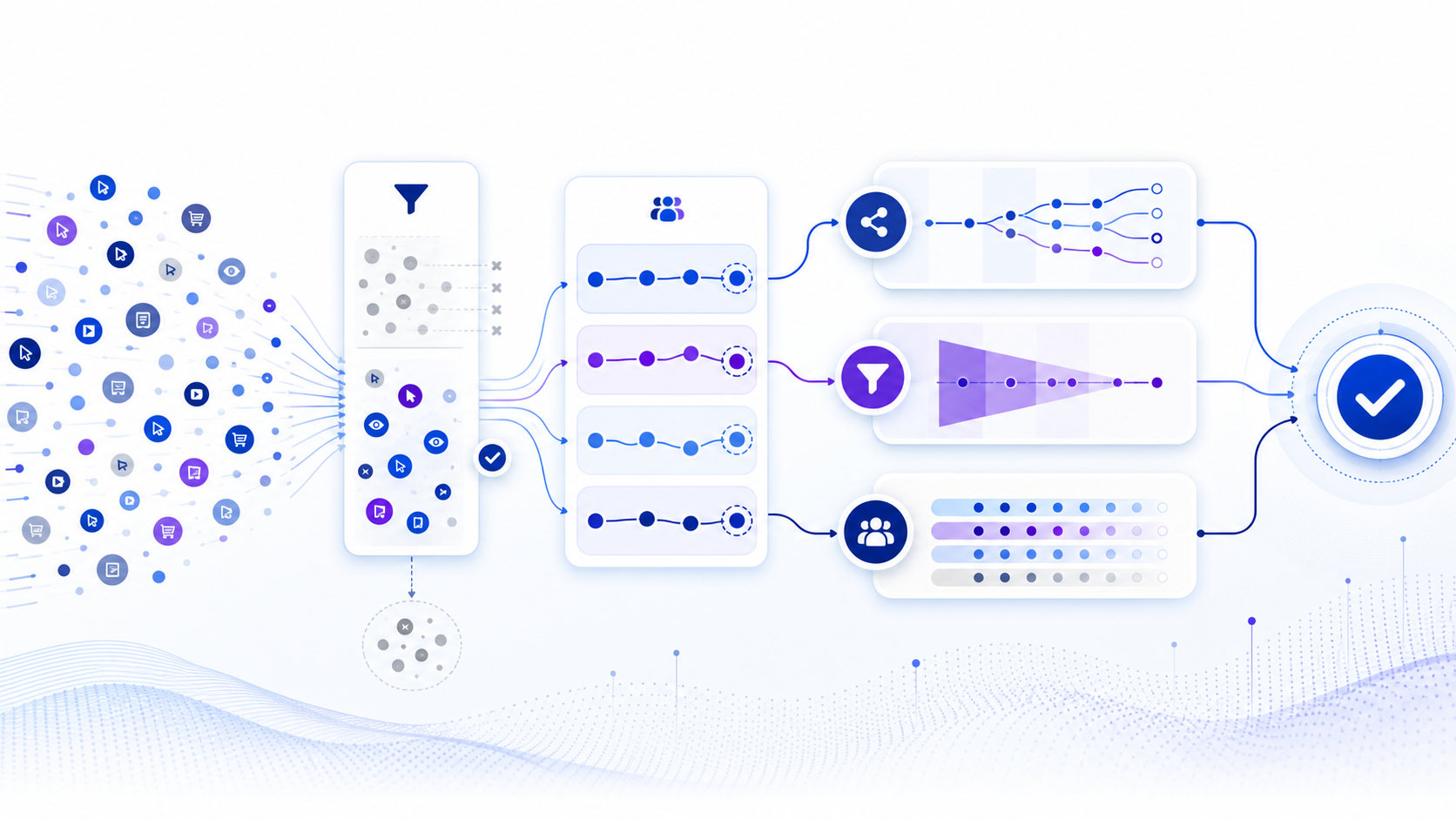
Clickstream analytics: a quick answer点击流分析:快速回答
Clickstream analytics is the process of ordering and analyzing timestamped page views, clicks, searches, and other digital interactions to understand the paths people take, where journeys break, and which sequences are associated with a useful outcome. A trustworthy analysis does more than draw a path diagram: it defines the analysis unit, cleans duplicate and automated activity, documents session and identity rules, selects a method that matches the decision, and verifies counts against a source system. Clickstream for agency work uses that same process on a client's event stream: the readout is one reviewable path or funnel, with bots and unconsented traffic excluded and the headline count reconciled to a source system.
点击流分析是把带时间戳的页面浏览、点击、搜索和其他数字交互按顺序组织并分析的过程,用于理解人们采取了哪些路径、旅程在哪里中断,以及哪些序列与有价值的结果相关。可靠分析不只是绘制路径图;它还要定义分析单位、清理重复与自动化活动、记录会话和身份规则、选择与决策匹配的方法,并与源系统核对计数。机构用点击流做客户工作时,沿用同一过程:读出是一条可复核的路径或一个漏斗,排除机器人与未同意流量,并把标题计数与源系统对上。
Analysts, product managers, growth teams, ecommerce teams, data engineers, and agency teams preparing a client readout often have raw events but need a defensible way to turn them into a path, funnel, segment, or hypothesis. Clickstream data can show what was recorded and in what order. It cannot, by itself, reveal motivation or prove that one action caused another.
分析师、产品经理、增长团队、电商团队、数据工程师,以及正在准备客户读出的机构团队,往往已经拥有原始事件,却需要一套可辩护的方法,把它们转化为路径、漏斗、分群或假设。点击流数据能显示记录了什么以及发生顺序,但不能单独揭示动机,也不能证明某个动作导致另一个动作。
Clickstream for agency: what the engagement delivers机构点击流:这次合作要交出什么
A clickstream for agency engagement is the right shape when the client needs sequence, not another traffic total. From one ordered event table, deliver three artifacts that a stakeholder can audit:
当客户需要的是行为顺序,而不是再一张流量汇总时,机构点击流合作才有明确形态。从同一张有序事件表交出三份干系人可以审计的材料:
- One reviewable path. Name the start node, end node, depth, session rule, and the share of eligible sessions the diagram actually covers. A deeper method lives in the path analysis guide.一条可复核的路径。写明起点、终点、深度、会话规则,以及这张图实际覆盖了多少合格会话。更细的方法见路径分析指南。
- One funnel with a denominator. Name the eligible population, time window, step order, and the counts excluded for consent, bots, or duplicates. Step math is covered in the funnel analysis guide.一个带分母的漏斗。写明合格总体、时间窗口、步骤顺序,以及因同意、机器人或重复而被排除的计数。步骤计算见漏斗分析指南。
- One reconciliation note. Place the headline count beside the source-system total—orders, leads, or server requests—for the same window. If the two diverge, say so before interpreting the path.一份对账说明。把标题计数与同一窗口的源系统总数放在一起,源系统可以是订单、线索或服务端请求。两者对不上时,先说明差异,再解释路径。
What to confirm before using a client's clickstream使用客户点击流之前要确认什么
Start the engagement only after these five items are written down. A missing row means the readout is blocked, not that the chart can ship with a footnote.
这五项写成文字之后再开工。缺一行,读出就先停,而不是在图下加一条脚注再交付。
| Confirm确认项 | Why the readout waits为什么读出要等 |
|---|---|
| Written access and purpose书面权限与目的 | The agency may analyze this property for this question, for this retention window, and for these named people.机构可以就这个问题、在这个保留期内、由这些具名人员分析该站点。 |
| Event dictionary and schema version事件字典与 Schema 版本 | A renamed or double-fired event will look like a journey change after a release.事件改名或重复触发,会在版本发布后看起来像旅程变了。 |
| Session timeout and identity unit会话超时与身份单位 | The client must know whether the count is a session, a device, or an account.客户必须知道计数单位是会话、设备还是账户。 |
| Consent state and bot flags同意状态与机器人标记 | Unconsented and automated hits need an explicit include-or-exclude rule before any rate is shown.展示任何比率之前,未同意流量和自动化流量都要有明确的纳入或排除规则。 |
| Source total for the same window同一窗口的源系统总数 | Orders, leads, or server requests are the check that the event table still describes the business.订单、线索或服务端请求用来核对事件表是否仍在描述这家业务。 |
Agency readout: paths, funnels, and claims to withhold机构读出:路径、漏斗,以及先不要下的结论
In the client meeting, split every finding into three lines. The checkout example later on this page is the same split applied to one hypothetical release.
客户会上把每条发现拆成三行。后文的结账示例,就是把同一种拆法用在一次假设中的版本发布上。
| Line一行 | Allowed statement可以说 | Withhold先不要说 |
|---|---|---|
| Observation观察 | Among eligible sessions, this path or step share changed after the named release, under the written rules.在书面规则下,合格会话中这条路径或这个步骤的占比在所述版本之后发生了变化。 | A reason the person chose that route.这个人为什么选择这条路线。 |
| Inference推断 | A layout, validation, or instrumentation change is a candidate explanation, listed next to alternatives.布局、校验或埋点变化是候选解释,并与其他解释并列。 | That the candidate is the cause.把候选解释说成原因。 |
| Next test下一步检验 | A staged fix with a target metric and guardrails such as error rate, latency, and source-system orders.一次分阶段修正,带目标指标,以及错误率、延迟和源系统订单等护栏。 | A business-impact claim before the guardrails move.护栏还没变化就声称业务影响。 |
Humans, bots, and devices in a client audit客户审计里的真人、机器人与设备
Put automated traffic on its own row in the client report. Count it from this property's flags, user-agent rules, known QA ranges, prefetch, and retry duplicates. An industry-wide bot share is not this site's exclusion rate, and it should not be subtracted from the client's total.
在客户报告里把自动化流量单独成行。用这个站点自己的标记、用户代理规则、已知 QA 范围、预取和重试重复来计数。全行业的机器人占比不是这个站点的排除率,也不要从客户总数里减掉一个行业数字。
State the identity unit in the same note. A device identifier is not a person: shared devices merge people, cleared cookies split one person, and a cross-device visit can look like a new client. Report the human-eligible share only after the exclusion rule and the identity unit are both written down.
同一份说明里写清身份单位。设备标识不是一个人:共享设备会把多人并在一起,清除 Cookie 会把一个人拆开,跨设备访问看起来会像新客户。排除规则和身份单位都写下来之后,再报告“真人合格流量”占比。
One workflow, separate client contracts同一套步骤,分开的客户合同
Reuse the seven-step workflow below for every client. Keep the datasets, retention windows, and access lists separate. Do not pool client event tables to produce a benchmark unless each contract allows that comparison and the populations are defined the same way.
下面的七步可以给每个客户复用。数据集、保留期和访问名单分开存放。除非每份合同都允许这种比较,而且总体定义一致,否则不要把多家客户的事件表合在一起做基准。
First-party events versus a clickstream data feed第一方事件与购买的点击流数据
Agencies meet two products that share the word clickstream. This page covers the first: the client's own ordered events. A purchased panel or search-volume feed answers a different question and does not replace the client readout above.
机构会遇到两种都叫 clickstream 的东西。本页覆盖第一种:客户自己的有序事件。购买的样本面板或搜索量数据回答的是另一个问题,不能代替上面的客户读出。
| Question问题 | Client's first-party events客户第一方事件 | Purchased clickstream feed购买的点击流数据 |
|---|---|---|
| What did eligible visits do on this site, in what order?合格访问在这个站点上按什么顺序做了什么? | Yes, after schema, session, and exclusion rules可以,在 Schema、会话和排除规则写清之后 | No不能 |
| Which queries does an outside panel associate with a domain?外部样本把哪些查询关联到某个域名? | No不能 | Sometimes, as search clickstream or search volume有时可以,形式是搜索点击流或搜索量 |
| Can the count be reconciled to this client's orders or leads?计数能否与该客户的订单或线索对账? | Yes, when a source total exists for the same window可以,同一窗口存在源系统总数时 | No不能 |
When clickstream analytics is useful—and when it is not点击流分析何时有用,何时不适用
Clickstream analytics is useful when sequence changes the meaning of an outcome. A purchase preceded by product comparison, delivery review, and coupon failure tells a different operational story from a purchase reached directly from a saved cart. A feature used once after a forced tutorial is different from the same feature revisited voluntarily. The ordered trail helps teams investigate navigation, discovery, abandonment, repeat use, and common detours.
当“顺序”会改变结果含义时,点击流分析很有价值。先比较商品、查看配送说明、遭遇优惠券失败后完成购买,与从已保存购物车直接购买,代表不同的运营故事;在强制教程后使用一次功能,也不同于用户主动再次使用同一功能。有序轨迹可帮助团队研究导航、发现、放弃、重复使用和常见绕路。
Use ordered events to find common entry paths, loops, dead ends, repeated errors, abandonment points, and sequences before a target action.
用有序事件查找常见入口路径、循环、死路、重复错误、放弃点,以及目标动作之前的序列。
Use the clickstream as a shared data foundation for path analysis, funnels, cohorts, sequence features, and behavior-based segments.
把点击流作为路径分析、漏斗、同期群、序列特征和行为分群的共同数据基础。
Clicks do not explain why a person acted. Interviews, usability tests, surveys, or controlled experiments are needed when motivation or causal effect matters.
点击不能解释人为何行动。需要判断动机或因果效应时,应结合访谈、可用性测试、问卷或受控实验。
Do not collect every interaction without a defined purpose, lawful basis, minimization rule, retention policy, access control, and consent handling where required.
不要在缺少明确目的、合法依据、最小化规则、保留政策、访问控制以及适用时的同意处理机制下采集所有交互。
Clickstream analytics overlaps with product analytics and user behavior analytics, but it is narrower: the clickstream is the ordered evidence layer, while those disciplines include broader metrics, research, decisions, and operating practices. The InfiniSynapse analytics blog covers related methods and workflows.
点击流分析与产品分析和用户行为分析有重叠,但范围更窄:点击流是有序证据层,而上述学科还包括更广泛的指标、研究、决策和运营实践。InfiniSynapse 分析博客还介绍相关方法与工作流。
Prepare a reliable clickstream data schema准备可靠的点击流数据 Schema
Start with a decision question and a data contract, not a chart. The minimum useful event row usually identifies what happened, when it happened, the actor or device, the page or screen context, and the event-specific details. An existing session ID can help, but it is not a substitute for documenting how the session was created. The AWS Clickstream Analytics data schema is one first-party example of event, pseudonymous user, session, and item tables.
应从决策问题和数据契约开始,而不是从图表开始。最小可用事件行通常需要标识发生了什么、何时发生、由哪个主体或设备触发、处于哪个页面或屏幕上下文,以及事件特有的细节。现成的会话 ID 很有帮助,但不能替代对会话生成规则的记录。AWS 点击流分析数据 Schema是一份关于事件、化名用户、会话与商品表的一手示例。
| Field字段 | Why it matters作用 | Validation question验证问题 |
|---|---|---|
| Event name and version事件名称与版本 | Defines the action consistently across releases.跨版本一致定义动作。 | Did meaning, casing, or payload change?语义、大小写或载荷是否改变? |
| Event timestamp事件时间戳 | Orders the stream and supports windows.为事件排序并支持时间窗口。 | Is it event time or ingestion time, and in which timezone?它是事件时间还是入库时间,使用哪个时区? |
| Event ID事件 ID | Supports deterministic deduplication.支持确定性去重。 | Can retries create duplicate records?重试是否会生成重复记录? |
| User, account, or device ID用户、账户或设备 ID | Defines the actor being followed.定义被跟踪的主体。 | Is it pseudonymous, stable, shared, or merged later?它是否化名化、稳定、共享或后续合并? |
| Session ID or rule会话 ID 或规则 | Groups interactions into visits or work periods.把交互分组为访问或工作时段。 | What timeout, midnight, campaign, and app-background rules apply?采用何种超时、跨日、活动与应用后台规则? |
| Page, screen, referrer, and properties页面、屏幕、来源与属性 | Provides navigation and business context.提供导航与业务上下文。 | Are URLs normalized and sensitive query values removed?URL 是否规范化,敏感查询值是否移除? |
| Consent, bot, release, and ingestion metadata同意、机器人、版本与入库元数据 | Separates eligibility, automation, product changes, and pipeline delay.区分合规资格、自动化、产品变化与管道延迟。 | Can excluded traffic and late data be reproduced?能否复现被排除流量与迟到数据? |
Before analysis, prepare: the event table or export, an event dictionary, the decision question, the analysis unit, timezone, identity policy, session rule, eligibility filters, consent status, release calendar, and a source total for reconciliation. If one of these is unknown, mark it as an assumption and test its effect.
分析前请准备:事件表或导出文件、事件字典、决策问题、分析单位、时区、身份策略、会话规则、资格筛选、同意状态、版本日历,以及用于对账的源系统总数。若其中某项未知,应把它标记为假设并测试其影响。
How to analyze clickstream data in seven repeatable steps如何用七个可重复步骤分析点击流数据
- Frame one decision. Write the actor, outcome, population, time window, and choice the analysis may change. “Why is conversion low?” is too broad; “Which eligible checkout paths gained abandonment after release 4.2?” is testable.界定一个决策。写明主体、结果、总体、时间窗口以及分析可能改变的选择。“为什么转化低?”过于宽泛;“4.2 版本后哪些合格结账路径的放弃率上升?”才可检验。
- Audit collection and coverage. Compare event counts to server transactions, page requests, orders, or another governed source. Inspect missing platforms, consent exclusions, ad blockers, bot traffic, duplicate retries, late arrivals, and tracking changes.审计采集与覆盖。把事件计数与服务端交易、页面请求、订单或其他受治理来源比较;检查缺失平台、同意排除、广告拦截、机器人流量、重复重试、迟到数据和埋点变化。
- Normalize and order events. Standardize names and URLs, resolve timezone, keep both event and ingestion time when available, deduplicate with a stable event ID, classify noisy technical events, and define tie-breaking rules for identical timestamps.规范化并排序事件。统一名称与 URL,解决时区问题;若条件允许,同时保留事件时间和入库时间;用稳定事件 ID 去重;分类嘈杂技术事件;为相同时间戳制定打破平局的规则。
- Choose identity and session boundaries. Decide whether the unit is a session, device, pseudonymous user, authenticated user, or account. Document timeout and cross-device rules. The Google Analytics sessions documentation shows one implementation with generated session IDs and a default inactivity timeout; your system may differ.选择身份与会话边界。决定分析单位是会话、设备、化名用户、已登录用户还是账户,并记录超时和跨设备规则。Google Analytics 会话文档展示了一种带生成会话 ID 和默认不活动超时的实现;你的系统可能不同。
- Select the method by question. Use paths for exploratory sequence discovery, funnels for a defined ordered process, cohorts for comparable start conditions, and sequence features or segments for repeated patterns. Do not force every journey into a funnel.按问题选择方法。用路径进行探索性序列发现,用漏斗研究已定义的有序流程,用同期群建立可比起点,用序列特征或分群研究重复模式。不要把每段旅程都强行放入漏斗。
- Segment and stress-test. Compare platform, release, acquisition source, account age, geography where appropriate, and meaningful behavior. Re-run with alternative identity, session, event, and time-window definitions. Suppress or label small samples.分群并进行稳健性检验。比较平台、版本、获客来源、账户年龄、适用时的地区和有意义行为;使用替代身份、会话、事件与时间窗口定义重新运行;抑制或标注小样本。
- Validate and decide. Reconcile headline populations, inspect raw journeys behind aggregates, separate observation from inference, record competing explanations, and define a follow-up test with target and guardrail metrics.验证并决策。核对核心总体,检查聚合结果背后的原始旅程,分开记录观察与推断,列出竞争解释,并定义包含目标指标和护栏指标的后续检验。
Choose a clickstream analytics method by the decision根据决策选择点击流分析方法
| Method方法 | Best question最适问题 | Required choices必要选择 | Main risk主要风险 |
|---|---|---|---|
| Path analysis路径分析 | What happens immediately before or after a chosen event?选定事件之前或之后紧接着发生什么? | Start/end node, repeated-event handling, depth, session scope起终节点、重复事件处理、深度、会话范围 | A noisy graph that reflects event taxonomy more than behavior图形噪声反映事件分类,而非真实行为 |
| Funnel analysis漏斗分析 | Where does a defined process lose eligible actors?既定流程在哪里失去合格主体? | Step order, window, optional steps, re-entry, denominator步骤顺序、窗口、可选步骤、重新进入、分母 | Treating valid nonlinear paths as failure把有效的非线性路径当成失败 |
| Cohort or retention analysis同期群或留存分析 | Do paths or repeat behaviors differ by start condition?不同起始条件下,路径或重复行为是否不同? | Cohort event, maturity, return event, interval分群事件、成熟期、回访事件、间隔 | Comparing incomplete recent cohorts with mature ones把不完整的新同期群与成熟群比较 |
| Sequence features or clustering序列特征或聚类 | Which recurring navigation patterns merit investigation?哪些重复导航模式值得调查? | Encoding, distance, frequency, minimum support, stability编码、距离、频率、最小支持度、稳定性 | Statistically tidy groups with no decision value统计上整齐但没有决策价值的群组 |
| Web analytics summaryWeb Analytics 汇总 | How much traffic, acquisition, content use, or conversion occurred?发生了多少流量、获客、内容使用或转化? | Metric definitions, channel rules, reporting scope指标定义、渠道规则、报告范围 | Aggregates hide the order and alternative paths聚合值掩盖顺序与替代路径 |
These methods are complementary. A broad click path can reveal an unexpected loop, a funnel analysis workflow can quantify loss at defined steps, and cohorts can show whether the problem belongs to one release or acquisition group. A deeper path analysis then specifies start points, end points, loops, and path pruning.
这些方法彼此互补。宽泛点击路径可以揭示意外循环,漏斗分析工作流可以量化既定步骤的流失,同期群则能判断问题是否属于某个版本或获客群体;更深入的路径分析会进一步规定起点、终点、循环与路径裁剪。
Clickstream analysis example: an ecommerce checkout detour点击流分析示例:电商结账绕路
Hypothetical example: an ecommerce team investigates checkout abandonment after a delivery-options redesign. This is an illustrative scenario, not InfiniSynapse customer data or an industry benchmark. The population is consent-eligible web sessions that added an in-stock item to cart and reached checkout during two mature fourteen-day windows before and after release.
假设示例:某电商团队调查配送选项改版后的结账放弃。该场景仅用于说明,不是 InfiniSynapse 客户数据,也不是行业基准。分析总体是同意状态合格、把有库存商品加入购物车并进入结账的 Web 会话,比较发布前后两个已成熟的十四天窗口。
The raw path view appears to show more visits to the delivery-help page before abandonment. The team first audits collection. It finds that a new client release emits `delivery_option_viewed` twice when a drawer reopens, while server order totals remain stable. After deduplication, the delivery-help detour still increases, but mainly on small screens where a validation error occurs after users return to checkout.
原始路径视图似乎显示,放弃前访问配送帮助页的次数增多。团队先审计采集,发现新版客户端在抽屉重新打开时会重复发送 `delivery_option_viewed`,而服务端订单总数保持稳定。去重后,配送帮助绕路仍然上升,但主要集中在小屏设备;这些用户返回结账后会遇到验证错误。
The clickstream supports a focused diagnosis, not a causal claim. The team inspects affected sessions, confirms the validation defect in usability testing, repairs instrumentation, and rolls out the interface fix gradually. Checkout completion is the target; error rate, help-page visits, refund contacts, page latency, and source-system order totals are guardrails. If the path changes but orders do not, the team avoids claiming business impact.
点击流支持聚焦诊断,但不构成因果结论。团队检查受影响会话,在可用性测试中确认验证缺陷,修复埋点,并逐步发布界面修正。结账完成率是目标;错误率、帮助页访问、退款联系、页面延迟与源系统订单总数是护栏。若路径改变但订单没有变化,团队不会声称产生了业务影响。
Common clickstream analytics errors, privacy risks, and limits点击流分析的常见错误、隐私风险与局限
Offline clients and pipelines can deliver late. Ordering by ingestion time can invent a path that never occurred.
离线客户端与管道可能迟到;按入库时间排序会制造从未发生的路径。
Shared devices, cookie deletion, cross-device use, and account switching change counts. State exactly what the identifier represents.
共享设备、Cookie 删除、跨设备使用与账户切换都会改变计数;必须明确标识符代表什么。
A short timeout can split one task; a long timeout can join unrelated visits. Test a defensible alternative.
过短超时会拆分一项任务,过长超时会合并无关访问;应测试合理替代值。
Bots, prefetching, QA traffic, network retries, and double handlers can dominate popular paths unless classified.
机器人、预取、QA 流量、网络重试与重复处理器若未分类,可能主导热门路径。
Query strings and form values may contain identifiers or confidential content. Minimize, redact, and restrict access before storage.
查询字符串与表单值可能包含标识符或机密内容;存储前应最小化、脱敏并限制访问。
A repeated path can reflect interface design, instrumentation, eligibility, or user choice. Keep competing explanations visible.
重复路径可能来自界面设计、埋点、资格或用户选择;应保留竞争解释。
Privacy requirements depend on jurisdiction, technology, purpose, and data handling. The UK Information Commissioner’s Office guidance on cookies and similar technologies is an official reference for one regulatory context; it is not a substitute for legal review. Apply purpose limitation, data minimization, retention limits, access controls, deletion procedures, consent handling where required, and documented exclusions.
隐私要求取决于司法辖区、技术、目的与数据处理方式。英国信息专员办公室关于 Cookie 与类似技术的指南是一种监管语境下的官方参考,但不能替代法律审查。应实施目的限制、数据最小化、保留期限、访问控制、删除流程、适用时的同意处理以及有记录的排除规则。
Validate clickstream analytics before making a decision用点击流分析作出决策前的验证方法
| Layer层级 | Check检查 | Evidence to retain应保留证据 |
|---|---|---|
| Collection采集 | Event fires once with expected name, timestamp, and properties.事件按预期名称、时间戳和属性触发一次。 | Tracking-plan version, payload sample, QA record埋点计划版本、载荷样本、QA 记录 |
| Coverage覆盖 | Eligible platforms, consent states, and populations are represented.合格平台、同意状态与总体均被表示。 | Exclusion rules, platform totals, consent counts排除规则、平台总数、同意计数 |
| Sequence序列 | Timezone, late events, duplicates, ties, identity, and sessions are reproducible.时区、迟到事件、重复、平局、身份和会话可复现。 | Saved transform, boundary rules, intermediate counts保存的转换、边界规则、中间计数 |
| Robustness稳健性 | The pattern survives reasonable alternative definitions and windows.模式经得住合理替代定义与窗口。 | Sensitivity table, uncertainty, suppressed small cells敏感性表、不确定性、被抑制的小单元格 |
| Interpretation解释 | Observation, inference, assumption, and missing evidence are separated.观察、推断、假设与缺失证据彼此分开。 | Decision note, alternatives, reviewer comments决策记录、替代解释、审核意见 |
| Outcome结果 | A follow-up test checks target and guardrail metrics.后续检验同时检查目标与护栏指标。 | Experiment or rollout plan, effect, follow-up date实验或发布计划、效果、复核日期 |
Re-run from a saved query or notebook and retain counts after each filter. Inspect representative raw sequences behind every major aggregate. Ask another reviewer to challenge the population, identity, and session definitions. If a result changes materially under a defensible alternative, report the range and decision sensitivity instead of selecting the most persuasive number.
应从保存的查询或 Notebook 重新运行,并保留每次筛选后的计数。检查每个重要聚合值背后的代表性原始序列,请另一位审核者挑战总体、身份与会话定义。若结果在合理替代定义下发生实质变化,应报告范围与决策敏感性,而不是挑选最有说服力的数字。
Use InfiniSynapse with prepared clickstream data使用 InfiniSynapse 分析已准备好的点击流数据
InfiniSynapse is relevant after collection and governance, not before. Prepare a structured event table or export, event dictionary, identity and session rules, eligibility filters, release notes, and a source total. Then use the data-analysis application to investigate connected database data or files, compare segments and time windows, and document the analysis. Always reconcile key counts to the source system and review generated analysis before acting.
InfiniSynapse 适用于采集与治理之后,而不是之前。请准备结构化事件表或导出文件、事件字典、身份和会话规则、资格筛选、版本说明与源系统总数;然后使用数据分析应用研究已连接数据库或文件中的数据,比较分群与时间窗口,并记录分析过程。行动前始终把关键计数与源系统对账,并审核生成的分析。
Bring the prepared table, schema notes, business question, and validation totals. InfiniSynapse can help analyze connected or uploaded data; it does not replace event collection, consent management, instrumentation QA, session replay, or causal testing.
请带上已准备的数据表、Schema 说明、业务问题和验证总数。InfiniSynapse 可协助分析已连接或上传的数据,但不能替代事件采集、同意管理、埋点 QA、会话回放或因果检验。
Open the InfiniSynapse data analysis app打开 InfiniSynapse 数据分析应用Clickstream analytics best practices and next steps点击流分析最佳实践与下一步
- Collect for a purpose. Tie every event and property to a decision, operational need, or documented compliance requirement; remove fields that are not used.按目的采集。把每个事件与属性关联到决策、运营需要或已记录的合规要求;移除未使用字段。
- Version semantics, not just code. Record when an event’s meaning, eligibility, firing condition, or property changed so releases do not create false trends.为语义而非仅代码做版本化。记录事件含义、资格、触发条件或属性的变化,避免版本制造虚假趋势。
- Keep raw and modeled layers separate. Preserve immutable source events where governance allows, then create reproducible cleaned, sessionized, and analysis-ready tables.分离原始层与模型层。在治理允许范围内保留不可变源事件,再创建可复现的清洗、会话化和分析就绪表。
- Attach denominators to every rate. Save eligible, included, excluded, and mature counts so funnel and path changes can be audited.为每个比率附带分母。保存合格、纳入、排除与成熟计数,使漏斗和路径变化可被审计。
- Pair sequence evidence with another method. Use a funnel to quantify a discovered detour, qualitative research to investigate motivation, or an experiment to test a causal hypothesis.把序列证据与另一种方法配对。用漏斗量化发现的绕路,用定性研究调查动机,或用实验检验因果假设。
- Schedule data-quality monitors. Track volume shifts, missing properties, duplicate rates, late-arrival rates, consent coverage, and the share of automated traffic.安排数据质量监控。跟踪事件量变化、缺失属性、重复率、迟到率、同意覆盖和自动化流量占比。
A practical next step is to choose one high-value journey, define its decision and source total, and complete the seven-step workflow before scaling collection. This produces a reviewable analysis pattern that can later support broader behavioral analytics without expanding the data footprint blindly.
一个务实的下一步是选择一段高价值旅程,定义其决策与源系统总数,在扩大采集前完整执行七步工作流。这样可先建立可审核的分析模式,再将其扩展到更广泛的行为分析,而不是盲目扩大数据足迹。
Frequently asked questions about clickstream analytics关于点击流分析的常见问题
Clickstream analytics is the process of ordering and analyzing timestamped page views, clicks, searches, and other digital interactions to understand navigation paths, friction, conversion, and repeat behavior.
点击流分析是把带时间戳的页面浏览、点击、搜索和其他数字交互排序并分析的过程,用于理解导航路径、摩擦、转化和重复行为。
At minimum, retain an event name, event timestamp, pseudonymous user or device identifier, session identifier or documented session rule, page or screen context, and relevant event properties. Also keep consent state, schema version, and ingestion metadata where applicable.
至少需要保留事件名称、事件时间戳、化名用户或设备标识、会话标识或有记录的会话规则、页面或屏幕上下文以及相关事件属性;适用时还应保留同意状态、Schema 版本与入库元数据。
Define a decision question, audit the event schema, clean and order events, establish identity and session rules, choose a path, funnel, cohort, or sequence method, segment the result, and reconcile key counts to a trusted source before acting.
先定义决策问题,审计事件 Schema,清洗并排序事件,建立身份与会话规则,选择路径、漏斗、同期群或序列方法,对结果分群,并在行动前把关键计数与可信来源对账。
Web analytics is the broader measurement discipline for traffic, acquisition, content, campaigns, and outcomes. Clickstream analytics focuses on the ordered interaction stream and the paths taken by users, devices, or sessions.
Web Analytics 是覆盖流量、获客、内容、活动与结果的更广泛测量学科;点击流分析则聚焦有序交互流,以及用户、设备或会话采取的路径。
Choose the analysis unit first, document timeout and boundary rules, avoid treating one device as one person, and test how identity merges and session definitions change the result. Preserve pseudonymous identifiers and minimize personal data.
先选择分析单位,记录超时与边界规则,避免把一台设备当成一个人,并测试身份合并和会话定义如何改变结果。应保留化名标识并最小化个人数据。
No. Clickstream data records what was captured and in what order. It can reveal patterns and support hypotheses, but motivation and causality require qualitative research, experiments, or other evidence.
不能。点击流数据记录采集到了什么以及发生顺序;它可以揭示模式并支持假设,但动机与因果需要定性研究、实验或其他证据。
Yes, when the client question depends on sequence: which path stalls, which funnel step loses eligible actors, and whether the count still matches a source system for the same window. A traffic total does not answer that question. The analysis still needs a written identity unit, session rule, bot exclusion, and consent filter.
有用,当客户的问题取决于顺序:哪条路径停住、漏斗哪一步失去合格主体、同一窗口的计数是否仍与源系统一致。流量总数回答不了这个问题。分析仍需要写明的身份单位、会话规则、机器人排除和同意筛选。
Report one reviewable path, one funnel with its denominator and exclusions, and one reconciliation to a source total for the same window. Separate what was observed from what is only inferred, and do not claim a cause the clickstream did not test.
报告一条可复核的路径、一个写明分母与排除项的漏斗,以及与同一窗口源系统总数的对账。把观察到的和仅仅推断的分开,不要把点击流没有检验过的原因说成结论。
Authoritative sources and evidence notes权威来源与证据说明
- AWS Clickstream Analytics data schema — first-party example of event, user, session, and item fields.AWS 点击流分析数据 Schema——事件、用户、会话和商品字段的一手示例。
- Google Analytics event definition and event parameter guidance — official references for interactions and their context.Google Analytics 事件定义与事件参数指南——交互及其上下文的官方参考。
- Google Analytics path exploration documentation — official example of forward and backward event-stream exploration.Google Analytics 路径探索文档——向前与向后事件流探索的官方示例。
- UK ICO guidance on cookies and similar technologies — official privacy reference for one regulatory context.英国 ICO 关于 Cookie 与类似技术的指南——一种监管语境下的官方隐私参考。
- InfiniSynapse product page — source for the connected-data analysis boundaries described here.InfiniSynapse 产品页——本文所述连接数据分析能力边界的来源。
The workflow, decision tables, and hypothetical example are editorial synthesis.
工作流、决策表与假设示例属于编辑整理与推演。