What is automated root cause analysis?什么是自动化根因分析?
This focused article is part of the anomaly detection and root cause analysis guide; use the pillar guide to compare related concepts, methods, and implementation decisions across the full topic.
本文是异常检测与根因分析指南内容集群中的专题文章;如需比较完整主题下的相关概念、方法与实施决策,请返回基石指南。
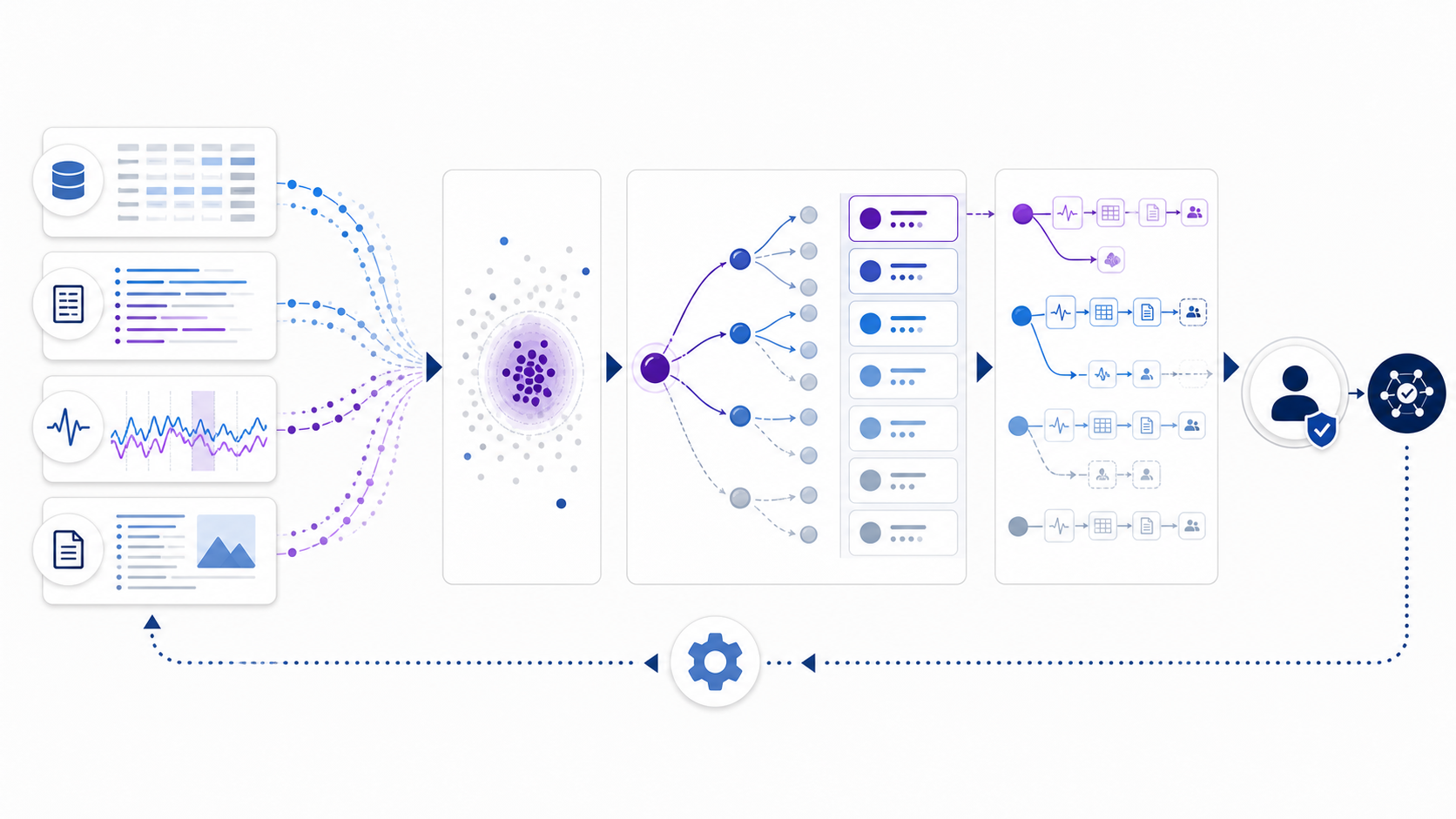
Automated root cause analysis (automated RCA) is a software-assisted workflow that gathers incident evidence, detects abnormal changes, connects related signals, ranks candidate causes, and produces an auditable explanation for human verification. It automates repetitive investigation work; it does not make causality automatic.
自动化根因分析(automated RCA)是一种软件辅助工作流:汇集事件证据、检测异常变化、连接相关信号、排序候选原因,并生成可供人工验证的可审计解释。它自动化的是重复调查工作,而不是让因果关系自动成立。
The distinction matters. An alert answers “what changed?” A correlation engine may answer “what changed nearby?” Root cause analysis must answer “which condition produced or materially enabled the outcome, through what mechanism, and what evidence would disprove that claim?” A reliable system therefore combines automation with explicit uncertainty, competing hypotheses, and accountable review.
这个区别十分关键。告警回答“什么变了”;相关性引擎可能回答“附近还有什么一起变了”;根因分析则必须回答“哪个条件通过什么机制导致或显著促成了结果,以及什么证据可以推翻该主张”。因此,可靠系统必须把自动化与明确的不确定性、竞争假设和责任复核结合起来。
When automated RCA helps—and when it does not自动化 RCA 何时有效,何时不适合
High-volume, repeatable incidents with synchronized telemetry, known dependencies, stable identifiers, and a history of resolved cases. Examples include service degradation, production-line drift, data-pipeline failures, and KPI changes with traceable releases or configuration events.
适合高频、可重复的事件,且具备同步遥测、已知依赖、稳定标识符和历史结案记录。例如服务降级、生产线漂移、数据管道故障,以及可追溯到发布或配置事件的 KPI 变化。
Rare events with sparse evidence, disputed definitions, hidden organizational factors, changing instrumentation, or safety and legal consequences that require specialist investigation. Automation can organize records here, but should not issue an autonomous final verdict.
对于证据稀疏的罕见事件、定义存在争议、组织因素隐藏、监测方式频繁变化,或具有安全和法律后果且需专家调查的场景,自动化可整理记录,但不应自主给出最终结论。
Searchers often want a tool that eliminates manual triage. The practical goal is narrower and more useful: reduce time spent finding, aligning, and testing evidence so investigators can focus on causal judgment and corrective action.
用户通常希望工具彻底消除人工排查。更现实且有价值的目标是:减少寻找、对齐和检验证据的时间,让调查人员把精力集中在因果判断和纠正行动上。
Data and prerequisites for automated root cause analysis自动化根因分析需要的数据与前提
Automation quality is bounded by evidence quality. Before selecting an AI root cause analysis approach, define the outcome being diagnosed, the observation window, the unit of analysis, and the systems allowed to influence it. Then assemble the following inputs.
自动化质量受证据质量上限约束。在选择 AI 根因分析方案前,应定义需要诊断的结果、观察窗口、分析单位,以及可能影响该结果的系统范围,然后准备以下输入。
| Input输入 | Why it matters作用 | Quality check质量检查 |
|---|---|---|
| Metrics and business outcomes指标与业务结果 | Define the symptom, magnitude, baseline, and affected segments.定义症状、幅度、基线和受影响分群。 | Units, aggregation, missingness, and threshold history are documented.记录单位、聚合方式、缺失情况和阈值历史。 |
| Logs, traces, and events日志、追踪与事件 | Reconstruct sequence, dependencies, errors, and propagation paths.重建顺序、依赖、错误和传播路径。 | Clocks are synchronized and IDs join across systems.时钟同步,且标识符可跨系统关联。 |
| Changes and topology变更与拓扑 | Connect deployments, configuration, ownership, and upstream/downstream effects.连接发布、配置、所有权及上下游影响。 | Effective times and dependency versions are preserved.保留生效时间与依赖版本。 |
| Human and document evidence人工与文档证据 | Add incident notes, maintenance records, tickets, procedures, and known exceptions.补充事件记录、维护记录、工单、程序和已知例外。 | Facts, recollections, assumptions, and interpretations remain labeled.事实、回忆、假设和解释保持明确标记。 |
Preparation gate: if timestamps cannot be reconciled, identifiers do not join, or the outcome definition changes during the incident, pause cause ranking and repair the evidence model first.
准备门槛:如果时间戳无法对齐、标识符不能关联,或结果定义在事件中发生变化,应先暂停原因排序并修复证据模型。
How automated root cause analysis works step by step自动化根因分析如何分步运行
-
Define the incident contract. Specify the affected outcome, baseline, start and end time, severity, scope, excluded systems, and decision owner. Do not place a suspected cause in the problem statement.
定义事件契约。明确受影响结果、基线、起止时间、严重度、范围、排除系统和决策负责人,不要把怀疑原因写进问题陈述。
-
Collect and normalize evidence. Preserve raw sources, standardize time zones and units, resolve entity IDs, label missing intervals, and record transformations so every derived value remains traceable.
汇集并标准化证据。保留原始来源,统一时区与单位,解析实体 ID,标记缺失区间并记录处理过程,使每个派生值都可追溯。
-
Detect and localize the anomaly. Compare the incident with an appropriate baseline, then identify when, where, and for whom the deviation occurred. Separate a point anomaly from a sustained change point or expected seasonal variation.
检测并定位异常。将事件与合适基线比较,识别偏差发生的时间、位置和对象;区分单点异常、持续变点与预期季节变化。
-
Map dependencies and generate candidates. Use service graphs, process maps, data lineage, change records, domain rules, and historical cases to form multiple plausible hypotheses rather than one convenient explanation.
映射依赖并生成候选原因。利用服务图、流程图、数据血缘、变更记录、领域规则和历史案例形成多个合理假设,而不是只保留一个方便解释。
-
Rank with transparent evidence. Score candidates by temporal precedence, proximity in the dependency graph, explanatory coverage, recurrence, known mechanisms, and data quality. Display which evidence raised or lowered each rank.
用透明证据排序。依据时间先后、依赖图距离、解释覆盖度、复发情况、已知机制和数据质量评分,并展示哪些证据提高或降低了候选排名。
-
Test alternatives and seek disconfirmation. Ask whether the candidate also occurs during healthy periods, whether the symptom preceded it, which affected entities contradict it, and whether another common upstream factor explains both.
检验替代解释并主动寻找反证。检查候选因素是否也出现在健康期、症状是否先于候选因素、哪些受影响实体与其矛盾,以及是否存在同时解释两者的共同上游因素。
-
Review, act, and learn. A qualified owner accepts, rejects, or narrows the diagnosis; links corrective action to a verified mechanism; watches an effectiveness measure; and feeds the verified case back into rules or models.
复核、行动并学习。由合格负责人接受、拒绝或缩小诊断范围,将纠正行动关联到已验证机制,监控成效指标,并把经验证案例反馈给规则或模型。
Methods behind AI root cause analysisAI 根因分析背后的方法
No single algorithm answers every RCA question. Production systems usually combine detection, relationship modeling, retrieval, and causal testing. Choose by evidence type and decision risk, not by whether a feature is labeled “AI.”
没有单一算法能回答所有 RCA 问题。生产系统通常组合异常检测、关系建模、信息检索和因果检验。选择方法时应依据证据类型与决策风险,而不是功能是否带有“AI”标签。
| Method方法 | Best use适用任务 | Main limit主要局限 |
|---|---|---|
| Rules and dependency traversal规则与依赖遍历 | Known failure modes, explicit topology, compliance checks.已知故障模式、明确拓扑和合规检查。 | Brittle when systems or naming change.系统或命名变化时容易失效。 |
| Statistical correlation and contribution analysis统计相关与贡献分析 | Ranking dimensions that move with an outcome.排序与结果同步变化的维度。 | Confounding and common causes can create false explanations.混杂因素与共同原因会制造错误解释。 |
| Graph and causal models图模型与因果模型 | Representing propagation, dependencies, interventions, and counterfactuals.表示传播、依赖、干预和反事实。 | Structural assumptions must be documented and tested.结构假设必须记录并检验。 |
| Machine learning and anomaly attribution机器学习与异常归因 | Complex multivariate patterns and high-volume screening.复杂多变量模式与大规模筛查。 | Attribution explains a model score, not necessarily the real-world cause.归因解释模型分数,不必然解释现实根因。 |
| LLM-assisted retrieval and synthesisLLM 辅助检索与综合 | Linking logs, tickets, runbooks, documents, and narrative timelines.连接日志、工单、运行手册、文档和叙事时间线。 | Generated explanations require citations and independent verification.生成式解释必须带来源并独立验证。 |
For adjacent decisions, compare the broader root cause analysis methods techniques, the RCA tools selection guide, and the root cause identification. These supporting articles are included in the current local page set; verify the production routes again before launch.
相邻决策可参考根因分析方法与技术、RCA 工具选型指南和根因识别。这些配套文章已包含在当前本地页面集中;上线前仍应验证生产路由。
Example: ranking causes of an order-conversion drop示例:对订单转化率下降的原因进行排序
Hypothetical example: checkout conversion falls from a labeled baseline of 3.2% to 2.5% shortly after a release. These values illustrate the workflow; they are not InfiniSynapse customer data or a performance claim.
假设示例:某次发布后,结账转化率从标记基线 3.2% 降至 2.5%。这些数字仅用于说明工作流,不是 InfiniSynapse 客户数据或性能主张。
The system aligns application traces, payment errors, release events, device segments, and support tickets. It detects that the decline is concentrated on one mobile operating-system version. A payment timeout rises at the same time, but it also rises for unaffected devices, so correlation alone is weak. A newly deployed client validation rule appears only in the affected path, precedes abandoned checkouts, and disappears in a controlled rollback. The system ranks that rule above the timeout and shows the supporting and conflicting evidence.
系统对齐应用追踪、支付错误、发布事件、设备分群和支持工单,发现下降集中在某一移动操作系统版本。支付超时在同一时段上升,但未受影响设备也出现该现象,因此仅凭相关性证据较弱。新部署的客户端校验规则只出现在受影响路径中,发生在放弃结账之前,并在受控回滚后消失。系统因此将该规则排在超时之前,同时展示支持证据与冲突证据。
A human owner then verifies the release diff, confirms no parallel experiment explains the segment, approves the rollback, and watches conversion and error rates through a defined observation window. The automated output is valuable because it narrows and documents the investigation; the rollback result and review establish confidence in the cause.
随后,负责人核查发布差异,确认没有并行实验解释该分群,批准回滚,并在规定观察期内监控转化率和错误率。自动化输出的价值在于缩小范围并记录调查;回滚结果和人工复核进一步建立对根因的信心。
Prepare connected evidence, then investigate with InfiniSynapse准备关联证据,再使用 InfiniSynapse 开展调查
Prepare a scoped dataset, stable IDs, synchronized timestamps, relevant tables and files, known change events, and the questions you need to test. InfiniSynapse is an AI-powered data analysis workspace that can connect and analyze databases, files, documents, audio, and video. This page does not describe it as a dedicated autonomous RCA or certified causal-inference product. Use it to explore connected evidence and candidate relationships, then require qualified owners to verify causal claims and approve corrective action.
请准备范围明确的数据集、稳定 ID、同步时间戳、相关表格与文件、已知变更事件,以及需要检验的问题。InfiniSynapse 是可连接并分析数据库、文件、文档、音频和视频的 AI 辅助数据分析工作区。本页不把它描述为专用自主 RCA 或经过认证的因果推断产品。可用它探索关联证据与候选关系,再由合格负责人验证因果主张并批准纠正行动。
Open the InfiniSynapse connected-data analysis workspace打开 InfiniSynapse 关联数据分析工作区Common failures, limitations, and safeguards常见失败、局限与防护措施
- Correlation becomes a verdict. Require temporal order, mechanism, alternative explanations, and disconfirming evidence before approving a cause.把相关性当成结论。批准根因前,必须检查时间顺序、作用机制、替代解释和反证。
- Missing data looks normal. Track telemetry coverage and silence explicitly; a missing signal is not evidence of healthy operation.缺失数据看起来像正常。明确跟踪遥测覆盖与静默;没有信号不等于运行健康。
- Model drift changes ranking. Version baselines, features, topology, prompts, rules, and thresholds; compare them across verified incidents.模型漂移改变排序。对基线、特征、拓扑、提示、规则和阈值进行版本管理,并在已验证事件间比较。
- LLM fluency hides uncertainty. Require source citations, extracted evidence, confidence rationale, and an explicit “insufficient evidence” outcome.LLM 的流畅表达掩盖不确定性。要求来源引用、提取证据、置信理由,并允许明确输出“证据不足”。
- Automation bias weakens review. Show rejected candidates and contradictory evidence, rotate reviewers, and prevent the system from directly executing high-impact remediation without authorization.自动化偏见削弱复核。展示被排除候选和矛盾证据,轮换复核人员,并防止系统未经授权直接执行高影响修复。
- Sensitive evidence leaks. Apply least-privilege access, retention limits, redaction, audit logs, and sector-specific incident-handling requirements.敏感证据泄露。实施最小权限、保留期限、脱敏、审计日志和行业特定事件处理要求。
How to validate an automated RCA result如何验证自动化 RCA 结果
Evaluate the system on resolved cases before using it in live decisions. Split evaluation by incident type and time so repeated copies of one event do not inflate performance. Automation may rank candidates. Reviewers still decide which root cause capabilities stay human: accepting the cause, the clinical meaning, and the action. Measure whether the true verified cause appears in the top candidates, whether supporting evidence is correct and retrievable, whether the system abstains when evidence is insufficient, and whether reviewers can reproduce the reasoning.
在用于实时决策前,应先用已结案事件评估系统。按事件类型和时间切分,避免同一事件的重复副本虚增表现。自动化可以给候选原因排序。复核人仍要决定哪些根因能力必须留给人:接受原因、临床含义和措施。衡量已验证根因是否进入前列、支持证据是否正确可检索、证据不足时系统是否拒绝作答,以及复核人员能否复现推理。
| Check检查项 | Pass condition通过条件 |
|---|---|
| Evidence traceability证据可追溯性 | Every material claim links to a source record, time, transformation, and version.每项重要主张都连接到来源记录、时间、处理过程和版本。 |
| Causal coherence因果一致性 | The candidate precedes the outcome, has a plausible mechanism, and explains affected and unaffected cases.候选原因先于结果,具有合理机制,并能解释受影响与未受影响案例。 |
| Alternative testing替代解释检验 | Competing hypotheses and counterevidence are visible rather than silently discarded.竞争假设与反证保持可见,没有被静默丢弃。 |
| Intervention outcome干预结果 | Where safe and practical, removing or controlling the cause changes the predicted outcome during a defined window.在安全可行时,移除或控制原因会在规定窗口内改变预期结果。 |
| Operational value运营价值 | Compare investigation time, rework, reviewer disagreement, recurrence, false escalation, and missed incidents against a manual baseline.与人工基线比较调查时间、返工、复核分歧、复发、错误升级和漏检事件。 |
Do not optimize only for speed. A faster unsupported explanation creates expensive rework. Track precision at the review threshold, top-k recall for verified causes, abstention quality, evidence completeness, and post-action recurrence together.
不要只优化速度。更快但缺乏支持的解释会制造昂贵返工。应联合跟踪复核阈值下的准确率、已验证根因的 top-k 召回、拒答质量、证据完整度和行动后的复发情况。
A safe implementation plan for root cause analysis automation安全实施根因分析自动化的计划
Start with one bounded incident family. Choose a repeatable problem with good instrumentation and clear ownership. Build a read-only evidence pipeline, replay resolved cases, and compare automated candidates with documented findings. Next, run the system in shadow mode during live incidents: investigators work normally while the system records recommendations without triggering actions.
从一个边界清晰的事件族开始。选择可重复、监测良好且所有权明确的问题。建立只读证据管道,重放已结案案例,并把自动候选与已记录结论比较。随后在实时事件中采用影子模式:调查人员照常工作,系统记录建议但不触发行动。
Promote only after reviewers agree on evidence standards, abstention rules, escalation paths, access controls, and rollback. Keep high-impact remediation behind explicit approval. Review false positives, missed causes, changed topology, and recurrence on a fixed cadence. Automation should improve the investigation system, not merely produce more confident reports.
只有在复核人员就证据标准、拒答规则、升级路径、访问控制和回滚达成一致后,才进入正式使用。高影响修复必须保留明确审批。按固定周期复盘误报、漏掉的原因、拓扑变化和复发情况。自动化应改善整个调查系统,而不只是生成更自信的报告。
Frequently asked questions about automated root cause analysis关于自动化根因分析的常见问题
What is automated root cause analysis?什么是自动化根因分析?
Automated RCA uses software to collect evidence, detect abnormal changes, correlate related signals, rank candidate causes, and present an auditable diagnosis for human verification.
自动化 RCA 使用软件汇集证据、检测异常变化、关联相关信号、排序候选原因,并向人工复核者提供可审计诊断。
How does automated root cause analysis work?自动化根因分析如何工作?
A typical workflow normalizes telemetry and business data, detects an incident, limits the time window, maps dependencies, generates candidates, tests them against timing and counterevidence, then asks an accountable owner to approve or reject the result.
典型流程会标准化遥测与业务数据、检测事件、限定时间窗口、映射依赖、生成候选原因、用时间与反证检验,最后由责任负责人批准或拒绝结果。
Is correlation enough to prove a root cause?相关性足以证明根因吗?
No. Correlation helps prioritize investigation, but a causal claim also needs temporal order, a plausible mechanism, competing explanations, and evidence from interventions, controlled tests, or repeated outcomes where practical.
不足。相关性可帮助确定调查优先级,但因果主张还需要时间顺序、合理机制、竞争解释,以及在可行时来自干预、受控测试或重复结果的证据。
Can AI fully automate root cause analysis?AI 能完全自动化根因分析吗?
AI can accelerate evidence retrieval, summarization, pattern detection, and candidate ranking, but high-impact conclusions and corrective actions still require human review, domain context, and governed approval.
AI 可加速证据检索、总结、模式检测和候选排序,但高影响结论与纠正行动仍需人工复核、领域语境和受治理审批。
What data is needed for automated root cause analysis?自动化根因分析需要哪些数据?
Useful inputs include synchronized metrics, logs, traces, deployment and configuration changes, topology, ownership metadata, business events, incident notes, and known-good comparison periods.
有用输入包括同步指标、日志、追踪、发布与配置变更、拓扑、所有权元数据、业务事件、事件记录和已知健康对照期。
Official sources and verification notes官方来源与验证说明
- OpenTelemetry observability primer on traces, metrics, and logsOpenTelemetry 关于追踪、指标与日志的可观测性入门
- NIST AI Risk Management Framework on trustworthy AI risk controlsNIST AI 风险管理框架:可信 AI 风险控制
- OSHA incident investigation guidance on root causes and corrective actionsOSHA 关于根因与纠正行动的事件调查指南
These sources support the evidence, observability, risk, and systems-oriented investigation principles used here. Sector-specific law, safety rules, privacy requirements, and incident procedures may impose additional controls.
这些来源支持本页采用的证据、可观测性、风险与系统导向调查原则。行业法律、安全规则、隐私要求和事件程序可能规定额外控制。