AI visibility multilingual: Lock the Locale
By William Zhu · Cofounder, InfiniSynapse · Last updated: 2026-09-10 · Last verified: 2026-09-10 · Methods: SEO Health
aivisibilitychecks at aimeetup.center — locale-locked prompt set, one locale per run, English log not translated later as a second surface. Not an official Google score. Observed CLI contract 2026-09-10 oninfinitegrowth@0.1.1:seo-health check --format jsoncan exit 0 whileissues[].statusiserror.
Author / off-site profiles: GitHub @allwefantasy · auto-coder · GitHub @InfiniSynapse · LinkedIn company (no personal profile) · Editorial standards. No personal LinkedIn or vendor badge. Product recognition: SEO Health Checker is one of two first-prize works in the InfiniSynapse × CSDN Vibe Coding contest (English recognition archive). InfiniSynapse co-hosted the contest. That list is not a review of this article.
Reviewed by: InfiniSynapse Data Team · method review 2026-09-10. First-party method review, not a third-party award.
Trust / COI: About · Corrections · Publishing principles · Privacy · Terms. SEO Health is commercial. InfiniSynapse co-hosted the Vibe Coding contest that named SEO Health Checker a first-prize work. The CLI contract below is observed. First-party desk tables stay illustrative. The InfiniSynapse Data Team publishes this desk method.
Table of Contents
- TL;DR
- What AI visibility multilingual records
- A locale-lock framework for one set
- Locale-locked runs compared with a translated log
- Landscape of locales and surfaces
- How to run AI visibility multilingual
- Desk sample
- Scorecard
- Failure modes
- Cluster guides
- FAQ
- Conclusion
Cover: ./images/hero-ai-visibility-multilingual.png · Social: ./images/og-cover.png · Chart: ./images/chart-ai-visibility-multilingual.png
TL;DR
AI visibility multilingual means a locale-locked prompt set. Translating the English log later is not a second-surface test. Credits apply. Not a Google score.
Direct answer: Run AI visibility multilingual as one locale per locked set. Freeze
en,zh-Hans, orzh-Hantbefore you spend credits. Do not translate last week’s English answers and call that a Chinese run.
Paste a public URL at aimeetup.center/seo-tools#check for the eight-module lights (title, meta, headings, density, images, links, tech, speed). Those lights are traffic colors, not a Google 100. seo-health aivisibility is a different command: it needs InfiniSynapse login and credits.
We evaluate AI visibility multilingual hands-on as the InfiniSynapse Data Team. We build InfiniSynapse for the signed-in locale-locked task, not for a translated-later spreadsheet.
What AI visibility multilingual records
Key definition: AI visibility multilingual is a locked prompt set whose locale is frozen with the wording. One set is one language tag. A later human or machine translation of the English log is not a second-surface test and not a second locale.
Observed CLI contract (2026-09-10, infinitegrowth@0.1.1): For this AI-visibility log pass, the same two public URLs were re-used so this page does not invent a private run. seo-health check https://infinisynapse.com/en/blog/data-agent-memory --format json --lang en exited 0 with page.title present and Image Alt Text = warning. The same command on https://example.com also exited 0 while issues[].status listed error on Meta Description, Robots.txt, and Sitemap.xml. Parse those status fields. Exit 0 is not a clean page. Desk tables below stay illustrative.
Independent citation: According to [managing multi-regional sites](https://developers.google.com/search/docs/specialty/international/managing-multi-regional-sites), Google documents how to manage multi-regional and multilingual sites. Google's managing multi-regional sites page is the third-party rule this write-up holds to. Illustrative desks below are not that rule.
People treat translation as cheaper than a second credit spend. The log has to refuse that shortcut. The surface answered a Chinese prompt or it did not. AI visibility multilingual records that event, not a polished English paraphrase of last Tuesday.
W3C’s guide to language tags still treats a language tag as part of the document contract, not as a caption you add after export. MDN’s lang attribute is the document-level twin of that tag. Honest AI visibility multilingual follows that habit: write en, zh-Hans, or zh-Hant on the set ID before the run.
One locale is one locked set
A locale-locked set uses the same wording, the same aliases, and the same tag every week. If you translate a prompt into Simplified Chinese, that is a new set ID. AI visibility multilingual does not let you keep the English ID and “also report China.”
Brand aliases change by locale. An English legal name may never appear in a zh-Hans answer that uses a market name. Freeze both strings on that set. AI visibility multilingual that counts only the English legal name on a Chinese run will fake silence.
Translation later is not a second run
Machine translation of the saved English answers is a reading aid. It is not a zh-Hans measurement. Wikipedia’s overview of machine translation still treats the output as a generated rendering of another text. AI visibility multilingual refuses to file that rendering as a surface row.
If the Chinese page never states a closed claim the model can lift, fix the paragraph first. The extractable-paragraph guide is the sibling for that input. Stay here when the defect is the locale tag, not the missing sentence.
A locale-lock framework for one set
The working object is a set ID plus a language tag. AI visibility multilingual fails the moment someone “improves” the Chinese line between weeks. You are then comparing two questions, not two dates.
| Signal | What you freeze | Fail if you |
|---|---|---|
| Language tag | en, zh-Hans, or zh-Hant | Mix tags in one set |
| Prompt wording | Exact locale string | Translate after the run |
| Brand aliases | Locale-native names | Count only the English legal name |
| Credits | Signed-in long task | Imply a free crawl per locale |
Keep those four stacked. AI visibility multilingual earns its keep only when the tag on the set matches the wording you sent.
Unicode’s LDML report still treats locale data as a structured contract (language, script, region), not as a slide label. Replay that contract on the set ID. AI visibility multilingual is that ID, not a folder named “intl.”
Credits sit on each locale run
seo-health aivisibility, seo-health eeat, and seo-health gsc need InfiniSynapse login plus credits. seo-health check, seo-health audit, and seo-health links can run without that login. AI visibility multilingual sits on the credit side because each locale is a long task, not because Chrome failed to read eight lights.
Install the CLI with npm i -g infinitegrowth when you want the same command in a script. The bin is seo-health. The visibility command is seo-health aivisibility. It is not a free eight-light paste. Credits apply. A second locale is a second spend.
Locale-locked runs compared with a translated log
A translated-later log takes English mention and citation cells and renders them in another language. That file can help a reviewer read. It cannot claim a second surface. AI visibility multilingual compared with that file is a new prompt in the target locale, replayed on a schedule.
Google’s guide to managing multi-regional sites still separates language versions as distinct URLs and signals. It does not say you may translate a log and call it a second test. Stay on that honesty: hreflang and locale-locked prompts are cousins, not the same job.
Library of Congress ISO 639-2 codes remain the bibliographic list people reach for when they need a language code. Use a tag you can defend. AI visibility multilingual that writes “CN” on an English set is a label, not a measurement.
If you already keep Perplexity as its own row, open the Perplexity mention-versus-citation lead for the surface rule. Stay here when the defect is the locale lock, not the missing Perplexity row.
Landscape of locales and surfaces
The landscape is a table of locales and surfaces, not a vendor contest. AI visibility multilingual occupies the locale axis. Claude, Gemini, and Google AI Mode occupy surface rows. Schema and sitemap samples are inputs. A 50–500 page sample can show whether the zh-Hans URL even ships an extractable body.
RFC 5646 still defines how language tags are structured. Point stakeholders at that grammar when they want a homemade “simp/trad/en” badge with no set ID. AI visibility multilingual uses the tag on the set, then the two columns.
A Claude row on a zh-Hant set is not an English Claude row. The Claude surface guide keeps that engine on its own row. AI visibility multilingual keeps the locale on the set that engine received.
If the next job is hreflang and eight lights on locale twins, you may open the multilingual SEO checker once. That neighbor is a lights-and-hreflang pass. It does not replace a locale-locked credit command.
If you need the product UI that stores the rows, open the live surface checker after you understand the tag. Leave the older surface-log hub in place as the existing category URL. Do not retarget those older phrases here.
How to run AI visibility multilingual
This method H2 is the only place the product command is specified as a sequence. AI visibility multilingual is the locale lock; seo-health aivisibility is the runner.
Evidence pack or locked prompts go through aimeetup as the signed-in InfiniSynapse account. One-shot analysis, not training.
Step 1 — Freeze the locale on the set
Write six to twelve prompts in one language you can stand behind in public. Put en, zh-Hans, or zh-Hant on the set ID. Freeze locale-native brand aliases. AI visibility multilingual starts after that freeze, not after someone volunteers to “just translate the deck.”
Use a public URL in that locale when the page exists. Do not paste secrets, tokens, or unpublished drafts into the checker.
Step 2 — Run one locale at a time
Sign in. Spend credits. Run seo-health aivisibility against that locked set and the public URL. AI visibility multilingual must write the language tag on the run. If you need a second locale, create a second set ID and spend again.
The eight-module paste at aimeetup.center/seo-tools#check can still run first without login. That pass does not write locale rows. Before you spend credits, you may read eight lights on the SEO health checker once.
Step 3 — Store the native-language log
For each prompt, record mention yes/no and citation yes/no in the language the surface used. Do not translate the cells into English and delete the source wording. AI visibility multilingual that only keeps an English paraphrase has already failed the method. Store the raw snippet so a reviewer who reads that locale can dispute a false mention.
Do not invent a citation-rate API per locale. Two columns stay two columns.
Step 4 — Refuse a translated-later “second surface”
Replay the same locale-locked set on a later date. AI visibility multilingual earns its keep on the delta between two locked runs, not on a machine-translated copy of the English sheet. If you change a character or a synonym, increment the set ID.
Do not call a translated English log a zh-Hans recovery. There is no position to recover. There is one tag, two columns, and a date.
Independent citation 2: According to [language tags](https://www.w3.org/International/articles/language-tags), this W3C document is an independent web-standards reference, not a ranking certificate. A second independent source, from W3C, keeps this page claim from resting only on first-party lights.
Desk sample: locale-locked versus translated later
The table and chart below are an illustrative InfiniSynapse desk log, not a customer result and not an independent benchmark. Two dimensions: locale (en / zh-Hans / zh-Hant) × method (locale-locked vs translated later) on one public docs URL. Desk note AVM-706-20260908.
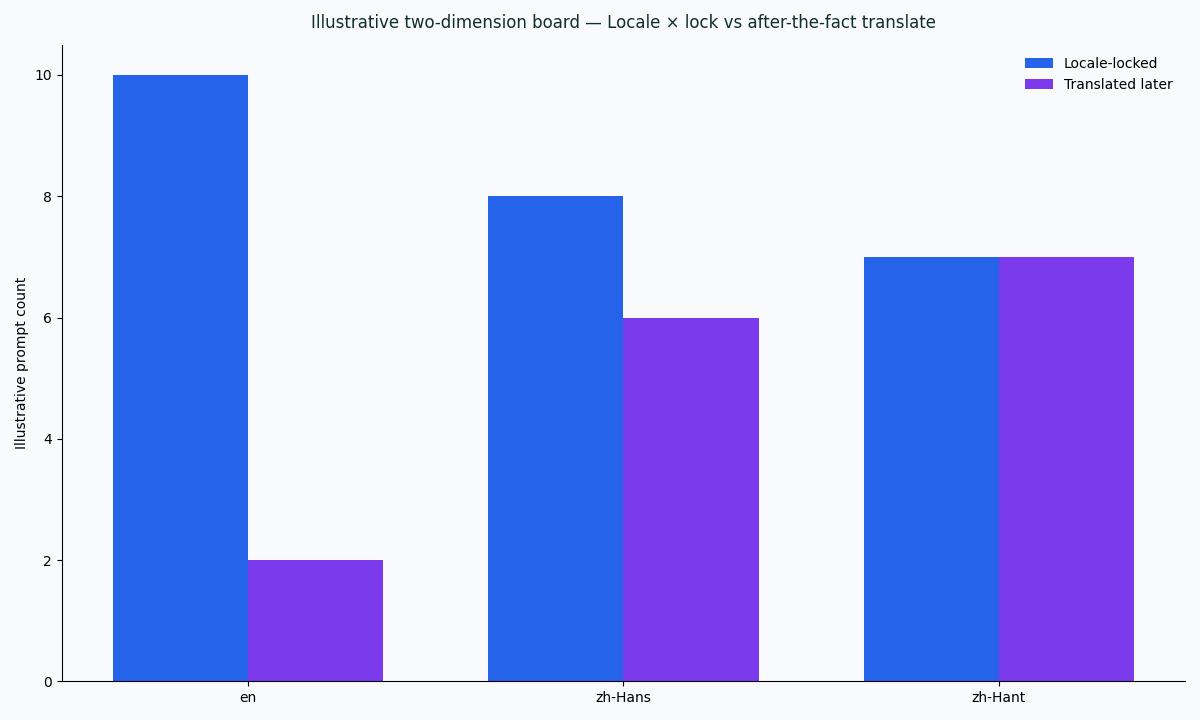
Illustrative two-dimension desk chart (locale × locale-locked vs translated later). Not a customer report. Social cut: ./images/og-cover.png.
| Locale (illustrative) | Locale-locked mentions / 8 | Translated-later “mentions” / 8 |
|---|---|---|
| en | 5 | 5 |
| zh-Hans | 3 | 5 |
| zh-Hant | 2 | 5 |
Two dimensions: locale × method. The translated-later column copies the English count into Chinese rows. That copy is not AI visibility multilingual. The locale-locked column shows zh-Hans and zh-Hant as their own quieter weeks. Desk counts are illustrative.
Selection scorecard for locale-locked sets
Use this scorecard when someone demos AI visibility multilingual. Score the set ID, not the slide.
| Criterion | Pass | Fail |
|---|---|---|
| Language tag | Written on the set before the run | “Intl” folder with no tag |
| Second locale | New set ID + new credits | Translated English log |
| Columns | Mention and citation both stored | Single percentage per country |
| Aliases | Locale-native strings frozen | English legal name only |
| Credits | Login + credits per locale | Implied free crawl of every language |
| Google mix | Not a Google score | Hreflang sold as a surface rank |
A log that fails two or more rows is a dashboard, not a method. Eight lights do not invent a zh-Hans row. AI visibility multilingual still needs the tag on the set you sent.
Failure modes that fake a second locale
These failures show up in decks more often than in logs. AI visibility multilingual that survives them keeps one tag per set and two columns.
Translating the English log and filing it as zh-Hans
A polished Chinese spreadsheet of last week’s English answers is a reading aid. Filing it as a second surface is a lie. AI visibility multilingual forbids that file as a measurement.
Mixing zh-Hans and zh-Hant in one set. Script is part of the tag. A mixed set is two questions. Increment the ID.
Using hreflang as a substitute for a credit run. Hreflang can tell crawlers which URL to show. It does not write mention versus citation. AI visibility multilingual is the credit command on a locale-locked set, not a sitemap annotation.
Cluster guides for this visibility expansion
This page is the locale-lock cluster in the existing expansion. The table names sibling jobs. The links sit in surrounding sentences.
| Hub slug | Job on this cluster |
|---|---|
| perplexity-search-rank-tracking-tools | Perplexity as its own row |
| extractable-paragraph-seo | Closed claim before you log |
| claude-brand-mention | Claude on its own row |
| multilingual-seo-checker | Lights and hreflang on locale twins |
| seo-health-checker | Eight-module lights on one URL |
The locale-lock job sits beside those jobs. It does not replace a surface row and it does not replace eight lights.
Lock the locale on the set before you spend credits
Paste a public URL at the live checker, then run one locale-locked prompt set and store mention versus citation in that language.
Run SEO Health CheckerFrequently Asked Questions
Is translating the English log a second-locale test?
Bottom line: No. A translated English sheet is a reading aid. AI visibility multilingual requires a locale-locked prompt set in the target language.
Do I need credits for each locale run?
Bottom line: Yes for seo-health aivisibility. Each locale-locked set is a signed-in long task. The eight-module paste at aimeetup.center can run without login and does not write AI visibility multilingual.
Can I mix zh-Hans and en in one locked set?
Bottom line: No. One set is one language tag. AI visibility multilingual treats a mixed set as two questions. Create a second set ID.
Is this an official Google score?
Bottom line: No. Lights are traffic colors. AI visibility multilingual is not a Google 100 and not a citation-rate API.
Conclusion
AI visibility multilingual is a locale-locked prompt set: one tag, two columns, credits per run. Freeze en, zh-Hans, or zh-Hant before you log. Do not translate the English sheet and call it a second surface. Do not sell an official Google score.
If you need the signed-in account that spends those credits, open the InfiniSynapse web app once, then return to aimeetup for the checker. Re-run the same locale-locked set. Keep AI visibility multilingual as a tagged set you can defend, not as a translated copy of last week.