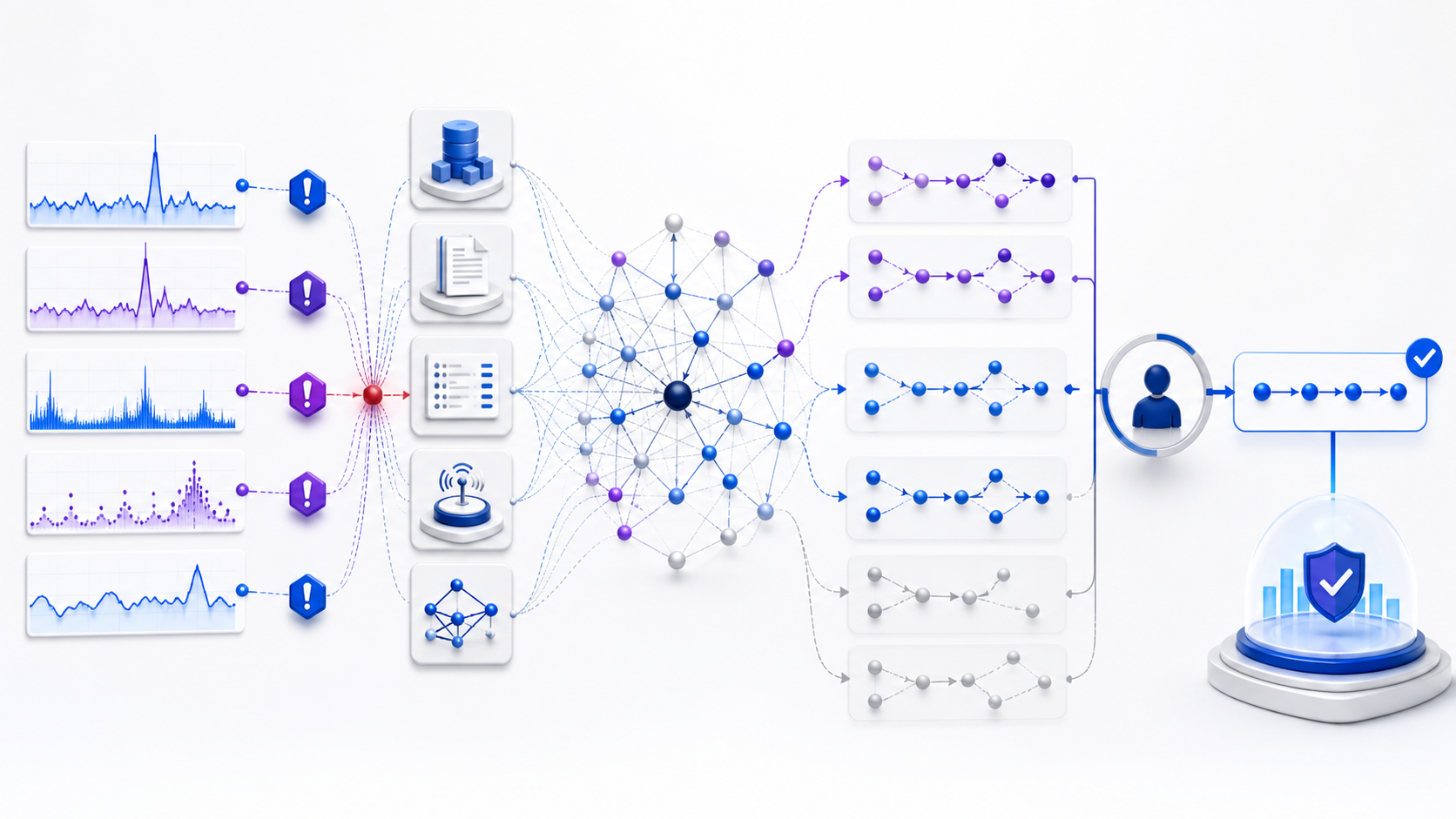
What AI root cause analysis actually doesAI 根因分析真正完成什么
For the full topic map and the neighboring methods that support this workflow, continue with the anomaly detection and root cause analysis guide.
如需查看完整主题结构以及支撑本流程的相邻方法,请继续阅读异常检测与根因分析指南。
AI root cause analysis turns a defined incident and its evidence into ranked, testable causal hypotheses, then supports human verification and corrective-action measurement. Automated root cause analysis may correlate signals, traverse dependencies, retrieve similar cases, analyze changes, or summarize documents. A responsible workflow preserves the evidence behind each claim and explicitly shows uncertainty. After a reconstruction flag, start from the reconstruction-error runbook. This URL stays on ranked causes.
AI 根因分析把已界定的事件及其证据转化为经过排序、可以检验的因果假设,再支持人工验证和纠正措施效果测量。自动化根因分析可以关联信号、遍历依赖关系、检索相似案例、分析变更或总结文档。负责任的流程会保留每项判断背后的证据,并明确显示不确定性。重构标记之后先看 重构误差操作文。本页仍讲排序后的原因。
The phrase covers several systems rather than one algorithm. Some products correlate observability telemetry; some classify failures from tickets and logs; others apply causal graphs, change-point detection, feature attribution, retrieval, or large language models. The common objective is to reduce the time spent finding and organizing relevant evidence without skipping the reasoning needed to distinguish a symptom, trigger, contributing condition, failed control, and controllable root cause.
这个术语覆盖多类系统,而不是某一种算法。有的产品关联可观测性遥测,有的从工单和日志中分类故障,还有的应用因果图、变点检测、特征归因、检索或大语言模型。共同目标是减少寻找和整理相关证据的时间,同时不能跳过区分症状、触发因素、促成条件、失效控制与可控根因所需的推理。
When AI-powered root cause analysis fits—and when it does notAI 驱动根因分析适合与不适合的场景
Frequent incidents, many timestamped signals, distributed evidence, recurring patterns, known dependencies, and enough reviewed history to compare outcomes.
事件频繁、时间戳信号多、证据分散、模式反复出现、依赖关系已知,并且有足够经过复核的历史结果可比较。
One-off events with missing records, shifting definitions, unobservable human decisions, tiny samples, unknown system boundaries, or no safe way to test an action.
缺少记录的一次性事件、定义不断变化、人员决策不可观察、样本极小、系统边界未知,或无法安全测试措施。
Use automation when investigators repeatedly search the same classes of logs, metrics, documents, or change records and can define what a useful explanation must contain. Do not use it to assign blame, bypass safety review, or generate certainty from incomplete evidence. In regulated, clinical, security, or high-hazard contexts, organization-specific procedures and accountable experts remain authoritative.
当调查人员反复搜索相同类型的日志、指标、文档或变更记录,并能定义合格解释必须包含什么时,自动化最有价值。不要用它归责个人、绕过安全复核或从不完整证据中制造确定性。在受监管、临床、安全或高危场景中,仍应以组织特定程序和负责任专家的判断为准。
Prepare evidence before starting automated RCA开始自动化 RCA 前准备证据
Start with an observable problem statement: affected service or process, expected behavior, actual behavior, severity, first and last known times, and excluded scope. Preserve original time zones and clocks. Then collect the smallest complete evidence window that includes normal behavior before the event, the onset, the incident, recovery, and relevant changes.
先写出可观察的问题陈述:受影响的服务或流程、预期行为、实际行为、严重度、首次与最后已知时间,以及排除范围。保留原始时区与时钟。随后收集能够完整覆盖事件前正常状态、事件开始、持续过程、恢复阶段和相关变更的最小证据窗口。
- Operational signals: metrics, logs, traces, alerts, sensor readings, quality measurements, and process outputs.运行信号:指标、日志、链路追踪、告警、传感器读数、质量测量与流程输出。
- Change evidence: deployments, configuration edits, maintenance, supplier lots, permissions, dependencies, and manual interventions.变更证据:部署、配置编辑、维护、供应批次、权限、依赖与人工干预。
- Context: topology, schemas, runbooks, tickets, incident notes, standard procedures, ownership, and known controls.上下文:拓扑、Schema、运行手册、工单、事件记录、标准程序、责任人与已知控制措施。
- Provenance: source, collector, timestamp, units, definition, transformations, access level, retention, and version.来源信息:来源、采集者、时间戳、单位、定义、转换过程、访问级别、保留策略与版本。
A seven-step AI root cause analysis workflowAI 根因分析七步工作流
- Define and contain the incident界定并遏制事件Record impact and scope before asking the model why. Separate immediate containment from the later corrective action so a successful workaround is not mislabeled as a root cause.在询问模型“为什么”之前记录影响与范围。把即时遏制与后续纠正措施分开,避免把成功的临时方案误标为根因。
- Align and quality-check evidence对齐并检查证据质量Normalize time, units, identifiers, and definitions while retaining originals. Mark missing intervals, sampling changes, duplicated events, and sources that arrived after the incident.对齐时间、单位、标识符和定义,同时保留原始数据。标记缺失区间、采样变化、重复事件以及事件后才到达的来源。
- Detect what changed检测发生了什么变化Compare affected and baseline periods. Use anomaly detection, change-point detection, cohorts, dependency changes, and incident retrieval to narrow the search—not to declare a cause.比较受影响时段与基线时段。使用异常检测、变点检测、群组比较、依赖变更和事件检索缩小搜索范围,而不是直接宣布原因。
- Generate competing hypotheses生成竞争假设Require multiple explanations, including data-quality and monitoring failure. Each hypothesis should state a mechanism, predicted observations, counterevidence, and the evidence still needed.要求生成多个解释,包括数据质量和监控失效。每个假设都要说明机制、预测观察、反证以及仍需收集的证据。
- Rank without hiding uncertainty排序但不隐藏不确定性Rank hypotheses by temporal precedence, dependency path, evidence strength, prior frequency, and contradiction. Keep model confidence separate from calibrated probability and investigation priority.按时间先后、依赖路径、证据强度、历史频率与矛盾程度排序假设。模型置信度、校准概率和调查优先级必须分开。
- Test causal implications检验因果含义Use safe reproductions, counterfactual comparisons, controlled changes, natural experiments, or expert review. Reject explanations that cannot account for chronology or fail against a stronger alternative.使用安全复现、反事实比较、受控变更、自然实验或专家复核。无法解释时间顺序或败给更强替代解释的假设应被否决。
- Act, monitor, and reopen行动、监测并重新开启Assign an owner, target, rollback rule, side-effect checks, and observation window. If the expected signal does not improve or recurrence continues, reopen the case instead of protecting the original conclusion.为措施指定责任人、目标、回滚规则、副作用检查和观察窗口。如果预期信号没有改善或仍然复发,应重新开启调查,而不是维护原结论。
Choose the method by evidence and question根据证据与问题选择方法
| Method方法 | Useful for适合问题 | Output输出 | Main limitation主要局限 |
|---|---|---|---|
| Correlation and lag analysis相关与滞后分析 | Finding signals that move before or with an incident寻找在事件之前或同时变化的信号 | Candidate variables and time relationships候选变量与时间关系 | Common causes and confounding can mimic causation共同原因与混杂会伪装成因果 |
| Dependency or causal graphs依赖图或因果图 | Tracing plausible paths through a known system沿已知系统追踪可能路径 | Ranked paths and affected entities排序路径与受影响实体 | Graph omissions and wrong edges distort results缺失节点或错误边会扭曲结果 |
| Retrieval and language models检索与语言模型 | Searching tickets, runbooks, reports, and unstructured logs搜索工单、运行手册、报告与非结构化日志 | Evidence-linked summaries and hypotheses带证据链接的摘要与假设 | Hallucination, stale sources, and prompt sensitivity幻觉、过期来源与提示词敏感性 |
| Supervised classification监督分类 | Recurring failures with stable reviewed labels具有稳定复核标签的重复故障 | Cause category and calibrated score原因类别与校准分数 | Label leakage, drift, and unseen incident classes标签泄漏、漂移与未知事件类别 |
AI RCA versus traditional root cause analysisAI RCA 与传统根因分析对比
Traditional methods such as 5 Whys, fishbone diagrams, change analysis, and fault trees structure human reasoning. AI methods search and compare more evidence, expose patterns, and rank where investigators should look first. They are complementary: a language model can draft a cause map, but a facilitated review may reveal missing controls; a correlation model can identify a leading signal, but a fault tree can clarify which combinations are actually sufficient.
五问法、鱼骨图、变更分析和故障树等传统方法用于组织人的推理。AI 方法可以搜索与比较更多证据、暴露模式并排序调查优先级。二者互补:语言模型可以起草原因图,但引导式复核可能发现缺失控制;相关模型可以找到领先信号,而故障树能说明哪些组合真正足以导致事件。
Decision rule: choose automation for evidence scale and repetition; choose structured human methods for framing, mechanism review, accountability, and novel conditions. Use both when consequences are material.
决策规则:证据规模大且任务重复时使用自动化;界定问题、复核机制、明确责任与处理新颖情况时使用结构化人工方法。后果重大时两者结合。
For detailed method selection, use the related root cause analysis methodology guide. To compare software categories, evidence traceability, collaboration, and governance requirements, review the RCA tools selection guide.
如需详细选择方法,请阅读相关的根因分析方法论指南。如需比较软件类别、证据可追踪性、协作和治理要求,请查看 RCA 工具选型指南。
Hypothetical example: diagnosing a delayed data pipeline假设示例:诊断数据管道延迟
This is a hypothetical example, not a customer result. A scheduled pipeline begins missing its completion objective after a deployment. The team defines the incident window and supplies orchestration logs, warehouse query history, source-arrival timestamps, deployment records, schema changes, and a normal comparison week. Automated analysis detects that source data arrived on time, but one stage's duration changed immediately after a schema modification.
这是一个假设示例,不是客户结果。某个定时数据管道在一次部署后开始错过完成目标。团队界定事件窗口,并提供编排日志、数据仓库查询历史、源数据到达时间、部署记录、Schema 变更和一周正常对照数据。自动分析发现源数据按时到达,但某一阶段耗时在 Schema 修改后立即改变。
The system ranks three hypotheses: a new join caused excessive data expansion; warehouse contention delayed execution; or monitoring timestamps changed. Investigators reject the timestamp explanation by checking raw events and weaken contention by comparing concurrent workloads. A safe replay with the old join plan restores the stage duration. The corrective action adds a guarded query change, a row-expansion threshold, an owner, and a two-week recurrence window. The replay is evidence for the mechanism; the monitoring period tests whether the action holds in production.
系统排序三个假设:新的连接导致数据过度膨胀;数据仓库资源争用造成延迟;或监控时间戳发生变化。调查人员通过检查原始事件否定时间戳解释,并通过比较同期负载削弱资源争用假设。使用旧连接计划进行安全重放后,该阶段耗时恢复。纠正措施包括受控查询变更、行数膨胀阈值、责任人和两周复发观察窗口。重放为机制提供证据,监测期则检验措施能否在生产环境持续有效。
Use InfiniSynapse to analyze connected RCA evidence使用 InfiniSynapse 分析相互关联的 RCA 证据
Before opening the tool, prepare a bounded question, affected and baseline time ranges, source identifiers, data definitions, and the files or connected sources your access policy permits. InfiniSynapse's publicly visible product description supports joint analysis across connected structured databases, documents, audio, and video. That makes it a relevant workspace for comparing incident evidence across sources; it is not presented here as an automatic causal-proof engine.
打开工具前,请准备边界明确的问题、受影响与基线时间范围、来源标识、数据定义,以及访问策略允许使用的文件或连接数据源。InfiniSynapse 公开产品说明支持对相互连接的结构化数据库、文档、音频和视频进行联合分析,因此适合作为跨来源比较事件证据的工作区;本页不会把它描述为自动因果证明引擎。
Bring the incident question, comparison window, source definitions, and permitted evidence. Use the workspace to explore patterns and assemble reviewable findings, then validate every material causal claim with domain evidence and a measured action.
准备事件问题、对比窗口、来源定义和获准证据。使用工作区探索模式并整理可复核发现,再用领域证据和可测量措施验证每项重要因果判断。
Open InfiniSynapse for connected data analysis打开 InfiniSynapse 进行关联数据分析Common AI RCA errors, limits, and governance risksAI RCA 的常见错误、局限与治理风险
- Correlation as causation: a leading signal may be a shared effect or proxy. Require a plausible mechanism and a discriminating test.把相关当因果:领先信号可能是共同结果或代理变量。必须要求合理机制与具有区分力的检验。
- Chronology mistakes: ingestion delays and clock drift can place evidence in the wrong order. Preserve event time and arrival time.时间顺序错误:摄取延迟与时钟漂移会把证据放错顺序。应同时保留事件时间和到达时间。
- Leakage and circular labels: models may learn the resolution text or downstream alert rather than the cause. Audit features and split training data by time or incident.泄漏与循环标签:模型可能学习处理结论或下游告警,而不是原因。应审计特征并按时间或事件划分训练数据。
- Hallucinated synthesis: generated explanations can cite nonexistent events or merge cases. Require source-level citations and reject unsupported statements.幻觉式总结:生成解释可能引用不存在的事件或混合不同案例。必须要求来源级引用并拒绝无证据判断。
- Privacy and access: incident evidence can contain credentials, personal data, security details, or privileged records. Minimize data and enforce source permissions.隐私与访问:事件证据可能包含凭证、个人数据、安全细节或特权记录。应最小化数据并执行来源权限。
- Automation bias: ranked output can anchor reviewers. Hide scores during an independent pass and require at least one competing explanation.自动化偏见:排序输出会锚定复核人员。可在独立复核阶段隐藏分数,并强制要求至少一个替代解释。
How to validate AI root cause analysis results如何验证 AI 根因分析结果
After a model links records, test the mechanism, an unaffected comparison, and the corrective action. Those are the root cause capabilities a care team must still test.
模型把记录关联起来之后,仍要检验机制、未受影响的对照和纠正措施。这些是照护团队仍须检验的根因能力。
| Check检查 | Pass condition通过条件 |
|---|---|
| Provenance来源 | Every material claim links to an accessible source, timestamp, definition, and version.每项重要判断都链接到可访问的来源、时间戳、定义与版本。 |
| Chronology时间顺序 | The proposed cause precedes the effect after correcting clock and ingestion differences.修正时钟与摄取差异后,候选原因发生在结果之前。 |
| Discrimination区分能力 | The hypothesis explains evidence that a serious alternative does not, including counterevidence.该假设能够解释重要替代假设无法解释的证据,并处理反证。 |
| Reproducibility可复现性 | Another reviewer can reproduce retrieval, transformations, rankings, and cited evidence.另一位复核者可以复现检索、转换、排序与引用证据。 |
| Intervention干预 | A controlled action changes the predicted outcome without unacceptable side effects.受控措施按预测改变结果,且没有不可接受的副作用。 |
| Recurrence复发 | The target remains improved across a predeclared observation window; otherwise the case reopens.目标在预先声明的观察窗口持续改善,否则重新开启调查。 |
Frequently asked questions about AI root cause analysisAI 根因分析常见问题
What is AI root cause analysis?什么是 AI 根因分析?
AI root cause analysis uses machine learning, statistical analysis, causal models, retrieval, or language models to organize evidence and rank explanations for an observed failure. Its output is a set of testable hypotheses, not automatic causal proof.
AI 根因分析使用机器学习、统计分析、因果模型、检索或语言模型整理证据,并为观察到的故障排序解释。它的输出是一组可检验假设,而不是自动因果证明。
How does automated root cause analysis work?自动化根因分析如何工作?
It defines an incident window, aligns evidence, detects relevant changes, generates competing hypotheses, ranks them, tests causal implications, and sends supported findings to human review and post-action verification.
它界定事件窗口、对齐证据、检测相关变化、生成并排序竞争假设、检验因果含义,再把得到支持的发现交给人工复核与行动后验证。
Can AI replace human RCA investigators?AI 能替代人工 RCA 调查人员吗?
No. AI can reduce search and synthesis work, but investigators still define scope, judge evidence quality, test alternatives, approve actions, manage risk, and verify whether recurrence declines.
不能。AI 可以减少搜索与整理工作,但调查人员仍要界定范围、判断证据质量、检验替代解释、批准措施、管理风险并验证复发是否下降。
What data does AI root cause analysis need?AI 根因分析需要什么数据?
Useful inputs include timestamped metrics, logs, traces, events, configuration and deployment changes, process records, documents, tickets, topology, and a stable baseline. Source identifiers and access controls must be preserved.
有用输入包括带时间戳的指标、日志、链路追踪、事件、配置和部署变更、流程记录、文档、工单、拓扑与稳定基线。必须保留来源标识和访问控制。
How do you validate AI root cause analysis?如何验证 AI 根因分析?
Check provenance, chronology, mechanism, counterevidence, alternative hypotheses, reproducibility, calibration, and the measured effect of a controlled corrective action. Reopen the case when the predicted effect does not occur.
检查来源、时间顺序、机制、反证、替代假设、可复现性、校准情况与受控纠正措施的实测效果。预测效果没有出现时重新开启调查。
Official sources and verification notes官方来源与验证说明
- NIST AI Risk Management Framework—guidance for trustworthy AI risk management, including validity, transparency, privacy, and human oversight.
- U.S. Department of Energy Root Cause Analysis Guidance Document—a structured reference for distinguishing symptoms, causes, contributing factors, and corrective actions.
- InfiniSynapse first-party product overview—the current description of connected structured and multimodal analysis capabilities referenced on this page.
- NIST AI 风险管理框架——有关可信 AI 风险管理的指南,涵盖有效性、透明度、隐私与人工监督。
- 美国能源部根因分析指导文件——用于区分症状、根因、促成因素与纠正措施的结构化参考。
- InfiniSynapse 第一方产品说明——本页所引用的关联结构化与多模态分析能力的当前说明。
These sources support the risk controls, investigation structure, and product context used in this article. They do not prove a candidate cause or establish a universal operating procedure. Recheck current documentation, regulations, system versions, and local requirements before applying the workflow. The worked example, method table, and validation checklist are practical learning aids and should be adapted to the evidence and controls of the organization using them.
这些来源用于支持本文采用的风险控制、调查结构与产品背景,但不能证明某个候选原因,也不构成通用操作规程。实际应用前,应重新核对最新文档、法规、系统版本与本地要求。文中的示例、方法表和验证清单属于实践型学习材料,应根据使用组织的证据条件与控制要求进行调整。