 InfiniSynapse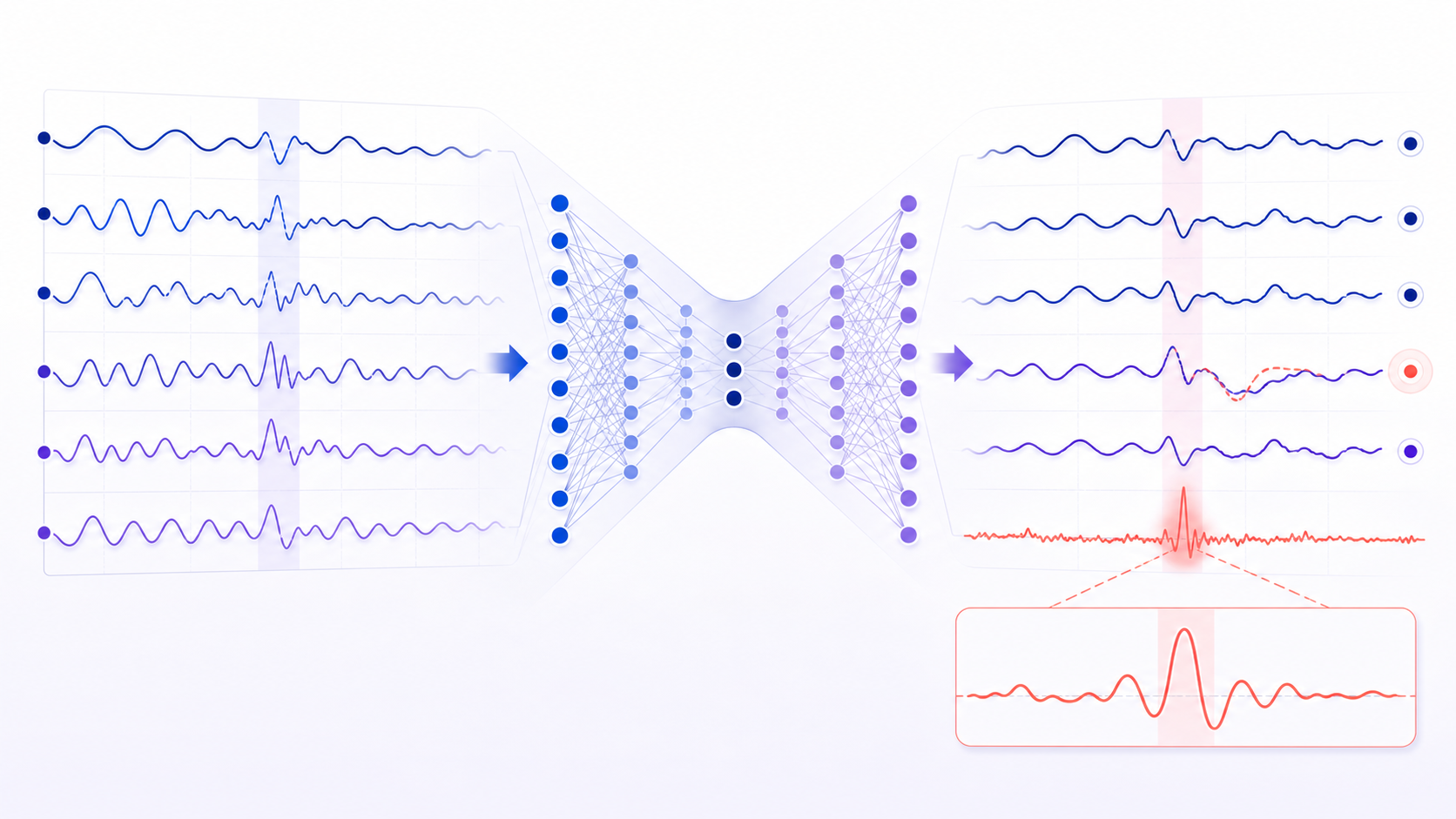
On this page本页目录
What is autoencoder anomaly detection?什么是自编码器异常检测?
For the full topic map and the neighboring methods that support this workflow, continue with the anomaly detection and root cause analysis guide.
如需查看完整主题结构以及支撑本流程的相邻方法,请继续阅读异常检测与根因分析指南。
Autoencoder anomaly detection is a reconstruction-based method that trains a neural network to reproduce representative normal inputs, then treats unusually large reconstruction errors as anomaly scores. The autoencoder is the feature learner; the thresholding and validation process turns its errors into operational alerts. On a series, put this error next to a residual score in time series anomaly detection before you treat the network as the method.
自编码器异常检测是一种基于重构的方法:训练神经网络复现有代表性的正常输入,再把异常偏大的重构误差作为异常分数。自编码器负责学习特征,阈值与验证流程则把误差转化为可执行告警。序列上先把它和 时间序列异常检测里的残差分数放在一起比,再决定是否用网络。
This method is useful when normal behavior contains nonlinear relationships that simple univariate rules cannot represent, especially in multivariate sensor, transaction, image, or sequence data. It is not proof that a sample is bad, and it is not automatically superior to Isolation Forest, PCA, robust statistics, or domain rules. A flag means “poorly reconstructed relative to the training reference,” not “root cause found.”
当正常行为包含单变量规则无法表示的非线性关系时,这种方法很有用,尤其适用于多变量传感器、交易、图像或序列数据。它不能证明样本一定有问题,也不必然优于 Isolation Forest、PCA、稳健统计或领域规则。标记只表示“相对训练参照重构较差”,不表示“已找到根因”。
How reconstruction error becomes an anomaly score重构误差如何变成异常分数
- Encode the input.编码输入。 The encoder maps an input vector or window into a lower-dimensional latent representation. A constrained bottleneck discourages trivial copying.编码器把输入向量或窗口映射为低维潜在表示;受约束的瓶颈用于避免简单复制。
- Reconstruct it.重构输入。 The decoder attempts to reproduce the original input from the latent code by minimizing a chosen loss on training data.解码器根据潜在编码复现原始输入,并在训练数据上最小化所选损失。
- Calculate an error per sample.计算逐样本误差。 Common scores aggregate absolute or squared feature residuals. Feature weighting must reflect scale, noise, and business importance.常见分数汇总各特征绝对残差或平方残差;特征权重应考虑尺度、噪声与业务重要性。
- Compare with a threshold.与阈值比较。 A sample is routed for review when its score exceeds a threshold selected on data not used to fit the network.当分数超过在独立数据上选择的阈值时,样本才进入复核流程。
score(x) = mean(|x − decoder(encoder(x))|)
That mean absolute error is one option, not a universal definition. Mean squared error emphasizes large deviations; per-feature standardized residuals make attribution easier; sequence models may aggregate per-timestep errors into point, window, or event scores. Use the same preprocessing, loss convention, and aggregation during training, validation, and inference.
平均绝对误差只是一个选项,并非通用定义。均方误差更强调大偏差;逐特征标准化残差更便于归因;序列模型可把逐时间点误差汇总为点、窗口或事件分数。训练、验证与推理必须使用相同预处理、损失定义和汇总方式。
Prepare clean reference data without leakage准备无泄漏的干净参照数据
- Define the detection unit: one row, image, timestamp, or fixed-length window. Preserve stable IDs and timestamps outside the feature matrix.定义检测单位:明确是一行、图像、时间点还是定长窗口;在特征矩阵外保留稳定 ID 与时间戳。
- Build a representative normal reference: cover legitimate regimes, seasons, devices, users, and operating ranges. Inspect known incidents and suspicious tails rather than assuming all history is clean.建立有代表性的正常参照:覆盖合法工况、季节、设备、用户与运行范围;检查已知事故和可疑尾部,不要假设全部历史都干净。
- Split before fitting transformations: use chronological splits for time series and group-aware splits when entities repeat. Fit imputation and scaling only on the training partition.先划分再拟合变换:时间序列使用时间顺序划分,实体重复时使用分组划分;插补与缩放只在训练分区拟合。
- Align feature scales: standard or robust scaling prevents a high-magnitude feature from dominating reconstruction loss. Record training statistics and reuse them at inference.对齐特征尺度:标准或稳健缩放可防止大数值特征支配重构损失;应记录训练统计量并在推理时复用。
- Document missingness: missing values can be signal, pipeline failure, or absence. Choose explicit indicators or an imputation policy rather than silently replacing them.记录缺失机制:缺失可能是信号、管道故障或真正不存在;应选择明确缺失指示或插补策略,不能静默替换。
Choose the autoencoder architecture by data structure根据数据结构选择自编码器架构
| Variant类型 | Useful for适用场景 | Main caution主要注意点 |
|---|---|---|
| Dense autoencoder全连接自编码器 | Scaled fixed-length numeric vectors and a transparent first neural baseline.已缩放的定长数值向量,以及透明的首个神经网络基线。 | Can reconstruct anomalies if capacity is excessive; weak temporal structure.容量过大时可能重构异常;无法充分表达时间结构。 |
| Convolutional autoencoder卷积自编码器 | Images or regularly sampled sequences with local patterns.图像或具有局部模式的规则采样序列。 | Window size and padding can create boundary artifacts.窗口大小与填充可能制造边界伪影。 |
| LSTM/GRU autoencoderLSTM/GRU 自编码器 | Sequences whose order and longer context are important.顺序和较长上下文重要的序列。 | Higher latency, harder tuning, and stateful preprocessing risks.延迟更高、调参更难,且有状态预处理风险。 |
| Variational autoencoder变分自编码器 | A regularized latent distribution and probabilistic extensions.需要正则化潜在分布和概率扩展的场景。 | Objective balances reconstruction and KL terms; anomaly scoring is less direct.目标需平衡重构项与 KL 项,异常评分更不直接。 |
Capacity is a detection parameter, not merely a performance setting. A wide bottleneck or powerful decoder may reconstruct both normal and anomalous inputs, collapsing score separation. Compare a small architecture, regularization, and early stopping before increasing complexity.
容量是检测参数,而不只是性能设置。过宽瓶颈或过强解码器可能同时重构正常与异常输入,使分数无法区分。增加复杂度前,应先比较小型架构、正则化与早停。
A repeatable autoencoder anomaly detection workflow可重复的自编码器异常检测流程
- Define the operational decision.定义运营决策。 Specify what happens after a flag, the review capacity, tolerated delay, and costs of missed events versus false alerts.明确标记后的动作、复核能力、允许延迟,以及漏报与误报成本。
- Establish baselines.建立基线。 Compare a domain rule, robust z-score, PCA residual, or Isolation Forest before training a neural model.训练神经模型前,比较领域规则、稳健 z 分数、PCA 残差或 Isolation Forest。
- Train on the reference partition.在参照分区训练。 Monitor training and validation reconstruction loss, stop before overfitting, and version data, transforms, code, weights, and random seeds.监控训练与验证重构损失,在过拟合前停止,并对数据、变换、代码、权重和随机种子进行版本管理。
- Score an untouched validation set.对未参与训练的验证集评分。 Retain aggregate and per-feature residuals. Plot score distributions by time, device, cohort, and operating regime.保留总残差与逐特征残差,按时间、设备、群组和工况绘制分数分布。
- Select and stress-test the threshold.选择并压力测试阈值。 Evaluate precision, recall, event overlap, alert volume, latency, and stability under small preprocessing or parameter changes.评估精确率、召回率、事件重叠、告警量、延迟,以及在轻微预处理或参数变化下的稳定性。
- Deploy a reviewable score pipeline.部署可复核的评分管道。 Log the raw input reference, model version, score, threshold, top residual features, and reviewer outcome. Monitor drift and recalibrate deliberately.记录原始输入引用、模型版本、分数、阈值、主要残差特征与复核结果;监控漂移并有计划地重新校准。
How to set an autoencoder anomaly detection threshold如何设置自编码器异常检测阈值
Threshold selection is a decision problem, not a property learned automatically by a standard autoencoder. Never choose the cutoff on the same reconstruction errors used to optimize the network, and do not assume a normal error distribution without checking it.
阈值选择是决策问题,不是标准自编码器自动学到的属性。不要在用于优化网络的同一批重构误差上选择阈值,也不要在未经检查时假设误差服从正态分布。
| Method方法 | Use when适用条件 | Tradeoff权衡 |
|---|---|---|
| Cost-based labeled threshold基于成本的有标签阈值 | Reliable validation labels and response costs exist.存在可靠验证标签和响应成本。 | Most decision-aligned, but labels may be delayed or biased.最贴近决策,但标签可能延迟或有偏。 |
| Precision-recall operating point精确率—召回率运行点 | Anomalies are rare and review capacity is constrained.异常稀少且复核能力受限。 | Explicit tradeoff; depends on representative prevalence.权衡明确,但依赖有代表性的异常比例。 |
| High normal-error quantile正常误差高分位数 | Only a clean normal validation reference is available.只有干净的正常验证参照可用。 | Simple and auditable; a chosen quantile is an assumption, not truth.简单可审计,但所选分位数只是运营假设。 |
| Extreme-value or adaptive model极值或自适应模型 | Tail behavior or regimes change and enough data exists.尾部行为或工况变化且数据充足。 | More flexible, but adds assumptions and monitoring burden.更灵活,但增加假设与监控负担。 |
A fixed example such as the 99th percentile is illustrative, not a recommendation. Report the resulting alerts per hour or per thousand records, event recall, median detection delay, and reviewer yield. If one threshold cannot serve distinct regimes, calibrate by documented group only when that grouping is legitimate, stable, and governed.
例如“第 99 百分位”只能作为说明,不能视为通用建议。应报告每小时或每千条记录告警量、事件召回率、检测延迟中位数和复核命中率。若单一阈值无法覆盖不同工况,只有在分组合法、稳定且受治理时,才可按明确分组校准。
Example: multivariate equipment anomaly detection示例:多变量设备异常检测
Consider a hypothetical fleet with temperature, vibration, pressure, and power readings sampled every minute. The team defines a 30-minute window as one detection unit, removes known maintenance periods from training, fits scaling on earlier normal weeks, and holds out later weeks for validation. A small convolutional autoencoder reconstructs each four-channel window.
假设某设备群每分钟记录温度、振动、压力与功率。团队把 30 分钟窗口定义为检测单位,从训练数据中移除已知维护时段,只在较早的正常周拟合缩放器,并保留较晚周进行验证。一个小型卷积自编码器负责重构每个四通道窗口。
For one illustrative window, the aggregate error is 0.084 while the example validation threshold is 0.052. Vibration and power residuals contribute most. Those numbers are hypothetical, not InfiniSynapse benchmarks or universal cutoffs. The flag triggers review of calibration records, work orders, operating mode, adjacent sensors, and pipeline health. If a sensor unit changed or a join duplicated values, the correct action is to repair data—not label an equipment fault.
某个说明性窗口的总误差为 0.084,而示例验证阈值为 0.052;振动与功率残差贡献最大。这些数字是假设值,并非 InfiniSynapse 基准或通用阈值。该标记会触发对校准记录、工单、运行模式、相邻传感器与管道健康状况的复核。如果传感器单位变化或连接操作复制了数值,正确动作应是修复数据,而不是判定设备故障。
Minimal TensorFlow scoring pattern最小 TensorFlow 评分模式
The code below is a methodological sketch. It assumes
X_train_normal and X_val are already
split, imputed, and scaled without leakage. Architecture, loss,
and cutoff must be validated for the actual data.
以下代码是方法示意。它假设 X_train_normal 与
X_val
已无泄漏地完成划分、插补和缩放。架构、损失与阈值必须针对真实数据验证。
import numpy as np
import tensorflow as tf

model = tf.keras.Sequential([
    tf.keras.layers.Input(shape=(n_features,)),
    tf.keras.layers.Dense(16, activation="relu"),
    tf.keras.layers.Dense(4, activation="relu"),
    tf.keras.layers.Dense(16, activation="relu"),
    tf.keras.layers.Dense(n_features)
])
model.compile(optimizer="adam", loss="mae")
model.fit(X_train_normal, X_train_normal,
          validation_split=0.2, epochs=100,
          callbacks=[tf.keras.callbacks.EarlyStopping(
              patience=8, restore_best_weights=True)])

val_recon = model.predict(X_val, verbose=0)
val_error = np.mean(np.abs(X_val - val_recon), axis=1)
threshold = np.quantile(val_error[known_normal_val], 0.99)  # example
flags = val_error > threshold
Keep the continuous error and per-feature residuals; do not save only the boolean flag. Reproduce the result from a versioned model and transformation pipeline, then evaluate the threshold on labels or reviewed events that were not used to set it.
应保留连续误差与逐特征残差,不能只保存布尔标记。结果必须能通过版本化模型与变换管道复现,再用未参与阈值设置的标签或已复核事件进行评估。
Evaluate alerts, not only reconstruction loss评估告警,而不只是重构损失
Low validation loss shows that the model reconstructs the reference data; it does not show that anomalies separate well. When point labels exist, report precision, recall, the precision-recall curve, and false alerts at the intended operating threshold. For contiguous incidents, point metrics can exaggerate success, so add event recall, time-to-detect, duplicate-alert suppression, and reviewer yield.
较低验证损失只说明模型能重构参照数据,并不能证明异常可被有效区分。有逐点标签时,应报告精确率、召回率、精确率—召回率曲线,以及目标阈值下的误报量。对于连续事故,逐点指标可能夸大效果,因此还要加入事件召回、发现时间、重复告警抑制与复核命中率。
- Slice performance: inspect devices, sites, user groups, seasons, and legitimate operating regimes to find concentrated false positives.分组检查:按设备、站点、用户群、季节与合法工况检查,寻找误报集中的分组。
- Test score stability: repeat seeds and vary bottleneck size, window length, and preprocessing. Large rank changes indicate a fragile detector.测试分数稳定性:重复随机种子并改变瓶颈大小、窗口长度与预处理;排序大幅变化说明检测器脆弱。
- Monitor input and score drift: compare feature distributions, missingness, residual patterns, alert rate, and reviewer outcomes with the validated reference.监控输入与分数漂移:把特征分布、缺失率、残差模式、告警率和复核结果与已验证参照比较。
- Use safe rollouts: begin in shadow mode, review alerts, set rollback criteria, and keep a fallback rule or previous model.安全上线:先影子运行、复核告警、设置回滚标准,并保留备用规则或上一版本模型。
Why autoencoder anomaly detection can fail自编码器异常检测为何会失效
Bottom line: Autoencoder anomaly detection flags high reconstruction error. That error is not proof. Reconstruction can fit out-of-distribution points, especially with linear autoencoders — see Bouman et al., Autoencoders for Anomaly Detection are Unreliable (2025). Treat residuals as a review priority, not a cause.
结论:自编码器异常检测用高重构误差打分。误差不是证明。重构仍可能拟合分布外点,线性自编码器更明显——见 Bouman 等 2025 年论文。残差只决定复核优先级,不是因果。
On a series, compare this score with a residual detector on time series anomaly detection. Tabular fraud uses the same error logic; a credit-card notebook is not a second page. Rare-event screening still starts on how to find outliers.
时间序列应把该分数与 时间序列异常检测 的残差检测对照。表格欺诈用同一套误差逻辑,不必另开信用卡 notebook。稀有事件筛查仍从 如何查找异常值 开始。
Common failure modes and troubleshooting常见失败模式与排查方法
Reduce capacity, strengthen regularization, clean contamination, or compare discriminative baselines. Memorization destroys score contrast.
降低容量、加强正则、清理污染,或比较判别式基线。记忆会破坏分数差异。
Check scaling, units, skew, noise, missingness, and loss weighting before changing the network.
更改网络前先检查缩放、单位、偏态、噪声、缺失与损失权重。
Investigate schema changes, preprocessing parity, drift, new regimes, and clock or window alignment.
调查模式变更、预处理一致性、漂移、新工况以及时钟或窗口对齐。
Audit leakage, duplicated entities, future information, threshold tuning on test labels, and incident overlap across splits.
审计泄漏、重复实体、未来信息、利用测试标签调阈值,以及事故跨分区重叠。
Reconstruction methods can also show the “generalization paradox”: a model may reconstruct an unseen anomaly well because it shares simple structure with normal data. Conversely, a rare but legitimate operating regime may reconstruct poorly. Treat residuals as evidence for prioritization, not a causal explanation or automated punishment.
重构方法还可能出现“泛化悖论”:未见异常因与正常数据共享简单结构而被良好重构;相反,罕见但合法的工况可能重构较差。残差应作为确定调查优先级的证据,而不是因果解释或自动处罚依据。
Investigate reviewed anomaly flags with connected evidence结合关联证据调查已复核异常标记
Before opening the app, prepare stable record IDs, timestamps, raw and transformed values, model version, reconstruction score, threshold, top residual features, review status, and relevant database or document context. InfiniSynapse supports AI-assisted joint analysis across connected databases, files, and documents; this page does not represent it as a built-in autoencoder trainer. Use it after scoring to examine reviewed flags alongside maintenance records, events, metrics, and other evidence, then verify conclusions before acting.
打开应用前,请准备稳定记录 ID、时间戳、原始与变换后数值、模型版本、重构分数、阈值、主要残差特征、复核状态,以及相关数据库或文档上下文。InfiniSynapse 支持跨已连接数据库、文件和文档的 AI 辅助联合分析;本页不把它描述成内置自编码器训练器。完成评分后,可用它把已复核标记与维护记录、事件、指标及其他证据一起调查,并在采取行动前验证结论。
Open InfiniSynapse for connected data analysis打开 InfiniSynapse 进行关联数据分析Frequently asked questions常见问题
What is autoencoder anomaly detection?什么是自编码器异常检测?
Autoencoder anomaly detection trains on representative normals, then flags samples whose reconstruction error exceeds a holdout threshold. A prompt is not a close. Error can still rebuild outliers — then review.
自编码器异常检测在有代表性的正常样本上训练,再把重构误差超过验证集阈值的样本标出来。一条提示词不是结案。误差仍可能重构异常,必须复核。
How does an autoencoder detect anomalies?自编码器如何检测异常?
An autoencoder learns to reconstruct representative normal inputs. At inference time, a reconstruction error is calculated for each sample; errors above a validated threshold are flagged for review as possible anomalies.
自编码器学习重构有代表性的正常输入。推理时为每个样本计算重构误差;超过已验证阈值的样本会被标记为潜在异常并进入复核。
How should I set the reconstruction-error threshold?应该如何设置重构误差阈值?
Choose the threshold on a separate validation set using labeled operating costs when labels exist, or a documented high quantile of clean normal errors when they do not. Recheck precision, recall, alert volume, and stability after deployment.
应在独立验证集上选择阈值:有标签时结合运营成本;无标签时可使用干净正常误差的已记录高分位数。部署后重新检查精确率、召回率、告警量与稳定性。
Should an autoencoder be trained only on normal data?自编码器是否应只用正常数据训练?
Prefer a representative, mostly clean normal training set when the objective is one-class anomaly detection. If anomalies contaminate training data, the model may learn to reconstruct them; robust training and contamination checks become necessary.
当目标是一类异常检测时,应优先使用有代表性且大体干净的正常训练集。若异常污染训练数据,模型可能学会重构它们,因此必须使用稳健训练与污染检查。
Official sources and verification notes官方来源与验证说明
- TensorFlow introduction to autoencoders—official reconstruction-error tutorial and implementation reference.
- Bouman et al., Autoencoders for Anomaly Detection are Unreliable (arXiv:2501.13864)—why reconstruction loss can fit out-of-distribution points. We do not reprint the proofs.
- Keras time-series anomaly detection example—official example of windowing and convolutional reconstruction.
- scikit-learn precision and recall documentation—official definitions for alert evaluation metrics.
- TensorFlow 自编码器入门教程——官方重构误差教程与实现参考。
- Bouman 等,Autoencoders for Anomaly Detection are Unreliable(arXiv:2501.13864)——说明重构损失仍可能拟合分布外点。本文不重印证明。
- Keras 时间序列异常检测示例——官方时间窗口与卷积重构示例。
- scikit-learn 精确率与召回率文档——告警评估指标的官方定义。
Library defaults, APIs, and product capabilities can change. Confirm current official documentation before implementation. Every numeric value in the worked example is hypothetical; no product performance result or universal cutoff is claimed.
库默认值、API 与产品能力可能变化,实施前应核对最新官方文档。示例中的所有数字均为假设值;本文不主张任何产品性能结果或通用阈值。