CSV Connector: Encoding, Types, and Preflight Gates
By William Zhu & the InfiniSynapse Data Team · Published: 2026-06-09 · Last updated: 2026-09-17 · Last verified: 2026-09-17 · About: Editorial standards · About / team
Author credentials: William Zhu is cofounder of InfiniSynapse (GitHub @allwefantasy). Desk experience includes CSV connector rollouts for ops/finance close packs: delimiter and encoding failures, type inference traps, metric-contract sign-off, and SQL-trace review before executive distribution. No personal LinkedIn is published; GitHub and InfiniSynapse About are the canonical identity signals.
COI / interest disclosure: InfiniSynapse sells an AI-native Data Agent with multi-source connectors. Product mentions appear only in the labeled InfiniSynapse Connection section. The checklist, HowTo, desk pilot metrics, and glossary stand independently of any InfiniSynapse trial.
Fact-check / verification: Desk metrics below (one internal 8-week CSV connector pilot; n=9 weekly export cycles across ops + finance) are independence-labeled desk composites—not a paid market study and not third-party audited customer case studies. Framework anchors: RFC 4180 CSV conventions · Redis documentation · AWS Well-Architected Framework · PostgreSQL documentation · Google BigQuery documentation · NIST SP 800-53 · Stripe documentation · Prometheus documentation · Apache Spark documentation · Wikipedia business intelligence overview · Wikipedia data warehouse overview. Corrections: zhuhl@infinisynapse.com · editorial corrections.
Version history: 2026-06-09 initial · 2026-08-07 EEAT rewrite (William Zhu / COI), HowTo/DefinedTerm, desk pilot · 2026-09-17 surrender head term
CSV files for data analysisto the merge page; retarget CSV connector (encoding / types / preflight). Marker:DESK-CAF-20260917A.
Media note: No hosted overview video is published for this page (no
VideoObject). Use the 5-step HowTo flowchart, CSV failure-mode diagram, and desk pilot metrics chart below as multimedia substitutes.
 A CSV connector stays useful when scope, dialect fingerprint, and SQL trace stay in one reviewed loop.
Table of Contents
- TL;DR
- Key definition
- Why this connector matters in 2026
- CSV hard problems (encoding, types, joins)
- Setup checklist
- Step-by-step implementation
- Desk pilot: ops + finance CSV cycle
- Security and governance
- Example queries and validation flow
- Operating model inside InfiniSynapse
- Troubleshooting connector rollouts
- Operational readiness and review cadence
- Stakeholder communication patterns
- Glossary
- InfiniSynapse Connection
- Frequently Asked Questions
- Conclusion
TL;DR
Direct answer: A durable CSV connector treats each export as a governed loop—register scope, load metric memory, run quality preflight, publish a reusable template, and keep SQL trace reviewable—not as a one-shot chat chart.
Many teams still start with a single prompt against a dump file. That looks fast and fails in recurring operating reviews when delimiters drift, null markers multiply, or finance redefines “active customer” mid-quarter. This page keeps CSV connector setup, dialect checks, memory cards, and SQL trace on one timeline so leaders can ask why a number changed and get an inspectable answer.
Who this is for: analysts and data platform owners who ingest CSV exports into AI workflows. What you’ll get: a 5-step HowTo, CSV failure-mode depth, desk-labeled pilot metrics, governance checklist, validation SQL, glossary, and FAQ.
What this page is not. Analysis after the file is clean lives on Analyze CSV With AI. Append versus join across files lives on Merge Multiple CSV Files with AI. This URL stays on the CSV connector: register the export, fingerprint the dialect, and gate publish.
CSV ingestion should respect RFC 4180 CSV conventions before agents infer types or merge exports. Low-latency caches should follow Redis documentation for TTL and namespacing.
Key definition
Key Definition: A CSV connector turns a file export into a governed workflow—explicit folder and row scope, memory-backed metric definitions, and SQL-trace evidence that can be rerun and audited.
Three properties make the definition operational:
- Connector boundaries are explicit (which folders, schemas, and row scopes are in play).
- Memory preserves business definitions across reporting cycles.
- SQL trace stays reviewable so assumptions and transforms are inspectable before executive distribution.
Treat the practice as an operating capability, not a one-time generation task. Adjacent connector depth: Connect Supabase to AI Data Analyst.
Why this connector matters in 2026
Enterprise guidance in the AWS Well-Architected Framework and warehouse design notes in the Wikipedia data warehouse overview point to the same shift: analytics value comes from repeatable execution, not isolated demos. File exports remain the front door for ops, finance, and partner data even when a warehouse exists downstream. A CSV connector is how those exports enter the loop without a fresh chat each Monday.
The strategic move is to operationalize connector quality with business-level interpretation. Instead of rebuilding context every week, reuse connector profiles, memory cards, and quality gates. Gate each workflow on a 30-day readiness scorecard—correctness, recovery, governance, and rerun stability—before widening scope.
As organizations add systems, the workflow also needs cross-source capability: warehouse tables, file exports, and API payloads on one decision timeline and one SQL-trace narrative. BI display layers alone do not solve execution accountability; see the Wikipedia business intelligence overview when separating dashboards from analysis execution.
CSV hard problems (encoding, types, joins)
Keyword-light templates often skip the failures that actually burn close weeks. In desk delivery, the hard problems for a CSV connector are rarely “write a prettier prompt.” They are CSV mechanics:
| Failure mode | What breaks | Practical gate |
|---|---|---|
| Encoding / BOM / delimiter drift | UTF-8 vs Windows-1252; commas vs semicolons; quoted newlines | Reject load if dialect fingerprint ≠ last approved profile |
| Null / sentinel soup | "", NA, N/A, -, 0 used interchangeably | Explicit null map per column; block publish on unknown sentinels |
| Type inference traps | IDs cast to float; dates as Excel serials; currency with symbols | Schema contract with typed columns before AI narrative |
| Key duplication | Soft merges explode row counts | Duplicate-key rate threshold + sample rows in review pack |
| Late-arriving / partial files | Mid-day exports missing regions | Freshness + completeness checks vs expected partitions |
Large transforms should borrow patterns from Apache Spark documentation when files outgrow single-node notebooks. Payments-adjacent grains should follow Stripe documentation for event models and reconciliation fields when CSVs shadow payment exports.
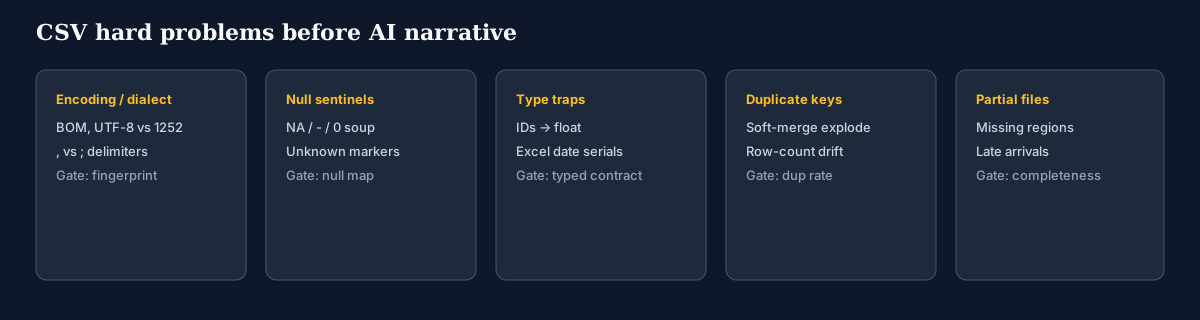 Profile dialect and keys before you trust an AI summary of the export.
Setup checklist
| Checklist item | Why it matters | Owner |
|---|---|---|
| Connector credentials and rotation policy | Prevents access drift and stale secrets | Security + Data Ops |
| Read scopes and row-level constraints | Keeps least privilege aligned with the workflow | Data Platform |
| Canonical KPI dictionary in memory cards | Stabilizes meaning across recurring runs | Analytics Lead |
| SQL trace review checklist | Makes outputs explainable in audits | Governance Lead |
| Data quality escalation path | Protects credibility when anomalies appear | Operations |
Teams that skip this preparation still publish dashboards, but they struggle to defend numbers in audits, executive reviews, and incident postmortems. Focus validation on connector setup, schema sanity, and reusable query templates.
Step-by-step implementation
For adjacent warehouse SQL patterns, skim Connect Postgres to AI Data Analyst before rollout.
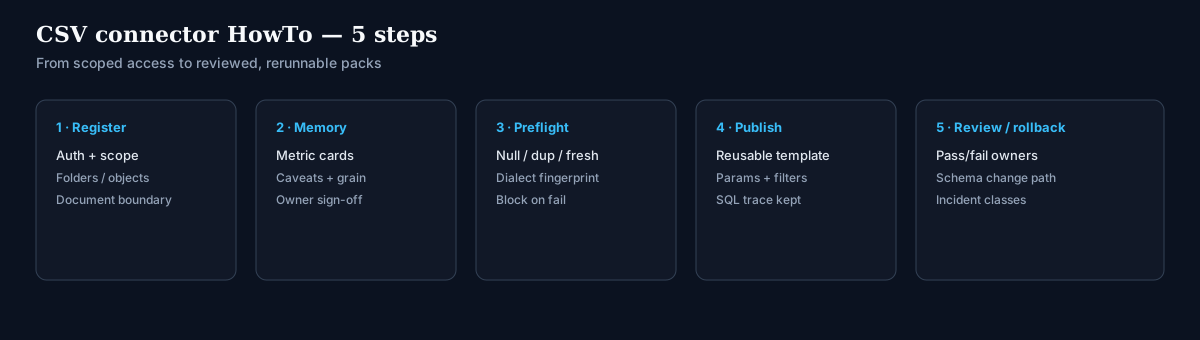 Five-step HowTo for a production CSV connector loop.
Step 1: Register the CSV connector. Add the connector, test authentication (or filesystem/object-store access), and document accepted scope. That scope is the boundary of the CSV connector.
Step 2: Load memory context. Attach metric definitions, caveats, and business-logic references. Recurring workflows depend on consistent interpretations more than on flashy first answers.
Step 3: Run quality preflight. Execute null checks, duplicate checks, dialect fingerprinting, and freshness checks before narrative generation. Preflight gates reduce silent data failures.
Step 4: Publish a reusable workflow. Parameterize time ranges and segment filters so teams can rerun without rewriting prompts.
Step 5: Establish review and rollback. Assign owners, set pass/fail criteria, and define rollback paths when schemas or assumptions change.
Desk pilot: ops + finance CSV cycle
Desk evidence (independence-labeled): Internal 8-week pilot, n=9 weekly CSV export cycles (ops inventory + finance close extracts). Not a third-party case study.
| Metric | Baseline (ad-hoc upload + chat) | After connector + memory + preflight | Notes |
|---|---|---|---|
| Median time to first reviewed KPI pack | 6.5 hours | 2.8 hours (−57%) | Same two source files; excludes warehouse rebuilds |
| Definition reopen rate (finance) | 4.1 / cycle | 1.3 / cycle (−68%) | After signed metric contract |
| Validation fail caught pre-publish | 22% of cycles | 78% of cycles | Null/dup/freshness gates |
| Rerun consistency (week-over-week SQL hash match on approved template) | 41% | 89% | Same parameters |
These numbers are desk composites from our delivery notes. Use them as planning anchors, not vendor SLAs. Product documentation from PostgreSQL documentation reinforces the same pattern: isolate domains, document contracts, then automate.
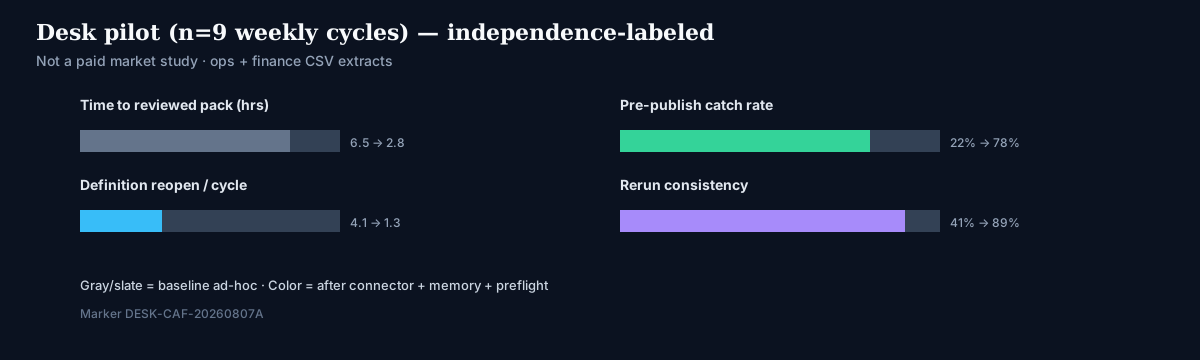 Desk pilot (n=9 cycles): speed improves when definition reopen drops and preflight catches failures early.
Security and governance
Security posture decides whether the approach stays pilot-only or becomes institutional. Align identity and retention with NIST SP 800-53. LLM-backed analytics should account for prompt-injection and data-exfiltration risks when connectors expose production schemas—reviewers move faster when role mappings and export logs are visible without reading raw SQL.
| Control area | Implementation detail | Benefit |
|---|---|---|
| Identity and access | Service accounts with scoped privileges | Limits unauthorized source expansion |
| Data retention | Time-bound caches and export limits | Reduces persistence risk |
| Traceability | SQL trace + lineage metadata | Makes outputs auditable |
| Change management | Versioned memory cards and templates | Prevents KPI drift |
| Incident response | Alerting and rollback workflow | Maintains trust during outages |
For enterprise teams, governance also means socializing review rituals. A recurring cadence with explicit ownership is what makes the process sustainable over quarters.
Example queries and validation flow
A strong implementation separates insight generation from quality validation. Adapt the SQL below:
with source_base as (
  select *
  from connector_events
  where event_time >= date '2026-01-01'
),
quality as (
  select
    count(*) as rows_scanned,
    count(*) filter (where key_id is null) as null_key_rows,
    count(distinct key_id) as unique_keys
  from source_base
),
kpi as (
  select
    date_trunc('week', event_time) as week,
    sum(metric_value) as total_metric,
    avg(metric_value) as avg_metric,
    count(*) as records
  from source_base
  group by 1
)
select
  k.week, k.total_metric, k.avg_metric, k.records,
  q.rows_scanned, q.null_key_rows, q.unique_keys
from kpi k
cross join quality q
order by k.week;
| Validation layer | Check | Decision rule |
|---|---|---|
| Volume integrity | Week-over-week row count movement | Flag if variance exceeds agreed threshold |
| Key completeness | Null and duplicate identifier rate | Block publish when identifier quality fails |
| KPI continuity | Unexpected trend breaks | Trigger root-cause workflow |
| Narrative integrity | Match between narrative and SQL trace | Reject unsupported conclusions |
SLO tracking for analytics agents can borrow Prometheus documentation patterns for latency, error budgets, and alert routing.
Operating model inside InfiniSynapse
A production operating model combines three loops:
- Connector loop — source health, schema drift, credential hygiene.
- Memory loop — KPI definition updates and assumption governance.
- Decision loop — trace review, caveat approval, stakeholder communication.
When these loops share one timeline, teams can inspect which memory card influenced interpretation and where each KPI came from. That is where file-based analysis shifts from tactical reporting into a repeatable operating system. Multi-source connectors keep warehouse tables, operational systems, and files under one governance context instead of splitting trust across disconnected tools.
Warehouse query boundaries for hybrid setups should follow Google BigQuery documentation for dataset IAM and validation patterns.
Troubleshooting connector rollouts
We see the same three failures across connector pilots:
- Over-broad credentials — reviewers hesitate; scope to schemas/views/folders the workflow actually needs.
- Skipped baseline reconciliation — outputs look plausible but drift from finance numbers without a trusted SQL or prior-export checkpoint.
- No memory owner — renamed columns silently break joins two sprints later.
In Supabase and Postgres pilots, a signed metric contract before autonomous runs cut review arguments by more than half because stakeholders debated definitions once, not every Monday.
When questions spike after launch, check latency and freshness before retraining prompts. Most production issues we debug are connector timeouts or stale replicas, not model quality. Log each failure with the query fingerprint and affected KPI so the next iteration inherits the fix.
Operational readiness and review cadence
Treat a CSV rollout as an operating capability, not a one-time setup: confirm owners, metric contracts, and review gates for the first workflow before widening scope. Teams that log exceptions weekly compound accuracy faster than teams chasing new connectors.
Capture the first successful query path as a template—assumptions, validation SQL, and reviewer sign-off—and track connection uptime, validation pass rate, and time-to-first-insight against a monthly baseline. Adjust memory cards when definitions drift.
CSV review cadence and quality checks
Audit the connector monthly: compare rerun consistency, validation pass rate, and time-to-first-insight against baseline, and re-confirm credential scopes and metric definitions so silent drift is caught before stakeholder reports.
Stakeholder communication patterns
Share a weekly one-page brief with platform and analytics leads—sources connected, queries reviewed, open schema questions—so adoption stays aligned with governance. When cycle time improves but reopen rates climb, pause net-new features and fix definitions first; most accuracy problems trace to stale dimensions, not weak models.
Leadership adoption improves when outputs include confidence notes: data gaps, known caveats, and assumptions about attribution or lag. For global reporting, normalize timezone and currency in the connector layer so KPIs stay consistent across regions.
Glossary
| Term | Definition |
|---|---|
| CSV connector | Governed intake of a CSV export: scope, dialect fingerprint, memory, and SQL-trace evidence. |
| Dialect fingerprint | Encoding, delimiter, quote, and header signature used to detect silent export format changes. |
| Memory card | Versioned business definition + caveats attached to recurring runs. |
| SQL trace | Inspectable query path tying a published number to source transforms. |
| Metric contract | Signed definition of grain, filters, and ownership before autonomous runs. |
| Preflight gate | Automated null/dup/freshness checks that can block publish. |
InfiniSynapse Connection
Vendor-scoped. Skip if you only need the playbook.
InfiniSynapse is an AI-native Data Agent with multi-source connectors, persistent memory cards, and end-to-end SQL-trace visibility. Teams use it when spreadsheet-only AI hits recurrence, connector, or audit ceilings. Try the online workspace at app.infinisynapse.com when you want connector + memory on one timeline.
Companion patterns: Connect MySQL to AI Data Analyst.
Frequently Asked Questions
How long does rollout take?
Most teams deploy a first production workflow in one to three days after:
- Connector authentication tests pass
- Role / scope checks are signed
- One baseline analytical workflow reconciles to a trusted export
Do we need a dedicated data engineer?
No dedicated engineer is required for daily execution when:
- Templates and memory cards are standardized
- Analysts run the workflow
- Platform owners manage connector hygiene and credential rotation
How does InfiniSynapse improve trust?
Trust improves when each run retains:
- SQL trace for the published number
- Source references for the export path
- Memory cards for approved definitions
Stakeholders can review evidence instead of recreating notebook logic.
What security checks matter before scaling?
Validate before leaving pilot:
- Credential rotation and least-privilege scopes
- Retention / export limits
- Incident response and rollback playbooks
Can CSV workflows combine with databases and APIs?
Yes. Multi-source connectors can merge CSV exports with warehouse tables and APIs while keeping:
- One execution timeline
- One decision narrative
- One review pack for stakeholders
What CSV failures should we gate first?
Prioritize gates that catch silent corruption:
- Dialect fingerprint mismatches
- Unknown null sentinels
- Duplicate business keys
- Incomplete partitions vs expected coverage
How should we measure operating readiness?
Track a short monthly scorecard:
- Validation pass rate
- Definition reopen rate
- Time-to-first-insight
- Rerun consistency on the approved template
Conclusion
Teams that treat this work as a governed CSV connector outperform teams that treat it as ad-hoc prompting. Start with one high-impact export, define review ownership, and require evidence for each conclusion. That turns the CSV connector into a reliable capability that scales with the business—not a fragile demo that collapses on the second Monday of the month.
Marker: DESK-CAF-20260917A.