AI-Assisted Query Generation for SQL and Python in Social Science Data Analysis
- AI-assisted query generation drafts SQL and Python from a researcher description; the researcher reviews and runs it. Speeds up the typing, not the thinking.
- For social science data analysis, the most useful pattern is paired prompts — describe the variable definition first, then the analysis question — so the generated code aligns with the operationalization.
- On public benchmarks (BIRD, Spider) AI text-to-SQL accuracy improves quickly but still trails an experienced analyst on real schemas without retrieval and verification.
- For research the bigger issue is reproducibility — the prompt, the generated code, the data version, and the verification step all belong in the replication package.
- AI query generation works best inside a data agent loop that retrieves a codebook, plans, runs, verifies, and outputs a citation-ready evidence trail.
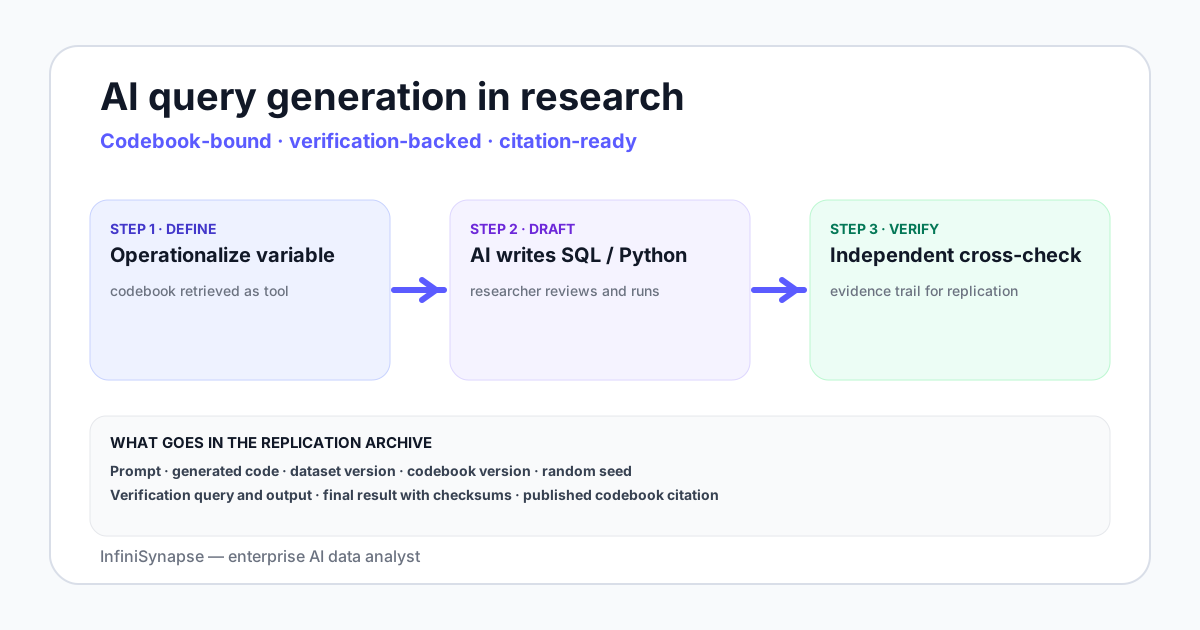
How the research workflow shifts when AI drafts the query
Three places the workflow changes:
- Variable operationalization. The researcher writes a description (Income = wage income from the past 12 months, excluding investment); the AI proposes a code construction. The review is where domain knowledge concentrates.
- Code drafting. The AI types the SQL or Python faster than the researcher; the time savings are real on routine recoding work.
- Replication packaging. The agent emits a citation-ready trail — prompt, generated code, dataset version, output checksums — that goes into the replication archive.
The thinking work — picking the variable, defending the operationalization, defending the inference — stays with the researcher.
AI-generated SQL on research datasets
Research datasets typically live in survey-flavored relational schemas (NLSY, GSS, ANES, IPUMS extracts) or in administrative tables with painful variable names. Three patterns where AI SQL helps researchers most:
-- 1. Codebook-aware recoding
-- "Recode income brackets into quintiles for individuals aged 25-64
--  who completed the panel wave"
WITH base AS (
  SELECT respondent_id,
         CASE income_bracket
           WHEN 1 THEN 5000 WHEN 2 THEN 15000 WHEN 3 THEN 30000
           WHEN 4 THEN 50000 WHEN 5 THEN 75000 WHEN 6 THEN 100000
           WHEN 7 THEN 150000 ELSE NULL END AS income_estimate
  FROM survey_panel
  WHERE age BETWEEN 25 AND 64
    AND panel_status = 'complete'
)
SELECT respondent_id, income_estimate,
       NTILE(5) OVER (ORDER BY income_estimate ASC NULLS LAST) AS income_quintile
FROM base;
The AI gets the CASE map and the NTILE shape correct from the prompt. The researcher checks the bracket midpoints against the codebook before trusting the recoding.
AI-generated Python for analysis pipelines
For deeper modeling — regression, propensity score matching, causal inference — Python is still the workhorse. AI is most useful for the boilerplate around the model:
- Data loading and cleaning. Pandas merges, type coercions, missing-value handling.
- Variable construction. The recodes that turn raw survey responses into analytical variables.
- Diagnostic plots. Distribution checks, balance tables, residual plots.
The model specification itself — choice of covariates, identification assumption, robustness checks — remains the researcher's responsibility. Code can be drafted by AI; defending the inference is not delegable.
Where AI query generation falls short for social science
| Limit | What happens | Mitigation |
|---|---|---|
| Operationalization drift | AI invents a plausible-looking variable definition that does not match the codebook | Bind the codebook as a retrieved tool; review the operationalization explicitly |
| Survey weights ignored | AI produces unweighted estimates by default | Always specify the weight variable in the prompt; verify against published estimates |
| Missing-value handling | AI silently drops NAs or codes them as zero | Demand explicit missing-value handling in the generated code |
| Reproducibility gap | Chat-based AI tools do not version the prompt with the output | Use a data agent that emits a citation-ready trail |
Audit and reproducibility for research
The replication crisis literature taught research communities that "we ran some code and got this number" is not enough. The replication package needs the dataset version, the code that ran, the random seed, and the output. AI-generated code adds two elements:
- The prompt. The natural-language description used to generate the code.
- The verification step. An independent recoding or aggregation that cross-checks the result.
Both go into the replication archive alongside the data and the code. See explainable AI data analysis for the deeper framing and database + knowledge base binding for codebook integration.
A practice rubric for researchers using AI for query generation
- Define the variable before the question. Write a one-paragraph operationalization; have the AI generate code that matches it.
- Always pass the survey weight. Explicit in the prompt, verified in the output.
- Demand explicit missing handling. NAs are not the AI's call.
- Run a verification query. A second independent recoding or aggregation cross-checks the main one.
- Save the prompt with the code. The prompt is part of the replication artifact, not metadata.
- Cite the codebook version. Codebooks change between waves; the version is part of the result.
Try a research data agent that emits a citation-ready trail
Connect a Postgres or warehouse where your research dataset lives. Bind the codebook as a knowledge base. Ask one operationalization-bound question and watch the plan, SQL, verification step, and source list come back together — ready for the replication archive.
Try InfiniSynapse onlineFAQ
Methodology and review notes
Last updated: 2026-06-28 · Next scheduled review: 2026-09-28
This research guide synthesizes public benchmarks for natural-language-to-code on BIRD and Spider, Anthropic agent research and the ReAct paper, ICPSR research data infrastructure documentation, replication crisis literature, and field experience with research and policy teams using AI for data work. The practice rubric reflects observed mistakes and mitigations rather than vendor positioning.
Conflict of interest: InfiniSynapse publishes this guide and sells an enterprise AI data analyst. To reduce bias, the page leads with the topic itself, treats InfiniSynapse as one option among many, and links to external sources for every numeric claim.
Update cadence: Reviewed every 90 days for accuracy and link health.
Sources and references
- [Independent] BIRD-SQL benchmark. bird-bench.github.io.
- [Independent] Yu et al. Spider benchmark. yale-lily.github.io/spider.
- [Vendor] ICPSR. Data citation and replication standards. icpsr.umich.edu.
- [Vendor] Anthropic. Building Effective Agents. anthropic.com/research/building-effective-agents.
- [Independent] Yao et al. ReAct paper. arxiv.org/abs/2210.03629.
- [Standard] NIST. AI Risk Management Framework. nist.gov/itl/ai-risk-management-framework.