What Is a Data Analyst? The Role Defined for 2026
By the InfiniSynapse Data Team · Last updated: 2026-07-08 · We build an AI-native data analysis platform and work with analysts daily; this definition reflects the role as it actually exists in 2026, not a dictionary entry.
Table of Contents
- TL;DR
- The Precise Definition
- Where the Role Sits
- What Distinguishes the Role
- Data Analyst vs Adjacent Roles
- Why the Role Exists
- How AI Is Redefining the Role
- The Role in a Modern Data Team
- How the Role Evolves
- Role Scorecard
- Common Misconceptions
- Frequently Asked Questions
- Conclusion
TL;DR
Direct answer: what is a data analyst? A data analyst is a professional who collects, cleans, analyzes, and communicates data to help an organization make better decisions. They sit closest to the business question among data roles, focusing on what happened and why, and translating messy data into clear, actionable insight.
Who this is for: anyone asking what is a data analyst before entering the field, hiring one, or working alongside one.
What you'll learn: a precise definition, where the role sits among data jobs, what distinguishes it, why it exists, and how AI is redefining it in 2026.
This guide sits under the data analyst career hub; for the day-to-day view, see what does a data analyst do.
The Precise Definition
The clearest way to answer what is a data analyst is with a precise definition rather than a vague gesture at "someone who works with data." Many roles touch data; the analyst has a specific job within that broad space, and pinning it down helps both aspiring analysts and the teams who hire them set accurate expectations for the work.
Key Definition: what is a data analyst, precisely? A data analyst is a professional who collects, cleans, analyzes, and communicates data so that an organization can make better-informed decisions, translating raw numbers into clear, actionable insight for the people who will act on it.
Understanding what is a data analyst means seeing that the role is defined by its purpose, not its tools. An analyst might use SQL, spreadsheets, a visualization platform, or an AI-native agent, but the constant is the goal: turning data into decisions. This purpose-first definition, grounded in the disciplined process described in the Wikipedia data analysis overview, is what makes the role coherent across the many industries and toolsets in which it appears. Warehouse-grounded analytics should align with Databricks documentation on SQL warehouses and data governance.
Where the Role Sits
To fully answer what is a data analyst, it helps to place the role on the map of data jobs. On one side sits the data engineer, who builds the pipelines and infrastructure that move and store data. On the other sits the data scientist, who builds predictive models and applies advanced statistics and machine learning. The analyst sits in the middle, closest to the business question, working with data that engineers have made available to answer questions that inform decisions.
This positioning is central to what is a data analyst. The role is the bridge between raw data and human decisions, which is why communication matters as much as technical skill. An analyst who can query a database but cannot explain the result to a product manager has done only half the job. We draw the boundaries with adjacent roles in detail in data analyst vs data scientist, a distinction that frequently confuses newcomers deciding which path to pursue.
What Distinguishes the Role
Several characteristics distinguish what is a data analyst from other data-adjacent work. The first is proximity to the decision: analysts work on questions whose answers directly inform choices, often on short timelines, rather than on long-horizon research or infrastructure. The second is the breadth of the workflow, since an analyst typically owns the whole cycle from gathering data through communicating the result, rather than specializing in one narrow slice.
The third distinguishing feature in what is a data analyst is the weight placed on communication. Unlike roles where the output is code or a model, the analyst's output is often an explanation that changes what someone does next. This makes clarity, judgment, and the ability to frame a question central to the role rather than peripheral. These traits explain why strong analysts are valued well beyond their technical skills, and why the role rewards people who genuinely enjoy translating complexity into clarity for others.
Data Analyst vs Adjacent Roles
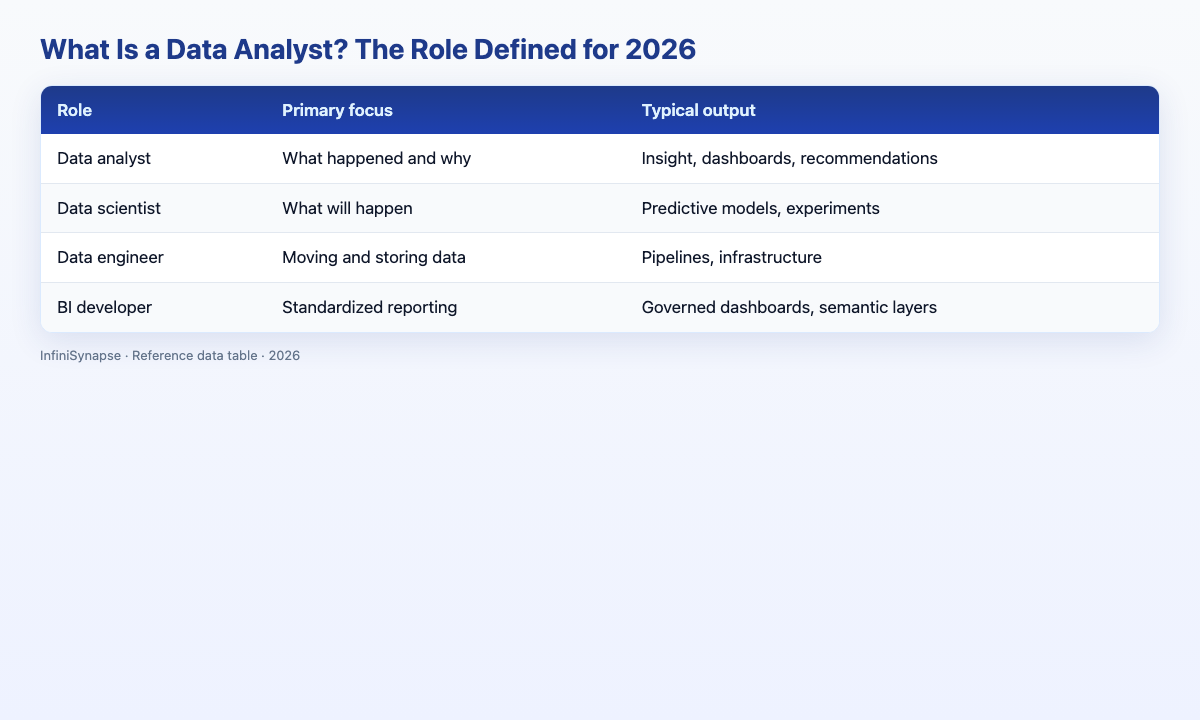
A concise comparison sharpens what is a data analyst by contrast:
| Role | Primary focus | Typical output |
|---|---|---|
| Data analyst | What happened and why | Insight, dashboards, recommendations |
| Data scientist | What will happen | Predictive models, experiments |
| Data engineer | Moving and storing data | Pipelines, infrastructure |
| BI developer | Standardized reporting | Governed dashboards, semantic layers |
Seeing what is a data analyst beside these roles clarifies both overlaps and boundaries. Analysts share tools with each neighbor—SQL with engineers, statistics with scientists, dashboards with BI developers—but their center of gravity is the immediate business question. Many careers move between these roles over time, and the boundaries blur in smaller organizations where one person wears several hats, but the definitional core of the analyst remains turning data into decisions. The move toward augmented workflows, outlined in IBM's augmented analytics overview, frames how teams evaluate modern tooling.
Why the Role Exists
Answering what is a data analyst also means understanding why organizations need the role at all. Every organization now collects far more data than any individual can interpret unaided, and raw data by itself changes nothing. The analyst exists to close the gap between having data and understanding it, converting an overwhelming volume of numbers into a small number of clear, decision-ready insights.
This is why what is a data analyst is ultimately an economic question as much as a technical one. The role creates value by improving decisions, and its worth is measured by the quality of the choices it enables rather than by the volume of queries it runs. Organizations that understand this hire analysts as decision partners, not as query-writing services, which is also why the communication half of the role is so consequential to its impact and its perceived value.
How AI Is Redefining the Role
The most significant 2026 development in what is a data analyst is the arrival of AI-native tools that automate the mechanical portions of the work. When cleaning and routine querying can be delegated to an agent, the definition of the role shifts toward the judgment and communication that machines cannot replicate, sharpening rather than erasing the analyst's purpose.
InfiniSynapse illustrates this redefinition. It is not an NLP2SQL box or a ChatBI widget but a system that behaves like a professional data analyst, connecting to sources with one-click authorization and running multi-step analysis through InfiniSQL. In practice, this means the human analyst spends less time on preparation and more on framing questions, validating results, and communicating insight, which is precisely the core of what is a data analyst. We explore this shift in what AI-native data analysis means, and the Stanford HAI AI Index documents how broadly this automation is reshaping knowledge work. The definition endures; the balance of time within it moves toward judgment.
The Role in a Modern Data Team
Seeing what is a data analyst inside a real team clarifies the definition further. On a typical data team, the analyst is the member who fields questions from the rest of the business, translates them into analyses, and returns answers that others can act on. Engineers keep the data flowing and scientists build models, but the analyst is usually the first point of contact when a product manager, marketer, or executive needs to understand something, which places the role at a busy intersection of technical work and human communication.
This central position shapes what is a data analyst in practice. Because the analyst sits between the data and the decision-makers, the role demands both the technical ability to get a correct answer and the interpersonal ability to deliver it persuasively. An analyst who produces a flawless query but cannot explain its meaning has not finished the job, and one who communicates beautifully but misreads the data is worse than useless. The best answer to what is a data analyst therefore describes a hybrid role, and the people who excel at it are comfortable on both sides of that divide, moving fluidly between a database and a boardroom. Enterprise adoption patterns in Google Cloud's AI overview mirror the shift from pilots to governed analytics.
How the Role Evolves
Understanding what is a data analyst also means seeing how the role evolves over a career. Early on, the work is largely execution: running defined analyses and building dashboards under guidance. As an analyst grows, what is a data analyst expands to include owning ambiguous problems end to end, choosing which questions are worth asking, and mentoring others. The trajectory moves from answering questions to shaping which questions get asked in the first place.
Further along, what is a data analyst can branch in several directions. Some analysts deepen into senior individual contributors whose judgment is trusted on the hardest questions; others move into analytics leadership, managing teams and setting direction; still others transition toward data science or analytics engineering as their interests shift. None of these paths is the single correct one, and the flexibility is part of what makes the role attractive. What remains constant across every stage of what is a data analyst is the core purpose: turning data into decisions, with the balance shifting from mechanical execution toward judgment and influence as experience accumulates. Recognizing this evolution helps newcomers see the role not as a fixed job but as the entry point to a broad and durable career.
Role Scorecard
Assess whether the role fits you (1 point each):
| Check | Pass? |
|---|---|
| I enjoy turning questions into answers | |
| I am comfortable with data and numbers | |
| I like explaining findings to others | |
| I am patient with messy data | |
| I care about decisions, not just analysis | |
| I can judge whether a result makes sense | |
| I collaborate well with stakeholders | |
| I am open to AI-native tools |
6–8: strong fit. 3–5: explore the fundamentals. Below 3: consider adjacent roles.
Common Misconceptions
Misconception 1: It is purely technical. What is a data analyst is as much about communication as computation.
Misconception 2: It is the same as data science. Analysts focus on what happened and why; scientists on prediction.
Misconception 3: AI makes the role obsolete. AI shifts the role toward judgment, which it cannot automate.
Misconception 4: Any data job is analysis. Engineering and reporting are distinct from analysis.
Frequently Asked Questions
What is a data analyst in simple terms?
In simple terms, a data analyst is a professional who collects, cleans, analyzes, and communicates data to help an organization make better decisions. They turn raw, often messy numbers into clear insight and recommendations, sitting closest among data roles to the actual business question being asked.
What is the difference between a data analyst and a data scientist?
A data analyst focuses on what happened and why, producing insight, dashboards, and recommendations, while a data scientist focuses on what will happen, building predictive models and running experiments. The analyst sits closer to the immediate business question, and the scientist leans toward advanced statistics and machine learning.
What does a data analyst need to know?
A data analyst needs SQL, spreadsheet fluency, and a visualization tool, plus increasingly the ability to direct AI-native tools. Beyond tools, the role requires analytical thinking, business understanding, and strong communication, since the output is usually an explanation that changes a decision rather than code.
Is a data analyst a good career?
Yes, being a data analyst is generally a strong career with solid pay, broad demand across industries, and clear progression toward senior and specialized roles. The role is also more learnable than many technical careers, and AI-native tools are shifting it toward higher-value judgment and communication work.
Will AI replace data analysts?
AI is redefining rather than replacing what a data analyst does. Tools automate mechanical tasks like cleaning and routine querying, which shifts the role toward framing questions, validating results, and communicating insight. Analysts who direct AI-native tools effectively become more valuable, not less, as the mechanical work is automated.
Conclusion
So what is a data analyst? A professional who turns raw data into decisions by collecting, cleaning, analyzing, and communicating it, sitting closest among data roles to the business question. In 2026, AI-native tools are sharpening that definition toward judgment and communication rather than erasing it.
To see the tools redefining the role, read what AI-native data analysis means and try the InfiniSynapse web app free on registration, no credit card required.