Secondary Data Analysis Explained (2026)
By the InfiniSynapse Data Team · Last updated: 2026-07-08 · We build an AI-native data analysis platform; this guide reflects how analysts reuse existing datasets effectively and responsibly.

Table of Contents
- TL;DR
- What It Is
- Advantages and Limits
- Finding Datasets
- Evaluating a Dataset
- Analyzing Secondary Data
- Ethical Considerations
- How AI Assists
- Combining Primary and Secondary Sources
- A Practical Checklist
- Scorecard
- Frequently Asked Questions
- Conclusion
TL;DR
Direct answer: secondary data analysis is analyzing data that someone else collected for a different purpose. It offers speed and low cost by reusing existing datasets, government statistics, prior research, public data, but requires careful evaluation of the data's quality, relevance, and limitations, since you did not control how it was collected.
Who this is for: researchers and analysts considering secondary data analysis using existing datasets.
What you'll learn: what it is, its advantages and limits, finding and evaluating datasets, analyzing them, ethics, and how AI assists.
This guide sits within the advanced methods hub; for the general process, see the data analysis process.
For related depth in this pillar, see Survey Data Analysis and Financial Data Analysis: Techniques and Tools.
What It Is
Secondary data analysis is the analysis of data originally collected by someone else, for some other purpose, repurposed to answer your question. This contrasts with primary analysis, where you analyze data you collected yourself. Sources for secondary data analysis include government statistics, academic datasets, public data repositories, and internal records gathered for operational rather than analytical reasons.
The defining feature of the approach is that you inherit the data rather than generate it. This shapes both its advantages and its challenges: you gain speed and scale but lose control over how the data was collected. Understanding this trade-off is central to secondary data analysis, and the general analytical process, described in the Wikipedia overview of data analysis, applies, with the crucial addition that you must first understand data you did not create.
Advantages and Limits
Secondary data analysis offers real advantages. It is fast and inexpensive, since the costly data-collection stage is already done, letting you begin analysis immediately. It can provide access to large-scale or hard-to-collect data, such as national statistics, that you could never gather yourself. For many questions, secondary data analysis is the only practical option.
The limits of the approach stem from not controlling collection. The data may not perfectly fit your question, since it was gathered for another purpose. Its quality and methods may be unclear, and it may lack variables you need or contain definitions that differ from yours. These limits mean secondary data analysis requires careful evaluation before you trust the data, and sometimes the data simply cannot answer your question well, in which case primary collection is necessary despite its cost.
Finding Datasets
Effective secondary data analysis starts with finding suitable datasets. Government agencies publish extensive statistics, academic repositories share research data, and many organizations release open data. Knowing where to look, official statistics portals, data repositories, and domain-specific archives, is a practical skill for secondary data analysis. Predictive workflows should be interpreted against the Wikipedia machine learning overview.
The goal in finding data for secondary data analysis is relevance to your question, not just availability. A large, well-documented dataset that does not address your question is useless, while a smaller one that fits precisely is valuable. Assessing relevance early saves effort in this approach, since discovering a mismatch after extensive work is costly. Cast a wide net across sources, then narrow to datasets whose content, coverage, and timeframe genuinely match what your question requires, which is the foundation of productive secondary data analysis.
Evaluating a Dataset
Evaluating a dataset before committing is the most important discipline in this approach. Because you did not collect the data, you must scrutinize how it was collected: who gathered it, when, using what methods, and for what original purpose. Documentation, often called metadata or a codebook, is essential to this evaluation in this approach.
Key evaluation questions in this approach include: does the data cover the right population and timeframe, are the variable definitions compatible with your question, what is the data quality, and are there known limitations or biases? A dataset that fails these checks may mislead your secondary data analysis no matter how carefully you then analyze it. This evaluation stage, understanding the data's provenance and fit, is what separates rigorous secondary data analysis from naively analyzing inherited data as if you had collected it yourself.
Analyzing Secondary Data
Once a suitable dataset is evaluated, the analysis stage of the approach proceeds much like any analysis, with one caveat: you must work within the data's constraints. You cannot add variables that were not collected or fix collection problems after the fact, so secondary data analysis adapts the question to what the data can actually support.
Analyzing in this approach still requires cleaning, since inherited data has its own quality issues, and then applying appropriate techniques to answer the question. The interpretation must stay honest about the data's origins, acknowledging that conclusions rest on data collected for another purpose. This constraint-awareness is what distinguishes skilled secondary data analysis: rather than forcing the data to answer questions it cannot, the analyst frames questions the data can genuinely address and interprets results with the data's provenance clearly in mind.
Ethical Considerations
Secondary data analysis carries ethical considerations that primary collection handles at the source. When reusing data about people, you must respect the terms under which it was collected and shared, including any consent limitations and privacy protections. Just because data is available does not mean any use is permitted, which is a key ethical principle in this approach.
Responsible secondary data analysis also means respecting data licenses, citing sources appropriately, and being careful not to re-identify individuals in ostensibly anonymized data. Public availability does not remove these obligations. Attending to ethics in this approach protects both the individuals represented in the data and the integrity of your work. Treating inherited data with the same ethical care you would apply to data you collected yourself is a hallmark of responsible secondary data analysis, and it is increasingly scrutinized as data sharing grows. Scripted analysis should follow Python documentation conventions for reproducibility and testable pipelines.
How AI Assists
In 2026, AI-native tools assist secondary data analysis at several stages. AI can help evaluate datasets by summarizing their structure and flagging quality issues, accelerate the cleaning that inherited data requires, and run the analysis itself, letting an analyst move quickly from a found dataset to insight while maintaining the evaluation discipline secondary data analysis demands.
InfiniSynapse illustrates this. It is not an NLP2SQL box or a ChatBI widget but a system that behaves like a professional data analyst, connecting to sources with one-click authorization and analyzing them through InfiniSQL. For secondary data analysis, its ability to quickly connect to and profile a dataset accelerates the evaluation and cleaning that reused data requires. We explore the paradigm in what AI-native data analysis means, and the Stanford HAI AI Index documents how these tools speed analysis while the analyst supplies the judgment about data fit and ethics that secondary data analysis fundamentally requires.
Combining Primary and Secondary Sources
Some of the strongest research combines reused data with data you collect yourself, playing to the strengths of each. Existing datasets can provide broad context, historical baselines, or large-scale patterns, while a targeted primary collection fills the specific gaps that inherited data cannot cover. This combination often yields a richer picture than either source alone, blending scale with precision.
A common pattern uses a large existing dataset to establish the general landscape, then a focused primary study to probe a particular question in depth. For example, national statistics might reveal a broad trend, and a small survey you run explains why it is happening in your specific context. The reused data supplies breadth and the primary data supplies depth, and together they answer questions neither could resolve on its own.
Combining sources does require care to ensure they are compatible, that definitions, timeframes, and populations align well enough to be used together. When they do, the combination is powerful; when they do not, forcing them together misleads. Thinking deliberately about how reused and freshly collected data complement each other, rather than treating them as alternatives, opens analytical possibilities that a single-source mindset misses, and it is a hallmark of resourceful research that makes the most of available evidence.
A Practical Checklist
Before committing to reuse a dataset, a short checklist prevents costly mistakes. First, confirm the data actually addresses your question, covering the right population, timeframe, and variables. Second, obtain and read the documentation to understand how the data was collected and what its limitations are. Third, assess quality by inspecting the data for completeness, consistency, and obvious errors before trusting it.
Fourth, verify that the terms of use permit your intended analysis, respecting any licensing and privacy constraints. Fifth, plan how you will handle the inevitable gaps and quirks of data you did not collect. Working through this checklist turns the decision to reuse a dataset from a hopeful guess into an evidence-based judgment. Analysts who apply it consistently avoid the frustrating experience of investing heavily in a dataset only to discover, too late, that it cannot answer the question. A few minutes of upfront evaluation, guided by a checklist like this, saves far more effort than it costs and is the practical foundation of sound work with inherited data. Query-first analysis aligns with concepts in the Wikipedia SQL overview.
Scorecard
Assess your secondary analysis (1 point each):
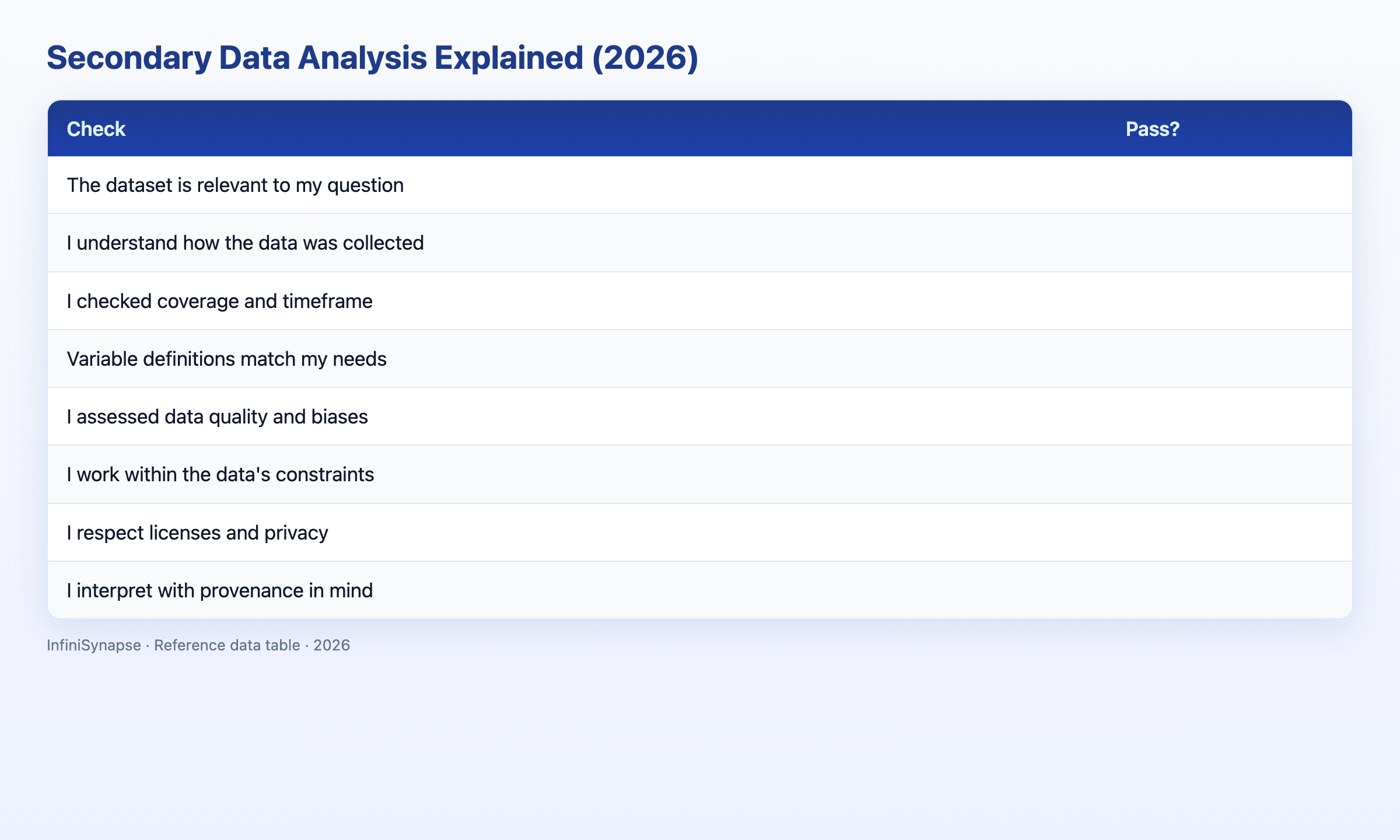
| Check | Pass? |
|---|---|
| The dataset is relevant to my question | |
| I understand how the data was collected | |
| I checked coverage and timeframe | |
| Variable definitions match my needs | |
| I assessed data quality and biases | |
| I work within the data's constraints | |
| I respect licenses and privacy | |
| I interpret with provenance in mind |
6–8: rigorous secondary analysis. 3–5: strengthen evaluation. Below 3: re-evaluate the dataset.
Frequently Asked Questions
What is secondary data analysis?
Secondary data analysis is analyzing data that someone else collected for a different purpose, such as government statistics, academic datasets, or public data. It contrasts with primary analysis of data you collected yourself. It offers speed and scale by reusing existing data but requires careful evaluation since you did not control the collection.
What are the advantages of the approach?
Secondary data analysis is fast and inexpensive because the costly collection stage is already done, and it can provide access to large-scale or hard-to-collect data like national statistics that you could never gather yourself. For many questions, it is the only practical option, letting you begin analysis immediately.
What are the limitations of the approach?
The limitations of the approach stem from not controlling collection: the data may not perfectly fit your question, its quality and methods may be unclear, and it may lack needed variables or use different definitions. These require careful evaluation, and sometimes the data simply cannot answer your question well.
How do you evaluate data for secondary analysis?
Evaluate data for secondary data analysis by scrutinizing how it was collected, who gathered it, when, how, and why, using its documentation or codebook. Check whether it covers the right population and timeframe, whether variable definitions match your question, its quality, and any known biases. This evaluation determines whether the data can be trusted.
Is secondary data analysis ethical?
Secondary data analysis is ethical when it respects the terms under which data was collected, including consent limitations and privacy protections, honors data licenses, cites sources, and avoids re-identifying individuals. Public availability does not remove these obligations, so responsible reuse treats inherited data with the same ethical care as data you collected yourself.
Conclusion
Secondary data analysis reuses existing datasets for speed and scale, but its success hinges on carefully evaluating data you did not collect, its provenance, fit, quality, and limitations, and working honestly within its constraints. In 2026, AI-native tools accelerate evaluation, cleaning, and analysis while the analyst supplies judgment about fit and ethics.
To see fast connection and profiling of existing datasets, read what AI-native data analysis means and try the InfiniSynapse web app free on registration, no credit card required.