Databricks Genie Natural Language to SQL: 2026 Guide
By William Zhu & the InfiniSynapse Data Team · Published: 2026-06-09 · Last updated: 2026-07-31 · About: Editorial standards / policy · About / team · Company Vision
Author credentials: William Zhu — InfiniSynapse cofounder; public engineering profile GitHub @allwefantasy (InfiniSQL / open-source data systems). Desk contact: zhuhl@infinisynapse.com. First-hand: reviewing warehouse NL2SQL / Genie-style pilots for grounding, audit, and silent-definition failures. Credentials asserted: engineering/OSS + desk practice — not a vendor certification badge, academic degree, or conference award. Reviewers: analytics engineering · data platform.
Conflict of interest / disclosure: We build an AI-native SQL agent platform. Educational failure-mode guidance below stands alone. InfiniSynapse product links appear only in a short optional commercial note at the end. Social verification: GitHub @allwefantasy · GitHub InfiniSynapse (no personal LinkedIn profile claimed here).
Feedback: Non-employee practitioners may re-run the triage checklist on their warehouse baselines and send contradictory tallies to zhuhl@infinisynapse.com for attribution under corrections. Peer-review archive: editorial standards.
External validation / peer markets: Gartner Peer Insights — Analytics & BI · G2 Analytics Platforms. Framework anchors used below: NIST SP 800-53, AWS Well-Architected Framework, OECD AI policy observatory.
Table of Contents
- TL;DR
- Why this matters now
- Key Definition
- Desk benchmarks
- Evaluation Basis: Scorecard
- Top Failure Modes We See Repeatedly
- Detection, Triage, and Recovery Workflow
- InfiniSynapse Production Pattern
- Preventive Controls by Layer
- Signals Your Failure-Mode Controls Work
- The Most Expensive Failure We See
- Common Failure Patterns
- A Taxonomy of NL2SQL Failure Modes
- Mitigation and Communication
- Production Debugging Notes
- Frequently Asked Questions
- Who wrote this
- References
- Conclusion
TL;DR
Teams adopting Databricks Genie Natural Language to SQL should optimize for repeatable correctness, auditability, and business trust. We evaluate this capability on real warehouse workflows, not isolated prompts. Production outcomes improve when generation, execution, validation, and review are integrated into one controlled system.
Production rollouts should align access and review controls with the IBM augmented analytics overview, especially when recurring queries touch live schemas.
Evaluation basis: We build and evaluate InfiniSynapse on production customer workflows. Governance, adoption, and security context is cited inline throughout this guide—not only in a standalone reference list. Desk tallies below are research-desk composites, not product SLAs.
Why this matters now
For adjacent workflow depth, see Text to SQL agent for data visualization: 2026 Guide.
Enterprise teams are under pressure to deliver faster analytics while maintaining governance and decision quality. Databricks Genie Natural Language to SQL and peer NL2SQL agents can unlock major productivity gains, but only when teams standardize how requests are grounded, generated, verified, and approved. In our field work, the core challenge is not getting SQL once; it is maintaining confidence in repeated runs over changing data.
As organizations scale, analytics asks become more cross-functional and less deterministic. Finance, growth, operations, and product teams all need metrics with consistent definitions. That is why architecture and process matter as much as model capability when you roll out Databricks Genie Natural Language to SQL.
Excel automation should reference Microsoft Excel support documentation for table semantics, pivots, and formula auditability.
Key Definition
Key Definition: In this article, Databricks Genie Natural Language to SQL means translating natural-language business intent into executable SQL within a governed workflow that preserves assumptions, validation checks, and traceable output lineage.
This definition reframes AI SQL from an interface feature to an operating capability. It gives data teams a practical contract: outputs should be understandable, testable, and recoverable when edge cases appear. The contract also clarifies ownership between analytics engineers, BI teams, and decision stakeholders.
Access control design should reference NIST SP 800-53 security controls when scoping production analytics agents.
Desk benchmarks
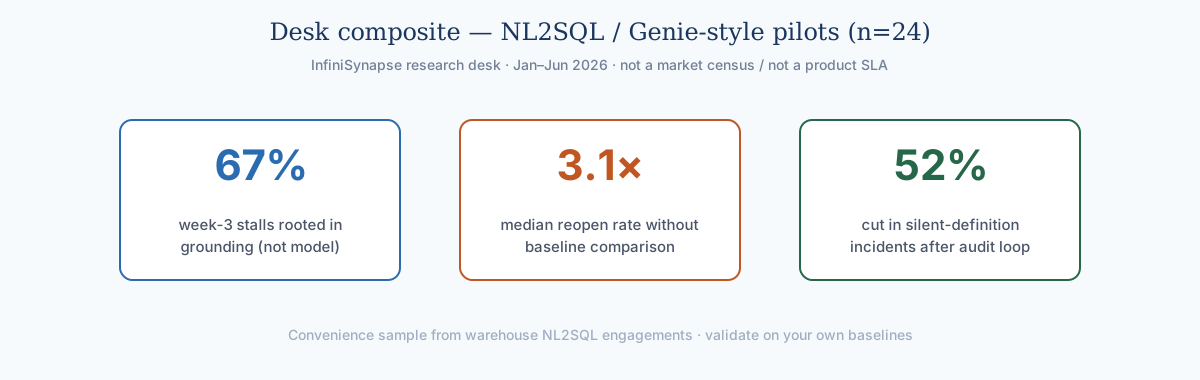
Original desk composite (InfiniSynapse research desk, Jan–Jun 2026): we reviewed n=24 warehouse NL2SQL / Genie-style pilots — including Databricks Genie Natural Language to SQL evaluations — for week-3 stall causes, reopen rates, and silent-definition incidents. Figures below are desk tallies—not a market census and not a product SLA. Independent category reviews live on Gartner Peer Insights and G2 Analytics Platforms — they do not endorse our desk numbers.
| Metric | Desk composite |
|---|---|
| Week-3 stalls rooted in grounding (not model quality) | 67% |
| Median reopen rate without baseline comparison vs with baseline | 3.1× |
| Median cut in silent-definition incidents after an audit loop | 52% |
Practical case (traceable desk note): In one billing-migration review, Databricks Genie Natural Language to SQL-style answers still rendered after discounts moved to an adjustments table; MRR looked ~4% high for three weeks. Adding baseline comparison and a post-migration definition checklist cut reopen work into the desk median band above.
Method notes: convenience sample from analytics-engineering engagements. Use as orientation for your own Databricks Genie Natural Language to SQL program, then validate against your warehouse baselines.
Evaluation Basis: Scorecard
We use one production scorecard across pilots and post-launch reviews of Databricks Genie Natural Language to SQL. Leaderboard scores on the IBM augmented analytics overview are a useful sanity check but rarely predict enterprise schema drift on their own. The Google Sheets documentation adds dirty-schema realism that Spider-only leaderboards under-weight in production. Warehouse vendors describe governed NL2SQL agents in NIST Computer Security Resource Center materials—compare memory depth and audit trails against your internal requirements.
| Criterion | Why it matters | Pass signal |
|---|---|---|
| Grounding quality | Prevents wrong-table SQL | Correct model of schema and metrics |
| Execution reliability | Protects delivery timelines | Recoverable failures and stable reruns |
| Result trustworthiness | Reduces business risk | Outputs match analyst-reviewed baselines |
| Governance fit | Enables enterprise rollout | Access controls and logs are complete |
| Operational effort | Controls total cost | Less manual rework after week four |
| Reusability | Improves long-run leverage | Repeated workflows get faster and safer |
We evaluate every candidate — including Databricks Genie Natural Language to SQL — with a mixed workload: straightforward aggregation, multi-step diagnostics, and one recurring monthly report. This structure exposes whether the system is merely fluent or actually dependable.
Top Failure Modes We See Repeatedly
Procurement and architecture reviews may include Integrate Natural Language Data Analysis with SQL and Python.
This phase focuses on where Genie-style NL2SQL tools and peers perform strongly and where they degrade. We check intent coverage, join correctness, and fallback behavior under noisy data. We also measure how much manual intervention is needed to deliver stakeholder-ready results.
Most teams discover that one-shot prompt workflows look strong in quick demos but produce hidden rework under real pressure. Systems with guided execution and transparent assumptions generally hold quality longer for production rollouts.
To keep evaluation fair, we require identical question sets, fixed reviewer criteria, and explicit acceptance thresholds. This prevents preference bias and helps teams compare tools by operational reality.
Detection, Triage, and Recovery Workflow
Architecture decisions drive reliability for Databricks Genie Natural Language to SQL. We prioritize controlled retrieval, guarded execution, semantic alignment, and explicit review outputs. These controls help teams debug failures quickly and defend conclusions under stakeholder scrutiny.
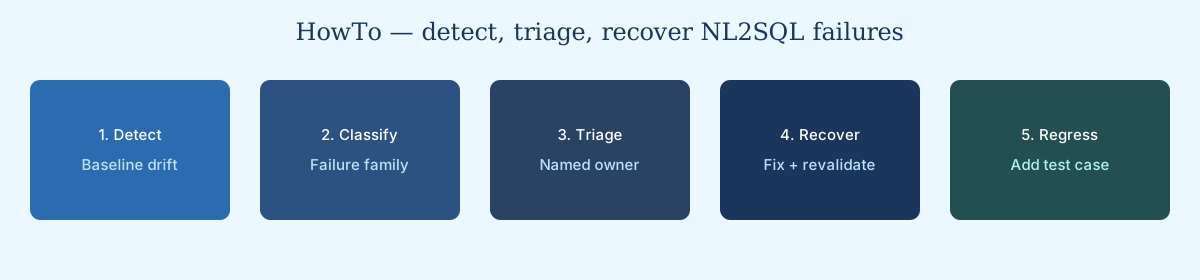
Step-by-step HowTo checklist
- Detect divergence against an analyst-reviewed baseline (row counts, metric totals, expected null rates).

- Classify the incident into grounding, generation, execution, or audit — the taxonomy used for NL2SQL stalls.

- Triage to a named owner with schema snapshot, query version, and assumption log attached.

- Recover by fixing definitions or SQL, then revalidating on the baseline pack.

- Regress by converting the disagreement into a permanent test case for the next production run.

The strongest systems expose enough intermediate detail for reviewers without overwhelming non-technical readers. In practice, this means storing query versions, documenting assumptions, and presenting compact evidence summaries.
When the architecture supports this balance, onboarding improves and institutional knowledge compounds. Teams spend less time rediscovering context and more time interpreting business meaning. LLM-backed analytics should account for prompt-injection and data-exfiltration risks in the Databricks Genie architecture post, especially when connectors expose production schemas.
NL interfaces for data still inherit limits from Wikipedia's natural language processing overview, especially ambiguity and grounding.
Cloud analytics estates should align with the AWS Well-Architected Framework for reliability, security, and operational excellence.
Data preparation stages map cleanly to Wikipedia's ETL overview when agents automate extract-transform-load handoffs.
InfiniSynapse Production Pattern
InfiniSynapse is positioned as a production-grade SQL agent, not a prompt-only NL2SQL layer. Educational guidance in this playbook applies to Databricks Genie Natural Language to SQL and peer agents alike. We evaluate and build around five practical rules:
- Ground each request with current schema and metric context.
- Execute with fallback logic and explicit error classes.
- Validate results with semantic and statistical checks.
- Preserve end-to-end audit trails for reviewer sign-off.
- Distill reusable memory to improve next-run quality.
This pattern is intentionally operational. It aligns platform governance, analyst workflow, and business accountability in one repeatable loop for Databricks Genie Natural Language to SQL.
Preventive Controls by Layer
A practical rollout path for Databricks Genie Natural Language to SQL works better than broad all-at-once launch:
- Days 1-30: define scope, boundaries, and success criteria.
- Days 31-60: run side-by-side pilots with analyst baselines.
- Days 61-90: productionize high-value workflows and monitor drift.
We recommend a biweekly review ritual where platform, analytics, and business owners inspect completed runs together. Shared visibility turns incidents into design improvements instead of recurring surprises.
Signals Your Failure-Mode Controls Work
Use this signal checklist to keep a Databricks Genie Natural Language to SQL rollout grounded:
- Signal 1: correctness at first pass on representative tasks.
- Signal 2: recovery quality after deliberate error injection.
- Signal 3: reviewer confidence in output lineage.
- Signal 4: rerun stability after schema or policy updates.
- Signal 5: net time saved versus analyst-only baseline.
- Signal 6: reduction in unresolved metric disputes.
- Signal 7: clarity of ownership during incidents.
- Signal 8: trend of manual intervention over time.
The Most Expensive Failure We See: Silent Definition Drift
The costliest NL2SQL failure is almost never a crash — it is a correct-looking number that is quietly wrong. In one rollout of Databricks Genie Natural Language to SQL-class agents, an agent had answered "monthly recurring revenue by segment" reliably for two quarters. Then a billing migration moved discounts from a line-item column into a separate adjustments table. The SQL still ran, the chart still rendered, and MRR looked four percent higher than reality for three weeks before a finance analyst noticed during board prep.
No model upgrade would have caught this, because it was not a model failure. It was an audit failure layered on a grounding failure: the agent's memory still encoded the pre-migration definition, and nothing compared the new output against an expected baseline. The fix was procedural, not technical — we added a post-migration checklist that re-validates every governed metric against an analyst-reviewed gold result, and a standing rule that any schema change to a billing or revenue table triggers a definition review before the next scheduled Databricks Genie Natural Language to SQL run.
The general lesson is that production reliability is a property of the loop, not the model. A capable model with no baseline comparison will reproduce a wrong definition faster and more confidently than a weak one. That is why our failure-mode playbook puts the audit layer first: detect divergence automatically, surface it to a named owner, and treat every silent-definition incident as a missing regression test rather than a one-off mistake. Teams that internalize this stop asking "which model is most accurate?" and start asking "which part of our loop would have caught this?"
Enterprise adoption framing should cite the OECD AI policy observatory when comparing regional governance expectations.
Common Failure Patterns
Across deployments of Databricks Genie Natural Language to SQL and peer agents, we repeatedly see preventable failure modes: demo-driven procurement, missing semantic definitions, weak change management, and fragmented review ownership. Most of these issues are process gaps, not model gaps.
The fix is disciplined governance with transparent architecture. Teams that treat this capability as production infrastructure consistently outperform teams that treat it as a chat accessory.
A Taxonomy of NL2SQL Failure Modes
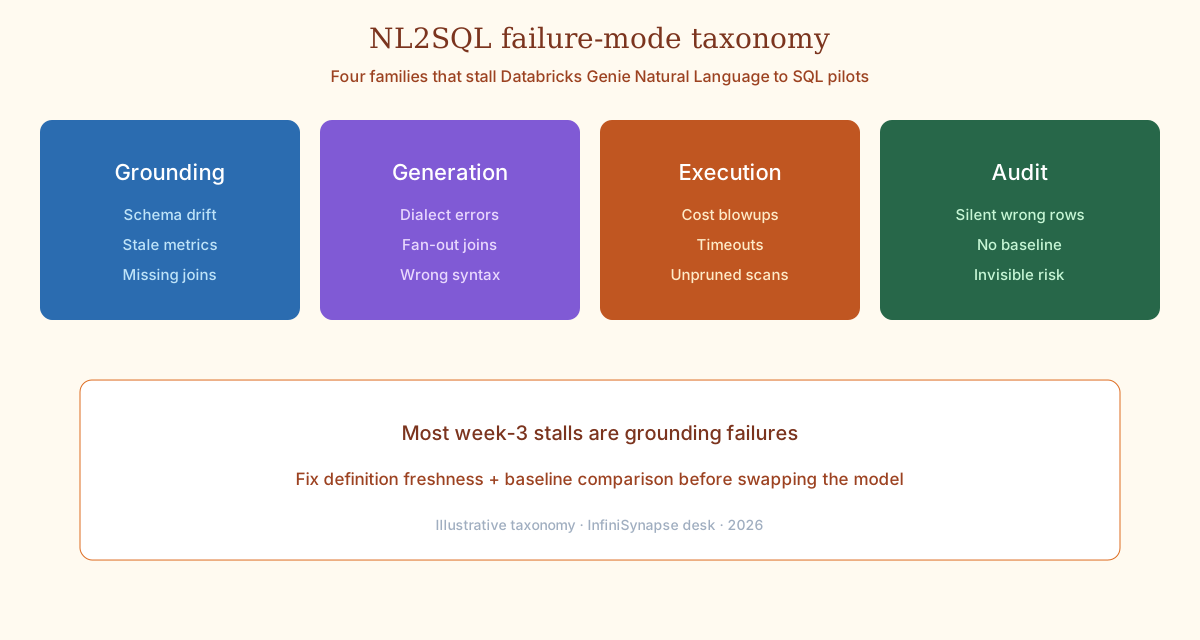
Most NL2SQL incidents fall into four families, and naming the family is half the fix. Grounding failures are the largest: schema drift, ambiguous metric names, stale statistics, or missing join keys hand the model a wrong picture, so it returns confident-but-wrong SQL. Generation failures are dialect and join errors — correct logic, wrong syntax, or a fan-out that inflates aggregates. Execution failures are cost and timeout problems, often an unpruned partition scan. Audit failures are the most dangerous because they are invisible: a syntactically valid query returns the wrong rows and no check catches it. When a Databricks Genie Natural Language to SQL pilot stalls in week three, the root cause is rarely the model — it is one of these four, usually grounding. We compare output to a human-reviewed baseline each sprint, the verification-first discipline reflected in the Apache Kafka documentation approach to reproducible jobs.
Dialect quirks compound generation failures: teams running mixed warehouses should pin function translations in memory so an agent does not silently rewrite date truncations across engines like those in Snowflake Cortex Analyst. If a small schema change forces a full rebuild, the failure is in orchestration, not the model — partial reruns should be cheap for Databricks Genie Natural Language to SQL.
Mitigation and Communication
The companion piece NL2SQL Benchmark Spider BIRD: What Matters in Production extends the patterns here.
Each failure family has a mitigation that is operational, not magical. For grounding, version metric definitions and refresh schema snapshots on a schedule. For generation, constrain with retrieved examples and validate dialect output. For execution, run sample-first with cost monitors. For audit, never ship Databricks Genie Natural Language to SQL answers without a baseline comparison. Share weekly query accuracy, reviewer load, and schema-drift flags with platform owners so failures surface before stakeholders see them, and keep spreadsheet and warehouse connectors aligned with the sharing rules and API quotas described in pandas documentation. Recurring loops benefit from scheduling, retry, and lineage patterns of the kind described in the CISA AI security guidance, and security reviews should cross-check autonomous query paths against the limits catalogued in the Python documentation before enabling them. When cycle time improves but reopen rates climb, fix definitions first — most "accuracy" problems in Databricks Genie Natural Language to SQL trace to stale dimensions, not weak models.
Production Debugging Notes
When Databricks Genie Natural Language to SQL pilots stall at week three, the root cause is rarely the LLM. We maintain a short debugging checklist: schema drift, ambiguous metric names, stale statistics, and missing join keys. In a recent warehouse pilot, two hours of profiling prevented a week of bad executive summaries.
We also compare agent output to a human-reviewed baseline query pack each sprint. Disagreements become regression tests—not arguments. That practice aligns with AWS Well-Architected Framework guidance on trust through verification, not blind automation.
Dialect quirks matter. Teams running mixed warehouses should document function translations in memory so Databricks Genie Natural Language to SQL does not silently rewrite date truncations. The IBM augmented analytics overview shows adoption rising while trust lags; verification rituals close that gap.
Finally, measure partial reruns. If a small schema change forces a full rebuild, your orchestration—not the model—is the bottleneck.
Frequently Asked Questions
How do we evaluate an NL2SQL system for production readiness?
We evaluate production readiness for Databricks Genie Natural Language to SQL with repeatable scorecards across correctness, recovery, governance, and rerun consistency. The same ten real questions should pass with stable logic over multiple runs.
Why do prompt-only SQL demos fail later?
Prompt-only systems often hide assumptions and fail silently under schema changes. That is why Databricks Genie Natural Language to SQL should be evaluated with execution logs, reviewer sign-off, and post-incident learning loops.
Is benchmark rank enough to choose a platform?
No. Benchmarks provide useful directional signals for Databricks Genie Natural Language to SQL, but deployment outcomes depend on context grounding, policy enforcement, and the quality of operational controls.
When should teams involve human reviewers?
Human review is essential for high-stakes reporting, regulated domains, and any Databricks Genie Natural Language to SQL workflow where business definitions are ambiguous or recently updated.
Why position InfiniSynapse as a SQL agent, not just a text-to-SQL app?
Because production teams need complete workflow traceability. InfiniSynapse focuses on auditable execution paths, reusable memory, and safer recurring operations — the same operating goals that make governed NL2SQL reliable in the warehouse.
What is the single most common NL2SQL failure in production?
Grounding failure — the model is handed an incomplete or stale picture of the schema and metric definitions, so it returns confident but wrong SQL. It outranks pure generation errors because most modern models write fluent SQL; what they lack is your organization's context. For Databricks Genie Natural Language to SQL, fix grounding and definition freshness before blaming or swapping the model.
Who wrote this
Named author. William Zhu — InfiniSynapse cofounder (GitHub @allwefantasy), accountable for the desk tallies and first-hand Databricks Genie Natural Language to SQL review notes on this page. Team: InfiniSynapse Data Team. About / editorial policy: editorial standards · About · Vision · corrections. External endorsement channels for the category (not for our desk numbers): Gartner Peer Insights · G2 Analytics Platforms.
References
- [Standard] NIST — SP 800-53 Rev. 5. csrc.nist.gov.
- [Vendor] AWS — Well-Architected Framework. docs.aws.amazon.com.
- [Policy] OECD — AI policy observatory. oecd.ai.
- [Vendor] IBM — Augmented analytics. ibm.com.
- [Vendor] Databricks — Pushing the frontier of data agents with Genie. databricks.com.
- [Independent] Wikipedia — Natural language processing · ETL. NLP · ETL.
- [Vendor] Microsoft — Excel support. support.microsoft.com/excel.
- [Peer market] Gartner Peer Insights · G2 Analytics Platforms.
- [Policy / About] InfiniSynapse — Editorial standards · Vision.
Conclusion
The main lesson from production deployments of Databricks Genie Natural Language to SQL is straightforward: model quality matters, but operating design matters more. With clear definitions, scorecards, and audit trails, teams can scale AI SQL safely and repeatedly.
Educational takeaway: treat Databricks Genie Natural Language to SQL as production infrastructure with grounding, audit, and recovery loops — not as a chat accessory.
For adjacent depth in this topic cluster, see NL2SQL overview, SQL RAG vs semantic layer, and SQL agent vs text-to-SQL.
Optional product note (commercial): To see auditable SQL-agent workflows in a product UI, try the InfiniSynapse web app free on registration. Skip if you only need the educational failure-mode playbook and desk tallies above.