Define Analytics: Types & Examples (2026)
By the InfiniSynapse Data Team · Last updated: 2026-07-15 · We build an AI-native data analysis platform and work with analytics of every kind daily; this explainer sets out to define analytics in 2026, in plain terms rather than a product pitch.
Table of Contents
- TL;DR
- How We Approach It
- What It Means
- The Four Types
- Why It Matters
- Putting It to Work
- Where the Term Came From
- Common Pitfalls
- Analytics in the Age of AI
- Readiness Scorecard
- Common Misconceptions
- Frequently Asked Questions
- Conclusion
TL;DR
Direct answer: to define analytics simply: it is the systematic examination of data to discover patterns, draw conclusions, and support decisions. In 2026, the clearest way to define analytics is by its four types — descriptive (what happened), diagnostic (why), predictive (what will happen), and prescriptive (what to do) — each answering a progressively harder question about the same data.
Who this is for: anyone who wants to define analytics clearly in 2026.
What you'll learn: what it means, the four types with examples, why it matters, how to apply it, and how AI relates.
This guide sits under the data visualization hub.
For the practice, see what data analytics is.
Also see data visualization examples.
How We Approach It
Governance and risk expectations are framed by NIST Computer Security Resource Center when programs need an external control reference.
We define analytics by its four types, because the types make the abstract term concrete. Every point reflects real practice. We anchor concepts to the W3C WCAG accessibility standard and weigh the framework against the guidance at Google SRE book.
The table below helps define analytics.
| Type | Question it answers |
|---|---|
| Descriptive | What happened? |
| Diagnostic | Why did it happen? |
| Predictive | What will happen? |
| Prescriptive | What should we do? |
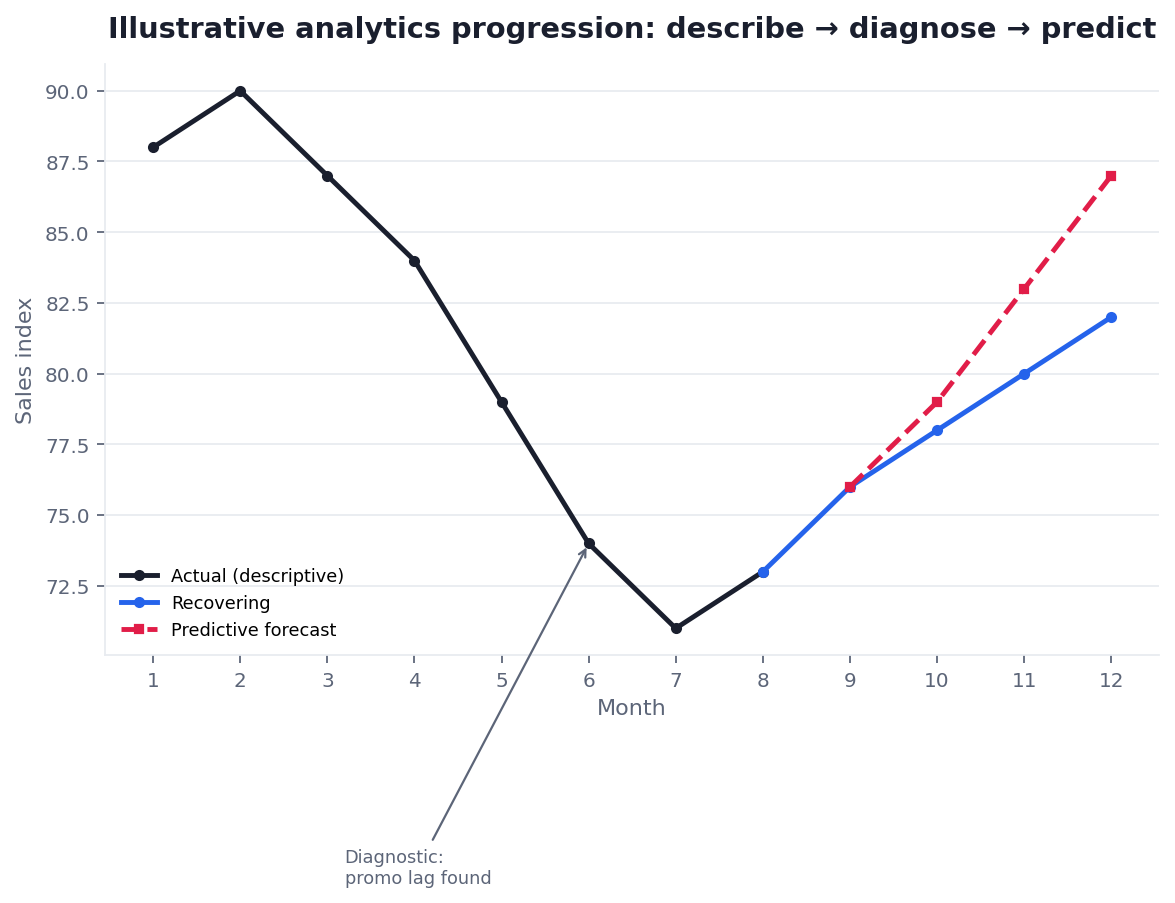
Practical example: to define analytics in action, a retailer used descriptive to see sales fell, diagnostic to find why, and predictive to forecast next quarter — the progression the guidance at EU AI Act overview lays out.
Scope note: This guide reflects patterns we see when mid-market and enterprise teams work with define analytics in 2026. It is not a substitute for legal counsel, vendor runbooks, or a formal survey of every industry — and when a smaller toolset or lighter process would serve, a full program is overkill.
What It Means
At its core, to define analytics is to name the systematic examination of data for the purpose of understanding and decision. It is not a single technique but a discipline — turning raw data into conclusions that inform what an organization does.
Key Definition: to define analytics precisely, it is the systematic computational and statistical examination of data to discover, interpret, and communicate meaningful patterns — and to use those patterns to describe what happened, explain why, predict what will happen, and recommend what to do, thereby supporting evidence-based decisions rather than intuition alone.
The essence when you define analytics is purpose: it exists to support decisions. Analysis without a decision it could inform is an academic exercise; analytics is the applied discipline of making data useful for action.
The Four Types
Teams evaluating this topic often cross-check Stanford HAI AI Index for a durable, vendor-neutral reference point.
The clearest way to define analytics is through its four types, each answering a harder question. Descriptive summarizes what happened; diagnostic explains why; predictive forecasts what will happen; prescriptive recommends what to do about it.
These types help define analytics as a progression, echoed in reference material at Apache Spark documentation. Descriptive is the foundation — you cannot explain or predict what you have not first measured. Diagnostic adds causation, predictive adds forecasting, and prescriptive adds recommendation, each building on the last and each generally harder and more valuable. Most organizations do plenty of descriptive work and progressively less of the harder types, which is exactly where the greatest untapped value usually sits.
Why It Matters
To define analytics matters because the word is used loosely, and a clear definition sets expectations. Knowing the four types tells you what a given analytics effort can and cannot deliver, and where an organization sits on the path from description to recommendation.
The value of being able to define analytics is practical, in the spirit of the clarity behind the Azure architecture center. A team that says it "does analytics" but only produces descriptive reports is not wrong, but naming that helps everyone see the opportunity in diagnostic and predictive work. A precise definition turns a vague ambition into a concrete roadmap, showing which questions are already answered and which remain.
Putting It to Work
Core definitions remain usefully summarized in Wikipedia business intelligence overview for shared vocabulary across stakeholders.
To define analytics usefully is to apply the types to real questions. Start with descriptive to establish what is happening, then move toward diagnostic and predictive as questions demand deeper understanding and the data supports it.
The discipline behind a working define analytics is to match ambition to readiness. Prescriptive analytics is powerful but demands reliable data, sound models, and trust; reaching for it before the descriptive foundation is solid produces confident recommendations built on sand. The practical path climbs the ladder deliberately — get description right, then explanation, then prediction — so each harder type rests on a foundation that can actually support it, rather than skipping ahead to the impressive-sounding types prematurely.
Where the Term Came From
The effort to define analytics has a long lineage — the word traces to the logical analysis of the ancients, but its modern data meaning grew with statistics, operations research, and business intelligence. The four-type framework crystallized as organizations sought a common language for what data work could deliver.
Understanding this history explains why the definition centers on decisions: analytics matured in business and operational settings where the point was always action, not knowledge for its own sake. It also explains the ladder — the types were named roughly in the order organizations learned to attempt them. The term keeps evolving as new methods arrive, and the latest chapter adds AI that can attempt the harder types conversationally, though the four-question framework still holds.
Common Pitfalls
Implementation details are commonly grounded in Google BigQuery documentation when teams translate concepts into production practice.
The pitfalls when people define analytics begin with overclaiming. Calling descriptive reporting "predictive analytics" or "AI" inflates expectations and erodes trust when the work cannot deliver what the label promised.
A subtler pitfall in how teams define analytics is skipping the ladder — reaching for prescriptive recommendations before the descriptive and diagnostic foundations are solid, producing confident advice built on shaky ground. The healthiest approach uses the definition honestly: name which type of work you are actually doing, match your ambition to your data's readiness, and climb from description toward recommendation deliberately. A precise, honest use of the term keeps expectations aligned with reality and points to genuine opportunity rather than hiding it.
A related pitfall is confusing the volume of output with the maturity of the work. A team can produce hundreds of dashboards and still be operating almost entirely at the descriptive level, mistaking activity for sophistication. The four-type framework is useful precisely because it measures depth, not quantity: it asks not how many reports exist but which questions they answer. Used as a diagnostic on your own practice, it often reveals that the next unit of value lies not in producing more descriptive views but in finally attempting the diagnostic and predictive questions the organization has been quietly avoiding because they are harder.
Analytics in the Age of AI
AI is reshaping how we define analytics by making the harder types more accessible — letting people ask predictive and diagnostic questions in plain language rather than building models by hand.
We explore this in what AI-native data analysis means. In the InfiniSynapse web app, an agent can analyze across your sources and attempt the harder questions from a plain-language prompt, so to define analytics in 2026 increasingly includes conversational access to prediction and explanation — while the four-question framework still describes exactly what is being attempted.
Readiness Scorecard
Architecture choices are often checked against Microsoft Excel support so boundaries, ownership, and scale patterns stay explicit.
Assess your analytics maturity (1 point each):
| Check | Pass? |
|---|---|
| Descriptive is solid | |
| Diagnostic is practiced | |
| Predictive is attempted responsibly | |
| Prescriptive rests on a foundation | |
| Claims match the actual type | |
| Data supports the ambition | |
| Each effort serves a decision | |
| The ladder is climbed deliberately |
6–8: mature. 3–5: strengthen the foundation. Below 3: start with description.
Common Misconceptions
Misconception 1: Analytics means prediction. Most analytics is descriptive.
Misconception 2: The fancy types are always better. Each rests on the ones below.
Misconception 3: Analytics equals dashboards. Dashboards are one output of it.
Misconception 4: More data guarantees good analytics. Purpose and rigor matter more.
Frequently Asked Questions
How do you define analytics?
Define it as the systematic computational and statistical examination of data to discover, interpret, and communicate meaningful patterns — and to use those patterns to describe what happened, explain why, predict what will happen, and recommend what to do, thereby supporting evidence-based decisions rather than intuition alone. Its essence is purpose: it exists to support decisions. Analysis without a decision it could inform is an academic exercise, whereas analytics is the applied discipline of making data useful for action. It is a discipline, not a single technique, aimed squarely at turning data into decisions.
What are the four types of analytics?
Descriptive answers what happened, diagnostic answers why it happened, predictive answers what will happen, and prescriptive answers what should be done about it. They form a progression: descriptive is the foundation because you cannot explain or predict what you have not measured, diagnostic adds causation, predictive adds forecasting, and prescriptive adds recommendation. Each builds on the last and each is generally harder and more valuable. Most organizations do plenty of descriptive work and progressively less of the harder types, which is exactly where the greatest untapped value usually sits waiting.
Why does defining analytics matter?
Because the word is used loosely, and a clear definition sets expectations. Once you know the four types, you can tell what a particular effort is capable of producing and how far along the description-to-recommendation path an organization actually stands. A group that describes its work as "analytics" while only issuing descriptive reports is not misusing the word, but labeling that work honestly lets everyone spot the untapped room in diagnostic and predictive work. A precise definition turns a vague ambition into a concrete roadmap, showing which questions are already answered and which still remain to be tackled.
How do I put the types to work?
Apply them to real questions, matching ambition to readiness. Begin by using descriptive work to pin down what is actually happening, and advance into diagnostic and predictive work only as the questions call for deeper understanding and the underlying data can bear the weight. Prescriptive analytics is powerful but demands reliable data, sound models, and trust, so reaching for it before the descriptive foundation is solid produces confident recommendations built on sand. Climb the ladder deliberately — get description right, then explanation, then prediction — so each harder type rests on a foundation that can actually support it rather than skipping ahead prematurely.
How is AI changing analytics?
AI is making the harder types more accessible, letting people ask predictive and diagnostic questions in plain language rather than building models by hand. An AI-native platform can analyze across your sources and attempt those harder questions from a plain-language prompt, so what it means to do analytics in 2026 increasingly includes conversational access to prediction and explanation. But the four-question framework still describes exactly what is being attempted — AI changes how you reach the answers, not what descriptive, diagnostic, predictive, and prescriptive analytics fundamentally are, and the discipline of honest, well-grounded work remains essential.
Is analytics the same as data science?
No, though they overlap heavily. Analytics is the broader, decision-focused examination of data across the four types, much of it descriptive and diagnostic and often done with established tools. Data science leans toward the harder end — building predictive and prescriptive models, engineering features, and applying machine learning — and typically involves more programming and statistical depth. You can think of a lot of data science as the advanced machinery behind predictive and prescriptive analytics. In practice the terms blur, but analytics emphasizes answering business questions while data science emphasizes building the methods that answer the hardest ones.
In practice, teams evaluating define analytics should judge outcomes by reliability and clarity, not by tool count alone.
When stakeholders ask for a short takeaway on define analytics, start from the decision it must support and work backward.
Conclusion
To define analytics clearly: it is the systematic examination of data to support decisions, best understood through its four types — descriptive, diagnostic, predictive, prescriptive — each answering a progressively harder question. In 2026, use the definition honestly, match ambition to data readiness, and climb the ladder deliberately. AI now makes the harder types more reachable, but the four-question framework still names exactly what is being attempted.
Then ask a harder question in plain language in the InfiniSynapse web app, free on registration.