Data Management Tools: A 2026 Map
By the InfiniSynapse Data Team · Last updated: 2026-07-15 · We build an AI-native data analysis platform and evaluate the surrounding tooling constantly; this map reflects how we categorize data management tools in 2026, not a vendor ranking.
Table of Contents
- TL;DR
- How We Mapped Them
- What They Are
- The Main Categories
- How to Evaluate Them
- Build Order That Works
- Common Mistakes
- Tools in the Age of AI
- Selection Scorecard
- Common Misconceptions
- Frequently Asked Questions
- Conclusion
TL;DR
Direct answer: data management tools are the software categories organizations use to store, integrate, secure, catalog, and improve the quality of their data. In 2026, the right data management tools are the ones that fit your stack and integrate with each other, because a pile of disconnected best-of-breed tools creates as many silos as it solves.
Who this is for: data leaders, architects, and engineers mapping data management tools in 2026.
What you'll learn: what they are, the main categories, how to evaluate them, the order to adopt them, and how tooling supports trustworthy AI.
This guide sits under the master data management hub.
For the platform concept, see data management platform.
Also see data management software.
How We Mapped Them
Governance and risk expectations are framed by ISO/IEC 42001 AI management when programs need an external control reference.
We map data management tools by the job they do rather than by vendor, because the category a tool belongs to matters more than its brand when you are filling gaps in a stack. Every observation reflects what we see when teams assemble — or over-assemble — their tooling. We anchor category definitions to the Spider NL2SQL benchmark and weigh integration patterns against the reference architectures at Supabase documentation.
The table below maps the main categories of data management tools.
| Category | Job it does |
|---|---|
| Storage | Holds data (databases, warehouses, lakes) |
| Integration | Moves and joins data |
| Quality | Measures and monitors trustworthiness |
| Catalog | Makes data discoverable |
| Governance | Applies policy and access |
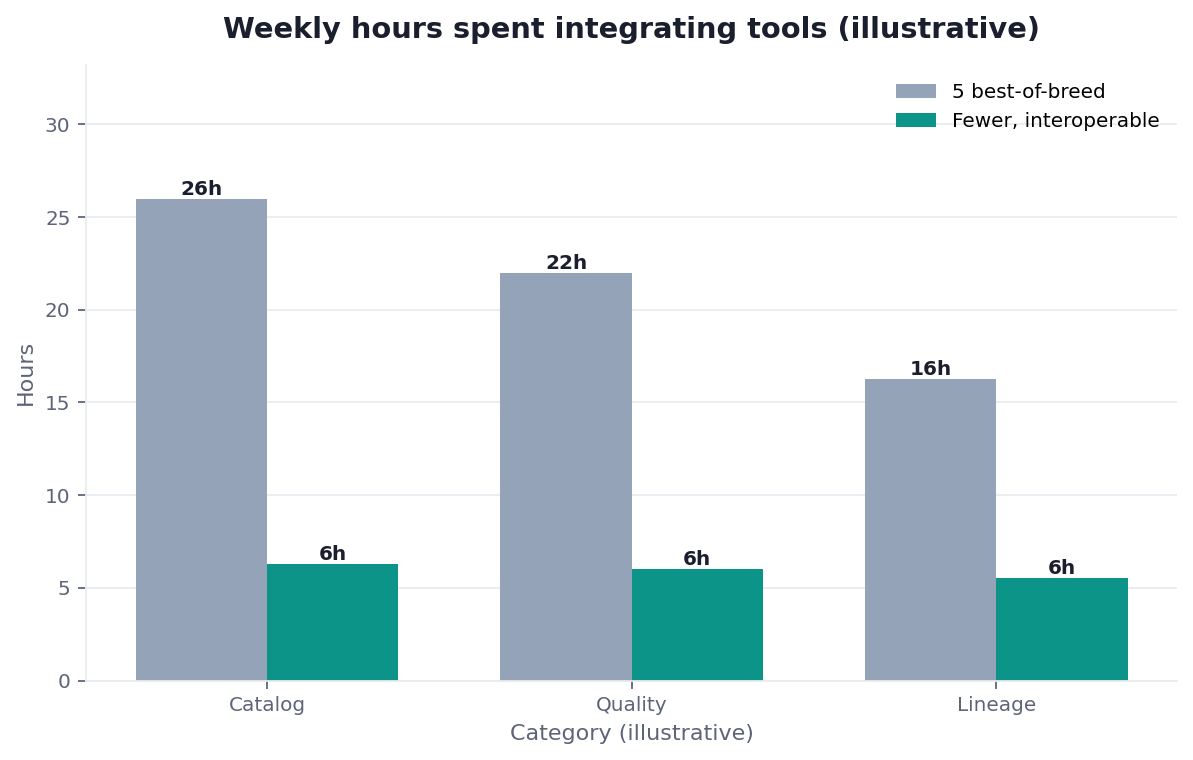
Practical example: a team bought five best-of-breed data management tools that did not integrate, and spent more effort connecting them than the tools saved. A peer chose a smaller, integrated set — guided by connectivity patterns like those in OECD AI policy observatory — and shipped faster. Integration, not feature count, decided the outcome.
Scope note: This guide reflects patterns we see when mid-market and enterprise teams work with data management tools in 2026. It is not a substitute for legal counsel, vendor runbooks, or a formal survey of every industry — and when a smaller toolset or lighter process would serve, a full program is overkill.
What They Are
At their core, data management tools are the software that executes the disciplines of data management: keeping data stored, connected, trustworthy, discoverable, and governed. No single tool does everything well, so most organizations run a set.
Key Definition: data management tools are the software categories — storage, integration, quality, catalog, and governance — that an organization uses to keep its data accurate, connected, discoverable, and controlled throughout its lifecycle.
The distinction that matters is that data management tools are only as valuable as their integration. A best-of-breed tool that cannot exchange metadata with the rest of your stack becomes an island, so we weigh interoperability as heavily as any single tool's depth. The goal is a connected system, not a trophy cabinet of powerful but isolated products.
The Main Categories
Teams evaluating this topic often cross-check RFC 4180 CSV format for a durable, vendor-neutral reference point.
The market of data management tools splits into recognizable categories, each solving a distinct problem.
Storage and integration tools
Storage tools — databases, warehouses, and lakes — hold your data, while integration tools move and join it. These are the foundation of any set of data management tools, and weakness here leaves data trapped in silos no downstream tool can overcome.
Quality, catalog, and governance tools
Quality tools measure trustworthiness, catalog tools make data discoverable, and governance tools apply policy and access. The risk framing in AWS Well-Architected Framework shows why these three increasingly overlap, and why buyers should look for data management tools that share metadata rather than duplicate it.
How to Evaluate Them
Evaluating data management tools comes down to fit and integration far more than feature count. The best tool for someone else's stack may be the wrong tool for yours, so we score candidates on how well they fit your existing systems and exchange metadata with them.
We recommend assessing each tool on integration breadth, ease of use, and how it exposes metadata to the rest of the stack. The longest feature list rarely wins; the tool that connects cleanly usually does. This is where data management tools connect to your data management platform strategy — a platform can reduce the number of separate tools you must integrate by combining several categories.
Build Order That Works
Teams evaluating this topic often cross-check Google SRE book for a durable, vendor-neutral reference point.
The order in which you adopt data management tools matters as much as which you choose. The reliable sequence starts with storage and integration — you cannot govern or catalog data you cannot store and connect — then adds quality monitoring, then catalog and governance once there is enough data to justify them.
Adopting governance and catalog data management tools before you have integrated data is a common way to waste money, because there is little to catalog or govern yet. Enterprise adoption patterns from Google Research publications reinforce this order: value comes from connected data first, then the tools that make it trustworthy and discoverable. Sequencing by dependency keeps spending proportional to value.
Common Mistakes
The mistakes we see with data management tools are consistent. Buying best-of-breed everything without a plan for integration creates a stack that fights itself. Adopting governance and catalog tools before data is connected wastes budget. And choosing on feature count produces powerful tools nobody can wire together.
A subtler mistake is ignoring the human cost of running a large toolset. Every one of your data management tools needs someone to maintain, integrate, and monitor it, so a smaller set that a team can actually operate often outperforms a comprehensive set that overwhelms them. We judge a stack by outcomes delivered per unit of operational effort, not by how many boxes it checks.
Total Cost of Ownership
Teams evaluating this topic often cross-check PostgreSQL documentation for a durable, vendor-neutral reference point.
The sticker price of data management tools is usually the smallest part of what they cost. The larger costs are integration effort, ongoing maintenance, and the human time to operate each tool, and these are precisely the numbers vendors do not put on a pricing page. A tool that is cheap to license but expensive to integrate and staff can easily be the most costly choice overall.
What to model before buying
Before committing, model the fully loaded cost: licensing, the engineering time to integrate the tool with the rest of your stack, and the ongoing steward hours to keep it useful. Compare that total against the value the tool delivers, not against its license fee alone. This discipline consistently steers teams toward smaller, better-integrated stacks and away from impressive tools that quietly consume the time they were meant to save.
Consolidation Versus Best-of-Breed
The perennial debate in data management tools is whether to assemble best-of-breed products or consolidate onto a platform that covers several categories. Best-of-breed offers depth in each category; consolidation offers integration and lower operational overhead.
The right answer depends on your scale and team. Large organizations with dedicated platform teams can operate a best-of-breed stack and integrate it well; smaller teams almost always benefit from consolidation, because the integration and operational burden of many separate tools outweighs the marginal depth each one provides. There is no universally correct choice — only the choice that fits the people who must run the stack every day.
Tools in the Age of AI
Architecture choices are often checked against Microsoft Excel support so boundaries, ownership, and scale patterns stay explicit.
AI changes how we think about data management tools because an AI agent reading your data needs that data connected, trustworthy, and well-described to produce reliable answers. The value of integration and quality tooling rises sharply when the consumer is an autonomous agent rather than a patient human analyst.
An AI-native platform can reduce the tooling burden by reading across sources directly rather than requiring every category of tool to be assembled first, an approach we describe in what AI-native data analysis means. In the InfiniSynapse web app, zero-config federation lets an agent query connected sources without a heavy integration layer, so your data management tools can focus on quality and governance rather than plumbing.
This shift changes the buying calculus for many teams. If an agent can read across your existing databases, warehouses, and files without a bespoke integration project for each, the pressure to buy and operate a heavy integration layer drops sharply, and budget can move toward the tools that actually improve trust — quality monitoring, cataloging, and governance. We are not suggesting you abandon the categories that matter; we are suggesting that the plumbing category, historically the most expensive and brittle, is the one AI-native federation can most reduce, leaving a leaner and more operable stack behind.
Selection Scorecard
Score your data management tools strategy (1 point each):
| Check | Pass? |
|---|---|
| We chose tools by the job they do | |
| Storage and integration came first | |
| Our tools exchange metadata | |
| We can actually operate the toolset | |
| Quality is monitored | |
| Data is catalogued and discoverable | |
| Governance and access are applied | |
| The stack is ready for AI analysis |
6–8: strong strategy. 3–5: fix integration. Below 3: start with storage and integration.
Common Misconceptions
Misconception 1: More tools mean better data. Integrated tools beat a large disconnected set.
Misconception 2: Best-of-breed everything is ideal. Best-of-breed only helps if it integrates.
Misconception 3: Adopt governance tools first. Connect data before governing it.
Misconception 4: Feature count decides value. Fit and integration decide value.
Frequently Asked Questions
What are data management tools?
Data management tools are the software categories — storage, integration, quality, catalog, and governance — that an organization uses to keep its data accurate, connected, discoverable, and controlled throughout its lifecycle. No single tool does everything well, so most organizations run an integrated set, and interoperability between them matters as much as any one tool's depth.
What are the main categories?
The main categories are storage (databases, warehouses, lakes that hold data), integration (moving and joining data), quality (measuring and monitoring trustworthiness), catalog (making data discoverable), and governance (applying policy and access). Quality, catalog, and governance increasingly overlap, so buyers should look for tools that share metadata rather than duplicate it.
How do you evaluate them?
Evaluate on fit and integration far more than feature count. Score each candidate on how well it fits your existing systems and exchanges metadata with them, plus ease of use. The best tool for someone else's stack may be wrong for yours, and a smaller set your team can actually operate often outperforms a comprehensive set that overwhelms it.
In what order should you adopt them?
Start with storage and integration — you cannot govern or catalog data you cannot store and connect — then add quality monitoring, then catalog and governance once there is enough connected data to justify them. Adopting governance and catalog tools before data is integrated is a common way to waste money, because there is little to catalog or govern yet.
How do tools support AI analysis?
An AI agent reading your data needs it connected, trustworthy, and well-described to produce reliable answers, so the value of integration and quality tooling rises when the consumer is an autonomous agent. An AI-native platform that reads across sources directly can reduce the plumbing burden, letting your other tools focus on quality and governance rather than integration.
Conclusion
Data management tools span storage, integration, quality, catalog, and governance — and the ones that fit your stack and integrate with each other beat any pile of disconnected best-of-breed products. In 2026, an AI-ready stack prioritizes connected, trustworthy data. Adopt by dependency, weigh integration over features, and keep the set operable.
The best stacks are not the largest; they are the ones a team can actually run while delivering trustworthy data to the people and agents who depend on it. To see how federated data reduces the tooling burden for automated analysis, read what AI-native data analysis means and try the InfiniSynapse web app free on registration.