Data Governance Definition: A Precise 2026 Explanation
By the InfiniSynapse Data Team · Last updated: 2026-07-15 · We build an AI-native data analysis platform and translate governance theory into practice; this is a precise, usable definition grounded in what works in 2026.
Table of Contents
- TL;DR
- How We Approached This
- The Precise Definition
- Unpacking the Definition
- How Authorities Define It
- Related Terms
- Common Confusions
- The Definition in the Age of AI
- Clarity Scorecard
- Common Misconceptions
- Frequently Asked Questions
- Conclusion
TL;DR
Direct answer: the data governance definition most teams can act on is: the system of decision rights, policies, roles, and controls that governs how data is defined, accessed, protected, and maintained across its lifecycle. In 2026, a precise data governance definition matters because vague ones lead to stalled programs and, increasingly, to AI systems built on data nobody actually governs.
Who this is for: anyone needing a precise, usable data governance definition in 2026.
What you'll learn: the exact definition, the parts that compose it, how authorities word it, related terms, and why precision matters for AI.
This guide sits under the data governance frameworks hub.
For a plain-language answer, see what is data governance.
Also see data governance.
How We Approached This
Core definitions remain usefully summarized in Wikipedia ETL overview for shared vocabulary across stakeholders.
We built this data governance definition to be usable, not just correct. Every element reflects what teams actually need the definition to do: guide decisions about ownership, access, and quality. We anchor wording to the Elastic documentation and relate the requirements to the OWASP API Security Top 10, which treats governed, well-provenanced data as foundational for AI risk management.
The table below breaks the data governance definition into its components.
| Component | What it contributes |
|---|---|
| Decision rights | Who decides about data |
| Policies | The rules that apply |
| Roles | Who owns and stewards |
| Controls | How rules are enforced |
| Lifecycle scope | From creation to disposal |
Practical example: a team argued for months because their data governance definition was "keeping data organized," which decided nothing. Adopting a precise definition — decision rights and controls — immediately clarified who owned what, a clarity the security guidance from Amazon Redshift documentation treats as prerequisite to protecting data at all. Precision ended the argument.
Scope note: This guide reflects patterns we see when mid-market and enterprise teams work with data governance definition in 2026. It is not a substitute for legal counsel, vendor runbooks, or a formal survey of every industry — and when a smaller toolset or lighter process would serve, a full program is overkill.
The Precise Definition
Teams evaluating this topic often cross-check pandas documentation for a durable, vendor-neutral reference point.
The most useful data governance definition is specific about what governance decides and how.
Key Definition: data governance is the system of decision rights, policies, roles, and controls that governs how data is defined, accessed, protected, and maintained across its entire lifecycle, so that data is trustworthy and used responsibly.
What makes this data governance definition usable is that every clause implies action. "Decision rights" means you must name who decides; "controls" means rules must be enforced, not just written; "lifecycle" means governance spans creation to disposal. A definition that implies concrete actions is worth far more than an elegant one that implies none.
Unpacking the Definition
Governance and risk expectations are framed by OECD AI policy observatory when programs need an external control reference.
Each part of the data governance definition carries weight.
Decision rights and roles
Decision rights answer who gets to decide about data — its definition, access, and use — while roles assign those rights to accountable people. This is the part of the data governance definition that most distinguishes governance from mere data handling: governance is fundamentally about accountable decision-making, echoed in international policy work at the Google Cloud AI overview.
Policies and controls
Policies codify the rules, and controls enforce them in systems. The data governance definition insists on both because a policy without a control is a suggestion. Grounding controls in recognized baselines such as Snowflake Cortex Analyst keeps enforcement defensible and consistent with security practice.
How Authorities Define It
Implementation details are commonly grounded in Apache Kafka documentation when teams translate concepts into production practice.
Different authorities word the data governance definition slightly differently, but the core is stable: decision rights and accountability over data. Industry bodies emphasize policy and stewardship; standards bodies emphasize controls and risk; academic sources emphasize decision rights.
The convergence matters more than the variation. Whatever the source, a credible data governance definition centers on who is accountable and what rules apply, which is why we recommend anchoring your own wording to a recognized reference and then making it concrete for your organization. Borrowing a definition verbatim without adapting it to your reality is how definitions become slogans rather than tools. It is worth reading two or three authoritative wordings side by side before you settle on your own, because the differences in emphasis highlight choices you should make deliberately rather than by default — whether to foreground risk, stewardship, or decision rights depends on what your organization most needs the definition to fix.
Related Terms
Core definitions remain usefully summarized in Wikipedia machine learning overview for shared vocabulary across stakeholders.
A precise data governance definition is clearer when set against neighbors. Data management is the broad practice of handling data; data governance is the decision layer above it. Data stewardship is the day-to-day execution of governance by assigned owners. Data quality is a property that governance maintains.
Keeping these distinct prevents the most common confusion, where teams use "governance" to mean any data activity. A tight data governance definition — decision rights and controls — draws a clean line between deciding the rules (governance) and doing the work (management and stewardship), which is exactly the line that lets you assign responsibility without ambiguity.
The line also clarifies who to hire and how to structure teams. If governance is decision-making and stewardship is execution, then a governance function needs people with authority and judgment, while stewardship needs people with domain knowledge and attention to detail — different profiles for different roles. Organizations that blur the data governance definition tend to blur these roles too, asking a single overloaded person to both set policy and enforce it across every dataset, which is a recipe for burnout and gaps. A precise definition lets you split the work sensibly: a small governance body that decides, and a distributed set of stewards embedded in the domains who execute, each accountable for a clearly bounded scope.
Common Confusions
The confusions we see trace back to loose definitions. Conflating governance with management leads teams to buy tools expecting decisions to follow. Conflating governance with restriction leads teams to see it as an obstacle rather than an enabler. And conflating governance with a project leads teams to disband it once "done."
A sharp data governance definition dissolves each confusion: governance decides (not just handles), enables safe use (not just restricts), and is ongoing (not a project). This is why we insist on precision — the data governance definition you adopt quietly shapes every downstream decision about staffing, tooling, and scope.
Writing Your Own Definition
Once you understand the standard data governance definition, the practical task is to adapt it into wording your own organization will actually use. We recommend a short, deliberate process. Start from the recognized definition — decision rights, policies, roles, controls, across the lifecycle — and then, clause by clause, make each one concrete for your context. "Decision rights" becomes the names of the bodies and individuals who decide; "controls" becomes the specific systems where enforcement happens; "lifecycle" becomes the actual stages your data passes through, from ingestion to archival to deletion. The exercise forces the abstract definition to touch reality, and it surfaces gaps — a stage with no owner, a policy with no control — that a purely borrowed definition would hide.
The wording matters more than teams expect, because the definition you publish becomes the reference everyone points to when a dispute arises. A vague data governance definition invites endless argument about scope; a precise one settles those arguments by pointing to the clause that applies. We advise keeping the published definition to a few sentences that anyone can remember, backed by a longer document that spells out the specifics, so the memorable version guides daily behavior while the detailed version resolves edge cases. This two-layer approach keeps the definition both usable and rigorous.
Finally, treat the definition as something you revisit, not carve in stone. As your data estate grows, your regulations change, and your organization matures, the concrete meaning of each clause shifts even if the words stay similar. The strongest programs review their data governance definition periodically, confirming that the roles it names still exist, the controls it assumes still run, and the lifecycle it describes still matches how data actually flows. A definition that drifts out of sync with reality quietly loses its authority, and with it the program's ability to settle the disputes it was written to resolve.
The Definition in the Age of AI
AI makes a precise data governance definition more valuable, because AI systems built on ungoverned data fail in ways that are hard to diagnose. When an agent reads your data and answers questions, the decision rights and controls in your definition determine whether the data it uses is trustworthy.
An AI-native platform operationalizes the definition by binding governed decisions and controls to the data an agent queries, an approach we describe in what AI-native data analysis means. In the InfiniSynapse web app, the governance your definition specifies travels with the data, so a precise data governance definition becomes a working reality rather than a paragraph in a policy.
Clarity Scorecard
Test how usable your data governance definition is (1 point each):
| Check | Pass? |
|---|---|
| It names decision rights | |
| It implies accountable roles | |
| It requires enforced controls | |
| It spans the data lifecycle | |
| It distinguishes governance from management | |
| It frames governance as enabling | |
| It treats governance as ongoing | |
| It guides real decisions |
6–8: usable definition. 3–5: add controls and lifecycle scope. Below 3: adopt a precise definition first.
Common Misconceptions
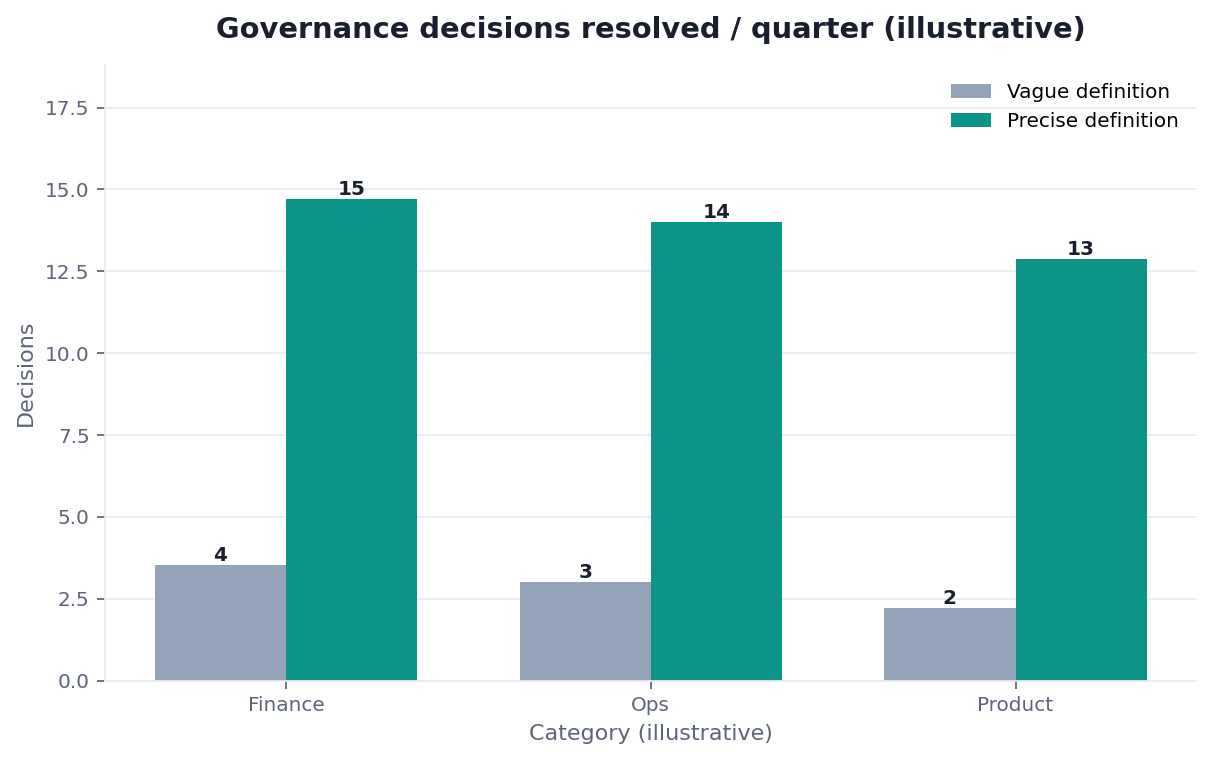
Misconception 1: Any definition will do. A vague data governance definition decides nothing and stalls programs.
Misconception 2: It equals data management. Governance decides; management executes.
Misconception 3: It means restriction. It enables safe use; restriction is a side effect.
Misconception 4: It describes a project. It defines a standing capability.
Frequently Asked Questions
What is the data governance definition?
The most usable data governance definition is: the system of decision rights, policies, roles, and controls that governs how data is defined, accessed, protected, and maintained across its lifecycle, so that data is trustworthy and used responsibly. Every clause implies action — naming who decides, enforcing rules, and spanning creation to disposal.
What are the parts of the definition?
The parts are decision rights (who decides), policies (the rules), roles (who owns and stewards), controls (how rules are enforced), and lifecycle scope (creation to disposal). Decision rights and roles distinguish governance from mere data handling; policies and controls insist that rules be enforced, not merely written down.
How do authorities define data governance?
Authorities word it slightly differently — industry bodies emphasize policy and stewardship, standards bodies emphasize controls and risk, academic sources emphasize decision rights — but the core is stable: accountable decision-making over data. The convergence on accountability and rules matters more than the variation in wording.
How is it different from data management?
Data management is the broad practice of handling data — storage, integration, operations. Data governance is the decision layer above it, deciding who is accountable and what rules apply. Data stewardship executes governance day to day, and data quality is a property governance maintains. Keeping these distinct prevents the most common confusion.
Why does a precise definition matter for AI?
Because AI systems built on ungoverned data fail in hard-to-diagnose ways. When an agent reads your data and answers questions, the decision rights and controls in your definition determine whether that data is trustworthy. A precise definition, operationalized so governance travels with the data, is what makes automated analysis reliable rather than confidently wrong.
Conclusion
A usable data governance definition is precise about decision rights, policies, roles, and controls across the data lifecycle — because every clause implies an action. In 2026, that precision is what keeps programs from stalling and AI from being built on ungoverned data. Adopt a concrete definition and make it real.
To see how a precise definition becomes working governance in automated analysis, read what AI-native data analysis means and try the InfiniSynapse web app free on registration.