Data Engineer vs Data Scientist (2026)
By the InfiniSynapse Data Team · Last updated: 2026-07-15 · We build an AI-native data analysis platform and work with both roles daily; this guide compares data engineer vs data scientist honestly for 2026, not by job-board cliché.
Table of Contents
- TL;DR
- How We Compare Them
- What Each Role Is
- The Core Differences
- Where They Overlap
- Which One You Need
- Common Pitfalls
- The Roles in the Age of AI
- Fit Scorecard
- Common Misconceptions
- Frequently Asked Questions
- Conclusion
TL;DR
Direct answer: in data engineer vs data scientist, the engineer builds and maintains the systems that make data reliable and available, while the scientist builds models and analysis on top of that data to produce predictions and insight. In 2026, the data engineer vs data scientist distinction still holds — one builds the foundation, the other builds on it — but AI tooling is blurring the boundary and making the shared skill of data literacy matter more than the title.
Who this is for: anyone weighing data engineer vs data scientist in 2026 for a hire or a career.
What you'll learn: what each role is, the core differences, where they overlap, which you need, and how AI is changing the line.
This guide sits under the data engineering hub.
For the engineer's role, see the data engineer role.
Also see what a data engineer is.
How We Compare Them
Governance and risk expectations are framed by CISA AI security guidance when programs need an external control reference.
We compare data engineer vs data scientist by output, because titles vary between companies but what each produces is consistent. Every point reflects working alongside both. We anchor the definitions to the Wikipedia machine learning overview and weigh the engineering side against the reference architectures at OECD AI policy observatory, where the two roles meet.
The table below frames data engineer vs data scientist by focus.
| Dimension | Data engineer | Data scientist |
|---|---|---|
| Output | Reliable data infrastructure | Models and insight |
| Focus | Systems and pipelines | Analysis and prediction |
| Core skill | Reliability engineering | Statistics and modeling |
| Question | "Is the data available and correct?" | "What does the data tell us?" |
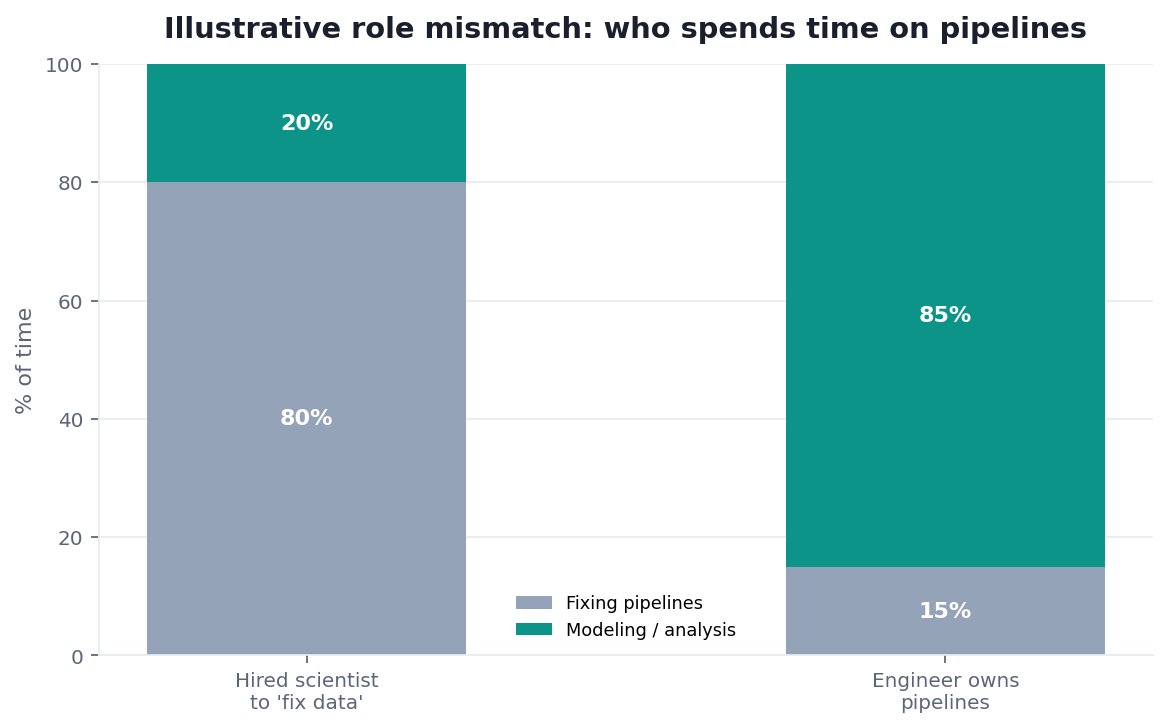
Practical example: a team hired a data scientist to fix its data engineer vs data scientist gap, then found the scientist spent all their time fixing pipelines. Hiring an engineer first — a sequencing point the guidance at AWS Well-Architected Framework reinforces — freed the scientist to do science.
Scope note: This guide reflects patterns we see when mid-market and enterprise teams work with data engineer vs data scientist in 2026. It is not a substitute for legal counsel, vendor runbooks, or a formal survey of every industry — and when a smaller toolset or lighter process would serve, a full program is overkill.
What Each Role Is
To understand data engineer vs data scientist, start with each role on its own. A data engineer builds and operates the pipelines, storage, and infrastructure that make data reliable and available.
Key Definition: the data engineer vs data scientist distinction separates who builds reliable data systems (the engineer) from who builds models and insight on top of that data (the scientist) — complementary roles that fail when one person is expected to own both without clear sequencing.
A data scientist, in the data engineer vs data scientist pairing, builds models, runs experiments, and produces predictions and insight from that data. The enterprise patterns from UK NCSC AI development guidelines show why both are needed: the scientist's models are only as good as the data the engineer delivers, so the roles are complementary rather than competing.
The Core Differences
Implementation details are commonly grounded in Azure architecture center when teams translate concepts into production practice.
The core of data engineer vs data scientist is what each produces and the question each answers. The engineer asks "is the data available, reliable, and correct?" and produces infrastructure. The scientist asks "what does the data tell us?" and produces models and insight.
The skill sets differ accordingly. In data engineer vs data scientist, the engineer's craft is reliability engineering — building systems that stay dependable — while the scientist's craft is statistics and modeling. The reference guidance at Stripe documentation on data roles reinforces that these are genuinely different disciplines, even though both work with data, and confusing them leads to mis-hires that frustrate everyone.
Where They Overlap
Despite the differences, data engineer vs data scientist is not a clean line. Both need data literacy, both write code, and both increasingly touch each other's territory — engineers doing light analysis, scientists building their own data pipelines.
The overlap in data engineer vs data scientist connects to the broader field of data engineering: as tooling improves, scientists can self-serve more data preparation and engineers can support more analysis. The boundary is a spectrum, not a wall, and many productive people sit somewhere in the middle, which is why the roles collaborate closely rather than working in isolation.
Which One You Need
Teams evaluating this topic often cross-check RFC 4180 CSV format for a durable, vendor-neutral reference point.
Deciding data engineer vs data scientist for a hire comes down to your bottleneck. If your data is unreliable, scattered, or inaccessible, you need an engineer first — no amount of modeling helps if the data cannot be trusted.
If your data is already reliable and available but you are not extracting insight from it, the data engineer vs data scientist answer tilts toward a scientist. The common mistake is hiring a scientist onto a broken data foundation, where they spend their time doing engineering work badly instead of science well. Fix the foundation first, then build analysis on it.
Common Pitfalls
The pitfalls in the data engineer vs data scientist decision are consistent. Hiring a scientist before the data foundation exists wastes expensive talent on plumbing. Expecting one person to be excellent at both is usually unrealistic. And treating the roles as interchangeable leads to mismatched expectations.
A subtler pitfall in data engineer vs data scientist thinking is undervaluing engineering because it is less glamorous. The modeling gets the attention, but the engineering determines whether the modeling is possible at all. Organizations that invest only in science and neglect engineering end up with brilliant analysts blocked by broken data, which is the most expensive way to learn this lesson.
The Roles in the Age of AI
Implementation details are commonly grounded in Python documentation when teams translate concepts into production practice.
AI is reshaping data engineer vs data scientist in two ways. AI tools handle more routine modeling and more routine pipeline work, shifting both roles toward judgment and oversight. And AI-native platforms reduce the engineering burden that often blocks scientists.
That second shift is the one we find most consequential, and we describe it in what AI-native data analysis means. In the InfiniSynapse web app, zero-config federation lets analysis happen across sources without heavy engineering first, so the data engineer vs data scientist handoff gets smoother when the data foundation is less of a barrier.
How They Work Together Day to Day
The comparison of data engineer vs data scientist is most useful not for drawing a boundary but for understanding a collaboration, because in practice the two roles hand work back and forth constantly. A typical cycle begins when a scientist needs data that does not yet exist in usable form. They describe what they need — which sources, at what grain, refreshed how often — and the engineer builds or extends the infrastructure to deliver it reliably. The scientist then builds models on that foundation, and if the models prove valuable, the engineer productionizes the data flows that feed them so they run dependably rather than as one-off experiments.
Friction between the roles usually traces back to unclear handoffs rather than any inherent conflict. When a scientist assumes data will be clean and it is not, or an engineer builds a pipeline without understanding how the output will be used, the result is rework and frustration on both sides. The teams that navigate data engineer vs data scientist collaboration well invest in a shared vocabulary and explicit contracts: agreements about what a dataset contains, how fresh it is, and what quality guarantees it carries. Those contracts turn an ambiguous handoff into a dependable interface, and they let each specialist trust the other's work without having to inspect it.
The healthiest arrangement gives each role room to do what it does best while blurring the edges just enough to avoid bottlenecks. Scientists who can write a basic query and understand where data comes from make lighter demands on engineers; engineers who understand what a model needs build more useful infrastructure. Neither has to master the other's craft, but a working literacy in both directions removes most of the friction. This is why the data engineer vs data scientist question is ultimately less about ranking the roles and more about designing the seam between them so that data flows smoothly from raw source to reliable insight.
As AI tooling matures, that seam is shifting. Self-serve data preparation lets scientists reach further into what used to be engineering territory, while automated pipeline generation lets engineers support more analysts with less manual work. The boundary is becoming more porous, not less, and the organizations that benefit are those that treat the two roles as a continuum to be staffed thoughtfully rather than as rival departments competing for headcount. Understanding the distinction remains essential, but understanding the collaboration is what actually turns two skilled specialists into a team that ships trustworthy insight.
Fit Scorecard
Implementation details are commonly grounded in Google Vertex AI documentation when teams translate concepts into production practice.
Decide which role you need (1 point toward engineer per yes):
| Check | Engineer needed? |
|---|---|
| Data is unreliable or scattered | |
| Pipelines break often | |
| Data is hard to access | |
| There is no trustworthy foundation | |
| Analysts spend time fixing data | |
| Infrastructure is undocumented | |
| Scaling data volume is a problem | |
| Data quality is inconsistent |
5–8 yes: hire an engineer first. 2–4: either could help. 0–1: a scientist likely adds more.
Common Misconceptions
Misconception 1: They are interchangeable. In data engineer vs data scientist, one builds systems, the other builds models.
Misconception 2: One person does both well. Excellence at both is rare.
Misconception 3: Science matters more than engineering. Engineering determines whether science is possible.
Misconception 4: Hire a scientist first. Fix the data foundation before adding modeling.
Frequently Asked Questions
What is the difference between a data engineer and a data scientist?
In data engineer vs data scientist, the engineer builds and operates the pipelines, storage, and infrastructure that make data reliable and available, while the scientist builds models and analysis on top of that data to produce predictions and insight. Framed by the question each answers: the engineer asks "is the data available and correct?" and the scientist asks "what does the data tell us?"
Where do the two roles overlap?
Both need data literacy, both write code, and both increasingly touch each other's territory — engineers doing light analysis, scientists building their own pipelines. As tooling improves, scientists self-serve more data preparation and engineers support more analysis. The boundary is a spectrum, not a wall, and many productive people sit in the middle, which is why the roles collaborate closely.
Which one should you hire first?
It depends on your bottleneck. If your data is unreliable, scattered, or inaccessible, hire an engineer first, because no amount of modeling helps if the data cannot be trusted. If your data is already reliable and available but you are not extracting insight from it, a scientist adds more. The common mistake is hiring a scientist onto a broken foundation.
Can one person do both roles?
Rarely at a high level. The skill sets differ genuinely — reliability engineering versus statistics and modeling — even though both work with data. Some people sit productively in the middle, especially with modern tooling, but expecting one person to be excellent at both building reliable infrastructure and building sophisticated models is usually unrealistic and leads to one side being neglected.
How is AI changing these roles?
Automated tools now absorb more routine modeling and more routine pipeline work, pushing both roles toward judgment and oversight. AI-native platforms also reduce the engineering burden that often blocks scientists, because federation lets analysis happen across sources without heavy engineering first. The handoff between the roles gets smoother when the data foundation is less of a barrier to getting to insight.
Do data engineers earn more than data scientists?
Compensation varies more by company, location, and seniority than by title, and the two roles are broadly comparable at similar levels. In organizations where reliable data is the binding constraint, strong engineers can command a premium precisely because their work unblocks everyone else. The more useful question than "which pays more" is which role fits your strengths, because a great engineer out-earns a mediocre scientist and vice versa; excellence within either discipline matters far more than the choice between them.
Conclusion
In data engineer vs data scientist, the engineer builds the reliable foundation and the scientist builds insight on it — complementary roles, not competing ones. In 2026, hire for your bottleneck (usually engineering first), respect that both are distinct disciplines, and expect AI to blur the line while making a solid data foundation easier to achieve.
To see how a stronger data foundation smooths the handoff between roles, read what AI-native data analysis means and try the InfiniSynapse web app free on registration.