Data Analyst Training: Paths and Programs for 2026
By the InfiniSynapse Data Team · Last updated: 2026-07-08 · We build an AI-native data analysis platform and have guided learners through every training path; this guide maps the options so you can choose efficiently.
Table of Contents
- TL;DR
- Training Paths Overview
- Self-Directed Training
- Structured Programs
- Corporate and Employer-Sponsored Training
- Bootcamp Training
- Certification-Based Training
- AI-Era Training Requirements
- Path Selection Scorecard
- Putting Your Learning Into Practice
- Frequently Asked Questions
- Conclusion
TL;DR
Direct answer: data analyst training in 2026 spans self-directed learning, structured courses, bootcamps, certifications, and employer-sponsored programs. The best path depends on your starting level, budget, and timeline. All effective data analyst training emphasizes hands-on SQL practice, portfolio-building, and increasingly AI-native tool fluency.
Who this is for: career changers and professionals evaluating data analyst training options.
What you'll learn: the major training paths, what each offers, how to choose, and what 2026 employers expect from trained analysts.
This guide sits under the data analyst certification hub; for degree context, see data analyst degree and for bootcamp details, see data analysis bootcamp.
Training Paths Overview
Data analyst training is not a single product but a spectrum of approaches, each with different trade-offs in time, cost, structure, and depth. Self-directed learning costs the least and offers maximum flexibility but demands the most discipline. Structured courses and certifications provide guided curricula with credentials. Bootcamps compress training into intensive programs with career support. University degrees offer the deepest foundation over years. Employer-sponsored training targets specific skill gaps for working professionals.
The right data analyst training path depends on four factors: your current skills, your target timeline, your budget, and your learning style. A career changer with no technical background needs different training than a marketing manager who wants to add SQL to an existing skill set. An honest assessment of where you are and where you need to be prevents wasted investment in the wrong format.
| Path | Time | Cost | Structure | Best for |
|---|---|---|---|---|
| Self-directed | 3–12 months | Lowest | Minimal | Disciplined self-starters |
| Courses/certifications | 2–6 months | Low–medium | Moderate | Career changers |
| Bootcamps | 3–6 months | Medium–high | High | Fast transition |
| University degree | 2–4 years | Highest | Highest | Students, max depth |
| Corporate training | Variable | Employer-paid | Targeted | Upskilling in role |
No path is universally best. The strongest analysts often combine approaches: a certification for structure, self-directed practice for depth, and employer-sponsored training for specialization. The constant across all data analyst training is hands-on practice on real data, as described in the Wikipedia data analysis overview.
Self-Directed Training
Self-directed data analyst training means learning without a formal program, using free resources, public datasets, and community feedback. This path costs the least and offers complete schedule flexibility. Major platforms provide free courses covering SQL, Python, spreadsheets, and visualization. Countless tutorials, documentation, and open-source tools fill specific knowledge gaps. Enterprise adoption patterns in Google Cloud's AI overview mirror the shift from pilots to governed analytics.
The challenge is structure and accountability. Without a curriculum sequencing your learning or deadlines pushing you forward, many self-directed learners stall or develop uneven skills. Strong SQL with weak visualization, or solid querying with no communication practice, are common patterns. Self-directed data analyst training works best for people who have successfully completed self-paced learning before and can create their own accountability systems.
To succeed self-directed, follow a defined skill progression: SQL first and deeply, then spreadsheets, then visualization, then statistics, then portfolio projects. Set weekly goals, publish work incrementally, and seek feedback in online communities. Supplement free content with one low-cost certification for the credential signal if desired. We curate free resources in data analyst course free).
Structured Programs
Structured data analyst training through courses and certifications provides guided curricula, instructor support, and recognized credentials. These programs sequence your learning from fundamentals through capstone projects, reducing the risk of gaps that self-directed paths create. They range from affordable online courses taking weeks to comprehensive programs taking months.
The value of structured data analyst training is efficiency and credibility. A well-designed program teaches exactly what employers want in the right order, with practice at every step. The credential signals commitment to hiring managers and can help pass automated resume screening. The trade-off is cost and less flexibility than self-directed learning.
When choosing structured programs, evaluate curriculum against current job postings rather than program marketing. Does the data analyst training teach SQL with extensive practice? Does it include portfolio-worthy projects? Does it address AI-native tools? We compare course options in data analyst course and data analysis courses. Complete one strong program before collecting additional credentials.
Corporate and Employer-Sponsored Training
Many organizations offer data analyst training to employees who want to develop analytical skills for their current roles or transition into dedicated analyst positions. Corporate training ranges from lunch-and-learn sessions on Excel and basic reporting to comprehensive upskilling programs sponsored through tuition reimbursement or learning-and-development budgets.
Employer-sponsored data analyst training has unique advantages. It is often free to the employee, may include access to real company data for practice, and can lead directly to internal role transitions. The training is typically tailored to the organization's tools and data environment, making the skills immediately applicable.
If your employer offers data analyst training or tuition reimbursement, investigate before investing personal funds in external programs. Some companies partner with bootcamp providers or online platforms for discounted access. Internal mentorship from existing analysts can supplement formal training with context that external programs cannot provide. Even if your employer does not offer formal programs, proposing a self-directed learning plan with periodic check-ins can secure support and visibility for your transition.
Bootcamp Training
Bootcamp-style data analyst training compresses learning into intensive, full-time or part-time programs lasting three to six months. Bootcamps emphasize project-based learning, career coaching, and job-placement support. They suit career changers who need structured, fast-paced training and benefit from cohort accountability. Warehouse-grounded analytics should align with Databricks documentation on SQL warehouses and data governance.
The ROI of bootcamp data analyst training depends heavily on the specific program. Strong bootcamps with verified job-placement rates and curricula aligned with current employer needs can justify their cost. Weak bootcamps that teach outdated tools, skip SQL depth, or overpromise placement rates waste time and money. We evaluate bootcamp value in data analysis bootcamp and compare options in data analyst bootcamp.
Bootcamp data analyst training is most appropriate for career changers who need external structure, can commit significant weekly hours, and value career services such as resume review and interview preparation. It is less appropriate for those who already have partial skills and need targeted gap-filling, or for those who thrive with self-paced flexibility.
Certification-Based Training
Certification programs represent a middle ground between self-directed learning and bootcamps. Data analyst training through certification typically takes two to six months at ten to fifteen hours per week, costs less than bootcamps, and issues a recognized credential upon completion. The curriculum is structured but usually self-paced or lightly cohort-based.
Certification-based data analyst training suits learners who want guided curricula and credentials without the intensity and cost of bootcamps. It works well paired with self-directed portfolio-building: use the certification for structure and the credential, and use independent projects for demonstrated ability. We map the certification landscape in data analyst certification guide) and certifications for data analyst).
The limitation of certification-based data analyst training is typically less career support than bootcamps provide. You may need to handle job searching, networking, and interview preparation independently. For self-motivated learners, this trade-off saves money without sacrificing skill quality.
AI-Era Training Requirements
Whatever data analyst training path you choose, it must address AI-native tools in 2026. As agents automate routine data cleaning, querying, and initial analysis, the analyst role shifts toward directing these tools, validating outputs, and focusing on interpretation and communication. Training that teaches only manual methods prepares you for a shrinking portion of the job.
Evaluate every data analyst training option on AI coverage. Does the curriculum include working with AI analysis agents? Does it teach validation of automated outputs? Does it discuss how AI changes analytical workflows? Programs that ignore these topics leave a growing gap regardless of how strong their traditional curriculum is.
InfiniSynapse supports AI-era data analyst training at every level. It is an AI-native agent that connects to data sources and runs analysis through InfiniSQL, modeling how professional analysts work with modern tools. Practicing alongside any training path builds the fluency that traditional programs often skip. We explore the paradigm in what AI-native data analysis means), and the Stanford HAI AI Index documents how rapidly these skills have become standard.
Path Selection Scorecard
Choose your data analyst training path (1 point per yes):
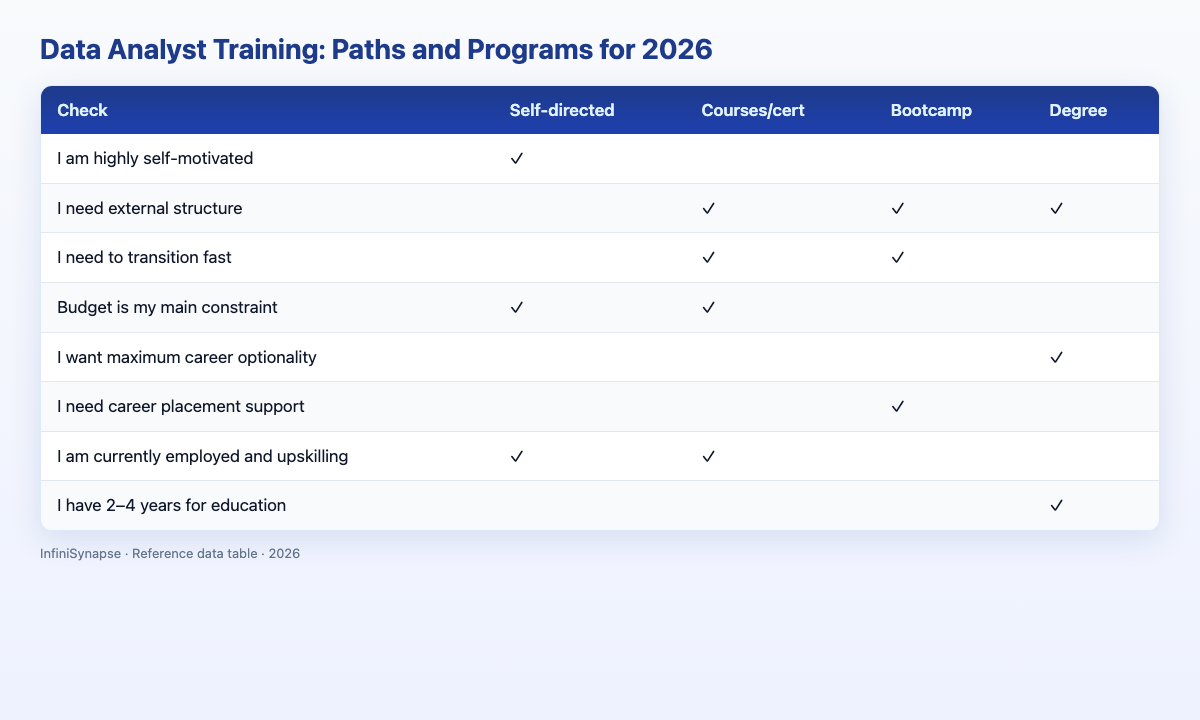
| Check | Self-directed | Courses/cert | Bootcamp | Degree |
|---|---|---|---|---|
| I am highly self-motivated | ✓ | |||
| I need external structure | ✓ | ✓ | ✓ | |
| I need to transition fast | ✓ | ✓ | ||
| Budget is my main constraint | ✓ | ✓ | ||
| I want maximum career optionality | ✓ | |||
| I need career placement support | ✓ | |||
| I am currently employed and upskilling | ✓ | ✓ | ||
| I have 2–4 years for education | ✓ |
Highest column count indicates your best starting path. Combine paths as needed.
Putting Your Learning Into Practice
Formal data analyst training supplies scaffolding; employability comes from deliberate reps afterward. Block recurring lab time—two evenings weekly—to re-run exercises from memory. If you need the video after week three, the skill is not yet muscle memory. Self-directed learners can benchmark progress against the OECD AI adoption overview.
Pair training with domain immersion. Read earnings summaries, operations dashboards, or nonprofit annual reports in your target industry so you recognize real metrics when datasets arrive. Training teaches methods; domain context teaches which questions matter.
Seek feedback loops training programs skip. Ask a mentor or peer to critique whether your chart axis starts at zero, whether your cohort definition is stable, and whether your conclusion matches the evidence. Training grades completion; managers grade judgment.
Document a personal ops manual: how you profile tables, how you version queries, how you store credentials safely, how you sanity-check AI-generated SQL. Analysts who arrive with habits—not just homework—onboard faster.
Frequently Asked Questions
What is the best data analyst training path?
The best path depends on your situation. Self-directed learning suits disciplined budget-conscious learners. Courses and certifications suit career changers wanting structure. Bootcamps suit those needing fast transition with career support. Degrees suit students wanting maximum depth. All paths require hands-on practice and portfolio-building.
How long does data analyst training take?
Self-directed training typically takes three to twelve months. Structured courses and certifications take two to six months. Bootcamps take three to six months intensive. University degrees take two to four years. Timeline depends on your starting level, weekly hours, and path chosen.
Is formal training worth it\1?
Yes, when it produces genuine skills and a portfolio. Data analyst training is not worth it when it only issues a credential without building demonstrated ability. Evaluate programs on practice depth, AI coverage, and whether graduates actually land analyst roles.
Can my employer pay for skill development?
Many employers offer tuition reimbursement, learning-and-development budgets, or partnerships with training providers. Ask your manager or HR department about available programs before investing personal funds. Internal training program may also be available through your organization's analytics team.
Should the training include AI tools?
Yes. In 2026, this learning path should cover AI-native tools because employers expect analysts to direct automated workflows and validate AI outputs. Programs teaching only traditional methods leave a skills gap you will need to fill independently.
Conclusion
analytics training in 2026 offers multiple viable paths, from self-directed learning to bootcamps to degrees. Choose based on your skills, timeline, budget, and need for structure, then invest in hands-on practice, portfolio-building, and AI-native tool fluency regardless of which path you take. The training path matters less than the consistent practice and demonstrated ability it enables.
To practice the AI-era skills employers want, read what AI-native data analysis means) and try the InfiniSynapse web app free on registration, no credit card required.