Data Analyst Salary in 2026: By Level, Region, and Industry
By the InfiniSynapse Data Team · Last updated: 2026-07-08 · We build an AI-native data analysis platform and work with analysts and hiring teams; this salary guide reflects real market patterns, not a single scraped number.

Table of Contents
- TL;DR
- What Drives a Data Analyst Salary
- Salary by Experience Level
- Salary by Region
- Salary by Industry
- How to Benchmark Your Own Pay
- Negotiating a Stronger Offer
- How Pay Evolves Over a Career
- Salary Scorecard
- Beyond the Paycheck
- Failure Modes
- Frequently Asked Questions
- Conclusion
TL;DR
Direct answer: a data analyst salary in 2026 varies widely by experience, region, and industry, but the role pays a solid professional wage that rises steeply with seniority and domain depth. The biggest levers you control are demonstrated impact, specialized skills, and the willingness to benchmark and negotiate with evidence.
Who this is for: anyone researching a data analyst salary to benchmark an offer, plan a career, or prepare to negotiate.
What you'll learn: what drives pay, ranges by level, region, and industry, how to benchmark your own number, and how to negotiate effectively.
This guide sits under the data analyst career hub; for the senior end and broader pay bands, see senior data analyst salary and data analyst pay.
What Drives a Data Analyst Salary
A data analyst salary is not a single number but the output of several factors. Experience is the largest: pay rises steeply from entry-level to senior as an analyst accumulates a track record of impact. Region matters nearly as much, since local cost of living and market demand shift compensation dramatically. Industry, company size, and specialized skills round out the picture.
Understanding these drivers turns a vague sense of a data analyst salary into a specific expectation. The most controllable driver is demonstrated impact: an analyst who can point to decisions their work shaped commands more than one who merely lists tools. Authoritative labor data such as the OECD AI policy observatory provides a baseline, but your individual number depends on how well you position the factors within your control.
Salary by Experience Level
Experience is the clearest predictor of a data analyst salary. Entry-level analysts, covered in entry-level data analyst jobs, start at a solid professional wage that reflects foundational skills. Mid-level analysts, who own analyses end to end, earn meaningfully more as they demonstrate independent judgment. Senior analysts and leads, whose pay we detail in senior data analyst salary, command the top of the range by setting analytical direction. The discipline follows the process described in the Wikipedia overview of data analysis.
The jump between levels is usually larger than annual raises within a level, which is why advancement—not just tenure—drives a rising data analyst salary. The lesson for career planning is to focus on the capabilities that earn promotion: owning bigger problems, mentoring others, and consistently turning analysis into decisions. Those who treat each level as a set of demonstrable skills to acquire, rather than a waiting period, tend to climb the pay curve faster.
Salary by Region
Region shapes a data analyst salary as strongly as experience in many cases. Major technology hubs pay the most in absolute terms, though high living costs offset much of the premium. Secondary cities and lower-cost regions pay less nominally but often offer better real purchasing power, and the spread between countries is even wider.
The rise of remote work has partly decoupled a data analyst salary from physical location, a shift covered in remote data analyst jobs. Some employers now pay closer to a national band regardless of where an analyst lives, which can be a significant advantage for those in lower-cost areas. When benchmarking, always compare against your specific region and remote-eligibility, since a national average can mislead in either direction depending on where you sit.
Salary by Industry
Industry adds another layer to a data analyst salary. Finance, technology, and specialized fields like pharmaceuticals tend to pay at the higher end, reflecting both the stakes of their decisions and their ability to pay. Retail, nonprofit, and government roles often pay less nominally but may offer stability, benefits, or mission alignment that partly compensate.
Industry also interacts with a data analyst salary through domain expertise. An analyst who understands the specific metrics and regulations of a high-paying field becomes more valuable within it over time, which compounds the pay advantage. This is why choosing an industry you find genuinely interesting pays off twice: curiosity sustains your development, and accumulated domain depth steadily raises what you can command. The move toward augmented workflows, outlined in IBM's augmented analytics overview, frames how teams evaluate modern tooling.
How to Benchmark Your Own Pay
Benchmarking a data analyst salary turns anxiety into evidence. Gather data from multiple sources—public salary surveys, the labor statistics above, and, most valuably, conversations with peers in similar roles and regions. Triangulating several sources gives a realistic range rather than a single misleading figure, and it accounts for your specific level, region, and industry.
The discipline of benchmarking a data analyst salary mirrors good analysis itself: gather multiple data points, account for context, and reach a defensible conclusion. Document your benchmark with sources so you can reference it in a negotiation. Analysts who benchmark rigorously are far better positioned than those who guess, because they enter compensation conversations with evidence rather than hope, which is exactly the posture that earns respect from employers.
Negotiating a Stronger Offer
A benchmarked data analyst salary is the foundation of a strong negotiation. Lead with demonstrated impact—decisions your analysis shaped, time or money saved—rather than personal need, and anchor your request in the market range you have documented. Employers respond to evidence, and an analyst who negotiates the way they analyze, with data and clear reasoning, tends to fare well.
Remember that a data analyst salary is only part of total compensation. Bonus, equity, benefits, flexibility, and growth opportunity all matter, and trade-offs among them can produce a better overall package than base pay alone. Approach the conversation collaboratively, seeking a fair outcome rather than a confrontation, and be prepared to walk if an offer sits well below your benchmark, since knowing your worth is the ultimate source of negotiating leverage.
How Pay Evolves Over a Career
Compensation is best understood as a curve rather than a point, and seeing the whole curve helps with planning. In the first few years, pay rises quickly as raw skills solidify and the analyst begins to work independently; each demonstrated capability—owning a project end to end, mentoring a junior, shipping a recurring report that leadership relies on—translates fairly directly into higher compensation. This early stretch is where deliberate skill-building pays the highest dividends. Enterprise adoption patterns in Google Cloud's AI overview mirror the shift from pilots to governed analytics.
The middle of the curve is where trajectories diverge sharply. Analysts who continue to grow—deepening domain expertise, expanding the scope of problems they own, and consistently connecting their work to business outcomes—see pay accelerate, while those who plateau technically tend to see raises flatten. The difference is rarely raw intelligence; it is the discipline of continually taking on bigger, fuzzier problems and turning them into decisions that matter. Specialization in a high-value domain often marks the inflection point where a good salary becomes a strong one.
Later in a career, the curve branches. Some analysts move into management, trading hands-on analysis for leading teams; others become senior individual contributors whose deep expertise commands premium pay without managing people; still others transition toward data science or analytics engineering. Each branch carries its own compensation logic, and none is universally best. The common thread is that pay follows demonstrated impact and scarce expertise, so the analysts who plan their development around those two levers—rather than waiting passively for raises—tend to shape the steepest curves for themselves.
Salary Scorecard
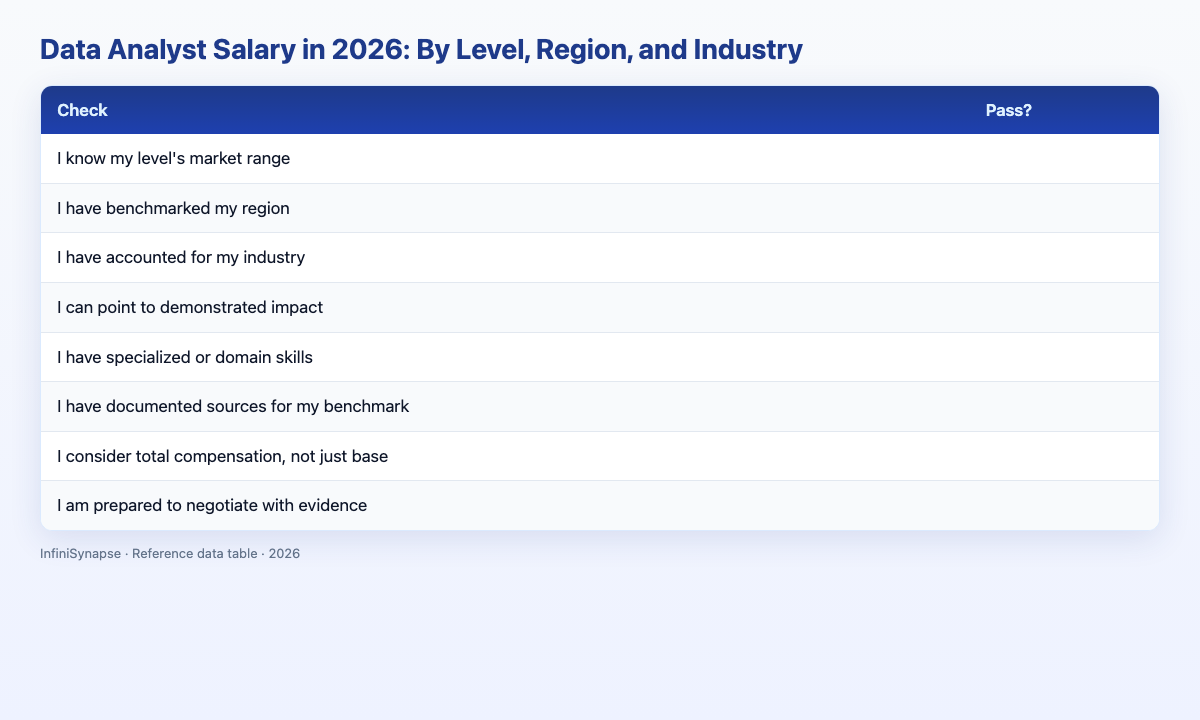
Assess your data analyst salary position (1 point each):
| Check | Pass? |
|---|---|
| I know my level's market range | |
| I have benchmarked my region | |
| I have accounted for my industry | |
| I can point to demonstrated impact | |
| I have specialized or domain skills | |
| I have documented sources for my benchmark | |
| I consider total compensation, not just base | |
| I am prepared to negotiate with evidence |
6–8: strong position. 3–5: gather more evidence. Below 3: benchmark before acting.
Beyond the Paycheck
Compensation matters, but the analysts who report the most career satisfaction weigh more than base pay when they evaluate a role. The quality of the problems you get to work on, the strength of the colleagues you learn from, and the degree of autonomy you are given all shape both day-to-day happiness and long-term growth. A role that pays slightly less but stretches you against harder, more interesting questions often produces a better career outcome than a higher-paying seat where the work stagnates.
Growth trajectory deserves particular attention. Early in a career, the rate at which you learn compounds into future earning power, so a position with strong mentorship and rising responsibility can be worth more over five years than a higher opening figure in a role that plateaus. Ask, during interviews, how the team develops its analysts, what the path to more senior work looks like, and whether people are promoted from within—the answers reveal whether a role is a launchpad or a cul-de-sac. The Stanford HAI AI Index documents how quickly AI capabilities are reshaping analytical work.
Benefits and flexibility round out the picture. Remote options, flexible hours, learning budgets, health coverage, and equity can materially change the value of an offer beyond the headline number. When you weigh two offers, translate the full package into comparable terms and consider your own priorities honestly. The goal is not to maximize a single figure but to choose the role that best serves your life and your growth, which is a more sophisticated optimization than chasing the largest base alone and one that pays off over the arc of a career.
Failure Modes
Failure 1: Guessing instead of benchmarking. Assuming a data analyst salary without evidence leaves money on the table.
Failure 2: Ignoring region and industry. A national average misleads without local and sector context.
Failure 3: Negotiating on need. Employers respond to demonstrated impact, not personal circumstances.
Failure 4: Fixating on base pay. Overlooking total compensation can mean accepting a weaker overall package.
Frequently Asked Questions
How much does a data analyst earn in 2026?
A data analyst salary in 2026 varies widely by experience, region, and industry, but the role pays a solid professional wage that rises steeply with seniority. Entry-level roles start lower, while senior analysts and specialists in high-paying industries command significantly more. Benchmark against your specific context for an accurate figure.
What factors affect a data analyst salary?
The main factors affecting a data analyst salary are experience level, region, industry, company size, and specialized skills. Experience and region typically have the largest effect, while demonstrated impact and domain expertise are the levers most within an analyst's own control to raise their pay.
How can I \1improve outcomes\2?
Increase your data analyst salary by advancing levels rather than just accruing tenure, developing domain expertise in a high-paying industry, demonstrating measurable impact, and benchmarking and negotiating with evidence. Advancement and specialization move pay more than annual raises within a single level.
Do remote data analyst jobs pay less?
Not necessarily. Remote work has partly decoupled a data analyst salary from location, and some employers pay closer to a national band regardless of where an analyst lives. This can benefit those in lower-cost regions, though policies vary, so confirm each employer's remote pay approach when benchmarking.
How do I \1get started\2?
Negotiate a data analyst salary by leading with demonstrated impact, anchoring your request in a documented market range for your level and region, and considering total compensation rather than base pay alone. Approach it collaboratively with evidence, the same way you would present an analysis.
Conclusion
A data analyst salary in 2026 rewards experience, region-aware benchmarking, domain depth, and demonstrated impact. The factors most within your control—impact, specialization, and evidence-based negotiation—are the ones that move your number most.
As AI-native tools raise the value of analysts who deliver impact efficiently, learning them strengthens your position; see what AI-native data analysis means and try the InfiniSynapse web app free on registration, no credit card required.