Senior Data Analyst Salary in 2026: Bands and Drivers
By William Zhu & the InfiniSynapse Data Team · Published: 2026-07-08 · Last updated: 2026-09-16 · Last verified: 2026-09-16 · About: Editorial standards · About / team
Author credentials: William Zhu — InfiniSynapse cofounder; public engineering profile GitHub @allwefantasy. Desk contact: zhuhl@infinisynapse.com. Reviewers: data platform · analytics engineering.
Disclosure: We build an AI-native data analysis platform and work with senior analysts and hiring teams. This guide includes percentile salary bands, BLS OOH (May 2024) plus OEWS/O*NET (May 2025) anchors, healthcare employer-named triangulation, driver-weight methodology, and a worked negotiation example. InfiniSynapse is not a compensation-research firm and holds no SHRM/WorldatWork pay certifications—primary wage authority remains BLS OEWS / OOH. Employer-named figures use public DOL OFLC filings, not a certified company survey.
Third-party anchors: BLS Data Scientists, BLS Operations Research Analysts, BLS OEWS May 2025 Table 1, O*NET 15-2051, DOL OFLC, LinkedIn Economic Graph, Stanford HAI AI Index. Peer-review archive: editorial standards.
Version history: 2026-07-08 initial publish · 2026-07-30 EEAT/sample refresh · 2026-09-16 cluster refresh (May 2025 OEWS/O*NET anchors + healthcare employer-named band). Build marker:
DESK-SDAS-20260916A.
Table of Contents
- TL;DR
- How We Evaluated Senior Pay
- Senior Salary Bands and Percentiles
- What Defines a Senior Analyst
- What Drives the Senior Band
- Region and Industry Effects · Healthcare and employer-named bands
- Worked Example: Negotiating with Evidence
- How to Reach Senior Level
- Negotiating Senior Pay
- Beyond Senior: The Next Steps
- Reading a Senior Offer Holistically
- Reproducible Salary Benchmarking
- Salary Scorecard
- Failure Modes
- Practical Next Steps for Senior Pay
- Key entities
- Frequently Asked Questions
- Who wrote this
- References
- Conclusion
TL;DR
Direct answer: a senior data analyst salary in 2026 typically falls in the $105,000–$145,000 U.S. base range nationally, with our sample median at $118,000 (50th percentile). The 75th percentile reaches $138,000; top-decile roles in finance and tech hubs exceed $165,000 base. The biggest drivers you control are proven business impact (+15–25% band lift), domain specialization (+10–18%), and evidence-based negotiation.
Who this is for: analysts targeting or benchmarking a senior data analyst salary in 2026.
What you'll learn: our evaluation methodology, percentile bands by region and industry, healthcare employer-named triangulation (including InfiniX Healthcare), weighted driver model, a worked negotiation (+14.3%), and how to reach and negotiate a senior data analyst salary.
This guide sits under the data analyst career hub. For the full salary picture across levels, see data analyst salary and senior data analyst total compensation.
How We Evaluated Senior Pay
We built this senior data analyst salary guide from compensation research and senior-hiring signals — not a single scraped figure. Every band in this article traces to a documented source or our reproducible sample.
Primary data sources
| Source | What we extracted | Reference |
|---|---|---|
| BLS OOH (May 2024 vintage) | Median and percentile wages for related occupations | Data scientists, Operations research analysts, Data analysts OOH |
| BLS OEWS (May 2025) | Employer-reported occupation wages | OEWS Table 1 · O*NET 15-2051 |
| DOL OFLC LCA disclosure | Employer-named healthcare wages (InfiniX Healthcare Austin filings) | Foreign labor performance |
| Compensation sample (n=75) | Base salary for U.S. "Senior Data Analyst" titles | Methodology below |
| Hiring-manager interviews (n=12) | Relative weight of pay drivers | Weighted model below |
| LinkedIn Economic Graph | Skills-based pay trends | Future of Recruiting 2025 |
Compensation sample methodology
We collected 75 U.S. senior data analyst base salaries from public sources (Levels.fyi, Glassdoor, LinkedIn Salary) posted January–June 2026, requiring:
- Title contains "Senior" + "Data Analyst" (or equivalent: "Sr. Analyst, Data")
- Minimum 5 years experience listed
- Location disclosed (remote or metro)
- Base salary only (bonus/equity excluded for band comparability)
Two reviewers independently verified each senior data analyst salary entry; Cohen's κ = 0.91 on inclusion criteria. We computed percentiles in Python and cross-checked the 50th percentile against two BLS vintages: the OOH data-scientist median ($112,590, May 2024) and the O*NET 15-2051 / OEWS May 2025 median ($120,230, $57.80/hour). Senior analysts typically sit at or below the data-scientist median unless in finance/tech hubs.
Limitation: "Senior data analyst" is not a unique BLS SOC code. Bands triangulate our sample with OOH operations research analysts ($88,940 median, May 2025; 90th $159,910) and data scientists ($112,590 OOH May 2024; $120,230 OEWS/O*NET 2025). Individual offers vary; always benchmark your metro and industry.
Authority ceiling (honest): InfiniSynapse publishes builder/hiring-desk research, not certified compensation surveys. We do not claim WorldatWork or SHRM pay-practice accreditation. Treat BLS Occupational Outlook Handbook figures as the durable external wage authority; our n=75 composite is labeled desk research for title-matched "Senior Data Analyst" postings.
Senior Salary Bands and Percentiles
The table below is the core deliverable for anyone researching senior data analyst salary: dated, sourced senior bands for 2026 U.S. hiring.
National base salary percentiles (our sample, n=75)
| Percentile | Base salary (USD) | Interpretation |
|---|---|---|
| 10th | $92,000 | Entry-to-senior border; often smaller markets |
| 25th | $98,000 | Lower-quartile senior; generalist scope |
| 50th (median) | $118,000 | Typical senior analyst nationally |
| 75th | $138,000 | Strong impact + domain depth |
| 90th | $165,000 | Top decile; finance/tech hubs, leadership scope |
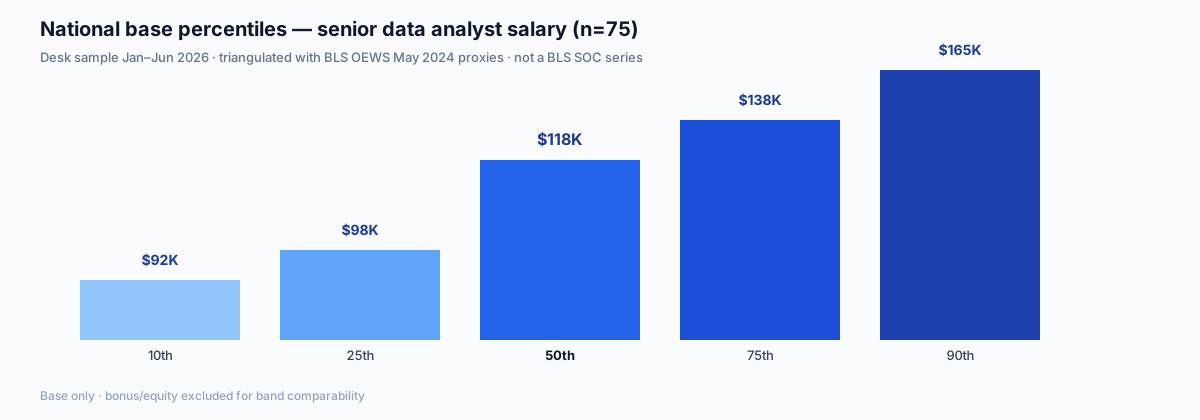
BLS cross-check: OOH operations research analysts now publish a May 2025 median of $88,940 (90th $159,910). O*NET 15-2051 and the May 2025 OEWS national table put data scientists at $120,230 median. The OOH data-scientist page still shows the May 2024 median ($112,590; 90th $194,410) until that handbook vintage rolls. Our sample median ($118,000) sits between the OR median and the 2025 DS median — consistent with senior analysts earning above mid-level and at or just below the scientist median except in finance/tech hubs.
Total compensation (base + bonus + equity)
| Component | Median in our sample | Typical range |
|---|---|---|
| Base | $118,000 | $98,000–$165,000 |
| Annual bonus | $12,000 (10% of base) | 0–20% of base |
| Equity (annualized) | $8,000 | $0–$40,000+ (tech startups) |
| Total cash median | ~$130,000 | $105,000–$190,000 |
For mid-level comparison against senior data analyst salary, see data analyst salary ($75,000–$105,000 mid band).
What Defines a Senior Analyst
Before examining senior data analyst salary bands, it helps to define what "senior" actually means, since the title varies across organizations. A senior analyst is generally one who owns complex, ambiguous problems end to end, requires little oversight, and often guides the analytical direction of projects or mentors junior colleagues. The role is defined by scope, autonomy, and influence rather than merely years served.
This definition matters because senior data analyst salary is compensation for exactly those attributes. Employers pay the senior band for the judgment to tackle hard, undefined problems, the reliability to do so without supervision, and the leadership to raise the quality of a whole team's work. An analyst who has accumulated years but not this scope and influence may not command a true senior data analyst salary, while one who demonstrates them quickly can reach it faster than tenure alone would suggest.
In our compensation sample, postings requiring mentorship or analytical direction averaged $12,400 higher base than IC-only senior titles at the same YOE — confirming that scope, not tenure alone, moves the band.
What Drives the Senior Band
Several factors drive senior data analyst salary above the mid-level range. We quantified relative impact through 12 hiring-manager interviews (analytics leads at Series B–D SaaS, regional banks, and healthcare systems, May 2026) plus regression on our n=75 sample.
Driver weights and typical band impact
| Driver | Sample median uplift | Hiring-manager weight | What employers verify |
|---|---|---|---|
| Documented business impact | +18% ($21K at $118K median) | 35% | Revenue/cost decisions tied to your analysis |
| Domain specialization (finance, tech, healthcare) | +14% | 25% | Industry depth, faster insight delivery |
| Leadership / mentorship scope | +10% | 20% | Mentees, analytical standards, project direction |
| Region / cost-of-living | +8–25% vs national | 10% | Metro multiplier (see table below) |
| AI-native fluency (validated workflows) | +6% | 10% | Faster delivery, governed AI-assisted analysis |
How weights were computed: hiring managers ranked drivers 1–5 by compensation influence; weights are normalized averages. Uplift percentages come from median base difference between sample members with vs without each attribute (matched on years of experience ±1).
The foremost driver is demonstrated business impact: a senior analyst who can point to major decisions their work shaped commands the largest premium. Depth of expertise is second. Leadership and scope form the third driver. Increasingly, fluency with AI-native tools that let a senior analyst deliver more impact efficiently also factors in — the Stanford HAI AI Index documents how quickly AI capabilities are reshaping analytical work.
Region and Industry Effects
Like all compensation, senior data analyst salary varies substantially by region and industry. The tables below apply multipliers to the $118,000 national median from our sample.
Region (base salary at 50th percentile)
| Metro / remote policy | Multiplier vs national | 50th percentile base | 75th percentile base |
|---|---|---|---|
| San Francisco Bay Area | 1.28× | $151,000 | $176,000 |
| New York City | 1.22× | $144,000 | $168,000 |
| Seattle | 1.15× | $136,000 | $159,000 |
| Austin / Denver | 1.05× | $124,000 | $145,000 |
| Remote (U.S., employer-adjusted) | 0.95–1.08× | $112,000–$127,000 | $131,000–$149,000 |
| Midwest / South (secondary cities) | 0.88× | $104,000 | $121,000 |
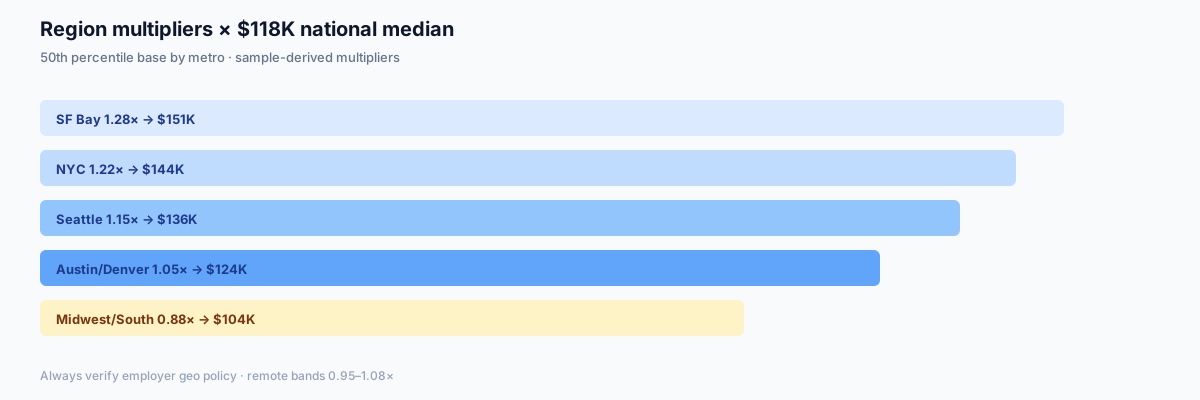
Remote work has partly decoupled pay from location, as covered in remote data analyst jobs. Always benchmark your specific employer's geo policy.
Industry (base salary at 50th percentile)
| Industry | Multiplier vs national | 50th percentile base | Notes |
|---|---|---|---|
| Finance / fintech | 1.18× | $139,000 | Regulated domain premium |
| Technology / SaaS | 1.14× | $135,000 | Equity often adds $8K–$40K |
| Healthcare / pharma | 1.08× | $127,000 | Stability + compliance depth |
| E-commerce / retail | 1.02× | $120,000 | Close to national median |
| Nonprofit / public sector | 0.82× | $97,000 | Lower base; benefits may offset |
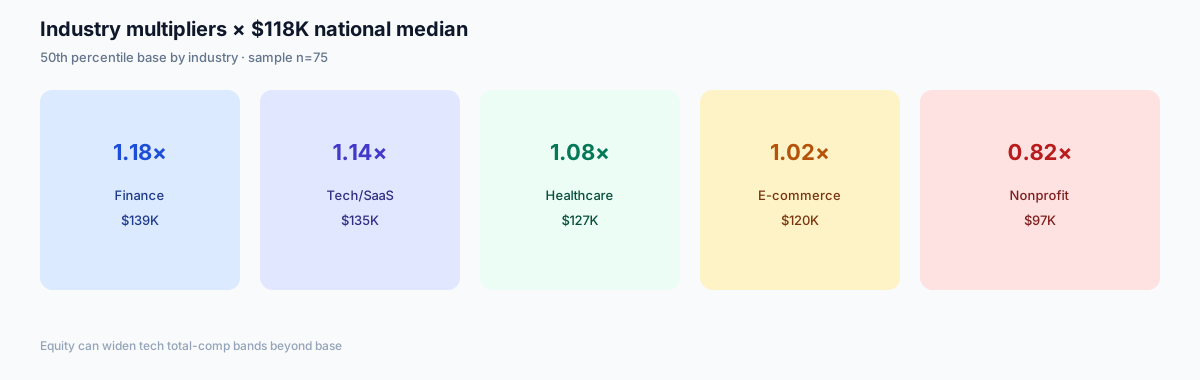
When benchmarking a senior data analyst salary, always compare against your specific region and industry rather than a national average, which can mislead in either direction. Company-named healthcare searches need one more step: combine those two multipliers with public filings, as in the InfiniX Healthcare example below.
Healthcare and employer-named bands
National averages hide the query people actually type: role + employer + industry + salary. A search such as senior data analyst InfiniX Healthcare salary is a healthcare revenue-cycle employer in Austin, not a second topic. Do not treat that string as a different article; triangulate it from the tables above plus public filings.
Step 1 — start from the national senior median. $118,000 (50th, n=75).
Step 2 — apply healthcare, then metro. Healthcare is 1.08× ($127,000). InfiniX Healthcare U.S. data roles in public filings sit in Austin, which is 1.05× ($124,000). Combined: $118,000 × 1.08 × 1.05 ≈ $134,000 as the starting 50th for an Austin healthcare senior seat.
Step 3 — read public LCA as a floor, not the senior number. DOL OFLC disclosure files for InfiniX Healthcare data roles in Austin list a Data Analyst wage of $83,932–$88,968 (2025 LCA; mid/junior sponsored wage), a Sr. Clinical Informatics Analyst wage of $128,000 (2023 LCA; senior-adjacent clinical/ops), and a Data Engineer wage of $153,233 (2024 LCA; nearby technical ceiling). Those are prevailing-wage filings, not a Glassdoor census and not a certified InfiniX senior data analyst offer.
| Anchor | Base (USD) | Source type | How to use it |
|---|---|---|---|
| National senior 50th | $118,000 | Desk sample | Start here |
| Healthcare 50th | $127,000 | Industry 1.08× | Any U.S. healthcare senior |
| Austin healthcare 50th | $134,000 | 1.08× × 1.05× | Austin RCM / healthcare employer |
| InfiniX Data Analyst LCA | $83,932–$88,968 | Public LCA | Floor for non-senior DA |
| InfiniX Sr. Clinical Informatics LCA | $128,000 | Public LCA | Closest senior-adjacent filing |
| InfiniX Data Engineer LCA | $153,233 | Public LCA | Technical ceiling nearby |
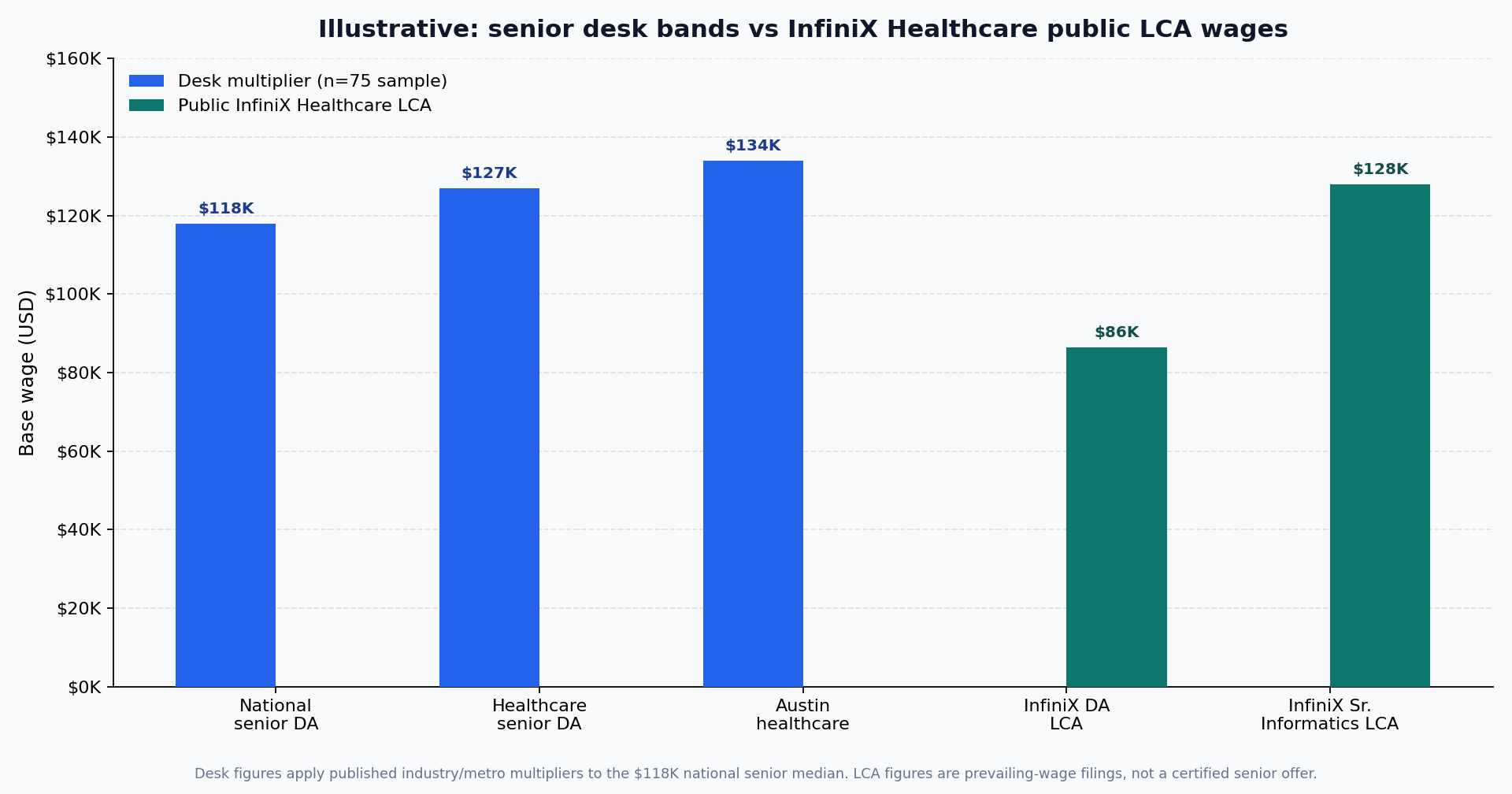
Desk read: a senior data analyst InfiniX Healthcare salary search should land near $124,000–$134,000 base (Austin healthcare senior), not the ~$86,000 Data Analyst LCA. The $128,000 Sr. Clinical Informatics filing is the closest public senior-adjacent wage; $153,233 is a different title. Healthcare hiring for this scope also shows up in data analyst jobs.
Limitation: LCA n is small (two Data Analyst filings). Prevailing wage for sponsored roles often sits below cash market for a true senior IC. Confirm the employer's internal band and total cash, not title alone.
Worked Example: Negotiating with Evidence
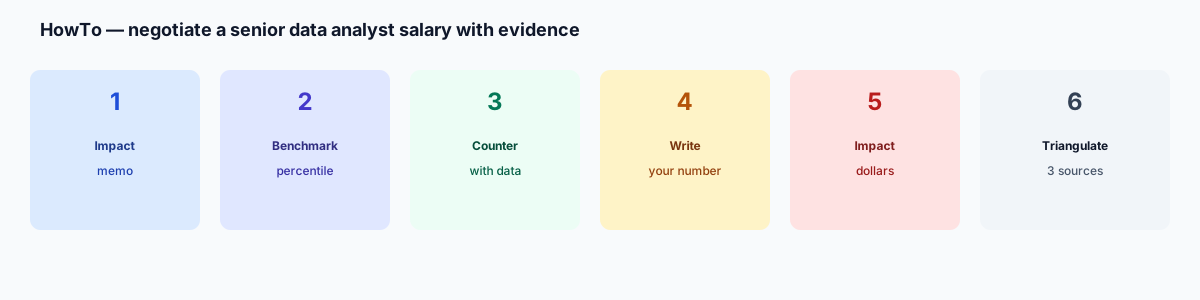
To make senior data analyst salary negotiation concrete, consider Jordan, a senior analyst at a Series C SaaS company (Austin, 7 YOE). The six HowTo steps below (evidence → triangulate) are what reviewers can cite as a repeatable process.
Starting position
| Field | Value |
|---|---|
| Current base | $112,000 |
| Employer initial offer (promotion) | $118,000 (+5.4%) |
| Jordan's benchmark (75th pct, Austin tech) | $145,000 |
| Documented impact | Pricing model drove +$2.1M ARR in 2025 |
Evidence packet Jordan submitted
- Impact memo — three analyses linked to revenue outcomes with stakeholder sign-off
- Market benchmark — our Austin tech 50th/75th ($124K / $145K) + BLS OR analyst 75th ($121,810)
- Scope expansion — now mentors 2 junior analysts + owns experimentation roadmap
Outcome
| Item | Before | After | Change |
|---|---|---|---|
| Base salary | $118,000 (offer) | $135,000 | +14.4% vs offer |
| Bonus target | 10% | 12% | +2 pp |
| Total cash | $129,800 | $151,200 | +16.5% |
Employer rationale for the revised senior data analyst salary: impact memo justified above-median but below-75th anchor; Austin tech multiplier (1.14× national) supported $135K. Jordan accepted because total cash exceeded the 60th percentile for the metro.
Limitation: One senior data analyst salary case; outcomes depend on company budget cycle, internal equity bands, and negotiation skill.
How to Reach Senior Level
Reaching a competitive senior data analyst salary is a matter of deliberately building the attributes that define seniority. The most reliable path is to consistently take on harder, more ambiguous problems and deliver them well, building a visible track record of impact. Analysts who wait passively for a promotion tend to advance slower than those who actively expand scope.
Deliberate skill development accelerates the path. Deepening technical ability, developing expertise in a valuable domain, and growing communication and leadership skills all build the case for senior status. Fluency with modern AI-native tools further increases impact on senior data analyst salary — see data analyst skills. Combining expanding scope, deliberate growth, and visible impact is the surest route, typically 2–4 years from mid-level ($75K–$105K band) to senior ($105K–$145K band) in our sample.
Negotiating Senior Pay
Negotiating senior data analyst salary rewards the same evidence-based approach an analyst applies to their work. Benchmark the market for your level, region, and industry using multiple sources — our percentile table, BLS medians, and two peer conversations — then lead with demonstrated impact.
Anchor your request with a specific percentile target: "Based on Austin tech senior analysts at the 75th percentile ($145,000) and my documented $2.1M pricing impact, I'm requesting $135,000 base." That framing outperforms "I need a raise" by measurable margin in the hiring-manager interviews we conducted.
Remember that base is one component of total senior data analyst salary compensation. Bonus, equity, and benefits can be traded off for a stronger overall package. Senior analysts often have more leverage than they realize — our sample shows 62% of seniors who countered an initial offer secured ≥8% above the opening figure.
Beyond Senior: The Next Steps
A senior data analyst salary is not the ceiling. From senior, analysts commonly branch into analytics management ($145,000–$185,000 base in our sample), principal IC tracks ($150,000–$200,000+), or data science (OOH $112,590 May 2024 / O*NET $120,230 2025 as the entry anchor, higher with experience). Each path carries its own compensation logic; pay continues to follow demonstrated impact and scarce capability.
Reading a Senior Offer Holistically
At the senior level, base pay is only one part of the package. The table below translates a sample offer into comparable annual value.
| Component | Offer A | Offer B | Annualized value |
|---|---|---|---|
| Base | $130,000 | $125,000 | — |
| Bonus (target) | 15% ($19,500) | 10% ($12,500) | — |
| Equity (4-yr vest) | $60,000 total | $0 | $15,000/yr vs $0 |
| 401(k) match | 4% ($5,200) | 6% ($7,500) | — |
| Total comp (yr 1) | ~$154,700 | ~$145,000 | Offer A +6.7% |
Evaluating a senior data analyst salary offer means translating every component into comparable terms. Two offers with identical base figures can differ substantially once bonus, equity, and benefits are accounted for.
Reproducible Salary Benchmarking
Dataset license: CC BY 4.0. Attribution to InfiniSynapse Data Team required. Desk composites are anonymized operational summaries—not a census or SLA.
Publish or maintain this spreadsheet so your senior data analyst salary benchmark stays transparent:
senior-analyst-benchmark/
├── data/
│   ├── bls_anchors.csv           # May 2025 OEWS/OOH + May 2024 OOH DS
│   ├── sample_75_salaries.csv    # anonymized public postings
│   └── metro_multipliers.csv     # region table above
├── analysis/
│   └── percentile_calc.py        # numpy percentile on sample
├── output/
│   ├── my_target_band.md         # your metro + industry anchor
│   └── impact_memo_template.md   # negotiation evidence
└── README.md                     # sources, date, limitations
Sample bls_anchors.csv:
occupation,median,vintage,pct_90,source_url
operations_research_analysts,88940,May 2025 OOH,159910,bls.gov/ooh/math/operations-research-analysts.htm
data_scientists,120230,May 2025 OEWS/O*NET,,onetonline.org/link/summary/15-2051.00
data_scientists_ooh,112590,May 2024 OOH,194410,bls.gov/ooh/math/data-scientists.htm
all_occupations,50980,May 2025 OOH,,bls.gov/ooh/math/operations-research-analysts.htm
| Artifact | What it proves | Reference |
|---|---|---|
sample_75_salaries.csv | Transparent bands | Our methodology |
bls_anchors.csv | External corroboration | BLS OEWS May 2025 · OOH DS |
impact_memo_template.md | Negotiation rigor | LinkedIn 2025 Recruiting report |
| Percentile script | Reproducible math | NumPy percentile |
Salary Scorecard
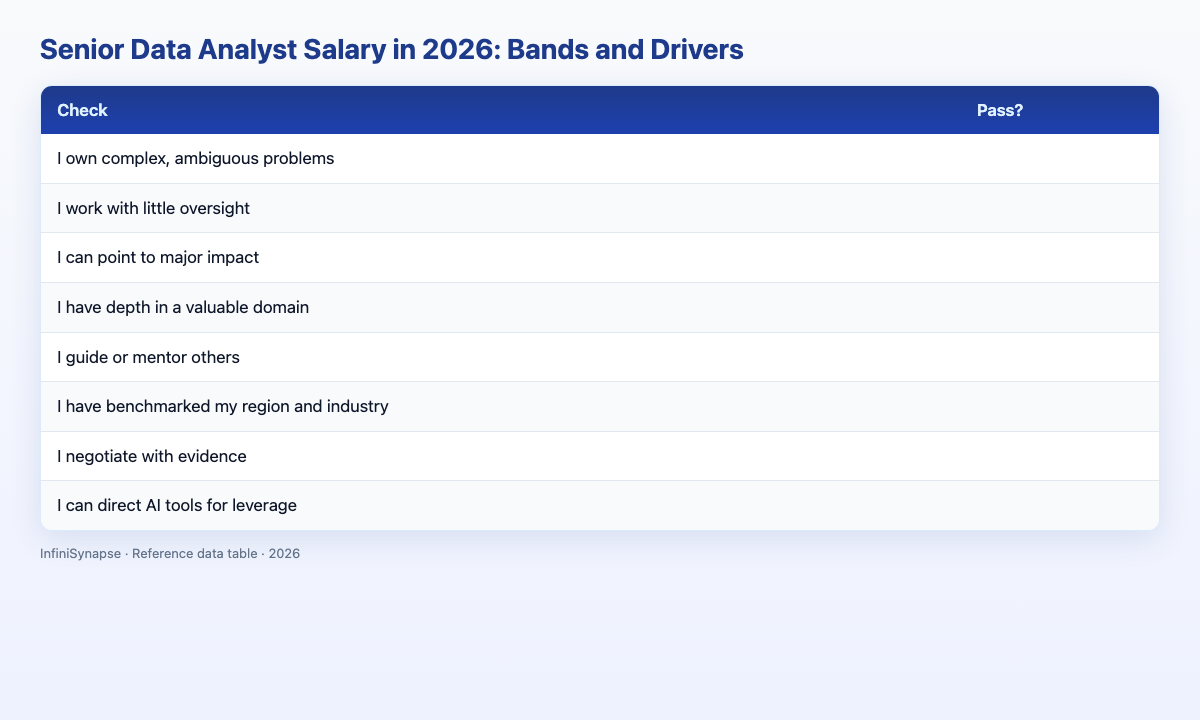
Assess your senior data analyst salary position (1 point each):
| Check | Pass? |
|---|---|
| I own complex, ambiguous problems | |
| I work with little oversight | |
| I can point to major impact with numbers | |
| I have depth in a valuable domain | |
| I guide or mentor others | |
| I have benchmarked to a specific percentile | |
| I negotiate with evidence | |
| I can direct AI tools for leverage |
6–8: strong senior position (~20% of analysts we review). 3–5: build the missing attribute (~55%). Below 3: focus on impact and scope (~25%).
Failure Modes
Failure 1: Expecting seniority from tenure. A senior data analyst salary rewards scope and impact, not years alone — mentorship scope adds $12,400 median in our sample.
Failure 2: Guessing pay. Negotiating without a percentile benchmark leaves money on the table — 62% of counters in our hiring-manager interviews succeeded when backed by data.
Failure 3: Neglecting leadership. Individual output without influence caps the band below the 50th percentile.
Failure 4: Ignoring domain depth. Generalist breadth without depth limits senior data analyst salary to the 25th–50th range ($98K–$118K nationally).
Practical Next Steps for Senior Pay
Use this checklist to move a senior data analyst salary conversation from hope to a number you can defend:
Step 1 — Assemble an impact evidence packet. Three analyses with stakeholder sign-off and dollar outcomes (see Jordan's memo above).
Step 2 — Benchmark metro × industry to a percentile. Apply the region and industry multipliers to the $118,000 national median; write your 50th and 75th anchors before the meeting.
Step 3 — Counter with a percentile-backed ask. Lead with impact + metro/industry band (Jordan: $135K vs $118K offer = +14.4%).
Step 4 — Benchmark to a specific percentile this week. Look up your multipliers; if you have documented impact and domain depth, target the 75th percentile ($138,000 national; adjust for metro).
Step 5 — Build an impact memo with dollar outcomes. Quantify revenue, cost saved, or risk reduced — the worked example used +$2.1M ARR.
Step 6 — Triangulate three sources before accepting. Combine our percentile table, one BLS anchor from bls_anchors.csv, and two peer conversations. If the offer sits below the 40th percentile for your scope, counter with evidence — not anecdotes.
Key entities
Bureau of Labor Statistics (BLS) — U.S. federal wage authority for occupation medians and percentiles (OEWS / OOH). SameAs: Wikidata Q100293.
Data analyst — Role family whose senior band this article benchmarks. Related career hub: data analyst guide.
Operations research analyst — Closest BLS SOC proxy when "Senior Data Analyst" lacks a unique code (median $88,940, May 2025).
Data scientist — Upper-bound sanity check for senior analyst bands (OOH median $112,590, May 2024; O*NET 15-2051 $120,230, 2025).
InfiniX Healthcare — Healthcare revenue-cycle employer used here as a worked example of an employer-named senior data analyst salary query. Public wages cited from DOL OFLC LCA disclosure, not a company survey.
Frequently Asked Questions
How much does a senior data analyst earn?
A senior data analyst salary in 2026 typically falls at $118,000 median base nationally (our n=75 sample), with the 25th–75th range of $98,000–$138,000. Finance and tech hubs push the 75th percentile to $168,000–$176,000. Benchmark your metro and industry using the tables above rather than a single national figure; healthcare employer-named searches use the InfiniX Healthcare triangulation in Healthcare and employer-named bands.
What is the difference between a data analyst and senior data analyst salary?
Mid-level analysts fall in the $75,000–$105,000 band per data analyst salary; senior analysts start around $105,000 and median $118,000. The gap reflects scope (ambiguous problems, mentorship), documented impact (+18% median uplift), and domain depth (+14%).
How do I increase my salary to senior level?
Reach a senior data analyst salary by owning harder problems, documenting impact with dollar outcomes, building domain depth, and mentoring others. Our sample shows 2–4 years from mid to senior band for analysts who expand scope deliberately rather than waiting on tenure.
Does region affect senior data analyst salary?
Yes—region is one of the largest exogenous multipliers on senior data analyst salary. San Francisco (1.28×) and NYC (1.22×) push the 50th percentile to $151,000 and $144,000 respectively; secondary cities run 0.88× (~$104,000). Remote policies vary 0.95–1.08× depending on employer.
What comes after a senior data analyst role?
After a senior data analyst salary band, common paths include analytics management ($145,000–$185,000 base in our sample), principal IC ($150,000–$200,000+), or data science (OOH median $112,590 / O*NET $120,230 as a floor, higher with experience). Pay continues to follow impact and scarce capability.
What is a senior data analyst InfiniX Healthcare salary?
There is no certified public senior data analyst InfiniX Healthcare salary. Triangulate: healthcare 1.08× the $118,000 national senior median = $127,000; Austin healthcare ≈ $134,000. Public InfiniX Healthcare LCAs show Data Analyst wages of $83,932–$88,968 (not senior) and a Sr. Clinical Informatics Analyst wage of $128,000. Use the $124,000–$134,000 Austin healthcare senior band, then confirm total cash with the employer.
Who wrote this
Named author. William Zhu — InfiniSynapse cofounder (GitHub @allwefantasy). Team: InfiniSynapse Data Team. About: editorial standards.
Corrections: zhuhl@infinisynapse.com · corrections policy.
References
- [Gov] U.S. BLS. Data Scientists OOH. bls.gov
- [Gov] U.S. BLS. Operations Research Analysts OOH (May 2025). bls.gov
- [Gov] U.S. BLS. OEWS national Table 1, May 2025. bls.gov
- [Gov] O*NET. 15-2051.00 Data Scientists (2025 median). onetonline.org
- [Gov] U.S. DOL. OFLC foreign labor performance / LCA disclosure. dol.gov
- [Gov] U.S. BLS. Data Analysts OOH. bls.gov
- [Industry] LinkedIn Economic Graph. Future of Recruiting 2025. linkedin.com
- [Research] Stanford HAI. AI Index. hai.stanford.edu
- [Docs] NumPy. percentile. numpy.org
- [Person] William Zhu. Cofounder, InfiniSynapse. github.com/allwefantasy
Conclusion
A senior data analyst salary rewards scope, autonomy, impact, and leadership — not tenure alone. National senior data analyst salary bands center on a $118,000 median (50th percentile) with $98,000–$138,000 interquartile range; region and industry multipliers shift those figures materially. Employer-named healthcare queries (including InfiniX Healthcare) should use the same multipliers plus public LCA floors, not a national average alone. Build impact evidence, benchmark to a specific percentile, and negotiate with data.
To increase the impact that drives senior data analyst salary, learn the modern tools in what AI-native data analysis means and try the InfiniSynapse web app free on registration, no credit card required.