Data Analyst Resume: Examples and Tips for 2026
By the InfiniSynapse Data Team · Last updated: 2026-07-08 · We build an AI-native data analysis platform and review analytics hiring materials with many teams; this guide reflects what actually gets a data analyst resume past screening in 2026.
Table of Contents
- TL;DR
- What a Resume Is Actually For
- The Structure That Works
- Writing the Summary
- Quantifying Your Experience
- The Skills Section
- The Portfolio Link
- Tailoring and Keywords
- Formatting for Applicant Tracking Systems
- Cover Letters and Beyond
- Resume Scorecard
- Common Mistakes
- Frequently Asked Questions
- Conclusion
TL;DR
Direct answer: a strong data analyst resume is concise, quantified, and tailored. It leads with a specific summary, presents experience as measurable impact rather than duties, lists real tools, links to a portfolio, and mirrors the language of the job posting so it passes both automated screening and human review.
Who this is for: anyone writing a data analyst resume for the 2026 job market.
What you'll learn: what a resume is for, the structure that works, how to quantify impact, which skills to list, and the mistakes that get resumes rejected.
This guide sits under the data analyst career hub; for the broader search, see data analyst jobs.
For related depth in this pillar, see Data Analyst Interview Questions and How to Answer Them and Data Analyst Job Description.
What a Resume Is Actually For
A data analyst resume has one job: to earn you an interview. It is not a complete autobiography or an exhaustive list of everything you have done; it is a targeted marketing document whose sole purpose is to convince a screener, in seconds, that you are worth talking to. Understanding this narrow purpose changes how you write every line, because it forces ruthless focus on what actually persuades rather than what merely describes. The move toward augmented workflows, outlined in IBM's augmented analytics overview, frames how teams evaluate modern tooling.
The reality a data analyst resume must survive is a two-stage screen. First, automated systems and quick human scans filter out most applications in seconds, so the resume must immediately signal relevance. Second, if it passes, a hiring manager reads it more carefully for evidence of impact. A resume that ignores either stage fails, which is why the strongest ones are both keyword-aware for the initial scan and substantively impressive for the closer read. This dual audience, grounded in the real work described in the Wikipedia data analysis overview, shapes every recommendation that follows.
The Structure That Works
An effective data analyst resume follows a predictable, screener-friendly structure. At the top sits a concise professional summary, followed by a skills section that surfaces relevant tools quickly, then experience presented as quantified accomplishments, and finally education and a prominent portfolio link. This ordering front-loads the information a screener needs to make a fast positive judgment.
Keep the data analyst resume to one page for early-career candidates and no more than two for experienced ones, because length dilutes impact and signals an inability to prioritize. Use clean, consistent formatting that automated systems can parse: standard section headings, simple bullet points, and no elaborate graphics or tables that parsers mangle. The goal is a document that is instantly scannable by a human and cleanly readable by software, since a beautifully designed data analyst resume that a parser cannot read is worse than a plain one that it can.
Writing the Summary
The summary at the top of a data analyst resume is prime real estate, and it should be specific rather than generic. A weak summary says "detail-oriented data analyst seeking opportunities to leverage skills." A strong one says "data analyst with three years turning product and marketing data into decisions that lifted retention and cut reporting time, fluent in SQL, Tableau, and AI-native analysis tools." The difference is concreteness and evidence of impact.
Tailor the summary of your data analyst resume to each role, echoing the language and priorities of the specific posting. A summary that mirrors the employer's stated needs signals fit immediately, both to the automated screen and to the human reader. Because this is the first thing anyone reads, investing disproportionate effort in these two or three sentences pays off, since a compelling summary earns the closer read that the rest of the data analyst resume needs to make its case. Enterprise adoption patterns in Google Cloud's AI overview mirror the shift from pilots to governed analytics.
Quantifying Your Experience
The single biggest differentiator in a data analyst resume is quantified impact. Screeners are numb to duty lists like "responsible for creating reports," which describe activity without outcome. They respond to measurable results: "built an automated dashboard that cut weekly reporting time by six hours" or "identified a churn driver that informed a retention campaign lifting renewals by eight percent." Numbers make impact concrete and credible.
To quantify a data analyst resume, revisit each role and ask what changed because of your work. What decision did your analysis inform, how much time did your automation save, what metric moved as a result? Even when exact figures are unavailable, reasonable estimates and directional outcomes beat pure duty descriptions. This discipline of framing experience as impact rather than activity is what most separates a data analyst resume that earns interviews from one that reads like a job description, because it demonstrates the very thing employers hire an analyst to produce: results.
The Skills Section
The skills section of a data analyst resume serves the automated screen especially, so it should list the real, relevant tools and abilities a posting seeks. Include SQL, spreadsheet proficiency, your visualization tools, any programming languages, and increasingly your fluency with AI-native analysis tools, which signal that you work the way modern teams do. We map the full set in data analyst skills.
Keep the skills section of your data analyst resume honest and specific rather than padded. Listing every technology you have ever touched dilutes the signal and risks an interview question you cannot answer. Instead, list the tools you can genuinely discuss and demonstrate, prioritizing those the posting names. A focused, truthful skills section both passes keyword screening and holds up under the interview scrutiny that follows, whereas an inflated one may win the screen only to collapse when a technical interviewer probes a skill you claimed but do not have.
The Portfolio Link
For analysts, a portfolio link elevates a data analyst resume from claims to evidence. A resume asserts that you can turn data into insight; a linked portfolio proves it, letting a hiring manager explore actual analyses you have produced. Place the link prominently, near the top, so it is easy to find, and ensure it leads to polished, well-explained work rather than half-finished experiments. The Stanford HAI AI Index documents how quickly AI capabilities are reshaping analytical work.
The portfolio behind a data analyst resume should showcase a small number of strong pieces, each framing a real question and ending in a clear recommendation, as discussed throughout this career pillar. This is especially decisive for candidates with limited professional experience, for whom the portfolio substitutes for a long work history. A data analyst resume paired with a compelling portfolio is far more persuasive than either alone, because together they claim a capability and immediately back the claim with explorable proof that a skeptical screener can verify in minutes.
Tailoring and Keywords
Tailoring is the highest-leverage habit for a data analyst resume. Rather than sending an identical document everywhere, adjust each submission to mirror the specific posting's language, priorities, and named tools. This matters for both screening stages: automated systems often match resume text against the posting, and human readers respond to a resume that visibly speaks to their stated needs.
Practically, tailoring a data analyst resume means reading each posting carefully and ensuring your summary, skills, and experience bullets reflect its emphasis without fabricating anything. If a role stresses stakeholder communication, foreground your communication accomplishments; if it stresses a particular tool you know, ensure that tool appears. This is not keyword stuffing but honest alignment, presenting your genuine experience in the terms the employer uses. A tailored data analyst resume dramatically outperforms a generic one, which is why the modest extra effort per application converts into far more interviews across a search.
Formatting for Applicant Tracking Systems
Much of the first screen is automated, so formatting a resume to be machine-readable is not optional. Applicant tracking systems parse the document into fields, and elaborate layouts defeat them. Use standard section headings that systems recognize, such as Experience, Skills, and Education, and avoid placing critical information inside headers, footers, text boxes, or images, which parsers frequently drop entirely. A clean, single-column layout with simple bullet points survives parsing far better than a two-column design with graphics.
The practical test is simple: copy the text of your document and paste it into a plain text file. If the result is jumbled, out of order, or missing content, the parser will likely mangle it too. Fonts should be common and legible, dates consistently formatted, and file type usually a standard document format the system accepts. This machine-readability discipline costs nothing in substance and prevents the frustrating outcome where a genuinely strong candidate is filtered out not for lack of qualification but because software could not read their application. Getting the plumbing right ensures your actual content reaches a human. Warehouse-grounded analytics should align with Databricks documentation on SQL warehouses and data governance.
Cover Letters and Beyond
While the resume does the heavy lifting, a well-crafted cover note still helps in many applications, especially when it is specific rather than formulaic. A short, tailored note that explains why this particular role and company interest you, and connects your experience to their stated needs, reinforces the fit your resume claims. Generic cover letters add little, but a specific one signals genuine interest and effort that a screener notices.
Beyond the resume and cover note, the strongest applications present a coherent professional story across every touchpoint. Your resume, portfolio, professional profile, and any cover note should tell a consistent narrative about the analyst you are and the value you create. When these elements align and reinforce one another, a candidate becomes memorable and credible in a way that a strong resume alone cannot achieve. Treating the application as an integrated package, rather than a set of disconnected documents, is a mark of the same clarity and coherence that employers hope to see in an analyst's actual work.
Resume Scorecard
Rate your data analyst resume (1 point each):
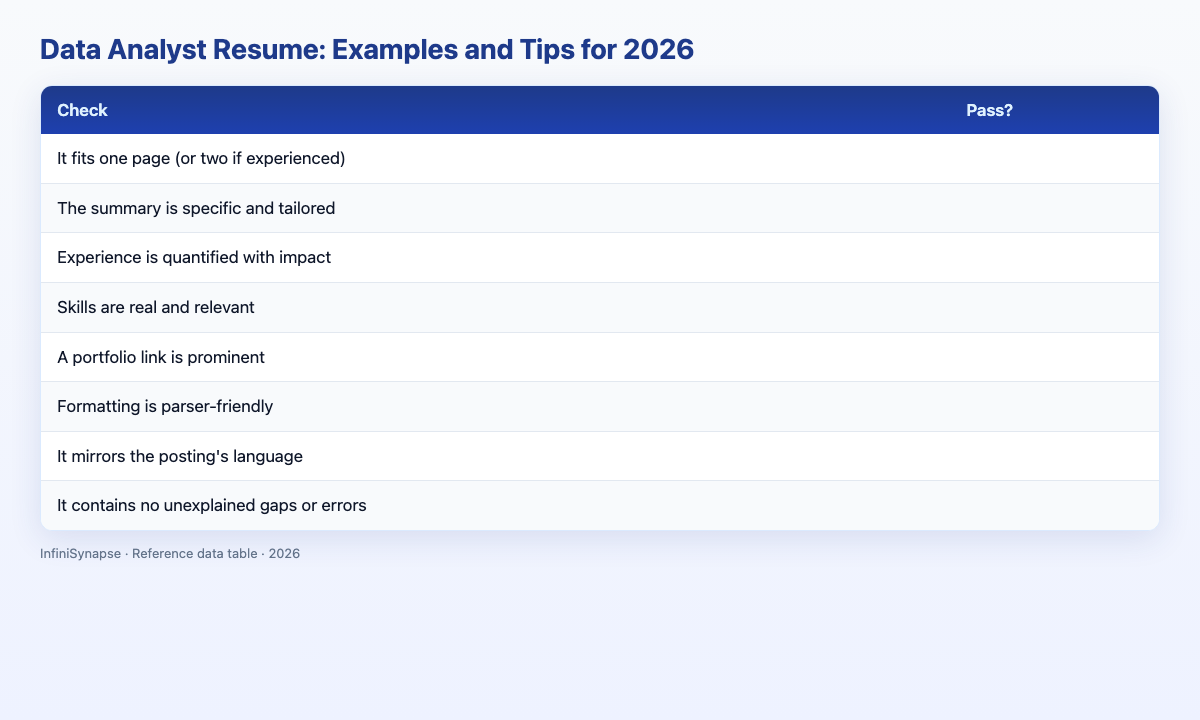
| Check | Pass? |
|---|---|
| It fits one page (or two if experienced) | |
| The summary is specific and tailored | |
| Experience is quantified with impact | |
| Skills are real and relevant | |
| A portfolio link is prominent | |
| Formatting is parser-friendly | |
| It mirrors the posting's language | |
| It contains no unexplained gaps or errors |
6–8: a strong resume. 3–5: tighten a section. Below 3: rewrite around impact.
Common Mistakes
Mistake 1: Listing duties, not impact. A data analyst resume of responsibilities without outcomes fails to persuade.
Mistake 2: Generic, untailored submissions. Identical resumes everywhere convert poorly.
Mistake 3: Overdesign. Graphics and tables that parsers cannot read sink an application.
Mistake 4: Padding skills. Inflated skills win the screen but collapse in the interview.
Frequently Asked Questions
What should a data analyst resume include?
A data analyst resume should include a specific professional summary, a skills section listing real tools like SQL and visualization software, experience presented as quantified impact, education, and a prominent portfolio link. It should be concise, parser-friendly, and tailored to each specific job posting.
How do I make my data analyst resume stand out?
Make a data analyst resume stand out by quantifying your impact rather than listing duties, tailoring it to each posting, and linking to a strong portfolio that proves your ability. Numbers, specificity, and explorable evidence of turning data into decisions are what most distinguish a resume that earns interviews.
How long should a be?
A data analyst resume should be one page for early-career candidates and no more than two pages for experienced ones. Length dilutes impact and can signal an inability to prioritize, so keep it concise and focused on the most relevant, quantified accomplishments rather than an exhaustive history.
Do \1employers require proof\2?
A portfolio strongly strengthens a data analyst resume by turning claims into explorable evidence, and it is especially important for candidates with limited professional experience. Link it prominently near the top, and ensure it showcases a few polished analyses that each frame a real question and end in a clear recommendation.
How do I \1get started\2?
Tailor a data analyst resume by reading each posting carefully and mirroring its language, priorities, and named tools in your summary, skills, and experience bullets, without fabricating anything. This honest alignment helps pass automated screening and signals fit to human readers, dramatically improving your interview rate.
Conclusion
A strong data analyst resume is concise, quantified, and tailored: it leads with a specific summary, frames experience as measurable impact, lists real skills, links to a portfolio, and mirrors each posting's language. Built this way, it passes both the automated screen and the human read that stand between you and an interview.
To strengthen the portfolio your resume links to, learn the modern tools in what AI-native data analysis means and try the InfiniSynapse web app free on registration, no credit card required.