Data Analyst Pay in 2026: Bands, Structure, and Negotiation
By the InfiniSynapse Data Team · Last updated: 2026-07-08 · We build an AI-native data analysis platform and work with analysts and hiring teams; this guide reflects how analyst pay is actually structured and negotiated in 2026.

Table of Contents
- TL;DR
- Pay Is More Than Base Salary
- The Components of Total Compensation
- What Moves Each Lever
- Pay by Level
- Benchmarking Your Pay
- Negotiating Total Compensation
- Pay Transparency and the Market
- Common Structures by Industry
- Pay Scorecard
- Failure Modes
- Frequently Asked Questions
- Conclusion
TL;DR
Direct answer: data analyst pay is best understood as total compensation, not just base salary. It combines base, bonus, equity, and benefits, each moved by different factors. Analysts who understand the whole structure and negotiate against a solid benchmark consistently secure stronger packages than those fixated on the headline base number alone.
Who this is for: analysts who want to understand and improve their data analyst pay in 2026.
What you'll learn: why pay is more than base, the components of total compensation, what moves each lever, pay by level, and how to benchmark and negotiate.
This guide sits under the data analyst career hub; for salary specifics, see data analyst salary and senior data analyst salary.
Pay Is More Than Base Salary
The most common mistake in thinking about data analyst pay is equating it with base salary alone. Base is the largest and most visible component for most analysts, but it is only one part of a package that can also include bonuses, equity, retirement contributions, benefits, and non-cash value like flexibility. Two roles with identical base figures can deliver very different total data analyst pay once everything is counted.
Understanding compensation holistically changes how you evaluate and negotiate offers. An analyst who fixates on base may accept a package that is weaker overall than an alternative with a lower base but stronger bonus, equity, or benefits. Conversely, understanding the full structure lets you compare offers accurately and negotiate the components that matter most to you. This total-compensation view, applied with the same rigor an analyst brings to any data problem, is the foundation for making good decisions about data analyst pay throughout a career.
The Components of Total Compensation
Data analyst pay typically comprises several components, each with its own logic. Base salary is the guaranteed cash paid regularly and forms the foundation. Bonuses, often tied to individual or company performance, add variable cash that can be significant in some industries and roles. Equity, common in startups and technology companies, offers ownership that may appreciate, trading certainty for upside. Enterprise adoption patterns in Google Cloud's AI overview mirror the shift from pilots to governed analytics.
Beyond cash and equity, data analyst pay includes benefits that carry real, if less visible, value: health coverage, retirement contributions, paid time off, learning budgets, and flexibility such as remote work. These components vary widely across employers, and their relative weight shifts by industry and company stage. A startup may offer lower base but meaningful equity, while an established enterprise may offer higher base and richer benefits with little equity. Understanding how these pieces fit together is essential to comparing data analyst pay across different types of employers accurately rather than being misled by a single figure.
What Moves Each Lever
Different factors move the different components of total compensation. Base salary responds mainly to experience level, region, industry, and demonstrated skill, rising steeply with seniority and domain expertise. Bonus potential depends on the role and industry, with finance and sales-adjacent analytics roles often carrying larger variable components than others.
Equity in data analyst pay is driven by company stage and your level within it, with earlier-stage companies typically offering larger equity grants to offset lower cash and higher risk. Benefits reflect employer policy and vary less with individual performance. The practical implication is that improving your data analyst pay requires understanding which lever you are pulling: advancing your level and expertise raises base, choosing a certain industry or company stage shapes bonus and equity, and negotiating can adjust several at once. Analysts who understand these distinct drivers make more strategic career and offer decisions than those who treat pay as a single undifferentiated number.
Pay by Level
Data analyst pay rises with level in a fairly predictable progression. Entry-level and junior roles, covered in entry level data analyst jobs, pay a solid starting wage. Mid-level analysts who own problems independently earn meaningfully more, and senior analysts, whose pay we detail in senior data analyst salary, command the top of the individual-contributor range. The Stanford HAI AI Index documents how quickly AI capabilities are reshaping analytical work.
The jumps between levels in data analyst pay are typically larger than annual raises within a level, which is why advancement drives compensation growth more than tenure. Beyond senior individual-contributor roles, pay continues to rise into management or principal tracks. The clear lesson for maximizing data analyst pay over a career is to focus on the capabilities that earn advancement, owning bigger problems, developing scarce expertise, and demonstrating impact, since progression through levels moves the total package far more than incremental raises at a single level ever will.
Benchmarking Your Pay
Benchmarking is essential to understanding whether your data analyst pay is competitive. Gather data from multiple sources, including public salary surveys, authoritative labor statistics such as the OECD AI policy observatory, and, most valuably, conversations with peers in similar roles, regions, and industries. Triangulating several sources produces a realistic range rather than a single misleading figure.
When benchmarking data analyst pay, account for the full package rather than base alone, and adjust for your specific region, industry, and level, since a national average can mislead badly in either direction. Document your benchmark with its sources so you can reference it in negotiations. Analysts who benchmark rigorously understand their market worth and negotiate from evidence, while those who guess either undervalue themselves or set unrealistic expectations. Treating the benchmarking of your own data analyst pay as a small analytical project, gathering data and reaching a defensible conclusion, is exactly the discipline the role itself rewards.
Negotiating Total Compensation
Negotiating data analyst pay effectively means negotiating the whole package, not just base. Lead with demonstrated impact and a documented market benchmark, anchoring your request in evidence rather than personal need. Then recognize that if an employer cannot move base far, other components of data analyst pay, such as bonus, equity, additional paid time off, a learning budget, or remote flexibility, may be negotiable and can materially improve the overall deal.
Approach negotiating data analyst pay collaboratively, framing it as finding a fair arrangement that reflects your value rather than a confrontation. Be prepared to prioritize the components that matter most to you and to trade off among them, and be willing to walk if an offer sits well below your benchmark. Analysts often have more leverage than they assume, especially when their skills are scarce, and negotiating data analyst pay the way you would present an analysis, with data and clear reasoning, tends to produce strong, durable outcomes that a purely emotional or need-based approach cannot match.
Pay Transparency and the Market
The market has grown more transparent, which shifts leverage toward informed candidates. Many regions now require employers to publish salary ranges in job postings, and public survey data has become richer and easier to access. This transparency means an analyst who does their homework can enter a conversation already knowing the plausible range for a role, which levels a playing field that historically favored employers who held more information than applicants. The discipline follows the process described in the Wikipedia overview of data analysis.
Transparency cuts both ways, however, and it rewards preparation rather than replacing it. Published ranges are often wide, and a posted band tells you little about where within it you will land or how the variable and equity components are structured. The informed analyst uses public ranges as a starting point, then refines the picture through peer conversations and targeted research to understand the full structure. Treating market transparency as raw material for analysis, rather than a finished answer, is what turns broadly available information into genuine negotiating leverage that a less prepared candidate cannot match.
Common Structures by Industry
Compensation structures differ enough across industries that the same headline figure can mean very different things. In finance, variable bonuses often form a large share of the package, so two roles with identical base can diverge sharply once performance pay is counted. In technology, especially at startups, equity can dominate, trading cash certainty for potential upside that depends heavily on the company's fortunes. In stable sectors like government or established non-profits, base tends to be steadier with fewer variable or equity components but often stronger benefits and security.
Understanding these industry patterns helps an analyst compare offers across sectors accurately and choose an environment that matches their risk tolerance and priorities. Someone who values predictability may prefer a structure weighted toward base and benefits, while someone comfortable with risk may chase equity upside at an early-stage company. Neither preference is wrong, but confusing the structures, such as judging a startup offer by base alone or a finance role without accounting for bonus, leads to poor decisions. Reading each offer in the context of its industry's typical structure is essential to evaluating it fairly.
Pay Scorecard
Assess your data analyst pay position (1 point each): The move toward augmented workflows, outlined in IBM's augmented analytics overview, frames how teams evaluate modern tooling.
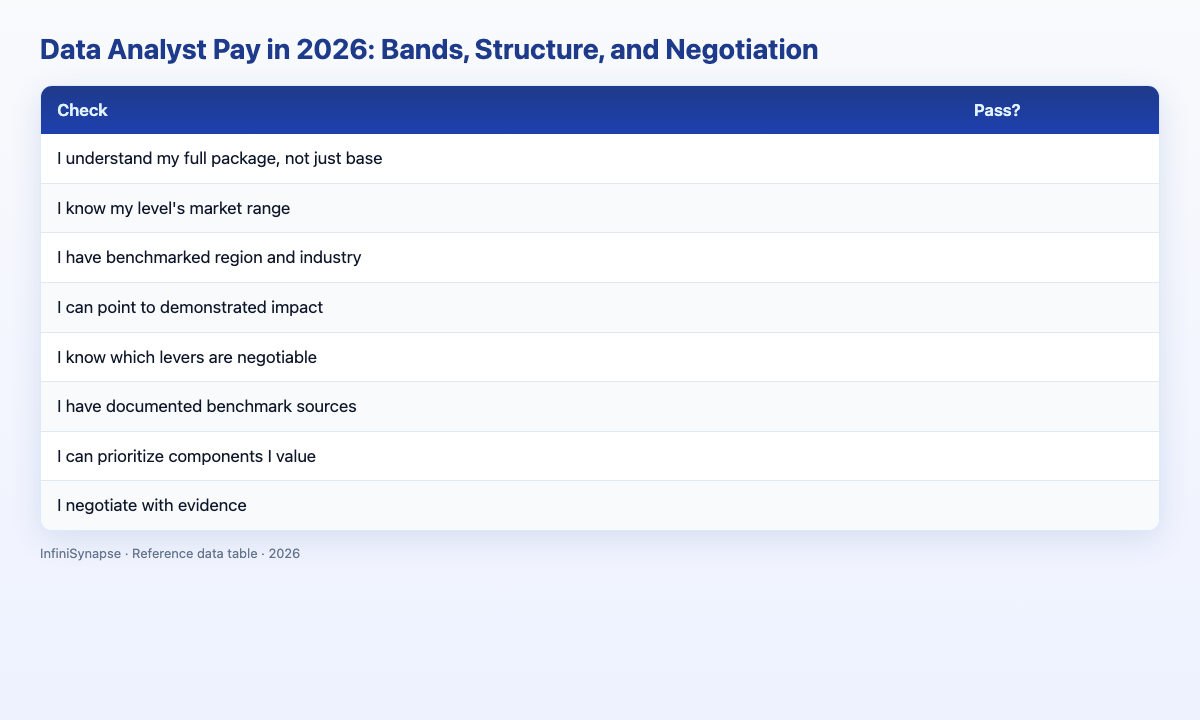
| Check | Pass? |
|---|---|
| I understand my full package, not just base | |
| I know my level's market range | |
| I have benchmarked region and industry | |
| I can point to demonstrated impact | |
| I know which levers are negotiable | |
| I have documented benchmark sources | |
| I can prioritize components I value | |
| I negotiate with evidence |
6–8: strong position. 3–5: gather more evidence. Below 3: benchmark before acting.
Failure Modes
Failure 1: Fixating on base. Judging data analyst pay by base alone misreads the true value of an offer.
Failure 2: Guessing the market. Negotiating without a benchmark leaves money on the table.
Failure 3: Negotiating only base. Ignoring negotiable bonus, equity, and benefits forfeits value.
Failure 4: Negotiating on need. Employers respond to demonstrated impact, not personal circumstances.
Frequently Asked Questions
What is included in data analyst pay?
Data analyst pay includes base salary, bonuses often tied to performance, equity that is common at startups and technology companies, and benefits such as health coverage, retirement contributions, paid time off, learning budgets, and flexibility. Judging an offer requires accounting for this whole package, not just the base figure.
How is data analyst pay structured?
Data analyst pay is structured as total compensation combining base salary, variable bonus, equity, and benefits, with the mix varying by industry and company stage. Startups often weight equity more heavily with lower base, while established enterprises typically offer higher base and richer benefits with little or no equity.
How can I \1improve outcomes\2?
Increase your data analyst pay by advancing levels rather than just accruing tenure, developing scarce expertise in a valuable domain, demonstrating measurable impact, and benchmarking and negotiating the whole package with evidence. Progression through levels moves total compensation far more than incremental raises within a single level.
How do I \1get started\2?
Benchmark data analyst pay using multiple sources: public salary surveys, authoritative labor statistics, and conversations with peers in similar roles, regions, and industries. Account for the full package and adjust for your specific context, since a national average can mislead. Document the sources so you can reference them in negotiations.
What is the difference between and salary?
Salary usually refers to base cash pay, while data analyst pay refers to total compensation including base, bonus, equity, and benefits. Understanding this distinction matters because two roles with the same salary can offer very different total data analyst pay once bonus, equity, and benefits are counted.
Conclusion
Data analyst pay is best understood as total compensation across base, bonus, equity, and benefits, each moved by different factors. Analysts who grasp the whole structure, benchmark rigorously, and negotiate the full package with evidence consistently secure stronger outcomes than those fixated on base alone.
To build the impact and scarce skills that raise pay, learn the modern tools in what AI-native data analysis means and try the InfiniSynapse web app free on registration, no credit card required.