Data Analyst Internship: Finding and Winning One in 2026
By the InfiniSynapse Data Team · Last updated: 2026-07-08 · We build an AI-native data analysis platform and work with early-career analysts; this guide reflects how internships actually launch analytics careers in 2026.

Table of Contents
- TL;DR
- Why an Internship Is the Best On-Ramp
- What the Internship Involves
- How to Qualify
- Where to Find One
- Winning the Offer
- Converting It Into a Full-Time Role
- Making the Most of the Experience
- Life After the Experience
- Internship Scorecard
- Failure Modes
- Frequently Asked Questions
- Conclusion
TL;DR
Direct answer: a data analyst internship is the most reliable on-ramp into the field, offering real experience, mentorship, and often a path to a full-time offer. You qualify with foundational skills and a small portfolio, and you win one through a targeted search, a tailored application, and interview preparation focused on SQL and communication.
Who this is for: students and career changers seeking a data analyst internship in 2026.
What you'll learn: why internships are the best on-ramp, what they involve, how to qualify and find one, how to win the offer, and how to convert it into a full-time role.
This guide sits under the data analyst career hub; for the broader entry point, see entry level data analyst jobs.
For related depth in this pillar, see Junior Data Analyst Jobs: What to Expect in 2026.
Why an Internship Is the Best On-Ramp
A data analyst internship is often the single most effective way to break into analytics, and the reason is that it resolves the experience paradox directly. Entry-level roles want experience you do not yet have; an internship is explicitly designed to give it to you. It provides real data, real stakeholders, and real deadlines in a structured, supported environment where learning is the expectation rather than an afterthought.
Beyond experience, a data analyst internship offers mentorship and a professional network that are hard to obtain any other way. Working alongside experienced analysts, you absorb not just technical skills but the judgment and communication habits that define the role, watching how professionals frame questions and handle ambiguity. Many internships also serve as extended interviews that convert into full-time offers, making the internship a low-risk audition for both sides. For anyone following the path described in how to become a data analyst, securing a data analyst internship accelerates every subsequent step.
What the Internship Involves
A typical data analyst internship involves supporting the analytics team with real but appropriately scoped work. Interns commonly pull and clean data, build or update dashboards, run defined analyses under guidance, and present their findings to the team. The work is genuine and contributes to the organization, but it comes with more support and less pressure than a full-time role, which is exactly what makes it an ideal learning environment. The Stanford HAI AI Index documents how quickly AI capabilities are reshaping analytical work.
The structure of a data analyst internship is a feature for a newcomer. Because expectations are calibrated for someone still learning, an intern can make the inevitable early mistakes in a supportive setting, ask questions freely, and build fluency without being thrown into the deep end. Interns who embrace this structure, treating every task as a learning opportunity and every mistake as feedback, progress rapidly. The work follows the same disciplined process described in the Wikipedia data analysis overview, just with mentorship surrounding it and room to grow.
How to Qualify
Qualifying for a data analyst internship is more accessible than qualifying for a full-time role, since employers expect less prior experience. The foundations still matter: basic SQL, spreadsheet comfort, and familiarity with a visualization tool form the technical baseline. A small portfolio of one or two analyses, even on public data, meaningfully strengthens an application by demonstrating genuine interest and initiative.
Beyond technical basics, employers offering a data analyst internship look heavily for aptitude and attitude. They want curiosity, a willingness to learn, and the communication skills to work within a team, since much of the internship is about developing technical depth on the job. This means a candidate who is not yet technically polished but shows clear promise and eagerness can win a data analyst internship over a more skilled but less motivated applicant. Demonstrating genuine enthusiasm for the field, backed by even a modest portfolio, goes a long way at this stage.
Where to Find One
Finding a data analyst internship works best through several channels. University career services are a prime source for students, often with relationships to employers actively seeking interns. Company career pages list internship programs, and large organizations frequently run structured summer programs with defined application windows worth tracking in advance. Warehouse-grounded analytics should align with Databricks documentation on SQL warehouses and data governance.
Beyond formal programs, a data analyst internship can also emerge from proactive outreach. Smaller companies and startups may not advertise internships but will create one for a promising candidate who reaches out with a clear pitch and a portfolio. Analytics communities and networking also surface opportunities that never appear on job boards. Casting a wide net, and being willing to propose an internship where none is advertised, expands the options considerably beyond the well-known structured programs that attract the most competition.
Winning the Offer
Winning a data analyst internship offer comes down to a tailored application and solid interview preparation. Rather than sending the same materials everywhere, tailor each application to the specific organization, showing genuine interest in their work and how your skills and portfolio fit. A brief, specific cover note explaining why this internship interests you distinguishes you from applicants who clearly applied in bulk.
Interview preparation for a data analyst internship should focus on the fundamentals employers actually test: basic SQL, a simple analytical problem, and communication. Practice explaining your portfolio projects clearly, since the ability to walk through your reasoning matters as much as technical correctness at this level. We cover the common ground in data analyst interview questions. Demonstrating enthusiasm, coachability, and clear communication throughout the process often matters more than technical perfection, because employers hiring interns are investing in potential rather than a finished product.
Converting It Into a Full-Time Role
The greatest value of a data analyst internship is often the full-time offer it can produce, and converting one requires deliberate effort during the internship itself. Treat every task as an audition: deliver reliable, well-communicated work, ask thoughtful questions, and show that you can be trusted with increasing responsibility. Interns who consistently exceed the modest expectations set for them make the conversion decision easy for the team.
Converting a data analyst internship also depends on relationships and visibility. Build genuine connections with the team, make your contributions visible through clear communication, and express your interest in a full-time role before the internship ends. Fluency with modern tools, including AI-native platforms, further strengthens your case by showing you work the way the team does. Even when a full-time role is not immediately available, a strong data analyst internship yields references, a portfolio of real work, and a network that accelerates the next opportunity, so the effort pays off regardless of the immediate outcome.
Making the Most of the Experience
Beyond simply completing assigned tasks, the interns who benefit most treat the experience as an immersive learning opportunity with a finite window. They observe how experienced colleagues frame ambiguous problems, ask why behind the requests they receive, and seek feedback actively rather than waiting for it. This posture transforms a few months of scoped work into a dense apprenticeship that compresses what might otherwise take a year of solo learning into a fraction of the time, because a good mentor can correct in minutes a misunderstanding that would take weeks to unlearn alone. The move toward augmented workflows, outlined in IBM's augmented analytics overview, frames how teams evaluate modern tooling.
Documentation and reflection amplify the value further. Keeping a running record of the analyses completed, the obstacles encountered, and the lessons learned reinforces the learning and builds a concrete portfolio of real work with genuine business context attached. This record becomes invaluable when the experience ends, supplying specific stories for future interviews and evidence of impact for conversations about a full-time role. Interns who invest a little effort in reflection consistently extract more lasting value than those who simply move from task to task, because the deliberate processing of experience is what converts activity into durable skill and memorable narrative.
Life After the Experience
When the internship concludes, its value extends well beyond whatever immediate offer may or may not follow. A completed internship yields a portfolio of real, business-context work that dramatically strengthens future applications, distinguishing a candidate from peers whose experience is limited to coursework and personal projects. It also produces professional references who can speak to your ability in a real workplace, which carry far more weight with employers than academic references alone.
Perhaps most valuably, the experience produces a professional network that keeps opening doors long after it ends. The colleagues you worked with move to other companies, hear of openings, and remember analysts who delivered reliable work and communicated well. Maintaining these relationships, even lightly, turns a single internship into a durable source of future opportunities. For anyone building the analytics career described across this pillar, treating the internship as the first node in a growing professional network, rather than an isolated line on a resume, is one of the highest-return moves available early in a career.
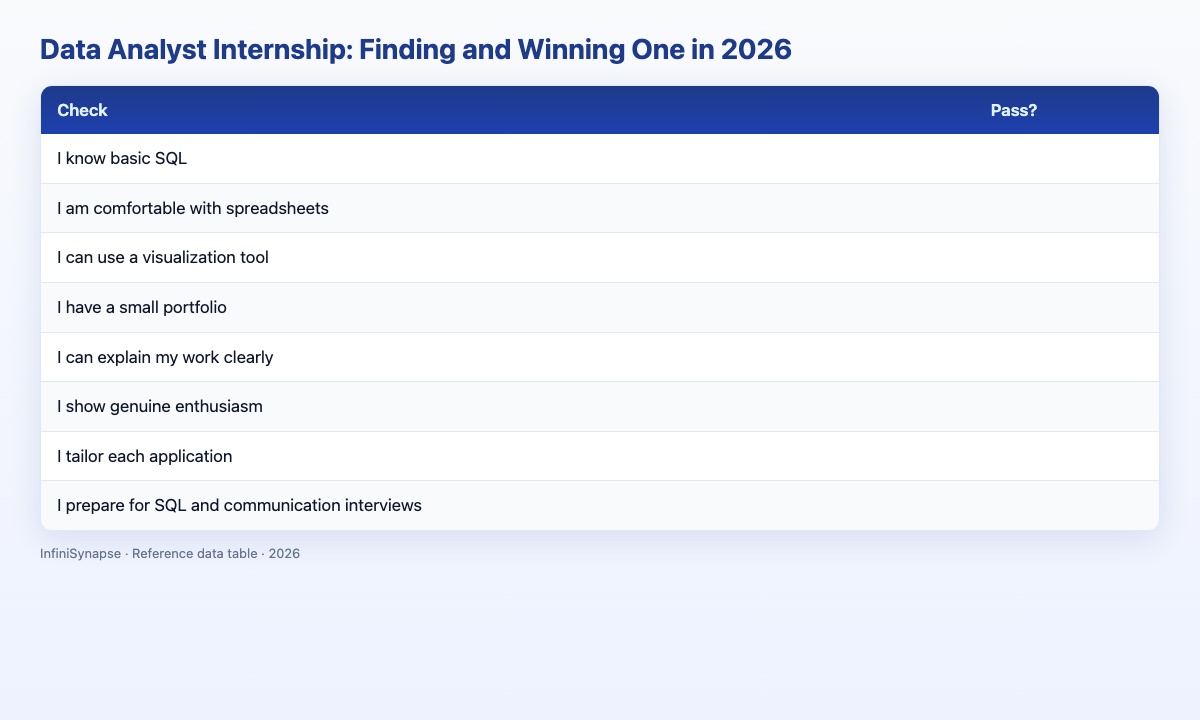
Internship Scorecard
Assess your readiness for an internship (1 point each): Enterprise adoption patterns in Google Cloud's AI overview mirror the shift from pilots to governed analytics.
| Check | Pass? |
|---|---|
| I know basic SQL | |
| I am comfortable with spreadsheets | |
| I can use a visualization tool | |
| I have a small portfolio | |
| I can explain my work clearly | |
| I show genuine enthusiasm | |
| I tailor each application | |
| I prepare for SQL and communication interviews |
6–8: ready to apply. 3–5: build a portfolio piece. Below 3: learn the fundamentals first.
Failure Modes
Failure 1: Applying only to advertised programs. A data analyst internship can be created through proactive outreach.
Failure 2: Generic applications. Untailored applications rarely win competitive internships.
Failure 3: Coasting during the internship. Treating it passively wastes the conversion opportunity.
Failure 4: Staying invisible. Undemonstrated contributions and unexpressed interest lose the full-time offer.
Frequently Asked Questions
What does a data analyst internship involve?
A data analyst internship involves supporting the analytics team with real but scoped work: pulling and cleaning data, building dashboards, running defined analyses under guidance, and presenting findings. It offers real experience with more support and less pressure than a full-time role, making it an ideal learning environment for newcomers.
How do I get a data analyst internship with no experience?
Get a data analyst internship with no experience by building foundational skills in SQL, spreadsheets, and a visualization tool, plus a small portfolio of one or two analyses. Employers expect less experience for internships and weight curiosity, enthusiasm, and coachability heavily, so genuine interest backed by a modest portfolio suffices.
Where can I \1find openings\2?
Find a data analyst internship through university career services, company career pages and structured summer programs, and analytics communities. You can also create one through proactive outreach to smaller companies and startups that will make a role for a promising candidate with a clear pitch and portfolio.
Do \1employers require proof\2?
Yes, a data analyst internship frequently leads to a full-time offer, since many function as extended interviews. Convert one by delivering reliable work, building relationships, making contributions visible, and expressing interest before it ends. Even without an immediate offer, it yields references, portfolio work, and a valuable network.
What skills do I need a ?
For a data analyst internship you need basic SQL, spreadsheet comfort, and familiarity with a visualization tool, plus a small portfolio and genuine enthusiasm. Employers hiring interns invest in potential, so curiosity, coachability, and clear communication matter as much as polished technical skill at this stage.
Conclusion
A data analyst internship is the most reliable on-ramp into analytics, giving you real experience, mentorship, and often a path to a full-time offer. Qualify with foundational skills and a small portfolio, search widely including through proactive outreach, and treat the internship itself as an audition worth acing.
To build the modern skills that impress internship teams, read what AI-native data analysis means and try the InfiniSynapse web app free on registration, no credit card required.