Data Analysis Meaning, Explained Simply for 2026
By the InfiniSynapse Data Team · Last updated: 2026-07-08 · We build an AI-native data analysis platform and explain the field to non-technical people daily; this guide reflects the plainest way to convey the meaning.
Table of Contents
- TL;DR
- The Meaning in Plain English
- An Everyday Analogy
- What the Words Really Mean
- The Meaning in a Work Context
- What It Is Not
- Why the Meaning Is Worth Knowing
- Everyday Examples of the Meaning
- From Meaning to Doing
- Meaning Scorecard
- Common Misunderstandings
- Frequently Asked Questions
- Conclusion
TL;DR
Direct answer: the data analysis meaning in plain English is simply making sense of information to answer a question. You take a pile of facts or numbers, look at them carefully, and figure out what they are telling you. It is organized curiosity applied to data, and everyone does a version of it already.
Who this is for: non-technical readers who want the data analysis meaning explained without jargon.
What you'll learn: the meaning in plain English, an everyday analogy, what the words really mean, how it applies at work, and what it is not.
For a more formal treatment, see the data analysis definition; for a beginner's guide, see what is data analysis.
For related depth in this pillar, see Analysis of Data: Process, Steps, and Examples.
The Meaning in Plain English
The data analysis meaning, stripped of jargon, is making sense of information. That is genuinely all it is at heart. When you look at your monthly bank statement and figure out where your money went, you are doing a form of it. When a shop owner notices that weekends are busier and staffs accordingly, that is the data analysis meaning in action. The move toward augmented workflows, outlined in IBM's augmented analytics overview, frames how teams evaluate modern tooling.
Understanding the data analysis meaning this way removes the intimidation that the technical vocabulary creates. The field has plenty of sophisticated tools and methods, but the underlying meaning is simple and human: you have information, you have a question, and you work out the answer by examining the information carefully. Everything else, described more formally in the Wikipedia overview of data analysis, is elaboration on this plain and approachable core.
An Everyday Analogy
A good analogy makes the data analysis meaning click. Think of a detective solving a case. The detective gathers clues, sorts the relevant from the irrelevant, looks for patterns and connections, and reaches a conclusion about what happened. That is almost exactly the data analysis meaning: clues are data, sorting is cleaning, finding patterns is analysis, and the conclusion is the insight.
The detective analogy captures the data analysis meaning because both start with a question and end with an evidence-based answer. A detective who ignored the clues and guessed would be a bad detective, just as analysis that ignores the data and assumes an answer is bad analysis. This is why the data analysis meaning centers on letting the evidence guide the conclusion rather than the other way around. Once you see analysis as detective work with data, the meaning feels natural rather than technical.
What the Words Really Mean
Breaking the phrase apart clarifies the data analysis meaning. "Data" simply means facts or information, often but not always numbers; a list of customer names, a set of temperatures, or a pile of survey responses are all data. "Analysis" means examining something closely to understand it, breaking it into parts to see how they fit together. Dashboard-centric workflows sit within the broader Wikipedia business intelligence overview.
Put together, the data analysis meaning is examining information closely to understand it and answer a question. There is nothing mysterious in the words once they are unpacked. This plain reading also explains why the data analysis meaning applies so widely: any time you have information and want to understand it, you are in the territory the phrase describes. The vocabulary sounds technical, but the meaning it points to is something people grasp intuitively the moment the words are explained simply.
The Meaning in a Work Context
In a workplace, the data analysis meaning takes on a practical shape. It means using the organization's data, such as sales figures, customer records, or operational metrics, to answer business questions and guide decisions. A marketer analyzing which campaign performed best, or a manager reviewing which process is slowest, is applying the data analysis meaning to real work.
What makes the data analysis meaning valuable at work is that it replaces guessing with evidence. Instead of deciding based on hunches, people who understand analysis base decisions on what the data actually shows. This is why the skill is so prized across roles, and why understanding the data analysis meaning benefits anyone whose job involves decisions, which is nearly everyone. The workplace version is the same meaning applied to business questions, with the added stakes that better analysis leads to better decisions and outcomes.
What It Is Not
Clarifying the data analysis meaning also means saying what it is not. It is not simply collecting data; gathering numbers without examining them is not analysis, just as owning a pile of clues does not solve a case. Collection is a preliminary step, not the meaning itself. Enterprise adoption patterns in Google Cloud's AI overview mirror the shift from pilots to governed analytics.
Nor is the data analysis meaning the same as displaying data. A chart or dashboard that shows numbers without interpreting them is presentation, not analysis. The data analysis meaning specifically involves making sense of the information, drawing out what it means, not merely showing it. It is also not about complexity for its own sake; sophisticated math is sometimes involved, but the data analysis meaning is about understanding, and often a simple examination understands better than an elaborate one. Keeping these boundaries clear preserves the plain, useful meaning.
Why the Meaning Is Worth Knowing
Grasping the data analysis meaning is worth the small effort because it demystifies a field that intimidates many people. Once you understand that the meaning is simply making sense of information, the technical tools and methods become approachable additions rather than barriers. You realize you already do a version of analysis and can build from there.
Knowing the data analysis meaning is also increasingly valuable as data pervades work and life. People who understand it can engage confidently with data-driven decisions, ask good questions of the numbers others present, and avoid being misled by poor analysis. In 2026, with data everywhere and AI-native tools making analysis more accessible, understanding the data analysis meaning is a foundational literacy, much like reading, that empowers people to navigate an information-rich world with confidence rather than confusion.
Everyday Examples of the Meaning
Everyday examples make the meaning concrete and show how naturally people already practice it. When you compare prices across a few shops before buying, weighing quality against cost, you are making sense of information to reach a decision. When a coach reviews which plays worked over a season and adjusts the strategy, that is the same activity applied to sport. When a parent notices which bedtime routine leads to fewer tantrums, they are drawing an evidence-based conclusion from observation. The Stanford HAI AI Index documents how quickly AI capabilities are reshaping analytical work.
These examples matter because they reveal that the activity is not confined to offices or laboratories. People make sense of information constantly, often without naming it. Recognizing these everyday instances removes the sense that analysis is a specialized, alien skill and reframes it as a natural human capacity that can be sharpened. The formal field simply brings structure, tools, and rigor to something people already do intuitively. Seeing your own daily reasoning as a form of the same activity is both encouraging and clarifying, because it means you are not starting from zero but refining an ability you already possess.
From Meaning to Doing
Understanding the meaning is the first step; the natural next one is putting it into deliberate practice. The move from grasping the idea to actually doing it is smaller than most people expect, because the intuitive reasoning you already do provides the foundation. What structured practice adds is discipline: framing the question explicitly, checking the data for errors before trusting it, and communicating the conclusion clearly rather than keeping it in your head.
A gentle way to begin doing it is to take one everyday question you would normally answer by gut feeling and instead answer it with a little data. Rather than assuming which day you spend most, pull a month of transactions and check. Rather than guessing which task drains your afternoon, log a week and look. These small exercises turn passive understanding of the meaning into active skill, and they build confidence for larger questions later. The path from meaning to doing is simply a matter of applying a little structure to the sense-making you already perform, and each small, completed exercise makes the next one easier and more natural.
Meaning Scorecard
Check your grasp of the meaning (1 point each):
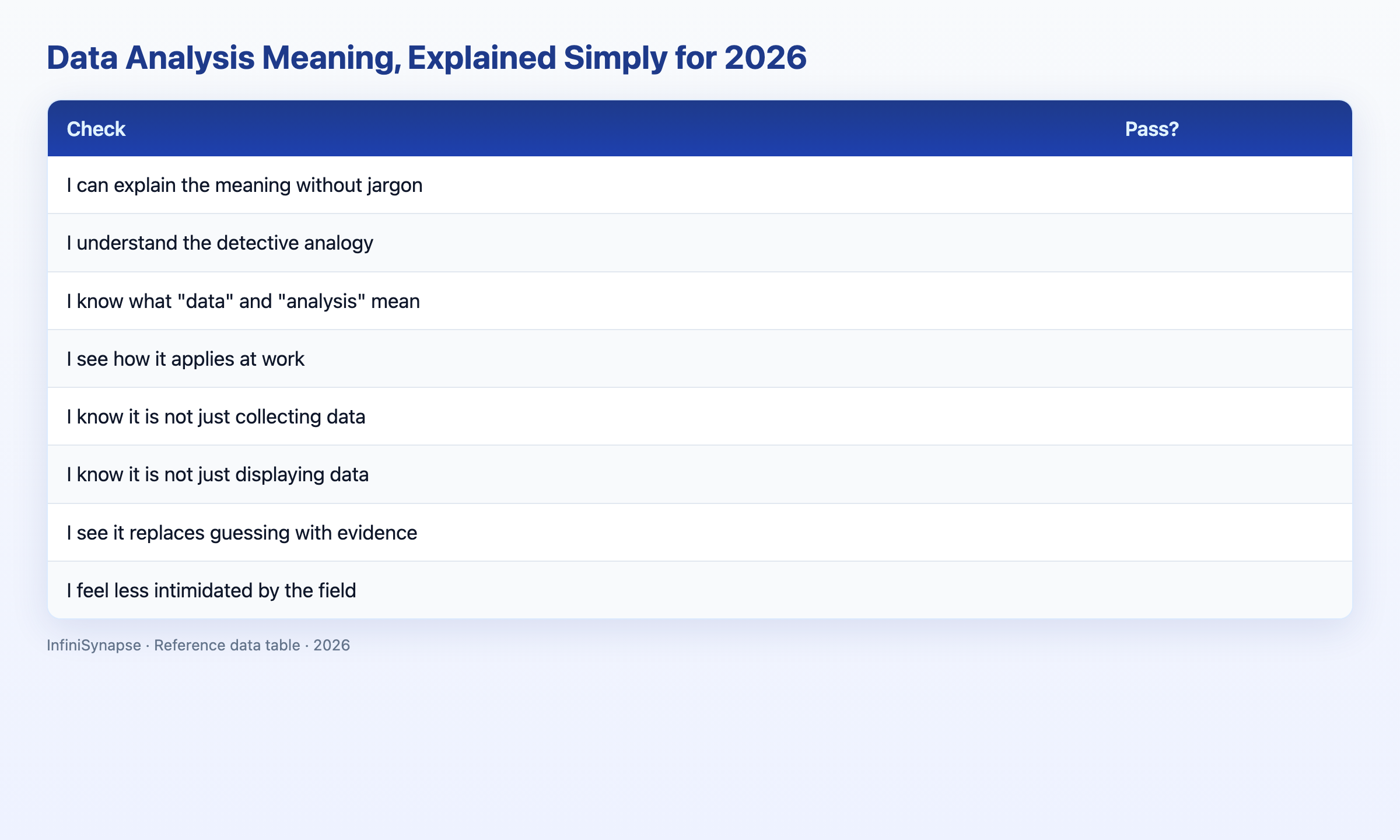
| Check | Pass? |
|---|---|
| I can explain the meaning without jargon | |
| I understand the detective analogy | |
| I know what "data" and "analysis" mean | |
| I see how it applies at work | |
| I know it is not just collecting data | |
| I know it is not just displaying data | |
| I see it replaces guessing with evidence | |
| I feel less intimidated by the field |
6–8: you understand the meaning. 3–5: revisit the analogy. Below 3: reread the plain-English section.
Common Misunderstandings
Misunderstanding 1: It requires being technical. The data analysis meaning is simply making sense of information, which anyone can grasp.
Misunderstanding 2: It is the same as collecting data. Collection is a step; the meaning is understanding the data.
Misunderstanding 3: Charts equal analysis. Displaying data is presentation; analysis means interpreting it.
Misunderstanding 4: It always needs advanced math. Often a simple examination captures the meaning better than complex methods.
Frequently Asked Questions
What is the data analysis meaning in simple terms?
The data analysis meaning in simple terms is making sense of information to answer a question. You take a set of facts or numbers, examine them carefully, find patterns, and work out what they are telling you. It is organized curiosity applied to data, something people do intuitively whenever they interpret information.
What does data analysis mean at work?
At work, the data analysis meaning is using an organization's data, such as sales figures or customer records, to answer business questions and guide decisions. It replaces guessing with evidence, so a marketer might analyze which campaign performed best, or a manager might review which process is slowest, to decide what to do next.
Is the data analysis meaning different from the definition?
The data analysis meaning and definition point to the same activity, but the meaning is the plain-English, intuitive sense while the definition is the precise, formal statement. This guide explains the meaning simply for non-technical readers, while the formal data analysis definition uses more exact, structured language for study and documents.
Do \1employers require proof\2?
No. The data analysis meaning is simply making sense of information, which anyone can grasp regardless of technical background. The field has technical tools, but the underlying meaning is human and intuitive. In fact, understanding the plain meaning first makes the technical tools far less intimidating to learn later.
Why is understanding the useful?
Understanding the data analysis meaning is useful because data pervades modern work and life. It lets you engage confidently with data-driven decisions, ask good questions of numbers others present, and avoid being misled by poor analysis. It is a foundational literacy that empowers people to navigate an information-rich world.
Conclusion
The data analysis meaning, in plain English, is making sense of information to answer a question, like a detective turning clues into a conclusion. It is not merely collecting or displaying data, it applies across work and life, and it is far more approachable than the technical vocabulary suggests. Once you see that you already reason this way every day, the formal field stops feeling like a locked door and starts feeling like a set of tools for doing better what you already do naturally.
To build on this understanding with practical guidance and modern tools, read the complete data analysis guide and what AI-native data analysis means, then try the InfiniSynapse web app free on registration.