
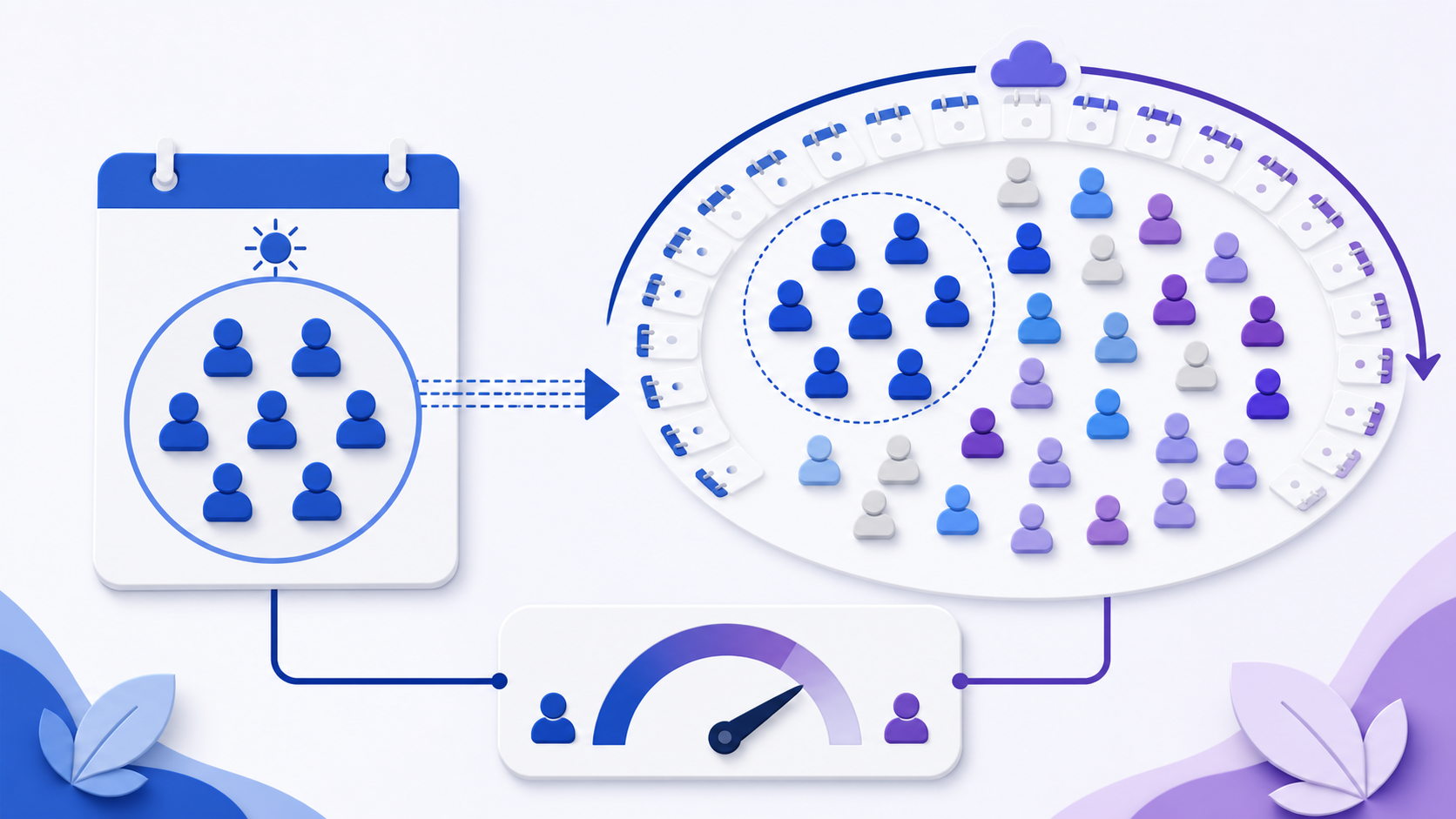
Daily active users vs monthly active users: the quick answer日活跃用户与月活跃用户:快速回答
Daily active users (DAU) count distinct users who complete your defined active behavior in one day; monthly active users (MAU) count distinct users who complete the same behavior during a stated monthly window. DAU reveals short-term frequency and operational change, while MAU reveals broader reach. DAU divided by MAU estimates the share of the monthly active base present on an average or specified day, but it is not a cohort-retention rate.
日活跃用户(DAU)统计一天内完成既定活跃行为的去重用户;月活跃用户(MAU)统计指定月度窗口内完成同一行为的去重用户。DAU 更适合观察短期使用频率和运营变化,MAU 更适合衡量较广的活跃覆盖。DAU 除以 MAU 可估计月活用户中在平均或指定一天出现的比例,但它不是 cohort 留存率。
The comparison is useful only after four rules match: the active event, user identity, time zone, and eligibility population. A dashboard can produce mathematically correct but incomparable numbers when any of these changes. Treat the metric definition as a small data contract, not merely a chart label.
只有当四项规则一致时,这组比较才有意义:活跃事件、用户身份、时区与合格人群。只要其中任何一项变化,仪表盘就可能生成数学上正确、业务上却不可比的数字。因此应把指标定义当作一份小型数据契约,而不只是图表标签。
Define DAU and MAU before comparing them比较之前先定义 DAU 与 MAU
Distinct eligible users who perform at least one qualifying value-linked action during a calendar day or a clearly stated trailing 24-hour window.
在一个自然日或明确说明的过去 24 小时窗口内,至少完成一次合格价值行为的去重合格用户。
Distinct eligible users who perform at least one qualifying action in a calendar month or a declared rolling 28- or 30-day window.
在一个自然月或明确声明的滚动 28 天/30 天窗口内,至少完成一次合格行为的去重合格用户。
“Active” should express delivered or pursued value. Logging in may be meaningful for a security console reviewed only when alerts occur, but opening a page through an automatic notification usually proves little. A collaboration product might use “sent a message or edited a shared document”; an analytics product might use “ran a query or reviewed a result.” The rule should be observable, stable, available on every relevant platform, and resistant to background events.
“活跃”应表达用户正在获得或追求产品价值。对于只在告警出现时查看的安全控制台,登录可能有意义;但由自动通知触发的页面打开通常说明不了什么。协作产品可以定义为“发送消息或编辑共享文档”,分析产品可以定义为“运行查询或查看分析结果”。该规则应可观察、稳定、覆盖相关平台,并能排除后台事件干扰。
MAU is not one universal window. A calendar month aligns with monthly reporting but has different lengths. A trailing 30-day window gives a continuously updated view; a trailing 28-day window keeps exactly four weeks and reduces weekday-mix differences. Choose one according to the decision, label it, and never splice different definitions into a single trend.
MAU 并不存在唯一窗口。自然月适合月度汇报,但月份长度不同;滚动 30 天可持续更新;滚动 28 天恰好覆盖四周,可减少星期构成差异。应按决策场景选择并清晰标注,不能把不同定义拼接到同一趋势中。
DAU vs MAU: what each metric can and cannot tell youDAU 与 MAU:每个指标能说明什么、不能说明什么
| Dimension维度 | DAU | MAU | Decision use决策用途 |
|---|---|---|---|
| Window窗口 | One day or stated 24 hours一天或明确的 24 小时 | Calendar month, rolling 28 days, or rolling 30 days自然月、滚动 28 天或滚动 30 天 | Match the window to expected product cadence让窗口匹配产品预期使用频率 |
| Primary signal主要信号 | Short-term frequency and operational movement短期频率与运营变化 | Broader active reach更广泛的活跃覆盖 | Use both when daily habit and monthly reach matter同时关注日常习惯和月度覆盖时结合使用 |
| Sensitivity敏感性 | Weekdays, incidents, campaigns, outages工作日、事件、活动与故障 | Slower acquisition and reactivation changes较慢的获客与召回变化 | Annotate releases and calendar effects为发布与日历效应添加注释 |
| Common misuse常见误用 | Treating every session or heartbeat as a user把每次会话或心跳都算成用户 | Calling registered accounts active把所有注册账户称为活跃 | Deduplicate stable identities after qualification先判断合格行为,再按稳定身份去重 |
| Does not prove不能证明 | Retention, satisfaction, or causal impact留存、满意度或因果影响 | Frequent use or durable retention高频使用或持久留存 | Pair with cohorts and value outcomes与 cohort 和价值结果配合 |
A daily-habit product can prioritize DAU and the ratio. A weekly planning workflow may be better served by WAU/MAU. A tax, travel, or incident-response tool can create strong value with episodic use; forcing DAU upward may even encourage unnecessary friction or notifications. The right headline metric follows the natural frequency of the job users need to complete.
日常习惯型产品可以优先关注 DAU 与粘性比率;每周规划工作流通常更适合 WAU/MAU;报税、旅行或事故响应工具即使低频使用也能创造很强价值。强行提高 DAU 甚至可能带来不必要的打扰。正确的核心指标应服从用户任务的自然频率。
How to calculate DAU, MAU, and the DAU/MAU ratio如何计算 DAU、MAU 与 DAU/MAU 比率
Write the metric contract. Record the qualifying event, eligible population, stable user key, bot/test exclusions, time zone, window, late-event policy, and owner.
编写指标契约。记录合格事件、合格人群、稳定用户键、机器人/测试数据排除项、时区、窗口、迟到事件政策与负责人。
Filter before deduplicating. Select eligible events and users first, then count each stable user once per window. Counting device IDs before identity resolution can split one person; merging shared accounts can hide multiple people.
先筛选,再去重。先选择合格事件与用户,再让每个稳定用户在窗口内只计一次。身份解析前统计设备 ID 会拆分同一人,共享账户则可能掩盖多人。
Build comparable series. For trend analysis, calculate one DAU value per day and one MAU value with the same activity and identity rules. Freeze historical numbers or document backfills explicitly.
构建可比序列。趋势分析时,每天计算一个 DAU,并用相同活跃与身份规则计算 MAU。应冻结历史数字,或明确记录回填。
Calculate and label stickiness. Divide average DAU across the evaluation period by MAU for that period when you want a stable summary. If you use a single day's DAU, label the date because weekday mix can change the result.
计算并标注粘性。需要稳定摘要时,用评估期平均 DAU 除以该期 MAU;若使用单日 DAU,必须标明日期,因为星期构成会改变结果。
DAU/MAU (%) = average daily active users ÷ monthly active users × 100DAU/MAU(%)= 平均日活跃用户 ÷ 月活跃用户 × 100
Hypothetical example: a product has 12,000 rolling-30-day active users and average DAU of 3,000 measured under the same rules. Its DAU/MAU ratio is 25%. This means the average day's active population equals one quarter of the monthly active population. It does not mean every MAU used the product on exactly 7.5 days, nor that 25% of a signup cohort was retained. Usage is usually uneven, so inspect the distribution of active days per user.
假设示例:某产品在相同口径下有 12,000 个滚动 30 天活跃用户,平均 DAU 为 3,000,则 DAU/MAU 为 25%。这表示平均一天的活跃人群相当于月活人群的四分之一;它不意味着每个 MAU 恰好使用了 7.5 天,也不表示注册 cohort 留存了 25%。使用频率通常分布不均,因此还应检查每用户活跃天数分布。
Interpret DAU/MAU without using a universal benchmark不要套用统一基准来解读 DAU/MAU
There is no universally “good” DAU/MAU ratio. A result becomes useful through comparison with the product's expected cadence, its own stable historical definition, and relevant segments. Benchmark articles often combine different active events, user populations, platforms, and windows. Copying their threshold can turn an honest low-frequency workflow into a false performance problem.
不存在普遍适用的“优秀”DAU/MAU。只有把结果与产品预期频率、自身稳定历史口径和相关分群比较,它才有意义。许多基准文章混合了不同活跃事件、人群、平台与窗口,直接复制阈值会把合理的低频工作流误判为绩效问题。
Use trend plus decomposition. If the ratio rises, determine whether DAU increased, MAU decreased, or both. A rising ratio caused by collapsing MAU can accompany shrinking reach. A falling ratio after a successful acquisition campaign may reflect many newly active monthly users who have not yet formed a habit.
同时看趋势与拆解。比率上升时,要判断是 DAU 增加、MAU 减少,还是两者共同变化。若 MAU 大幅下降,比率上升也可能伴随覆盖萎缩;获客活动成功后,比率下降则可能是大量新月活用户尚未形成习惯。
Segment by lifecycle stage, platform, geography, plan, role, and acquisition source only when sample sizes remain credible. Compare new and established users separately; average DAU/MAU can hide a small daily power-user group and a large one-time monthly group. Pair the ratio with active days per MAU, cohort retention, value-action completion, and account-level coverage where appropriate.
在样本量可信的前提下,可按生命周期、平台、地区、套餐、角色和获客来源分群。应分别比较新用户与成熟用户;整体 DAU/MAU 可能掩盖一小群每日重度用户与一大群每月一次用户。必要时还应结合每 MAU 活跃天数、cohort 留存、价值行为完成率与账户级覆盖。
Common active-user measurement errors and how to prevent them活跃用户衡量的常见错误与预防方法
Heartbeat, auto-refresh, push delivery, or tracking pixels can inflate active users. Require an intentional value-linked event.
心跳、自动刷新、推送送达或追踪像素会抬高活跃用户,应要求主动完成的价值行为。
UTC and local-day boundaries move events between dates. Choose one reporting zone and test users near midnight.
UTC 与本地自然日边界会把事件移到不同日期。选择统一报告时区,并测试午夜附近事件。
Anonymous-to-known merges, cross-device IDs, deleted accounts, and shared seats alter distinct counts. Version the policy.
匿名转登录、跨设备 ID、删除账户与共享席位都会改变去重结果,应对身份政策进行版本管理。
A month-to-date MAU is not comparable with a complete prior month. Use matched elapsed days or wait for closure.
本月至今 MAU 不能直接与完整上月比较,应匹配已过去天数或等待窗口结束。
Overlapping active windows do not follow a fixed starting cohort. Run cohort analysis separately.
重叠活跃窗口不会追踪固定起始 cohort,必须单独做 cohort 留存分析。
Retries and delayed mobile uploads can change historical counts. Deduplicate event IDs and publish a backfill policy.
重试与移动端延迟上传会改变历史数字,应按事件 ID 去重并公布回填政策。
Privacy, consent, and access rules also matter. Use the minimum identifiers needed, enforce retention and deletion policies, and avoid exporting user-level event data merely to calculate aggregates. Active-user counts are descriptive observations, not proof that a release or campaign caused the change.
隐私、同意与访问规则同样重要。只使用必要身份字段,执行保留与删除政策,不要为了计算汇总指标而随意导出用户级事件。活跃用户数字属于描述性观察,不能单独证明某次发布或活动导致了变化。
Validate daily and monthly active users before making decisions在决策前验证日活与月活指标
- Recalculate several users manually from raw events and confirm qualification, identity resolution, and window boundaries.从原始事件手工复算若干用户,确认合格判断、身份解析与窗口边界。
- Reconcile DAU and MAU to a trusted source for a frozen date; explain every material difference rather than forcing totals to match.在冻结日期把 DAU、MAU 与可信来源核对;解释每个重大差异,不要强行让总数一致。
- Test duplicate events, anonymous-to-known merges, deleted users, bots, internal staff, shared accounts, and events near midnight.测试重复事件、匿名转登录、已删除用户、机器人、内部员工、共享账户与午夜附近事件。
- Confirm that DAU is never greater than same-rule rolling MAU for the corresponding date; if it is, inspect windows and filters.确认同一规则下对应日期的 DAU 不会大于滚动 MAU;若出现,应检查窗口与筛选器。
- Monitor event volume and missing identity rates by platform version so instrumentation breaks do not masquerade as behavior change.按平台版本监控事件量与身份缺失率,避免埋点故障被误认为行为变化。
- Publish the formula, owner, last-change date, exclusions, known limitations, and dashboard freshness beside the chart.在图表旁公布公式、负责人、最后变更日期、排除项、已知局限与数据新鲜度。
After validation, define an action condition before watching the dashboard. For example: investigate when average DAU falls outside its expected weekday-adjusted range while MAU and event delivery remain stable. A prewritten rule reduces reactive storytelling after every fluctuation.
验证后,应在查看仪表盘前定义行动条件。例如:当平均 DAU 超出按星期调整后的预期区间,而 MAU 与事件送达保持稳定时再调查。预先写好的规则能减少对每次波动进行事后编故事。
Analyze DAU and MAU across governed data sources跨受治理数据源分析 DAU 与 MAU
Before opening the tool, prepare a read-only event table or warehouse connection, a stable user or account key, event timestamps, the qualifying activity rule, reporting time zone, window definition, exclusions, and a trusted total for reconciliation.
打开工具前,请准备只读事件表或数据仓库连接、稳定的用户/账户键、事件时间戳、合格活跃规则、报告时区、窗口定义、排除项,以及用于核对的可信总数。
Use the InfiniSynapse online data analysis application to ask a natural-language question across connected structured sources, then inspect the analysis plan, queries, evidence, tables, and visualizations. It supports analysis; it does not replace event instrumentation, identity governance, or source-total validation.
使用 InfiniSynapse 在线数据分析应用,对已连接的结构化数据源提出自然语言问题,并审查分析计划、查询、证据、表格与可视化。它用于辅助分析,但不会替代事件埋点、身份治理或源总数验证。
Analyze active-user data with InfiniSynapse使用 InfiniSynapse 分析活跃用户数据A useful first prompt is: “Using the approved activity event and user key, calculate daily active users, rolling-30-day monthly active users, and average-DAU/MAU by plan for the last 12 complete weeks; show the time zone, exclusions, missing-ID rate, and query behind each result.” Verify the output against your source and metric contract before sharing it.
一个合适的首个问题是:“使用已批准的活跃事件与用户键,计算过去 12 个完整周的日活跃用户、滚动 30 天月活跃用户及按套餐分组的平均 DAU/MAU;显示时区、排除项、身份缺失率和每个结果背后的查询。”分享前仍需依据源系统与指标契约验证结果。
Daily active users and monthly active users FAQ日活跃用户与月活跃用户常见问题
DAU counts distinct users who complete the defined active behavior in one day. MAU counts distinct users who complete it during a stated monthly window, commonly a trailing 28 or 30 days or a calendar month.
DAU 统计一天内完成既定活跃行为的去重用户;MAU 统计指定月度窗口内完成该行为的去重用户,常见窗口为滚动 28 天、30 天或自然月。
Divide DAU for a representative day, or average DAU for the period, by MAU measured with the same identity and activity rules, then multiply by 100. State the exact windows used.
用代表性单日 DAU 或期间平均 DAU 除以采用相同身份与活跃规则计算的 MAU,再乘以 100,并说明准确窗口。
No. A high ratio is useful only when the product should deliver value daily. Weekly, monthly, seasonal, or episodic products can be healthy with lower daily frequency.
不一定。只有产品本应每日创造价值时,高比率才有相应意义。每周、每月、季节性或偶发型产品即使日频率较低也可能健康。
Either can be valid, but they answer different questions. Calendar months support financial reporting; rolling windows support trend monitoring. Label the choice and do not mix them in one series.
两者都可以,但回答的问题不同。自然月适合财务报告,滚动窗口适合趋势监控。应标明选择,不能在同一序列中混用。
No. DAU/MAU compares overlapping active-user windows, while cohort retention follows the same starting group over elapsed time. Use both when frequency and durable return matter.
不能。DAU/MAU 比较重叠的活跃用户窗口,而 cohort 留存持续跟踪同一初始群体。若频率与持续回访都重要,应结合使用。
Official definitions and related InfiniSynapse guides官方定义与 InfiniSynapse 相关指南
Platform definitions are not automatically interchangeable. Google Analytics documents DAU/MAU, DAU/WAU, and WAU/MAU user-stickiness ratios and explains its own 24-hour, 7-day, and 30-day active-user windows. Adjust's first-party help center also describes DAU, WAU, and MAU definitions and reporting windows. Preserve each source's semantics when reconciling systems.
不同平台定义不能自动互换。Google Analytics 官方说明了 DAU/MAU、DAU/WAU 与 WAU/MAU 用户粘性比率,并解释其 24 小时、7 天与 30 天活跃用户窗口;Adjust 第一方帮助中心也介绍了 DAU、WAU、MAU 的定义与报告窗口。跨系统核对时必须保留来源语义。
For broader tool and architecture context, use the InfiniSynapse data analytics tools map and data analytics software selection guide. Both explain how governed data preparation, query, BI, and AI-supported analysis fit together; this page remains focused on active-user definitions and validation.
如需更广泛的工具与架构背景,可阅读 InfiniSynapse 数据分析工具地图与数据分析软件选型指南。两者说明受治理的数据准备、查询、BI 与 AI 辅助分析如何协同;本页仍聚焦活跃用户定义与验证。