
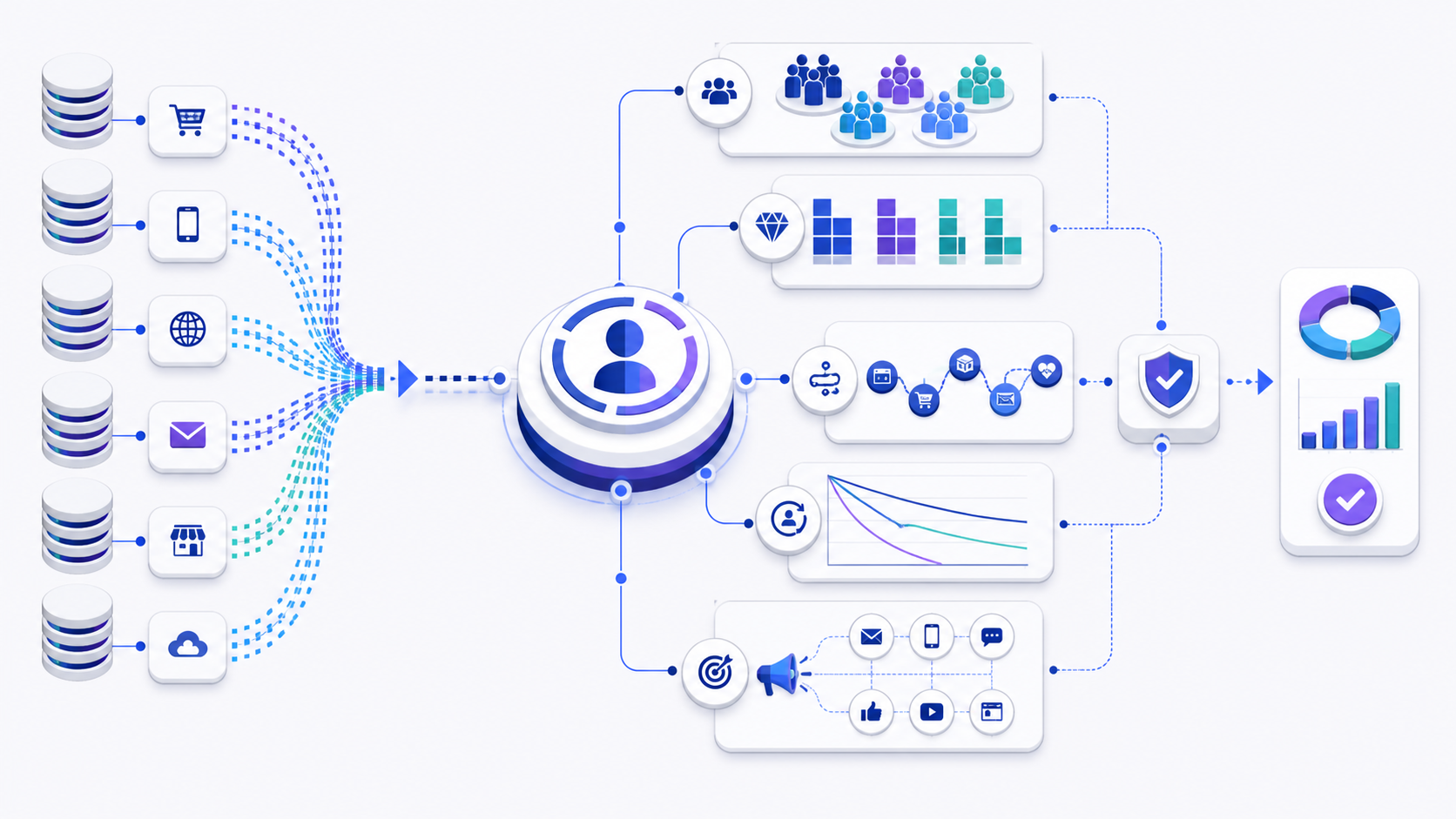
Customer analytics: a practical definition客户分析:可执行的定义
Customer analytics is the governed process of turning customer records and interactions into evidence for segmentation, product, retention, service, and marketing decisions. It starts with a decision and a defined population, connects permitted CRM, transaction, web/app, advertising, and support data, applies methods appropriate to the question, and ends with validation and a measurable next action.
客户分析是把客户记录与互动转化为客户细分、产品、留存、服务和营销决策证据的受治理过程。它从一项决策和明确人群开始,连接获准使用的 CRM、交易、Web/App、广告与客服数据,按问题选择合适方法,并以验证和可测量的下一步行动结束。
Four levels should remain separate. Descriptive analysis reports what happened. Diagnostic analysis investigates plausible explanations. Predictive analysis estimates an outcome for new cases. Causal measurement estimates what changed because of an intervention. A cohort chart, churn score, attribution report, and randomized experiment may all appear in one program, but they answer different questions and require different evidence.
四个层级必须分开。描述性分析回答发生了什么;诊断性分析调查可能解释;预测性分析估计新样本的结果;因果测量估计某项干预真正改变了什么。群组图、流失评分、归因报告和随机实验可能都出现在同一项目中,但它们回答的问题不同,所需证据也不同。
Customer analytics data architecture: sources, identity, and metrics客户分析数据架构:来源、身份与指标
A reliable architecture does not begin with a “360-degree customer” promise. It begins with a source inventory and an explicit statement of what can and cannot be observed. CRM records describe accounts, contacts, stages, and managed relationships. Orders and billing describe purchases, refunds, subscriptions, margin inputs, and status. Web and app events describe instrumented behavior. Advertising systems describe impressions, clicks, cost, and platform-attributed outcomes. Support systems contain cases, topics, timestamps, and service outcomes. A warehouse can preserve history and shared transformation logic, but it does not automatically resolve identity or consent.
可靠架构不能从“客户 360 度视图”的承诺开始,而应从来源清单以及“哪些信息可观察、哪些不可观察”的明确声明开始。CRM 记录描述账户、联系人、阶段和受管理关系;订单与账单描述购买、退款、订阅、利润输入和状态;Web 与 App 事件描述已埋点行为;广告系统描述展示、点击、成本和平台归因结果;客服系统包含工单、主题、时间戳和服务结果;数据仓库可保存历史与共享转换逻辑,但不会自动解决身份或同意问题。
| Layer层级 | Define before analysis分析前定义 | Common failure常见失败 |
|---|---|---|
| Identity身份 | Person, household, account, device, anonymous-to-known, merge and split rules个人、家庭、账户、设备、匿名转已知、合并与拆分规则 | Duplicate people or incorrect profile merges重复客户或错误档案合并 |
| Time时间 | Event time, processing time, time zone, snapshot, window, late arrivals事件时间、处理时间、时区、快照、窗口与迟到数据 | Leaked future data and reordered journeys未来信息泄漏与旅程乱序 |
| Grain粒度 | One row per event, order, customer-day, customer, or account-period每事件、订单、客户日、客户或账户周期一行 | Many-to-many joins inflate totals多对多连接放大总额 |
| Metrics指标 | Numerator, denominator, exclusions, status, currency, refunds, version owner分子、分母、排除项、状态、币种、退款、版本负责人 | Teams compare labels that use different logic团队比较名称相同但逻辑不同的指标 |
| Governance治理 | Purpose, permission, minimization, access, retention, deletion, sensitivity目的、许可、最小化、访问、保留、删除与敏感性 | Repurposed or excessive personal data个人数据被改作他用或过度收集 |
Prepare a data dictionary, source owners, freshness expectations, reconciliation totals, and a metric semantic layer before distributing dashboards. If identity confidence varies, retain match method and confidence instead of presenting a single profile as certain. If an attribute is not needed for the decision, do not collect it merely because a model might use it.
在分发仪表板前,应准备数据字典、来源负责人、新鲜度要求、对账总额与统一指标语义层。如果身份匹配置信度不同,应保留匹配方法和置信度,而不是把统一档案呈现为确定事实。如果某个属性并非决策所需,就不应仅因模型“可能有用”而收集。
Customer segmentation turns differences into testable decisions客户细分:把差异转化为可测试决策
Segmentation divides a defined population into groups that are meaningfully different for a decision. Demographic and firmographic segments describe who customers are; geographic segments describe where they are; psychographic segments describe attitudes or needs gathered through appropriate research; behavioral segments describe observed actions; and value segments compare historical or expected economic contribution. These dimensions can complement one another, but they are not interchangeable.
客户细分把明确人群划分为对某项决策具有实质差异的群组。人口与企业属性细分描述客户是谁;地理细分描述客户在哪里;心理细分通过合适调研描述态度或需求;行为细分描述已观察行动;价值细分比较历史或预期经济贡献。这些维度可以互补,但不能互相替代。
Define whether the segment changes onboarding, service capacity, research sampling, retention treatment, or reporting. If no decision changes, the label is decoration.
明确分群是否会改变入门流程、服务容量、调研抽样、留存措施或报告。如果没有决策变化,标签只是装饰。
Document eligible population, fields, thresholds, missing-data rules, refresh cadence, and precedence when customers qualify for several groups.
记录合格人群、字段、阈值、缺失规则、刷新频率,以及客户同时符合多个群组时的优先级。
Compare size, behavior, outcome, uncertainty, and contactability. Avoid turning sensitive or proxy attributes into unsupported explanations.
比较规模、行为、结果、不确定性和可触达性,避免把敏感属性或代理属性变成无依据解释。
Confirm audience counts and exclusions in the destination system, then use a controlled test where possible to estimate incremental value.
在目标系统中核对受众数量与排除项,并尽可能通过受控测试估计增量价值。
For method selection, governance, and implementation detail, use the dedicated customer segmentation guide. This overview connects segmentation with identity, metrics, retention, product, and marketing measurement.
如需方法选择、治理与实施细节,请阅读客户细分指南。本节说明细分如何连接身份、指标、留存、产品与营销测量。
RFM analysis and customer value tiersRFM 分析与客户价值分层
RFM summarizes transaction history with recency, frequency, and monetary value. Define a snapshot date and observation window; calculate days since the latest eligible transaction, distinct eligible orders, and the approved value measure; transform each measure into documented bands; reverse recency so more recent activity scores higher; and retain the three components rather than relying only on a total score.
RFM 用最近购买、购买频率和消费金额汇总交易历史。先定义快照日期与观察窗口;计算距最近合格交易的天数、不同合格订单数和获批价值指标;把每个指标转换为有文档的分档;反转最近性,使越近期的行为得分越高;并保留三个独立维度,而不是只依赖总分。
| Profile画像 | R / F / MR / F / M | Responsible interpretation负责任的解释 | Next test下一项测试 |
|---|---|---|---|
| Recent, frequent, high value近期、高频、高价值 | 5 / 5 / 5 | Strong historical purchasing; not proof of loyalty or future value历史购买强;不能证明忠诚或未来价值 | Service or benefit test with margin and holdout checks结合利润与留出组测试服务或权益 |
| Recent, one high-value order近期一次高价值订单 | 5 / 1 / 5 | Potential new customer; do not label “loyal”可能是新客户;不能标为“忠诚” | Onboarding or second-purchase experiment入门或第二次购买实验 |
| Historically frequent, now inactive历史高频、当前不活跃 | 1 / 5 / 4 | Investigate category cycle, seasonality, service, and eligibility调查品类周期、季节性、服务与资格 | Eligible win-back test with suppression rules带排除规则的合格召回测试 |
RFM is transparent and useful when transactions are meaningful, but it is historical rather than causal, can misstate value when returns or margin are ignored, and may penalize seasonal or long-cycle customers. Quantile scores are relative to the current population and can drift as the population changes. For formulas, threshold choices, SQL/Excel implementation, and sensitivity checks, use the complete RFM analysis guide.
当交易具有业务意义时,RFM 透明且实用,但它描述历史而非因果;忽略退货或利润时会误报价值;还可能不利于季节性或长周期客户。分位数评分相对于当前人群,随着人群变化可能漂移。如需公式、阈值选择、SQL/Excel 实施与敏感性检查,请阅读完整的 RFM 分析指南。
Customer behavior analysis across journeys and lifecycle stages跨旅程与生命周期的客户行为分析
Customer behavior analysis examines observed sequences such as discovery, visit, signup, activation, feature use, purchase, renewal, support, and return. Begin with an event taxonomy and instrumentation plan: stable event names, required properties, actor and account identifiers, event time, source, version, consent status, and tests for duplicates or missing events. A journey is only as complete as the instrumented channels; offline interactions, blocked tracking, shared devices, and cross-device behavior create known blind spots.
客户行为分析检查发现、访问、注册、激活、功能使用、购买、续费、客服和回访等已观察序列。首先建立事件分类与埋点计划:稳定事件名、必需属性、人员与账户标识、事件时间、来源、版本、同意状态,以及重复或缺失事件测试。旅程完整度只等于已埋点渠道的完整度;线下互动、被拦截的追踪、共享设备与跨设备行为都会形成已知盲区。
- Define the behavior and population定义行为与人群Use an observable event or state, eligible users, a start condition, and a time window. Avoid labels such as “engaged” until their logic is explicit.使用可观察事件或状态、合格用户、起始条件与时间窗口。在逻辑明确前,不要使用“高参与”等模糊标签。
- Validate the event stream验证事件流Compare client and server counts, check schema versions, retries, bots, late events, duplicate IDs, and instrumentation release dates.比较客户端与服务器计数,检查模式版本、重试、机器人、迟到事件、重复 ID 与埋点发布日期。
- Choose the right view选择正确视图Use funnels for ordered steps, paths for common sequences, cohorts for change by start period, and state transitions for movement among lifecycle stages.用漏斗分析有序步骤,用路径分析常见序列,用群组比较不同起始周期,用状态转移研究生命周期阶段变化。
- Compare composition and context比较构成与语境A rate can change because the customer mix, product, price, season, channel, or measurement changed. Test those alternatives before assigning motivation.比率变化可能来自客户构成、产品、价格、季节、渠道或测量变化。在推断动机前,应测试这些替代解释。
Behavioral data reveals what the instrumentation captured, not what a person felt or intended. Combine it with appropriately collected qualitative research and support evidence when the decision depends on motivation. See the focused customer behavior analysis workflow for event design, funnels, paths, cohorts, and validation.
行为数据揭示的是埋点捕获了什么,而不是客户感受或意图。当决策依赖动机时,应结合合规收集的定性研究与客服证据。有关事件设计、漏斗、路径、群组与验证,请参阅独立的客户行为分析工作流。
Customer retention, churn, and high-risk groups客户留存、流失与高风险群体
Retention measures continuing eligible activity after a defined start. Churn measures a transition from an eligible active state to a defined inactive, cancelled, or lost state. Neither has a universal definition. A subscription product may use cancellation or non-renewal; retail may use inactivity beyond a category-specific expected cycle; a marketplace may track activity on several sides. Publish the population, start, return event, interval, grace period, reactivation rule, and denominator with every rate.
留存测量客户在明确起点之后是否继续发生合格活动;流失测量客户从合格活跃状态转为明确不活跃、取消或流失状态。两者都没有统一定义。订阅产品可用取消或未续费;零售可按超过品类特定预期周期的不活跃定义;平台业务可能需要同时跟踪多方活动。每个比率都应同时发布人群、起点、回访事件、间隔、宽限期、再激活规则与分母。
| Question问题 | Method方法 | Do not conclude不能直接得出 |
|---|---|---|
| Which cohorts return?哪些群组会回访? | Cohort retention table or survival curve群组留存表或生存曲线 | That acquisition source caused retention获客来源导致了留存 |
| Where did retention change?留存在哪些位置变化? | Segmented trends with release, price, service, and mix annotations带版本、价格、服务和构成注释的分层趋势 | That the nearest event was the cause时间最近事件就是原因 |
| Who is at elevated risk?谁的风险更高? | Time-safe model with holdout, calibration, subgroup, and drift checks带留出、校准、子群与漂移检查的时间安全模型 | That an individual will certainly churn某个人一定会流失 |
| Did a treatment reduce churn?措施是否降低流失? | Randomized holdout or defensible causal design随机留出或可辩护因果设计 | Impact from contacted-customer outcomes alone仅凭已触达客户结果判断影响 |
A churn model should never be activated merely because its overall accuracy looks high; class imbalance can make that metric misleading. Check precision and recall at operational thresholds, calibration, lead time, subgroup performance, contact capacity, treatment eligibility, expected incremental value, and monitoring. Read the dedicated customer churn guide and customer retention rate guide for deeper definitions and implementation.
流失模型不能仅因总体准确率看似很高就投入使用;类别不平衡会使该指标产生误导。应检查运营阈值下的精确率与召回率、校准、提前期、子群表现、触达容量、措施资格、预期增量价值和监控。更深入定义与实施请阅读客户流失指南和客户留存率指南。
Marketing analytics connects channels, campaigns, and customer outcomes营销分析连接渠道、活动与客户结果
Marketing analytics should join exposure and cost data to customer outcomes without collapsing every question into return on ad spend. Build a measurement hierarchy: delivery metrics such as impressions and reach; interaction metrics such as clicks and sessions; acquisition metrics such as qualified leads or new customers; lifecycle outcomes such as activation, retention, margin, or lifetime value; and incremental outcomes estimated through experiments or causal models.
营销分析应把曝光与成本数据连接到客户结果,而不是把所有问题压缩为广告支出回报。应建立测量层级:展示与覆盖等投放指标;点击与会话等互动指标;合格线索或新客户等获客指标;激活、留存、利润或生命周期价值等后续结果;以及通过实验或因果模型估计的增量结果。
Cross-source reporting requires campaign naming rules, channel taxonomy, cost currency and time zone, landing-page tags, conversion definitions, deduplication, refunds, offline imports, modeled-data labels, and reconciliation with finance or billing. Platform reports can be useful within their scope, but different platforms may each claim credit for the same outcome. A unified report should preserve the source and model behind each number rather than forcing false agreement.
跨来源报告需要活动命名规则、渠道分类、成本币种与时区、落地页标签、转化定义、去重、退款、线下导入、建模数据标签,并与财务或账单对账。平台报告在其范围内有价值,但不同平台可能同时为同一结果分配功劳。统一报告应保留每个数字背后的来源与模型,而不是强制制造虚假一致。
Decision rule: optimize the metric closest to the business outcome that is still timely, sufficiently observable, and resistant to manipulation. A fast proxy is useful only when its relationship to the outcome is monitored. Segment marketing results by acquisition period and customer quality so a cheap conversion is not mistaken for a valuable customer.
决策规则:优先优化最接近业务结果、同时仍具时效性、可观察性且不易被操纵的指标。快速代理指标只有在持续监测其与最终结果关系时才有用。应按获客周期与客户质量拆分营销结果,避免把便宜转化误当成高价值客户。
Continue with the digital marketing analytics guide and advertising analytics guide for channel data, campaign QA, cost normalization, reporting, and decision design.
Attribution, marketing mix modeling, and incrementality answer different questions归因、营销组合模型与增量测量回答不同问题
Attribution assigns credit among observed touchpoints on a path to a conversion. It is useful for reporting paths and comparing allocation rules, but credit is not automatically causal impact. Multi-touch attribution depends on identity, observation, lookback windows, channel coverage, model assumptions, and the conversion definition. It struggles with unobserved exposure, offline influence, privacy-related gaps, and correlated channels.
归因把转化功劳分配给路径中已观察触点。它适合报告路径并比较分配规则,但功劳不自动等于因果影响。多触点归因依赖身份、可观察性、回溯窗口、渠道覆盖、模型假设与转化定义,也会受到未观察曝光、线下影响、隐私造成的缺口和渠道相关性的限制。
Marketing mix modeling (MMM) estimates aggregate relationships between media, controls, and outcomes over time. It can include channels without user-level paths and support budget scenarios, but it needs enough variation, defensible controls, stable time-series data, uncertainty reporting, and calibration where possible. Incrementality experiments hold back treatment from a comparable group or geography to estimate what would have happened without the intervention. Experiments provide stronger causal evidence for a defined treatment and population, but require power, operational discipline, spillover control, and careful interpretation.
营销组合模型(MMM)估计媒体、控制变量与业务结果随时间的总体关系。它可覆盖没有用户级路径的渠道并支持预算情景,但需要足够变化、可辩护控制变量、稳定时间序列、不确定性报告,并尽可能进行校准。增量实验对可比群体或地区保留不投放组,估计没有干预时会发生什么。实验为特定措施与人群提供更强因果证据,但需要统计功效、运营纪律、溢出控制和谨慎解释。
| Method方法 | Best suited to适合问题 | Primary boundary主要边界 |
|---|---|---|
| Multi-touch attribution多触点归因 | Observed paths and reporting credit已观察路径与报告功劳 | Incomplete paths and credit-versus-causality confusion路径不完整及功劳与因果混淆 |
| MMM | Aggregate channel contribution and budget scenarios总体渠道贡献与预算情景 | Confounding, limited variation, and wide uncertainty混杂、变化不足与不确定性较宽 |
| Incrementality experiment增量实验 | Causal effect of a defined intervention明确干预的因果效果 | Power, spillover, cost, and scope功效、溢出、成本与适用范围 |
Use the focused marketing attribution software guide and marketing mix modeling guide to implement each method without blurring its estimand or validation requirements.
Customer analytics, customer insights, and customer intelligence platforms客户分析、客户洞察与客户智能平台的区别
Customer analytics is the analytical discipline. Customer insights are reviewed findings that combine evidence and context into an explanation relevant to a decision. Customer intelligence is the broader operating capability that connects ongoing collection, identity, analysis, research, review, activation, and outcome learning. Software labels overlap: a CRM manages relationships and workflows; a CDP generally unifies profiles and supports activation; product analytics focuses on digital behavior; experience analytics organizes feedback and service signals; BI and data platforms provide flexible transformation and reporting.
客户分析是一套分析方法;客户洞察是经复核的发现,把证据与语境组合为与决策相关的解释;客户智能是更广泛的运营能力,连接持续采集、身份、分析、调研、复核、激活与结果学习。软件标签会重叠:CRM 管理关系与流程;CDP 通常统一档案并支持激活;产品分析关注数字行为;体验分析整理反馈与服务信号;BI 与数据平台提供灵活转换和报告。
Select a stack from representative decisions, not a category checklist. Test access with least privilege, identity and grain, metric transparency, reproducibility, required methods, qualitative evidence, governance, audit history, export and portability, monitoring, team skills, implementation effort, and total cost. A dedicated platform may be unnecessary when a governed warehouse, analytics environment, research repository, and activation systems already support the workflow. Conversely, a dashboard alone is insufficient when identity, definitions, consent, or operational feedback loops remain unresolved.
技术栈应从代表性决策出发选择,而不是按类别清单采购。测试最小权限访问、身份与粒度、指标透明度、可复现性、所需方法、定性证据、治理、审计历史、导出与可移植性、监控、团队技能、实施投入和总成本。如果受治理的数据仓库、分析环境、研究资料库与激活系统已经支撑流程,就不一定需要专用平台。反之,如果身份、定义、同意或运营反馈闭环尚未解决,单个仪表板也远远不够。
For adjacent definitions and buying criteria, review the customer insights guide, customer intelligence guide, and existing customer analytics software selection guide.
有关相邻概念与选型标准,请参阅客户洞察指南、客户智能指南以及现有的客户分析软件选型指南。
An AI-assisted customer analytics workflow with verifiable outputs可验证输出的 AI 辅助客户分析工作流
- Write the decision brief编写决策简报Name the owner, population, question type, period, action, success measure, permitted use, and evidence that would change the decision.明确负责人、人群、问题类型、周期、行动、成功指标、允许用途,以及什么证据会改变决策。
- Prepare governed inputs准备受治理输入Provide approved files or read-only database access, a data dictionary, join keys, source totals, metric definitions, known gaps, and privacy constraints.提供获批文件或只读数据库访问、数据字典、连接键、来源总额、指标定义、已知缺口与隐私约束。
- Profile before modeling建模前先概览Check schemas, row counts, date coverage, missingness, duplicates, identity coverage, outliers, refunds, cancellations, and instrumentation changes.检查模式、行数、日期覆盖、缺失、重复、身份覆盖、异常值、退款、取消与埋点变化。
- Ask for inspectable transformations要求可检查转换Keep query or code logic, intermediate tables, exclusions, assumptions, and versions. Natural-language convenience must not hide how the result was produced.保留查询或代码逻辑、中间表、排除项、假设与版本。自然语言便利不能隐藏结果如何生成。
- Match method to claim让方法匹配主张Use descriptive summaries for what happened, time-safe models for predictions, and experiments or defensible causal designs for impact.用描述性汇总回答发生了什么,用时间安全模型进行预测,用实验或可辩护因果设计估计影响。
- Validate, review, and monitor验证、复核与监控Reconcile totals, compare baselines, test sensitivity, quantify uncertainty, review subgroups and privacy, assign an owner, define rollback, and monitor after action.对账总额、比较基线、测试敏感性、量化不确定性、审查子群与隐私、指定负责人、定义回滚,并在行动后监控。
InfiniSynapse is a general AI data analysis application, not a CRM, CDP, survey collector, campaign sender, identity-resolution authority, or automatic source of causal truth. Its public product information supports analysis across connected databases and files, natural-language analytical workflows, and multi-source or multimodal analysis. That makes it relevant as an analytical workspace after the organization has prepared permitted sources, stable definitions, and accountable review.
InfiniSynapse 是通用 AI 数据分析应用,不是 CRM、CDP、调查采集器、活动发送平台、身份解析权威,也不会自动提供因果真相。其公开产品信息支持分析已连接数据库与文件、自然语言分析工作流,以及多源或多模态分析。因此,在组织准备好合规来源、稳定定义与责任复核后,它可作为客户分析工作区。
Bring an approved CSV, spreadsheet, or authorized database connection; a data dictionary; customer and account keys; metric definitions; source reconciliation totals; permitted-use notes; and one testable decision. Use InfiniSynapse to profile data, compare segments and cohorts, create transparent tables and charts, and document validation. Keep legal basis, identity policy, causal interpretation, fairness review, and operational action under human ownership.
请准备已批准的 CSV、电子表格或授权数据库连接、数据字典、客户与账户键、指标定义、来源对账总额、允许用途说明,以及一项可测试决策。可使用 InfiniSynapse 概览数据、比较分群与群组、创建透明表格和图表并记录验证。合法依据、身份策略、因果解释、公平性审查与运营行动仍由人员负责。
Analyze prepared customer data with InfiniSynapse使用 InfiniSynapse 分析已准备的客户数据Validate customer analytics before decisions reach customers客户分析影响客户前的验证方法
| Layer层级 | Check检查 | Stop condition停止条件 |
|---|---|---|
| Source来源 | Permission, provenance, freshness, schema, counts, known gaps权限、来源、新鲜度、模式、数量与已知缺口 | Unknown origin or unauthorized purpose来源不明或用途未获授权 |
| Transformation转换 | Grain, joins, time, status, exclusions, versions, reconciliation粒度、连接、时间、状态、排除、版本与对账 | Totals change without explanation总额无解释变化 |
| Method方法 | Assumptions, baseline, holdout, sensitivity, uncertainty, leakage假设、基线、留出、敏感性、不确定性与泄漏 | Claim exceeds the design主张超出设计能力 |
| Interpretation解释 | Alternatives, subgroup behavior, limitations, non-causal language替代解释、子群表现、局限与非因果措辞 | Association presented as cause or certainty把相关性写成因果或确定事实 |
| Action行动 | Owner, eligibility, guardrails, capacity, experiment, monitoring, rollback负责人、资格、护栏、容量、实验、监控与回滚 | No accountable owner or measurable outcome没有责任负责人或可测量结果 |
- Selection bias: observed customers may exclude people who blocked tracking, purchased offline, never converted, or left before identification.选择偏差:已观察客户可能排除了阻止追踪、线下购买、从未转化或在识别前离开的人员。
- Survivorship and leakage: future status, later service outcomes, or post-decision fields can make a model look better than it will perform at decision time.幸存者偏差与信息泄漏:未来状态、后续服务结果或决策后字段会使模型看起来优于真实决策时表现。
- Proxy discrimination: location, device, behavior, and value may act as proxies for protected or vulnerable groups. Review necessity, fairness, and consequences.代理歧视:地区、设备、行为与价值可能成为受保护或弱势群体的代理变量,应审查必要性、公平性与后果。
- Metric gaming: teams optimize what is measured. Pair targets with guardrails for customer harm, service quality, margin, complaints, and long-term retention.指标博弈:团队会优化被测量内容。目标必须配套客户伤害、服务质量、利润、投诉与长期留存护栏。
Privacy boundary: use only data authorized for a defined purpose, minimize fields, restrict access, honor communication preferences, support correction and deletion, and review applicable law and policy. Do not use marketing or behavioral analysis as an eligibility, credit, employment, insurance, medical, pricing, or other high-impact decision rule without specialized legal, governance, fairness, security, and human review.
隐私边界:只使用为明确目的获准的数据,尽量减少字段,限制访问,遵守沟通偏好,支持更正与删除,并审查适用法律政策。未经专门法律、治理、公平性、安全与人工审查,不得把营销或行为分析用作资格、信贷、就业、保险、医疗、定价或其他高影响决策规则。
Customer analytics questions客户分析常见问题
Customer analytics is the governed use of customer data to describe behavior, compare segments, predict defined outcomes, and measure interventions. It combines identity, time, and metric rules with methods matched to a business decision.
客户分析是以受治理方式使用客户数据,描述行为、比较分群、预测明确结果并测量干预。它把身份、时间和指标规则,与匹配业务决策的方法结合。
Use only decision-relevant, permitted sources such as CRM, transactions, product events, advertising, support, and consented research. Define identifiers, grain, time, status, metrics, permissions, source totals, and known gaps before analysis.
只使用与决策相关且获准的数据,如 CRM、交易、产品事件、广告、客服与已同意调研。分析前定义标识符、粒度、时间、状态、指标、权限、来源总额与已知缺口。
Customer analytics is the process and method used to examine data. A customer insight is a reviewed finding that connects evidence and context to a decision. Not every pattern is an insight; it must be relevant, credible, and actionable.
客户分析是检查数据的过程与方法;客户洞察是经复核的发现,把证据与语境连接到决策。并非每个模式都是洞察,它必须相关、可信且可行动。
Define the eligible population, start event, return or active event, interval, grace period, churn state, reactivation rule, and denominator. Use cohorts or survival methods, then separate risk prediction from causal treatment evaluation.
定义合格人群、起始事件、回访或活跃事件、间隔、宽限期、流失状态、再激活规则与分母。使用群组或生存方法,并把风险预测与措施因果评估分开。
No. Attribution assigns credit among observed touchpoints under a model. Incrementality estimates what changed because of an intervention compared with what would have happened without it, usually through experiments or causal designs.
不等同。归因按模型在已观察触点之间分配功劳;增量估计相对于没有干预时,某项干预真正改变了什么,通常通过实验或因果设计完成。
AI can help profile data, generate inspectable transformations, compare groups, summarize evidence, and create tables or charts. People must still own permissions, identity rules, definitions, validation, causal claims, fairness, and customer-facing decisions.
AI 可以帮助概览数据、生成可检查转换、比较群组、汇总证据并创建表格或图表;权限、身份规则、定义、验证、因果主张、公平性与面向客户的决策仍须由人员负责。
Authoritative sources and evidence scope权威来源与证据范围
- Google Analytics Life cycle collection documentation describes acquisition, engagement, monetization, and retention reports for websites and apps.Google Analytics 生命周期报告文档说明网站与 App 的获客、互动、变现和留存报告。
- Google Analytics attribution documentation defines attribution and documents available reporting models and their settings.Google Analytics 归因文档定义归因,并说明可用报告模型及其设置。
- Google Meridian guidance on model fit and causal inference explains why MMM causal quality cannot be established by predictive fit alone and why experiments are important.Google Meridian 模型拟合与因果推断指南说明为何不能仅凭预测拟合确认 MMM 因果质量,以及实验为何重要。
- UK ICO guidance on data minimisation is an official source for one regulatory context; organizations must assess their own applicable law.英国 ICO 数据最小化指南是一种监管语境下的官方来源;组织仍须评估自身适用法律。
- InfiniSynapse product overview is the first-party source for the product capabilities described in the AI workflow.InfiniSynapse 产品概览是 AI 工作流中产品能力表述的第一方来源。