Top Certifications for Data Analysts in 2026
By the InfiniSynapse Data Team · Last updated: 2026-07-08 · We build an AI-native data analysis platform and track which credentials employers actually mention; this breakdown covers the certifications worth pursuing.
Table of Contents
- TL;DR
- How We Evaluate Certifications
- Vendor-Neutral Certifications
- Platform-Specific Certifications
- Industry-Focused Certifications
- Certification Comparison Table
- Which Certification Should You Pick?
- AI Coverage Across Certifications
- Certification ROI Scorecard
- Putting Your Learning Into Practice
- Frequently Asked Questions
- Conclusion
TL;DR
Direct answer: the top certifications for data analyst roles in 2026 combine hands-on SQL and visualization training with recognized credentials and, ideally, AI tool coverage. Vendor-neutral programs offer the broadest applicability; platform-specific ones suit tool-focused positions. Choose certifications for data analyst career paths that match your goals, include portfolio projects, and that you will realistically complete.
Who this is for: learners who want a cert-by-cert breakdown rather than a general overview of analytics credentials.
What you'll learn: how we evaluate certifications, the major options by category, a comparison table, and how to pick the right one.
This guide sits under the data analyst certification hub; for certificate programs, see data analyst certificate and the full directory in data analysis certification.
How We Evaluate Certifications
Not every credential marketed to aspiring analysts deserves attention. We evaluate certifications for data analyst roles on criteria that predict whether they help you get hired and do the job. Recognition: do employers in your target market know and respect the credential? Curriculum: does it teach SQL, visualization, and statistics through hands-on practice? Assessment: are skills tested through projects and practical exams, not just multiple-choice quizzes?
Portfolio value: does the certification program produce work you can show employers? AI coverage: does it address modern AI-native analysis tools? Completion feasibility: can you realistically finish it given your schedule and budget? Certifications for data analyst career preparation that fail on multiple criteria are excluded from this breakdown regardless of marketing prominence.
This evaluation aligns with the competencies in data analyst skills and the analytical process in the Wikipedia data analysis overview. A certification's spot in this guide means it delivers genuine preparation, not just a line on your resume.
Vendor-Neutral Certifications
Vendor-neutral certifications for data analyst roles teach general analytics skills applicable across tools, platforms, and industries. They typically cover SQL, spreadsheet analysis, data visualization, basic statistics, and data cleaning through a structured curriculum with a capstone project. These are the most versatile credentials because they do not tie you to a specific technology ecosystem.
Major technology companies and education platforms offer vendor-neutral certifications for data analyst career entry. These programs are often affordable, self-paced, and widely recognized on job postings and LinkedIn profiles. They suit career changers seeking broad preparation and analysts who want a baseline credential without committing to a particular platform. Warehouse-grounded analytics should align with Databricks documentation on SQL warehouses and data governance.
The strength of vendor-neutral certifications for data analyst roles is breadth; the limitation is depth in any single tool. You learn enough SQL, visualization, and statistics to start working, but may need platform-specific training once you know your target employer's stack. Pair a vendor-neutral certification with portfolio projects demonstrating your ability across tools.
Platform-Specific Certifications
Platform-specific certifications for data analyst roles validate proficiency with particular technology ecosystems. Cloud providers, database vendors, and visualization platforms each offer credentials that prove you can work within their environments. These certifications carry weight when you target roles at organizations using those specific platforms.
Platform-specific certifications for data analyst positions are most valuable after you have general analytics fundamentals. Learning a cloud analytics platform before you can write SQL fluently produces shallow knowledge that fails under scrutiny. Use platform certifications to specialize once your core skills are solid, not as your first credential.
The trade-off is narrower applicability. A certification tied to one cloud provider is highly relevant for roles using that platform and less relevant elsewhere. If you know your target industry or employer, platform-specific certifications for data analyst roles can differentiate your profile. If you are exploring broadly, start vendor-neutral.
Industry-Focused Certifications
Industry-focused certifications for data analyst roles target specific domains: healthcare analytics, financial analysis, marketing measurement, supply chain analytics, and others. They teach domain-specific metrics, regulations, data sources, and analytical frameworks alongside general skills. These credentials suit analysts who know their target industry and want to demonstrate domain fluency.
Industry certifications for data analyst career paths are most valuable at the intermediate to advanced stage. They assume general analytics competency and add domain context that general certifications lack. A healthcare analytics certification signals you understand HIPAA constraints and clinical metrics; a marketing analytics certification shows you know attribution models and campaign measurement.
If you are a career changer entering analytics in a specific industry, an industry-focused certification for data analyst roles can accelerate your credibility. It shows employers you understand their domain, not just generic SQL and charts. Pair it with general fundamentals and portfolio projects demonstrating domain-relevant analyses.
Certification Comparison Table
Use this framework to compare certifications for data analyst roles across dimensions that matter.
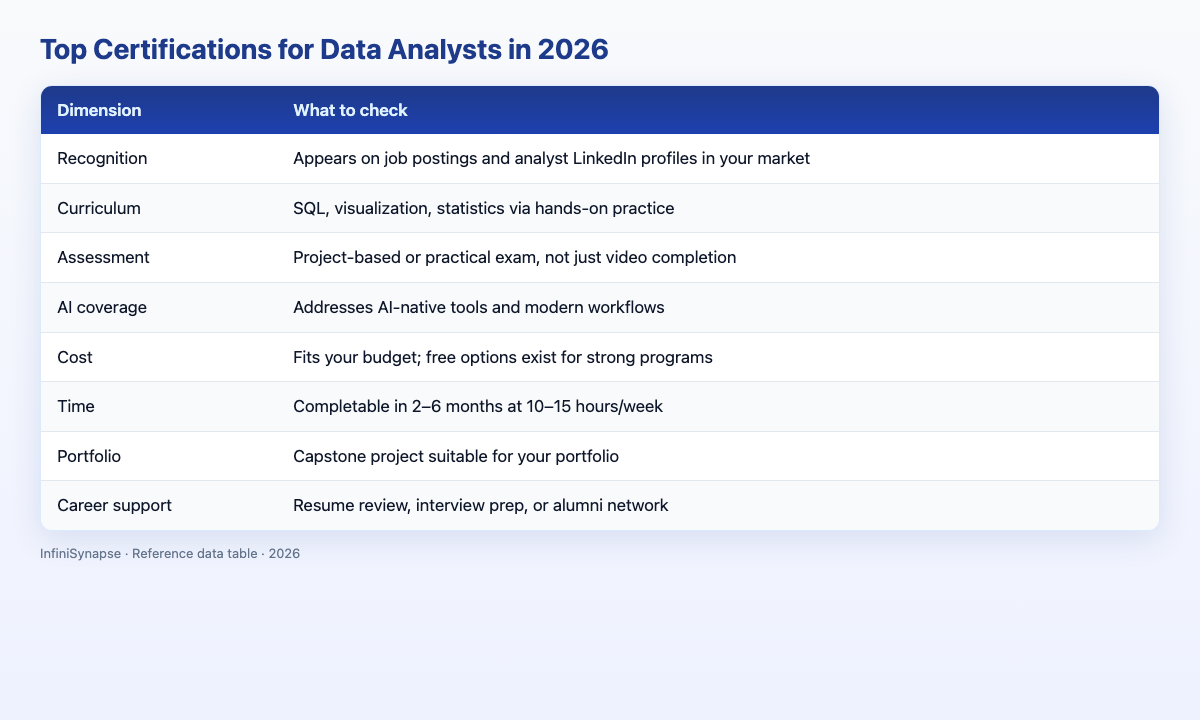
| Dimension | What to check |
|---|---|
| Recognition | Appears on job postings and analyst LinkedIn profiles in your market |
| Curriculum | SQL, visualization, statistics via hands-on practice |
| Assessment | Project-based or practical exam, not just video completion |
| AI coverage | Addresses AI-native tools and modern workflows |
| Cost | Fits your budget; free options exist for strong programs |
| Time | Completable in 2–6 months at 10–15 hours/week |
| Portfolio | Capstone project suitable for your portfolio |
| Career support | Resume review, interview prep, or alumni network |
No single certification excels on every dimension. Certifications for data analyst entry-level roles should prioritize curriculum depth and portfolio value. Mid-career certifications should prioritize recognition and specialization. Evaluate your specific needs rather than seeking a universally perfect credential.
Which Certification Should You Pick?
Choosing among certifications for data analyst career preparation starts with three questions. What skills do you lack? What roles do you target? What can you realistically complete? The move toward augmented workflows, outlined in IBM's augmented analytics overview, frames how teams evaluate modern tooling.
Complete beginners should start with a vendor-neutral certification that teaches fundamentals from scratch with extensive hands-on practice. Career changers with some technical background may prefer a certification that fills specific gaps and adds a recognized credential quickly. Working analysts seeking advancement should target platform-specific or industry-focused certifications for data analyst specialization in their domain.
Avoid collecting multiple certifications without building a portfolio. Two credentials without demonstrated work impresses less than one certification with three published analyses. Avoid choosing based on brand alone without evaluating curriculum. Avoid starting advanced certifications before SQL fundamentals are solid.
We compare certificate programs in data analyst certificate and training paths in data analyst training. The best certifications for data analyst roles is the one you will finish, that builds real skills, and that produces portfolio evidence alongside the credential.
AI Coverage Across Certifications
A growing differentiator among certifications for data analyst roles is AI coverage. Programs that teach AI-native analysis tools, prompt engineering for data queries, and validation of automated outputs prepare you for the 2026 job market. Programs that ignore AI teach an increasingly incomplete skill set.
When comparing certifications for data analyst career paths, check whether AI modules are core curriculum or optional add-ons. Core integration signals the provider understands how the role is evolving. Optional or absent AI coverage signals an outdated program, regardless of how strong its traditional curriculum is.
InfiniSynapse supports practice alongside any certification. It is an AI-native agent connecting to data sources and running analysis through InfiniSQL, modeling the tools modern certifications should cover. Practicing with it supplements any credential with hands-on AI fluency. We explore the paradigm in what AI-native data analysis means), and the Stanford HAI AI Index tracks how rapidly AI skills have become a baseline expectation.
Certification ROI Scorecard
Evaluate certifications for data analyst career value (1 point each):
| Check | Pass? |
|---|---|
| Teaches SQL with hands-on practice | |
| Includes portfolio-worthy capstone | |
| Recognized in my target job market | |
| Covers or addresses AI-native tools | |
| Skills tested through projects, not just quizzes | |
| Cost and time are realistic for me | |
| Positive outcomes from past graduates | |
| I will realistically complete it |
6–8: strong ROI, worth pursuing. 3–5: compare against alternatives. Below 3: skip or consider other paths.
Putting Your Learning Into Practice
Certifications for data analysts clarify baseline skills but rarely differentiate finalists. After earning one, publish a comparative post or repo README explaining what the exam tested versus what your last job simulation required. That meta-analysis shows evaluative thinking recruiters want. Hiring trends in the OECD AI adoption overview show employers pairing credentials with demonstrable project work.
Stack certifications only when each fills a distinct gap—cloud warehouse, statistics, visualization platform. Otherwise you accumulate logos without expanding capability. Pair every new badge with a fresh portfolio piece that uses the certified tool on unclean data.
Practice exam scenarios under time pressure, then practice stakeholder scenarios under ambiguity. Certifications validate structured tasks; workdays mix both. Run mock sessions where a teammate changes the question mid-analysis.
Maintain a living study queue: note concepts you guessed on during the exam and schedule micro-labs until guesses become derivations. Certified analysts who keep sharpening weak areas outpace peers who treat passing as permanent proof.
Frequently Asked Questions
What are the best certifications for data analysts?
The best certifications for data analyst roles combine hands-on SQL and visualization training with recognized credentials and AI tool coverage. Vendor-neutral programs from major education platforms offer the broadest preparation. Choose based on your level, goals, and target job market rather than brand alone.
Are certifications for data analysts worth it?
Yes, as structured learning paths that teach job-relevant skills and provide resume signals. Certifications for data analyst entry are not worth it as standalone job tickets without portfolio work. Pair any certification with real projects for the strongest preparation and job-search results.
How many certifications should I get?
One well-chosen certification paired with a strong portfolio is more effective than multiple credentials without demonstrated work. Certifications for data analyst career building should be milestones in ongoing learning, not collectibles. Add a second certification only when it fills a specific gap your first one left.
Do employers care about data analyst certifications?
Employers view certifications for data analyst candidates as positive signals showing structured learning and commitment. They value demonstrated ability through portfolios more than credentials alone. A certification combined with published analyses is compelling; a certification without portfolio work is significantly weaker.
Which certification is best for beginners?
Beginners should choose vendor-neutral certifications for data analyst fundamentals that teach SQL, spreadsheets, and visualization from scratch with heavy hands-on practice and a capstone portfolio project. Avoid platform-specific or advanced certifications until core skills are solid.
Conclusion
The top these credentials roles in 2026 teach hands-on skills, issue recognized credentials, and increasingly cover AI-native tools. Choose based on your level and goals, prioritize portfolio-building alongside any credential, and remember that analytics certifications career success are learning accelerators, not guaranteed job tickets. One well-chosen certification with demonstrated ability beats a collection of credentials without proof.
To practice the AI-era skills employers want, read what AI-native data analysis means and try the InfiniSynapse web app free on registration, no credit card required.