Azure Data Lake: A Practical Guide (2026)
By the InfiniSynapse Data Team · Last updated: 2026-07-15 · We build an AI-native data analysis platform and work across cloud storage layers; this guide covers the Azure Data Lake in 2026 in practical terms rather than as a product pitch.
Table of Contents
- TL;DR
- How We Approach It
- What It Is
- How It Works in a Stack
- When It Fits
- Governance Realities
- Where It Came From
- Common Pitfalls
- This Storage Layer in the Age of AI
- Readiness Scorecard
- Common Misconceptions
- Frequently Asked Questions
- Conclusion
TL;DR
Direct answer: the azure data lake is Microsoft's cloud storage service for large-scale analytics, providing scalable, low-cost object storage where raw and processed data of any type can be kept for later processing. In 2026, the azure data lake is a foundational layer in many Microsoft-centric stacks, but like any lake it delivers value only when paired with governance and a clear processing strategy — the storage alone is not analysis.
Who this is for: engineers and architects working in Azure who are evaluating the azure data lake in 2026.
What you'll learn: what it is, how it works in a stack, when it fits, governance realities, and how AI relates.
This guide sits under the warehouse and lakehouse hub.
For the general concept, see data lake architecture.
Also see what a data lake is.
How We Approach It
Core definitions remain usefully summarized in Wikipedia statistics overview for shared vocabulary across stakeholders.
We explain the azure data lake as one implementation of the general data-lake idea, because that framing separates what is Azure-specific from what is universal. Every point reflects real deployments. We anchor concepts to the Wikipedia conceptual data model overview and weigh patterns against the reference architectures at Microsoft data architecture guidance.
The table below frames the azure data lake.
| Aspect | Azure Data Lake |
|---|---|
| Role | Scalable cloud object storage |
| Data | Raw and processed, any type |
| Strength | Cheap, scalable, Azure-integrated |
| Watch-out | Storage is not analysis |
| Pairs with | Governance, processing engines |
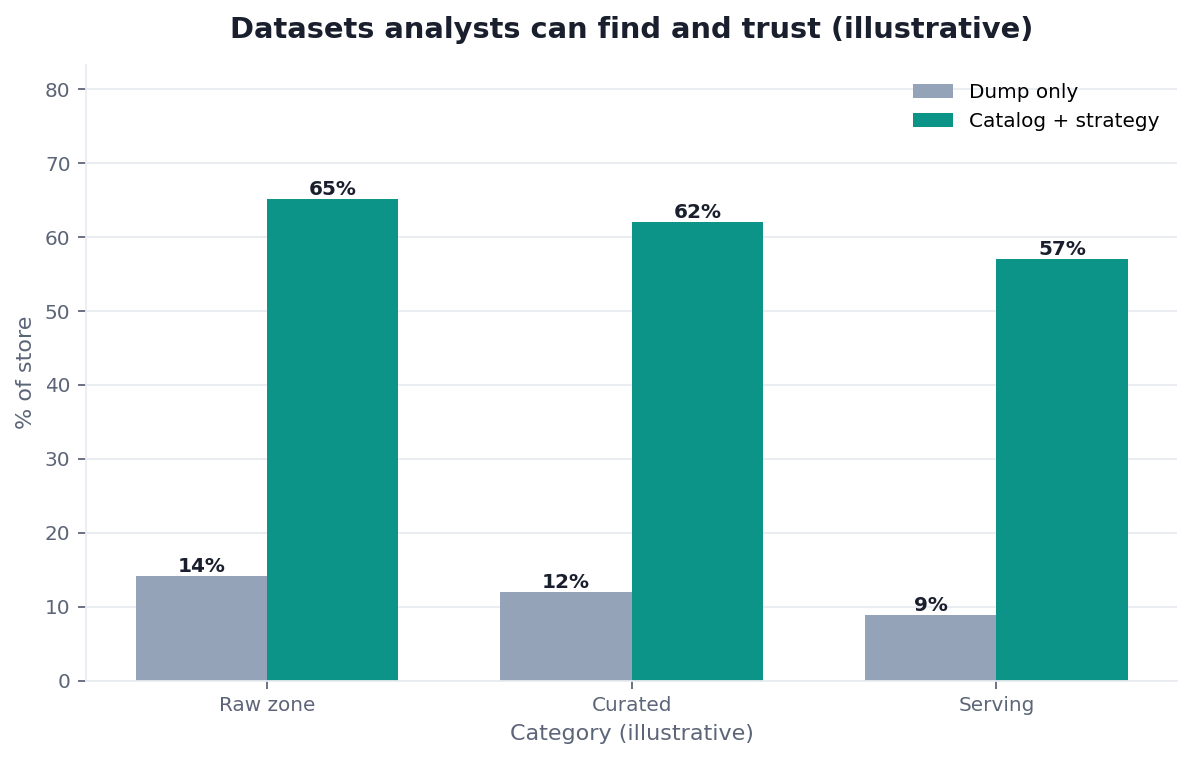
Practical example: a team stored everything in an azure data lake but skipped cataloging and processing strategy, so it became hard to use — the swamp pattern the guidance at PostgreSQL documentation on comparable lakes warns against.
Scope note: This guide reflects patterns we see when mid-market and enterprise teams work with azure data lake in 2026. It is not a substitute for legal counsel, vendor runbooks, or a formal survey of every industry — and when a smaller toolset or lighter process would serve, a full program is overkill.
What It Is
At its core, the azure data lake is Microsoft's cloud service for storing very large volumes of data of any type at low cost, in a way tuned for large-scale analytics workloads.
Key Definition: the azure data lake is Microsoft's cloud-based storage service designed for big-data analytics, providing highly scalable, low-cost object storage in which data of any type — structured, semi-structured, or raw — can be kept in its native form for later processing by analytics engines, without requiring a schema to be defined before the data lands.
The essence of the azure data lake is scalable, schema-on-read storage inside the Azure ecosystem. It holds data cheaply and flexibly, integrates with Azure's analytics and processing services, and defers structure until the data is actually queried — the same principle behind any data lake, implemented as a managed Azure service.
How It Works in a Stack
Governance and risk expectations are framed by NIST Computer Security Resource Center when programs need an external control reference.
The azure data lake works as the storage foundation of an analytics stack. Data lands there raw from many sources; processing engines then read, transform, and analyze it, often moving refined results into a warehouse or serving layer.
In practice, the azure data lake rarely stands alone, as the patterns at NIST SP 800-53 security controls for comparable lake-based stacks illustrate. It integrates with processing engines, orchestration, and often a lakehouse layer that adds structure on top. Its job is to be the cheap, scalable place everything can land; the surrounding services turn that stored data into usable analysis, which is why a processing strategy matters as much as the storage itself.
When It Fits
The azure data lake fits organizations already invested in Azure that need scalable, low-cost storage for large and varied data feeding analytics or machine learning, especially where a schema-on-read approach suits the workload.
Like any lake, the azure data lake is not universal. The Microsoft Excel support notes that teams needing only structured reporting may be served better by a warehouse alone. The lake earns its place where data is large, varied, and destined for flexible processing, and where the Azure ecosystem is already the home for the organization's analytics work.
Governance Realities
Implementation details are commonly grounded in Snowflake documentation when teams translate concepts into production practice.
The reality of the azure data lake is that its flexibility is also its risk. Because it accepts anything cheaply and defers schema, it can silently become a disorganized swamp where data is stored but not findable or trustworthy.
Governing the azure data lake means cataloging what lands, enforcing access control, tracking lineage, and maintaining quality — practices covered across the warehouse and lakehouse hub. Azure provides tools for this, but they must be used deliberately; the storage service will not impose organization on its own. The difference between a valuable lake and a swamp is governance applied consistently from the start, not retrofitted after the mess appears.
Where It Came From
The azure data lake exists because cloud providers recognized that big-data analytics needed a storage layer separate from, and cheaper than, the warehouse. As data volumes and variety exploded, forcing everything into structured warehouse tables before storage became too rigid and too expensive, and a place to keep raw data affordably until it was needed became essential.
Microsoft built its lake offering to fill that role within Azure, integrating it with the platform's analytics and processing services. Understanding this origin clarifies why schema-on-read and low cost are its defining traits: they are the direct answer to the rigidity and expense of storing everything in a warehouse. It also explains why governance is the recurring caveat — the very flexibility that makes the lake valuable is what allows it to decay into a swamp without deliberate management.
Common Pitfalls
Implementation details are commonly grounded in AWS Well-Architected Framework when teams translate concepts into production practice.
The pitfalls of the azure data lake are the pitfalls of any lake, made easy by Azure's convenience. Dumping data without cataloging, skipping access control, and having no processing strategy all turn cheap storage into an unusable liability.
A subtler pitfall is treating the azure data lake as a destination rather than a stage. Data landing in the lake is the beginning of the analytics process, not the end; without engines to process it and a plan to refine and serve it, the lake holds potential that never becomes value. The storage is genuinely useful, but only as part of a stack that turns stored bytes into trustworthy answers.
A further trap is neglecting cost structure in the belief that lake storage is simply cheap. The per-gigabyte price is low, but costs accumulate through data movement, the compute that processing engines consume when they scan the lake, and the quiet growth of data that is never deleted because no one owns its lifecycle. Teams that never set retention policies or tier rarely accessed data to cheaper storage find that a lake meant to save money slowly becomes a line item no one can explain. Treating the lake as a managed asset — with lifecycle rules, tiering, and clear ownership of what stays and what goes — keeps its economics as attractive in practice as they look on the price sheet.
This Storage Layer in the Age of AI
AI intersects the azure data lake because machine learning thrives on the large, varied, raw data a lake holds. Trusted, well-governed lake data feeds better models and analysis.
But data rarely lives only in one lake, and we explore the implication in what AI-native data analysis means. In the InfiniSynapse web app, zero-config federation lets an agent analyze across an azure data lake, a warehouse, and operational databases together without first consolidating them, so the lake becomes one federated source in a broader analysis rather than a silo to be moved wholesale.
Readiness Scorecard
Governance and risk expectations are framed by NIST AI Risk Management Framework when programs need an external control reference.
Assess your Azure Data Lake usage (1 point each):
| Check | Pass? |
|---|---|
| Landed data is cataloged | |
| Access control is enforced | |
| Lineage is tracked | |
| A processing strategy exists | |
| Quality is maintained | |
| It is treated as a stage, not a destination | |
| Azure fit was chosen on merit | |
| Federation was considered |
6–8: well-run lake. 3–5: add governance. Below 3: risk of a swamp.
Common Misconceptions
Misconception 1: The lake is the analysis. It is storage; processing turns it into value.
Misconception 2: Cheap storage means dump everything. Ungoverned, that becomes a swamp.
Misconception 3: Azure imposes organization automatically. Governance must be applied deliberately.
Misconception 4: Everything must be consolidated. Federation can query across sources.
Frequently Asked Questions
What is the Azure Data Lake?
It is Microsoft's cloud-based storage service designed for big-data analytics, providing highly scalable, low-cost object storage in which data of any type — structured, semi-structured, or raw — can be kept in its native form for later processing. No schema is required before the data lands, so it defers structure until query time. In essence it is scalable, schema-on-read storage inside the Azure ecosystem, integrated with the platform's analytics and processing services.
How does it work within a stack?
It works as the storage foundation: data lands there raw from many sources, and processing engines then read, transform, and analyze it, often moving refined results into a warehouse or serving layer. It rarely stands alone — it integrates with processing engines, orchestration, and often a lakehouse layer that adds structure on top. Its job is to be the cheap, scalable place everything can land, while surrounding services turn stored data into usable analysis.
When does it fit best?
It fits organizations already invested in Azure that need scalable, low-cost storage for large and varied data feeding analytics or machine learning, especially where schema-on-read suits the workload. It is not universal — teams needing only structured reporting may be served better by a warehouse alone. It earns its place where data is large, varied, and destined for flexible processing, and where Azure is already the home for the organization's analytics work.
Why does governance matter so much?
Because its flexibility is also its risk: it accepts anything cheaply and defers schema, so it can silently become a disorganized swamp where data is stored but not findable or trustworthy. Governing it means cataloging what lands, enforcing access control, tracking lineage, and maintaining quality. Azure provides tools for this, but they must be used deliberately — the service will not impose organization on its own, and the difference between a valuable lake and a swamp is consistent governance from the start.
How does AI relate to the Azure Data Lake?
Machine learning thrives on the large, varied, raw data a lake holds, so well-governed lake data feeds better models and analysis. But data rarely lives only in one lake: federation lets an agent analyze across an Azure lake, a warehouse, and operational databases together without first consolidating them. That makes the lake one federated source in a broader analysis rather than a silo to be moved wholesale, reducing both movement cost and the risk of stale copies.
Is it the same as a lakehouse?
No. The lake is the storage layer — cheap, scalable, schema-on-read object storage that holds data in its native form. A lakehouse is an architecture that adds warehouse-style structure, transactions, and governance on top of that kind of storage to make it reliable for analytics. You can build a lakehouse on Azure's lake storage, but the storage service by itself is not a lakehouse; it becomes one only when the table formats and governance layer are added and enforced. Confusing the two leads teams to expect reliability the raw storage does not provide.
Conclusion
The azure data lake is Microsoft's scalable, low-cost, schema-on-read storage for big-data analytics — foundational in Azure stacks, but valuable only when paired with governance and a processing strategy. In 2026, catalog and govern what lands, treat the lake as a stage rather than a destination, and remember AI-native federation lets it be one source among many rather than a silo.
To see federated analysis across an Azure lake and other sources, read what AI-native data analysis means and try the InfiniSynapse web app free on registration.