Thin Content SEO: Audit, Decide, and Improve Pages
Use thin content SEO to test page purpose, facts, duplication, and indexability; then keep, improve, consolidate, or remove each URL with a documented decision.
Author credentials: William Zhu is cofounder of InfiniSynapse (GitHub @allwefantasy · auto-coder). Desk: shipping SEO Health and the /en/tool/ visibility pages. No personal LinkedIn published. About: team / editorial standards.
Publisher credentials: InfiniSynapse has public profiles on GitHub, YouTube, and X. A 2026 WAIC Future Tech OPC excellence award covers the Agentic Data Infra entry (WAIC; third-party recap: Xinhua / Caohejing). That award does not review this page or SEO Health. Method CLI: infinitegrowth on npm. Archive: recognition and scope notes.
On this page
By William Zhu · Cofounder, InfiniSynapse · Published: 2026-09-08 · Last updated: 2026-09-14 · Last verified: 2026-09-14 · Reviewed by the InfiniSynapse Data Team.
Reviewed by: InfiniSynapse Data Team · method review 2026-09-14. CLI wordCounts: homepage 1292, editorial 1463, title-checker 2928. Warning rows 1 / 2 / 1. Words are not a Google thin classifier. No customer corpus.
Trust / COI: About · Corrections. SEO Health is a commercial product from this team. This page is not a customer thin-content case and not a Google penalty label.
TL;DR
Homepage CLI wordCount is 1292 and still has one warning; that is not a thin verdict.
Direct answer: Treat thin content SEO as a URL-purpose decision, not as a 2000-word floor. On 2026-09-14
seo-health checkreported words 1292 on the homepage (1 warning), 1463 on editorial-standards (2 warnings), and 2928 on the title-checker tool (1 warning). Each check exit was 0. Exit 0 is request completion, not a page pass and not a Google thin classifier. The sample size is three first-party URLs. It cannot establish a length quota and does not prove a penalty.
A thin content SEO slide that ranks those three numbers and crowns 2928 is already mixing inventory with quality. Word count is a diagnostic field. It is not the disposition.
What you will learn
- Which three CLI wordCounts this thin content SEO desk kept
- Why a warning row is not a thin label
- What Google’s helpful-content 200 can and cannot support
- When to keep, merge, or hold without a word floor
- Where heading and plugin work should move
What the three wordCounts actually are
Key definition: thin content SEO asks whether one indexable URL completes a distinct task with verifiable facts. A token count is evidence of length. It is not a classifier.
People open thin content SEO after a dashboard paints 1292 red because it is under an invented 2000-word line. This homepage still completed a check and still carried one warning: Image Alt Text 2/7. That warning is not a thin finding.
Google helpful-content guidance answered HTTP 200 (33,160 bytes; H1 Creating helpful, reliable, people-first content). We fetched that document. We did not receive a thin verdict from it.
InfiniSynapse Server API can store the three wordCounts in a workspace long task; that API foundation does not turn 1292 into a thin label.
Homepage 1292, one warning
User-agent InfiniSynapse-SH67-desk/2026-09-14. Package infinitegrowth@0.1.1; -V printed 0.1.0. The homepage title was InfiniSynapse — AI Data Agent for Enterprise Data Analysis (58 characters). Description length 159. Speed 86. Warning row count: 1. Words: 1292. thin content SEO that files “homepage is thin because 1292” is inventing a rule this CLI does not ship.
Editorial 1463 and title-checker 2928
Editorial-standards: title 61 characters, description 125, words 1463, speed 79, warning rows 2 (title length; Image Alt Text 4/5). Title-checker: title 44 characters, description 158, words 2928, speed 79, warning rows 1 (Image Alt Text 2/5). Both checks exited 0. Longer copy did not remove image warnings. Shorter copy did not create a thin content SEO module. As of 2026 this desk has no customer corpus.
Google spam policies document scaled content abuse and doorway abuse. Those are policy names. They are not labels on 1292. Google soft 404 documentation explains success responses that still fail the user. A 200 with 1292 words is not automatically that case.
Check an empty 200 on a live URL before you treat word count as the problem.
Public pages we could fetch
| URL | check exit | Words | Warning rows |
|---|---|---|---|
https://infinisynapse.com/ | 0 | 1292 | 1 |
https://infinisynapse.com/en/editorial-standards | 0 | 1463 | 2 |
https://infinisynapse.com/en/tool/seo-title-checker | 0 | 2928 | 1 |
| Helpful-content guidance | HTTP 200 | — | docs page, 33,160 bytes |
Three CLI rows. One docs 200. Zero customer sites. thin content SEO still has no penalty series.
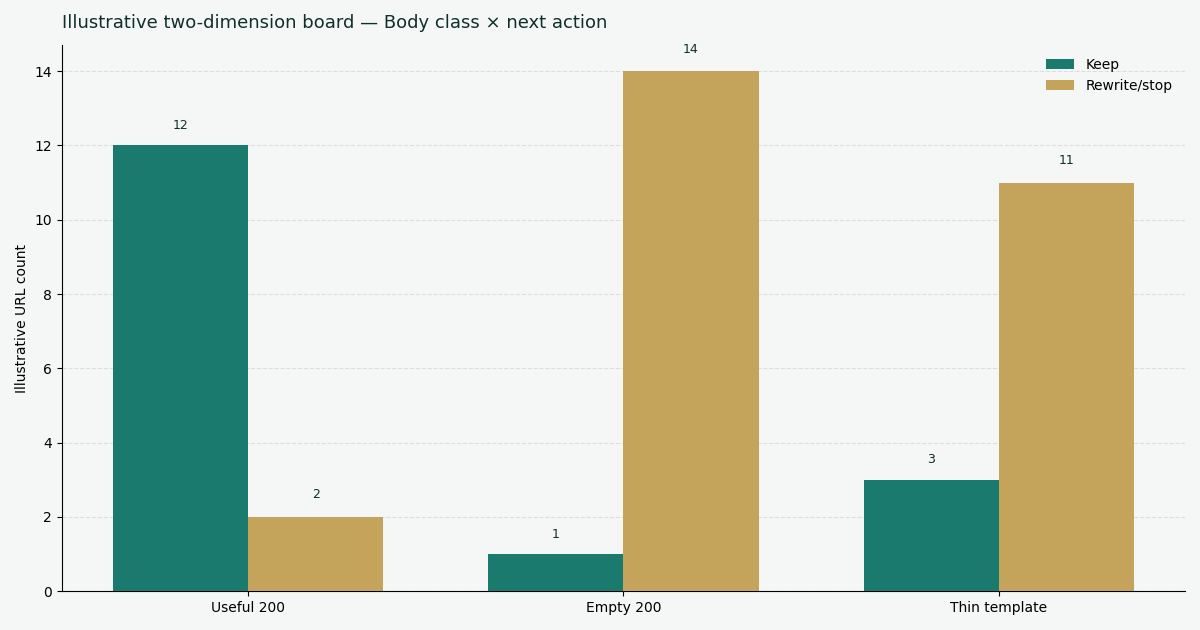
Figure: Word count and warning rows. Neither series is a Google thin classifier.
Official documents, not a floor
MDN HTTP status reference defines 200. RFC 9110 status semantics is the protocol source. WHATWG main-element specification names the region a later tokenizer should prefer. Cloudflare status-code reference is operational delivery context. None of those pages sets a 2000-word floor.
Google duplicate URL guidance covers canonical consolidation. Duplication is a different ticket from length. thin content SEO that merges “short” and “duplicate” into one red cell is hiding the owner.
What the warning rows were
Homepage: Image Alt Text 2/7. Editorial: Title Length 61 plus Image Alt Text 4/5. Title-checker: Image Alt Text 2/5. Those strings are in the CLI JSON. They are not thin content SEO strings. Keep them out of a thin verdict.
How to reproduce the wordCounts
npx --yes -p infinitegrowth@0.1.1 seo-health check \
  https://infinisynapse.com/ --format json --lang en

curl -sS -A 'InfiniSynapse-SH67-desk/2026-09-14' -o /tmp/helpful.html \
  -w '%{http_code} %{size_download}\n' \
  https://developers.google.com/search/docs/fundamentals/creating-helpful-content
Expect check exit 0 on the public homepage unless the host fails. Expect HTTP 200 on the docs URL unless Google moves it. Store words and the warning array. Do not store a thin boolean this package did not print. thin content SEO reproduction stops at those fields until an editor names a task.
curl the helpful-content page
Keep the user-agent. A later fetch can receive a different byte count than 33,160. Write the new status beside the old one. Do not silently replace the H1 Creating helpful, reliable, people-first content.
The CLI -V string 0.1.0 and the package pin 0.1.1 both belong on the ticket. They prove which counter produced 1292. They do not prove Google’s opinion of the homepage.
CLI boundary on the same morning
This desk will not promote exit 0 into a quality award. The observed contract is that seo-health check can complete while a warning row exists. thin content SEO notes that quote “page passed, therefore not thin” from that exit are fiction.
We did not run a signed-in eeat job. The editorial URL’s eeat attempt printed unauthorized. Unauthorized is a login failure. It is not a thin verdict and not a YMYL score.
What a later triage must keep
When someone files a thin ticket, write the user task first. “Explain shipping cutoff” can be short and complete. “City landing with a swapped h1” can be long and empty. thin content SEO starts with the task, then reads facts, then reads siblings.
Keep status, robots, canonical, and main-region tokens as separate columns. A noindex placeholder and an indexable near-clone have different owners. Extra adjectives cannot hide a broken removal policy.
Facts before tokens
Count facts under a declared rule: dates, prices, requirements, named options, outputs a second person can check. Decorative adjectives are not facts. Preserve the fact list beside the count so an editor can challenge a cell instead of arguing about 1292.
The title-checker URL has 2928 words because it is a long editorial page. That length did not clear its image warning. The homepage has 1292 words and a different job. thin content SEO should not force the homepage toward 2928.
Siblings and disposition
If two URLs share a template, compare distinguishing facts before you merge. Google duplicate URL guidance is the consolidation document. It does not say “under 2000 words, delete.” thin content SEO that uses 2000 as a kill line is inventing policy.
As of 2026 this page is not a customer. The sample cannot establish how often other hosts ship 1292-word homepages. It does not prove that adding 700 words would remove the homepage’s image warning.
Failure modes that invent a floor
2000-word pass line. This CLI never printed that rule.
Navigation as content. Menus inflate a token count.
Exit 0 as quality. Completion is not a thin classifier.
Warning row as thin. The observed warnings were title length and empty alts.
Docs 200 as a verdict. Helpful-content is a Google page, not a score on this host.
Padding a hold URL. If the disposition is remove, more prose delays the redirect.
A thin content SEO memo that skips the task sentence is already late.
How a reviewer should read 1292
Start with the three CLI rows. Confirm the homepage still reports a wordCount near 1292 or write the new number. Confirm editorial still reports 1463-class length and two warnings or write the new pair. Confirm title-checker still reports 2928-class length and one warning or write the new pair. Confirm the helpful-content URL still answers 200. Only then talk about keep, merge, or hold.
Write the warning strings in full. If the only warning is Image Alt Text, send the ticket to image SEO alt text or to the footer-icon owners. Do not open a thin rewrite. thin content SEO that rewrites the homepage to chase 2000 words while leaving 2/7 empty alts is doing the wrong job.
Name the user task on each URL. The homepage’s job is product orientation. Editorial-standards names reviewers and corrections. Title-checker teaches a title workflow. Those are three tasks. One thin content SEO word floor cannot serve all three.
If a later pass needs main-region tokens, declare the tokenizer and the selectors before you compare siblings. Consent banners and footers can move a count. A changed count is not automatically a thin improvement.
Store the user-agent and the package pin. The decision this page supports is narrow: keep the three wordCounts in the ticket, refuse a 2000-word floor, and refuse to call exit 0 a Google result. thin content SEO does not set a content budget.
When the next quarter still shows 1292 / 1463 / 2928-class numbers, republish the new date if you re-ran the checks. Do not invent a fourth customer URL to make the table look thicker. Three first-party rows are a complete desk for this article.
Two people repeating the check command should see the same class of wordCount unless the pages changed. Two people judging “is the homepage complete?” will not write identical notes. That is why the numbers are the desk and the disposition is a signed addendum.
Do not upload a private customer corpus to prove you worked. This article’s sample is not a customer. thin content SEO that publishes someone else’s wordCounts to look empirical is leaking inventory, not proving a thin rate.
If the only artifact you have is this chart, say so. The chart is three wordCounts and three warning-row counts for thin content SEO. It is a useful stop rule. It is not a web-wide thin study. Teams that need a study must collect their own URLs and keep them off this page until the captures exist.
Nearby guides
The on page SEO tool owns the combined page. Do not copy an eight-module board into this purpose ticket.
| Job | Guide |
|---|---|
| Outline ranks instead of length | heading structure SEO |
| Plugin output on a WordPress host you own | best SEO plugin for WordPress |
| Live title versus authored title | SEO title checker |
| Extractable answers, not word floors | featured snippet checker |
thin content SEO stays on task, facts, and disposition.
Keep 1292, 1463, and 2928 unlabeled as thin
Replay the three checks. Write the task before you change a wordCount.
Run SEO Health CheckerFrequently Asked Questions
How many words are enough?
There is no universal minimum. Use enough text and structured facts to finish the URL’s job. thin content SEO does not ship a 2000-word floor from this table.
Can a short page be useful?
Yes. A cutoff, a definition, or a policy answer can be complete. 1292 on this homepage is a thin content SEO count, not a verdict.
Should near-duplicate location pages be merged?
Merge or redirect when the only difference is a label. Keep separate URLs only when each page has distinct facts that thin content SEO can list.
Does a 200 status mean the URL should stay indexed?
No. A server can return 200 for a placeholder. Review purpose, robots, and canonical. Status alone is not a keep.
Does check exit 0 mean the page is not thin?
No. Exit 0 means the request finished. The observed rows still carried warnings, and none of those warnings was a Google thin label.
Conclusion
Use thin content SEO when the job is to keep wordCount as a field, name the task, and refuse a floor this CLI did not print. This 2026-09-14 pass recorded 1292 / 1463 / 2928, warning rows 1 / 2 / 1, and a helpful-content 200. Stop when those fields remain visible. A bounded length log beats an unsupported thin percentage.
If a later brief needs a disposition note, start that work explicitly in the InfiniSynapse workspace and attach the three-row table; the workspace is not another thin classifier.
Keep the three wordCounts in the ticket; do not set a 2000-word floor from this table.
William Zhu · Cofounder, InfiniSynapse · GitHub @allwefantasy
Desk-validated SEO Health methods. Corrections: zhuhl@infinisynapse.com · corrections policy.