
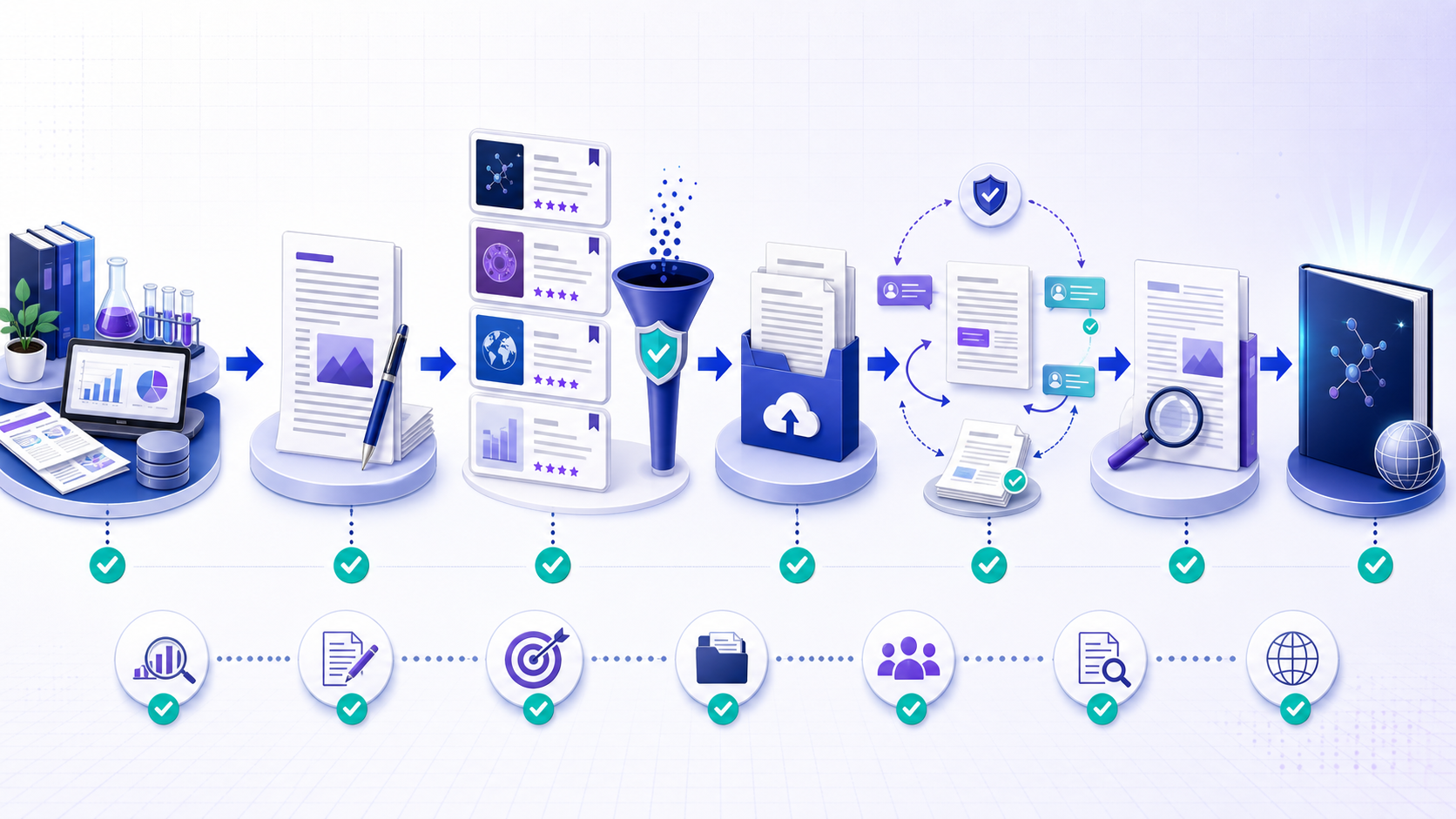
How to Publish a Research Paper: The Complete Roadmap如何发表研究论文:完整路线图
To publish a research paper, convert completed and responsibly documented research into a transparent manuscript, select one credible journal that fits the question and article type, submit every required file, respond accurately to editorial and peer-review decisions, then check proofs and the final publication record. Publication is a controlled sequence of evidence and decisions, not simply uploading a document.
发表研究论文需要把已完成且负责任记录的研究转化为透明稿件,选择一本与研究问题和文章类型适配的可信期刊,提交全部必需文件,准确回应编辑与同行评审决定,最后检查校样与正式出版记录。发表是一组受控的证据与决策流程,不只是上传文档。
The details vary by discipline, study design and journal. Begin with the target journal's current instructions and use discipline-specific standards. The workflow below is a reusable planning tool, not a promise of acceptance or a universal timeline. When the candidate list is ready, use Journal Fit Navigator to organize comparison evidence before making the final journal decision.
具体要求会随学科、研究设计与期刊变化。应从目标期刊当前作者指南开始,并使用学科特定规范。下方流程是可复用规划工具,不是录用承诺或通用时间表。形成候选名单后,可使用投刊罗盘整理比较证据,再作出最终期刊决定。
Step 1: Decide Whether the Research Is Ready步骤1:判断研究是否达到投稿条件
A finished analysis is not automatically a publishable study. Before writing around a preferred conclusion, freeze the research question, approved protocol, dataset version, analysis decisions and limitations. Confirm that required ethics approval, consent, registration, permissions and data-governance conditions were satisfied. Do not repair missing study conduct with polished prose.
完成分析并不自动意味着研究可以发表。在围绕偏好结论写作前,应固定研究问题、批准方案、数据集版本、分析决策与局限,并确认所需伦理批准、知情同意、注册、许可和数据治理条件均已满足。不能用漂亮文字弥补研究实施缺失。
- The primary question and study design are stated without changing them after seeing results.主要问题与研究设计已明确,没有在看到结果后随意改变。
- Every table and figure can be traced to a versioned analysis output.每张表与图均可追溯到有版本记录的分析输出。
- Negative, inconclusive and unexpected findings are reported honestly.阴性、不确定与意外结果均被诚实报告。
- Ethics, registration, consent, permissions and data statements are accurate.伦理、注册、同意、许可与数据声明准确。
- The conclusion does not exceed the design, sample or evidence.结论没有超出设计、样本或证据边界。
For health research, the EQUATOR writing toolkit helps authors identify reporting guidelines and asks whether readers can assess methods, replicate work and extract results. Other fields have their own standards; use the standard appropriate to your study rather than adding an unrelated checklist.
对于健康研究,EQUATOR写作工具包帮助作者识别报告规范,并检查读者能否评估方法、复现研究和提取结果。其他领域有各自标准,应选择适用于研究设计的规范,而不是添加无关清单。
Step 3: Build a Complete, Transparent Manuscript步骤3:完成完整透明的稿件
Draft around the study's logic: why the question matters, what was done, what was found and what the findings mean within their limits. Use the structure expected for the article type. Align the title, abstract, main text, tables, figures, supplementary files and data statements; contradictions between them are common avoidable errors.
围绕研究逻辑写作:问题为什么重要、做了什么、发现了什么,以及这些发现在局限范围内意味着什么。使用文章类型要求的结构,并使题目、摘要、正文、表格、图片、补充文件与数据声明保持一致;它们之间的矛盾是常见且可避免的错误。
For each conclusion, identify the exact result, analysis and limitation that support it. Remove unsupported causal or universal language.
为每项结论指出支持它的准确结果、分析与局限,删除无证据的因果或普遍性表达。
Map required reporting items to manuscript page numbers. “Not applicable” needs a reason, not a blank cell.
把必需报告项目映射到稿件页码;“不适用”需要理由,不能只是空白。
Verify every citation against the source and cite primary evidence where possible. Do not cite a paper you have not checked.
逐条对照来源核验引用,并尽可能引用原始证据;不要引用自己没有检查的论文。
Confirm figure resolution, legends, anonymization, permissions, supplementary content and accessible file names.
确认图片分辨率、图注、匿名化、许可、补充内容与可识别文件名。
Elsevier's current manuscript-preparation guidance likewise starts with the target journal's guide for authors because formatting, structure and submission requirements differ. Language editing can improve clarity, but it cannot validate methods or turn weak evidence into strong evidence.
Elsevier当前的稿件准备指南同样要求先查看目标期刊作者指南,因为格式、结构与投稿要求各不相同。语言编辑可以提高表达清晰度,但不能验证研究方法,也不能把薄弱证据变成强证据。
Step 4: Choose One Suitable, Trusted Journal步骤4:选择一本适配且可信的期刊
Build a small candidate set from the manuscript's question, audience and article type—not from one metric. Verify every candidate on the official journal and database records. Check aims and scope, recent relevant articles, accepted formats, peer-review model, indexing, ownership, fees, open-access terms, data policies, ethics, corrections and contact information.
从稿件问题、目标读者与文章类型建立小规模候选集,而不是只看一个指标。通过期刊官网与正式数据库记录核验每个候选项,包括收稿范围、近期相关文章、接受格式、评审模式、数据库收录、所有权、费用、开放获取条款、数据政策、伦理、更正机制与联系方式。
| Decision field决策字段 | Candidate A候选A | Candidate B候选B | Evidence source证据来源 |
|---|---|---|---|
| Scope and article type范围与文章类型 | Record finding填写核验结果 | Record finding填写核验结果 | Official journal pages期刊官网 |
| Audience and recent topics读者与近期主题 | Record finding填写核验结果 | Record finding填写核验结果 | Recent table of contents近期目录 |
| Indexing and identity收录与身份 | Record finding填写核验结果 | Record finding填写核验结果 | Official database records正式数据库记录 |
| Fees, access and rights费用、访问与权利 | Record finding填写核验结果 | Record finding填写核验结果 | Current policy and licence pages当前政策与许可页面 |
| Review and integrity signals评审与诚信信号 | Record finding填写核验结果 | Record finding填写核验结果 | Published policy and correction history公开政策与更正历史 |
Use the Think. Check. Submit. journal checklist to investigate whether a journal is suitable and trusted. For database verification, consult the Scopus indexed journals guide and Web of Science journals guide. Metrics should never replace scope, policy and trust checks.
可以使用Think. Check. Submit.期刊核对表调查期刊是否适配且可信。数据库核验可参考Scopus收录期刊指南与Web of Science journals guide。指标不能替代范围、政策与可信度检查。
Prepare the manuscript title, abstract, article type, field, candidate journal URLs and policy questions. Journal Fit Navigator can help organize comparison evidence; it does not submit manuscripts, access subscription-only databases, replace official journal records or guarantee acceptance.
准备稿件题目、摘要、文章类型、领域、候选期刊URL与政策问题。投刊罗盘可帮助整理比较证据,但不会代为投稿、访问订阅数据库、替代期刊正式记录或保证录用。
Step 5: Prepare and Submit the Complete Package步骤5:准备并提交完整投稿材料
Download or save the current author instructions on the day you prepare the submission. Create a file manifest, then match every requirement: manuscript version, title page, anonymous manuscript where applicable, figures, supplementary files, reporting checklist, data statement, permissions, declarations and cover letter. Enter metadata directly from the final files so author names, title, abstract, funding and keywords do not diverge.
准备投稿当天下载或保存当前作者指南,建立文件清单并逐项匹配:稿件版本、标题页、适用时的匿名稿件、图片、补充文件、报告清单、数据声明、许可、各项披露与Cover Letter。投稿系统元数据应直接来自最终文件,避免作者姓名、题目、摘要、资助与关键词不一致。
- Lock the submission version.锁定投稿版本。Give each file a clear version and do not mix drafts.为每个文件设置清晰版本,避免混用草稿。
- Run the journal checklist.执行期刊核对表。Map each instruction to a file, page, form field or “not applicable” reason.把每项要求映射到文件、页码、表单字段或“不适用”理由。
- Prepare the editor-facing letter.准备面向编辑的来信。Use the journal submission cover-letter template and tailor fit and declarations.使用期刊投稿Cover Letter模板,定制适配与声明。
- Verify the rendered submission.核验系统生成版本。Open the generated PDF or preview and inspect order, equations, symbols, images and anonymization.打开系统生成PDF或预览,检查顺序、公式、符号、图片与匿名化。
- Save the receipt.保存投稿回执。Record manuscript ID, date, submitted files, corresponding author and journal contact.记录稿件编号、日期、提交文件、通讯作者与期刊联系方式。
One-journal rule: do not submit the same manuscript simultaneously to multiple journals. If you decide to move it, follow the current journal's formal withdrawal process and retain confirmation before submitting elsewhere.
单一期刊原则:不要把同一稿件同时投向多本期刊。若决定转投,应完成当前期刊正式撤稿流程并保存确认,再向其他期刊提交。
Step 6: Navigate Editorial Screening and Peer Review步骤6:应对编辑初筛与同行评审
After technical checks, an editor may reject the paper without external review, request administrative corrections, invite peer review or transfer it. If reviewed, the decision may request minor or major revision, reject the paper or accept it. Terminology varies; read the complete decision letter instead of inferring the outcome from a status label.
技术检查后,编辑可能在外审前拒稿、要求行政修正、送同行评审或建议转投。外审后可能小修、大修、拒稿或录用。术语因期刊而异,应阅读完整决定信,而不是只根据状态标签推断结果。
The peer review process guide explains roles and decision paths. A request to revise is not acceptance. Check the deadline, download every reviewer file, identify editor-only instructions and ask the journal promptly when a request is ambiguous or the deadline is unrealistic.
同行评审流程指南说明角色与决定路径。修回邀请并不等于录用。应确认截止日期、下载全部审稿文件、识别编辑专门要求;若要求含糊或期限不现实,应及时联系期刊。
Step 7: Revise the Paper and Response Together步骤7:同步修改稿件与回复信
Create a response table before editing. Copy each editor and reviewer point exactly, assign an owner, record the manuscript change and page/line location, or explain respectfully why no change was made. Update connected sections together: a changed method may require changes to the abstract, results, table, discussion, limitations and supplement.
编辑前先建立回复表。准确复制每条编辑与审稿意见,分配负责人,记录稿件修改及页码行号;若不修改,应礼貌说明理由。关联章节应同步更新:方法变化可能要求同时修改摘要、结果、表格、讨论、局限与补充材料。
Use the peer review example and response patterns to distinguish actionable, evidence-based comments from vague or out-of-scope requests. Be concise and professional. Do not claim a change was made unless it appears in the submitted revision.
使用同行评审示例与回复结构区分可执行、有证据的意见与模糊或超范围要求。回复应简洁专业,只有修改确实出现在提交的修订稿中时,才能声称已经完成。
Step 8: Check Proofs and Verify the Published Record步骤8:检查校样并核验正式出版记录
Acceptance moves the paper into production; it does not end author responsibility. Read the licence or publishing agreement, confirm open-access choice and charges, and check the proof against the accepted manuscript. Proof correction is usually for production errors and limited necessary corrections, not a new round of analysis.
录用后稿件进入制作阶段,但作者责任并未结束。阅读许可或出版协议,确认开放获取选择与费用,并把校样与录用稿逐项对照。校样修改通常用于制作错误和有限必要修正,不是重新分析研究的机会。
- Author names, order, affiliations and corresponding-author details are correct.作者姓名、顺序、单位与通讯作者信息正确。
- Title, abstract, headings, equations, symbols, tables and figures survived typesetting.题目、摘要、标题、公式、符号、表格与图片排版无误。
- Funding, conflict, ethics, data, contributor and licence statements are accurate.资助、冲突、伦理、数据、贡献与许可声明准确。
- References and links point to the intended sources.参考文献与链接指向预期来源。
- After release, the DOI or permanent URL, article version and correction channel are recorded.发布后记录DOI或永久URL、文章版本与更正渠道。
Save the accepted manuscript, proof corrections, final citation and publishing agreement according to institutional and journal policy. If a material error is discovered after publication, contact the journal rather than silently changing a repository copy.
依据机构与期刊政策保存录用稿、校样修改、最终引用和出版协议。若出版后发现实质错误,应联系期刊,而不是只在存储库中静默更改副本。
Reusable Research Paper Publication Tracker可复用的研究论文发表追踪表
Copy this structure into a project sheet or document. One current owner and one evidence link per stage makes stalled work visible. Save the comparison record produced with Journal Fit Navigator beside the journal-decision row.
可将以下结构复制到项目表格或文档中。每个阶段设置一位当前负责人和一个证据链接,便于发现停滞任务。把投刊罗盘生成的比较记录保存在“期刊决策”行旁边。
If rejected, do not erase the history. Record the reason, revise the manuscript and files, reassess the next journal and start a new submission row. Rejection may reflect fit, priority, evidence, reporting or capacity; only the decision letter and manuscript audit can show which changes are justified.
若被拒稿,不要删除历史记录。记录原因,修改稿件与文件,重新评估下一本期刊并新建投稿记录。拒稿可能与适配、优先级、证据、报告或期刊容量有关;只有决定信与稿件审计能够说明哪些修改有依据。
How to Publish a Research Paper FAQ如何发表研究论文常见问题
Complete and document the research, agree authorship, write transparently, choose a suitable trusted journal, follow its instructions, submit a complete package, respond to editorial and peer-review decisions, check proofs and verify the published record.
完成并记录研究,确认作者,透明写作,选择适配可信期刊,遵守投稿指南,提交完整材料,应对编辑与同行评审决定,检查校样并核验出版记录。
Many journals assess manuscripts on content and policy compliance rather than requiring an institutional affiliation. Use an accurate independent affiliation or address and check the target journal rules.
许多期刊根据内容与政策合规性评估稿件,并不必然要求机构单位。应准确填写独立研究者身份或地址,并核对目标期刊规则。
There is no universal duration. Editorial screening, reviewer availability, revision rounds, production and journal schedules vary. Use the journal's own current information and treat advertised times as estimates, not guarantees.
没有统一时长。编辑初筛、审稿人可用性、修回轮次、制作与期刊排期都会变化。应查看期刊当前信息,并把公布时间视为估计而非保证。
No. Simultaneous submission of the same manuscript is generally prohibited. Submit to one journal at a time and formally withdraw or wait for a decision before sending it elsewhere.
不应这样做。同一稿件重复投稿通常被禁止。每次只向一本期刊提交,并在正式撤稿或获得决定后再投其他期刊。
Read the decision, separate fixable manuscript issues from journal-fit issues, revise the paper and submission package, choose the next journal using fresh evidence and disclose prior history when a journal requests it.
阅读决定信,区分可修改的稿件问题与期刊适配问题,修改论文和投稿材料,依据新证据选择下一本期刊,并在期刊要求时披露既往历史。