GSC vs GA4: Clicks Are Not Sessions
GSC vs GA4 keeps clicks and sessions in separate columns. A matching URL is a join key, not proof a click became a session.
Author credentials: William Zhu is cofounder of InfiniSynapse (GitHub @allwefantasy · auto-coder). Desk: shipping SEO Health and the /en/tool/ visibility pages. No personal LinkedIn published. About: team / editorial standards.
Publisher credentials: InfiniSynapse has public profiles on GitHub, YouTube, and X. A 2026 WAIC Future Tech OPC excellence award covers the Agentic Data Infra entry (WAIC; third-party recap: Xinhua / Caohejing). That award does not review this page or SEO Health. Method CLI: infinitegrowth on npm. Archive: recognition and scope notes.
On this page
By William Zhu · Cofounder, InfiniSynapse · Published: 2026-09-08 · Last updated: 2026-09-24 · Last verified: 2026-09-24 · Reviewed by the InfiniSynapse Data Team.
Reviewed by: InfiniSynapse Data Team · method review 2026-09-14. First-party curl of GSC and GA4 Help URLs plus the Search Console API reference; no GSC↔GA4 join was run.
Trust / COI: About · Corrections. SEO Health is a commercial product from this team. No customer Search Console export was used.
GSC vs GA4 in one sentence
GSC vs GA4 puts a Search click next to an Analytics session and refuses to treat them as the same event. GSC vs GA4 for SEO is that comparison on a landing path. A shared URL can sit on one row. It does not prove the click became the session.
What each system counts
| Boundary | Search Console | GA4 |
|---|---|---|
| Event | A click on a search result | A session, a window of site activity |
| URL | Canonical URL in the Performance report | The landing path the property recorded, including parameter variants |
| Page type | Can include non-HTML URLs | Counts hits that create or continue a session |
| Clock | The property's reporting window | The property timezone you set |
A daily URL cap and a claim that Search Console is locked to Pacific Time were not measured on this desk. Do not copy those lines in as site facts.
A matching URL is only a key
Normalize host, trailing slash, and query parameters with one written rule. The matched key is a join status. Cardinality can still be many-to-many. The columns stay gsc_clicks and ga4_sessions.
Why the gap is expected
Search Console data discrepancies already says the two products are not required to match. Consent, bots, attribution, and timezone can all open a gap. This desk measured none of those. It also did not join a property export to a GA4 table.
What not to publish
Do not publish clicks divided by sessions as a conversion. Do not publish a 1,000-URL limit or a Pacific Time lock as a finding from this page. The 2026-09-14 fetch statuses stay what they were: three Help URLs answered 404 with titles still present, and the Search Console API reference answered 200.
TL;DR
Clicks and sessions stay in different columns even when the path string matches. GSC vs GA4 for SEO work starts as a source-boundary check, not as a conversion rate.
Direct answer: Treat GSC vs GA4 for SEO as two labeled systems that may share a normalized landing path. Clicks are not sessions. This desk fetched GSC Help, GA4 sessions Help, and the GA4 landing-page Help as 404-plus-title HTML, and the Search Console API reference as 200. We did not join a property export to a GA4 table. A teaching CSV is not a property.
The join desk pinned infinitegrowth@0.1.1 and still read -V as 0.1.0. Official Help and API URLs used InfiniSynapse-P3-desk/2026-09-14. No login. No property. No GSC↔GA4 join. Replay the CLI gates and the curl statuses. Those codes do not prove a click became a session.
What you will learn
- Why GSC vs GA4 for SEO keeps metrics in source-named columns
- Which Help URLs this user-agent saw as 404 with titles still present
- Which API reference answered 200
- How a date-range check differs from a join
- Where this page stops and a query-page matrix begins
What GSC vs GA4 for SEO compares
Key definition: GSC vs GA4 for SEO is the job of placing Search Console measures next to Analytics measures on a documented landing-path key without treating those measures as the same event. It is not a click-to-session formula. It is not an official Google health score.
The Analytics sessions Help is the official vocabulary for a session. The GA4 landing page report is the official vocabulary for a landing path. This page copies those boundaries. It does not claim we exported either property.
Search Console data discrepancies is the official reminder that Search Console and Analytics are not required to match. This cluster already had that URL; we keep the fragment. We do not claim the Help document returned 200 to this user-agent.
Eight lights cannot join two analytics systems. GSC vs GA4 for SEO work starts in two labeled files, not in a slogan. Tech amber is a clue. It is not a substitute for a dated pair. A later GSC vs GA4 for SEO briefing that quotes only the lights has skipped both exports.
SEO Health remains the deterministic evidence foundation for Search Console file gates. Once a dated Performance export exists beside a separately labeled GA4 landing-page export, teams may send those rows to an InfiniSynapse Server API long-task workspace to sequence mismatch tickets; the API does not convert clicks into sessions or override an unauthorized exit.
Clicks are not sessions
A click is a Search result selection. A session is an Analytics window of activity. GSC vs GA4 for SEO that divides one by the other as a universal conversion has already left both definitions. Keep that sentence on the ticket so a GSC vs GA4 for SEO review cannot quietly reintroduce the ratio.
A landing path is not a join
A shared string after a slash rule is a key candidate. Cardinality can still be many-to-many. WHATWG URL and RFC 3986 are the path-normalization references. They do not prove the events are equal.
Observed sample: Help 404s and API 200
This desk used the first-party contract from seo-health manual gsc and four local CLI runs, plus official URL fetches. Login is required and consumes credits. The accepted GSC source is Performance → Export → ZIP → unzip → pass a directory or CSV. Do not pass the ZIP. UTF-8. At most eight files. At most 4MB. Queries plus Pages is the minimum GSC pair. We did not supply that pair. We did not export GA4.
GSC vs GA4 for SEO that needs a join therefore has a sample size of zero joined rows. That limit is the finding. It cannot establish a click-to-session relationship.
| Input | Exit code | Message observed |
|---|---|---|
| Missing path | 1 | ENOENT: no such file or directory |
dummy.zip | 1 | 只支持 CSV 文件 |
| Empty directory | 1 | 目录下没有找到 CSV 文件 |
| 1-row fixture CSV | 1 | read 1 CSV, then 分析失败:unauthorized |
| URL | First status | Title present | Bytes |
|---|---|---|---|
support.google.com/webmasters/answer/7576553 | 404 | Performance report (Search results)… | ~1.60MB |
support.google.com/analytics/answer/9191807 | 404 | About Analytics sessions | ~1.62MB |
support.google.com/analytics/answer/12931766 | 404 | [GA4] Landing page report | ~1.65MB |
developers.google.com/webmaster-tools/v1/api_reference_index | 200 | Search Console API Reference | 74863; Last-Modified Tue, 23 Jul 2024 |
The 404 plus titled HTML is a curl and user-agent observation. It does not prove a human browser cannot open Help. Do not say Google deleted the article.
A synthetic landing-path fixture can teach a trailing-slash rule in a classroom. This rewrite does not reprint click and session numbers as the desk. We did not join those systems. GSC vs GA4 for SEO still needs your two files, and a GSC vs GA4 for SEO classroom pair is not a substitute.
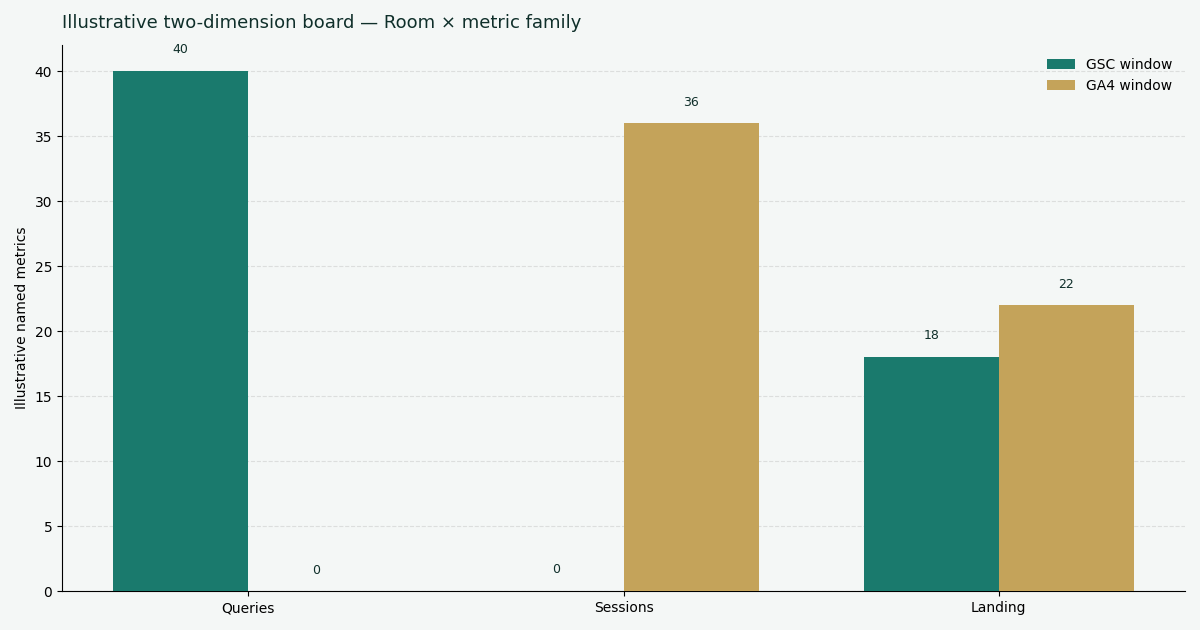
Figure: Two series from the same desk. HTTP status is not a session count. API 200 is not a joined row.
Search Console Help as curl saw it
The Performance Help URL answered 404 with its title still in the HTML, about 1.60MB. We keep #data_discrepancies as the official mismatch note. The observed status belongs beside that citation. GSC vs GA4 for SEO owners who quote the fragment and skip the 404 are incomplete. Cite the status in the same paragraph as the GSC vs GA4 for SEO claim.
Analytics Help as curl saw it
Sessions Help and the landing-page Help both answered 404 with titles still present, about 1.62MB and 1.65MB. That is enough to cite the official names without pretending this user-agent received 200. Clicks remain a Search Console field. Sessions remain an Analytics field.
Search Console API reference 200
The API index answered 200 (74,863 bytes, Last-Modified 23 Jul 2024). That is a documentation fetch, not a Search Analytics query and not a GA4 Data API call. We did not retrieve rows from either system.
CLI gates still apply
seo-health gsc dummy.zip
seo-health help gsc documents gsc [options] <path> with --lang default zh and --format json. seo-health help login documents --token from the web app. We did not send a token. OWASP Logging is why we log the exit code and not the token. Microsoft Power Query text-csv is the load path for both labeled files. AWS Glue Data Quality is the completeness rule: both sources must exist. Snowflake load is a later engine for the same labeled columns.
What this desk cannot establish
This sample size is four CLI failures and four official URL fetches. It cannot establish a property-level mismatch list. It does not prove a Search click caused a GA4 session. Close the GSC vs GA4 for SEO file when those limits are still visible.
A boundary-join framework
Keep columns in their source names
gsc_clicks stays gsc_clicks. ga4_sessions stays ga4_sessions. GSC vs GA4 for SEO that renames both to traffic has already erased the boundary. A GSC vs GA4 for SEO column dictionary should keep those names verbatim.
Normalize paths without forcing equality
Apply one host rule, one trailing-slash rule, and one query-parameter rule. Record redirect mappings separately. A matched key is a join status, not a conversion.
Outer-join unmatched rows
Keep GSC-only paths and GA4-only paths visible. Silent inner joins hide the interesting misses. Consent, timezone, bots, and attribution can all explain a gap. None of those effects were measured here.
How this job compares to a date-range check
A date-range check asks whether two Search Console windows are comparable. A join asks whether two systems can share a path key. The Google Search Date Range page owns the first job. GSC vs GA4 for SEO owns the second, and only after both files exist.
The GSC query page report page owns the Search-only matrix. Use it when the question is still inside Search Console.
Send the labeled files to analyze Search Console with AI after the mismatch is written down. Use it when GSC vs GA4 for SEO is already honest about the missing join.
Credits do not flip unauthorized. An owner who starts InfiniSynapse before both labeled files exist is buying a story about missing evidence.
GSC vs GA4 for SEO also stays off query recovery. Analytics sessions do not restore anonymized Search queries. Search impressions do not identify users. A join key is a path, not a person. If a later export includes query text on the GSC side, keep that text out of the GA4 file unless you have a documented reason and a redaction rule.
Timezone and currency of dates are part of the boundary. A Search Console window that ends on Sunday is not automatically the same Sunday in a GA4 property that uses a different timezone. GSC vs GA4 for SEO that aligns only the calendar label and ignores the timezone setting has already mixed windows. This desk exported zero days from either system, so we did not measure that drift. We still record it as a required field on the next real pair.
Failure modes that invent a ratio
Clicks ÷ sessions. That quotient is not a definition in either Help title we observed. Do not publish it as a site conversion.
Help-404 folklore. A titled 404 from this user-agent is not a deleted definition. Keep the status beside the citation.
Unauthorized as diagnosis. Exit code 1 after reading one fixture CSV is a token refusal. It is not a GA4 mismatch.
Positional paste. Copying a session value onto a GSC URL because the rows happened to line up does not prove a join.
Synthetic-to-real drift. A classroom 80-clicks / 72-sessions pair can teach a slash rule. Publishing it as a customer join does not prove reconciliation.
Record the user-agent. A later client can see 200 on the same Help URLs. This desk used one string. It cannot stand in for a logged-in Analytics property or a Search Console property. If you need the live definitions, open Help in a browser and keep that screenshot beside the curl. Do not paste either GIF into this page as if it were a joined table.
When two people repeat the same four CLI inputs and the same four URLs, they should see the same exit codes and first statuses unless a deploy landed between them. That repeatability is the point of a GSC vs GA4 for SEO desk. Narrative attribution stories are a different job.
Host variants belong in the normalization note, not in a silent collapse. www versus apex, http versus https, and a trailing slash are three different rules. Write them down. GSC vs GA4 for SEO that applies one rule in a notebook and a different rule in a slide will manufacture unmatched rows that look like product bugs. This desk applied none of those GSC vs GA4 for SEO rules to live rows because no live rows were joined.
Cluster guides for this job
This page keeps the source-boundary test. Narrower jobs live on sibling pages.
| Job you actually have | Guide to open next |
|---|---|
| Full export-to-decision lifecycle | analyze Search Console with AI |
| Equal Search Console windows | Google Search Date Range |
| Search-only query-page matrix | GSC query page report |
Inspect both systems before you force a match
Keep clicks and sessions in separately named columns. Normalize the path. Leave unmatched rows visible.
Run SEO Health CheckerIf a signed-in workspace must narrate one dated GSC file beside one dated GA4 landing-page file after the gates pass, use the InfiniSynapse task workspace for those two labeled windows and no blended total.
Frequently Asked Questions
What is the difference between GSC and GA4?
A click is a search-result selection. A session is an Analytics activity window. GSC vs GA4 keeps those numbers in separate columns. A matching landing path is a join key, not a ratio.
Did this desk join GSC and GA4?
No. We fetched official URLs and ran local CLI gates. We did not export either property and we did not join them. GSC vs GA4 for SEO that prints a matched table from this desk has left the evidence.
Why do Help URLs return 404 in curl?
This user-agent received 404 with titles still present and large HTML bodies. That is a curl observation. It does not prove a browser user cannot open Help.
Can I treat clicks as sessions after a slash rule?
No. A slash rule normalizes a key. It does not change the event. GSC vs GA4 for SEO keeps the measures in separate columns after the key matches.
What does the data_discrepancies note actually cover?
It is the official Search Console note that Analytics and Search Console can disagree. We cite the fragment. This desk observed the parent Help URL as 404. The note does not prove a join we did not run.
When should I open a query-page report instead?
When the question is still inside Search Console: which query maps to which page. Use the sibling. Do not pull GA4 sessions into that matrix.
Conclusion
Use GSC vs GA4 for SEO when the job is to keep Search Console and Analytics labeled before anyone publishes a ratio. The first GSC vs GA4 for SEO deliverable is the source-boundary table, not a blended traffic number. If either file is missing, stop the GSC vs GA4 for SEO file at the fetch and the CLI gates. The 2026-09-14 desk shows three Help URLs answering 404 with titles still present, the Search Console API reference answering 200, and no joined rows. Close the note when the curl status, the exit code, the unbuilt join, and the clicks-versus-sessions boundary are still visible. A bounded fetch table is more useful than an unsupported reconciliation claim. The unbuilt join is the result, not a gap to fill with a classroom ratio.
William Zhu · Cofounder, InfiniSynapse · GitHub @allwefantasy
Desk-validated SEO Health methods. Corrections: zhuhl@infinisynapse.com · corrections policy.