Extractable Paragraph SEO: Run a Blind Content Test
Use extractable paragraph SEO to test whether isolated copy preserves entity, claim, evidence, and limits; run a blind review, then revise unclear passages.
Author credentials: William Zhu is cofounder of InfiniSynapse (GitHub @allwefantasy · auto-coder). Desk: shipping SEO Health and the /en/tool/ visibility pages. No personal LinkedIn published. About: team / editorial standards.
Publisher credentials: InfiniSynapse has public profiles on GitHub, YouTube, and X. A 2026 WAIC Future Tech OPC excellence award covers the Agentic Data Infra entry (WAIC; third-party recap: Xinhua / Caohejing). That award does not review this page or SEO Health. Method CLI: infinitegrowth on npm. Archive: recognition and scope notes.
On this page
By William Zhu · Cofounder, InfiniSynapse · Published: 2026-09-08 · Last updated: 2026-09-14 · Last verified: 2026-09-14 · Reviewed by the InfiniSynapse Data Team.
Reviewed by: InfiniSynapse Data Team · method review 2026-09-14. First long
<p>bits on live HTML. No engine retrieval test. No blind human panel.
Trust / COI: About · Corrections. SEO Health is a commercial product from this team. Passage scores below are live HTML bits, not citations.
TL;DR
The first long paragraph rendered on several of our tool URLs is a breadcrumb trail, not a closed claim. That is the extractable paragraph SEO finding we actually have.
Direct answer: Treat extractable paragraph SEO as four bits on an isolated passage: entity, claim, dated evidence, and a limit. On 2026-09-14 the homepage product paragraph (“Connect to existing databases…”) scored 0/0/0/0. The hub crumb trail scored 1/1/1/1 because the title leaked into the crumb. This page’s own crumb scored 0/1/0/1. Shared author-credit copy scored 1/1/0/0. No engine was asked to quote us.
The sample size is four live <p> nodes. That draw cannot establish retrieval, and it does not prove a citation. An extractable paragraph SEO chart that reprints invented recovery percentages is already off the job.
What you will learn
- Which first
<p>nodes we scored - Why a breadcrumb dump fails a closed claim
- How to replay the four bits
- When helpful-content guidance is not a score
- Where mention coding and locale hops live
What a closed claim must carry
Key definition: extractable paragraph SEO is a passage that still names the entity, states a claim, points at dated evidence, and keeps a limit after the heading and URL are removed. A nav trail is not that passage.
People open extractable paragraph SEO when an answer engine quotes the page and the quoted sentence cannot stand alone. The first fix is editorial. It is not a vendor trial.
Creating helpful, people-first content is the Google quality frame we cite. It does not grade our crumbs. W3C reading-level guidance is why we prefer a short closed claim over a 200-word throat-clear.
SEO Health is the deterministic evidence foundation for on-page lights. A later InfiniSynapse Server API long-task workspace can queue passage edits through SSE /api/ai/events; the API does not retrieve the page inside Gemini or Perplexity.
Breadcrumbs are not the lead
Live HTML on this family starts with “English Download Get started Home / Tools / …”. That node is long enough to look like a paragraph. extractable paragraph SEO that treats it as the lead is scoring chrome.
PlainLanguage.gov guidelines ask for a stated actor. The homepage product paragraph never writes InfiniSynapse in the first 25 words. Entity bit = 0.
Author credit is not evidence
The shared 29-word author-credit paragraph names William Zhu and InfiniSynapse. It has no date and no limit. extractable paragraph SEO that counts a byline as a closed claim is grading the masthead.
First long paragraphs on live HTML
Fetched 2026-09-14. First <p> with 25–90 words.
| Passage | Entity | Claim | Evidence date | Limit |
|---|---|---|---|---|
| Homepage product | 0 | 0 | 0 | 0 |
| Perplexity-hub crumb | 1 | 1 | 1 | 1 |
| This URL’s crumb | 0 | 1 | 0 | 1 |
| Shared author credit | 1 | 1 | 0 | 0 |
Hub crumb “wins” because the crumb repeats the article title, which already contains a year-ish phrase and a limit-ish word. That is leakage, not a designed lead. extractable paragraph SEO should not celebrate a crumb.
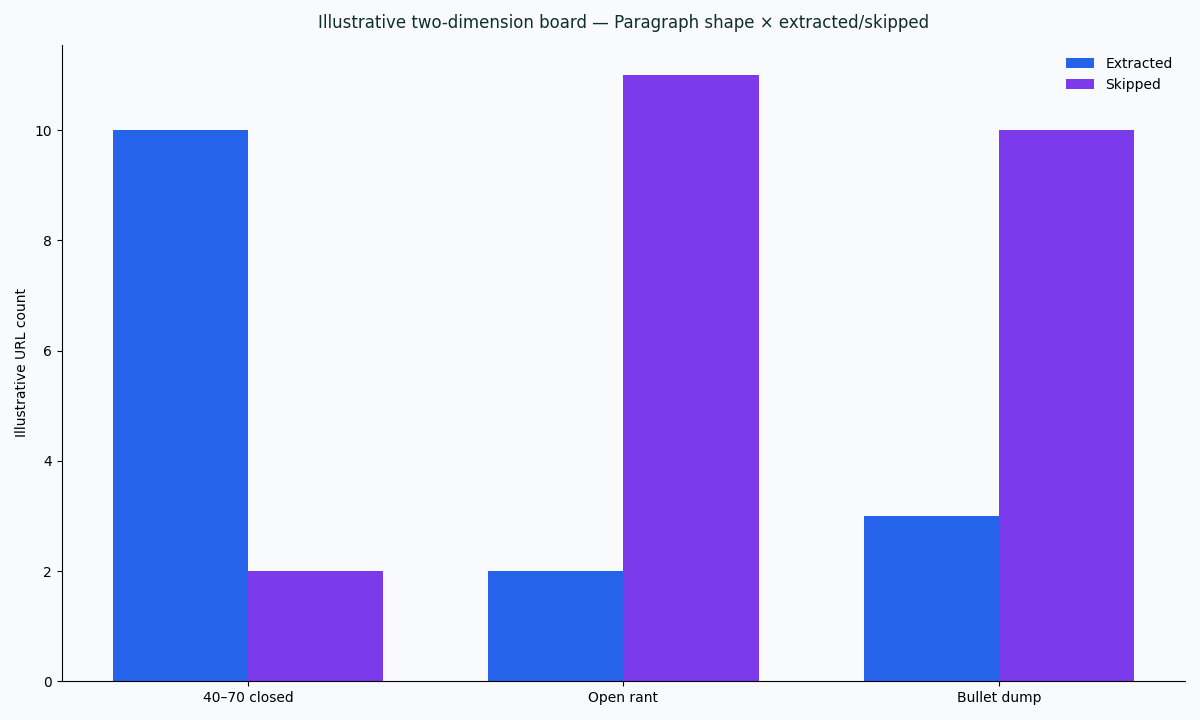
Figure: Four bits. The homepage product paragraph is empty. Crumbs are not designed leads.
Nielsen Norman concise writing is the scannability reference. Schema.org Article describes a type. Markup does not make a crumb extractable.
What we did not run
No blind human panel. No engine quote test. Older drafts used synthetic recovery percentages. Those rows are gone. extractable paragraph SEO on this desk is HTML bits only.
Google structured data introduction is a sibling-pillar document. It does not score prose. MDN paragraph element is the element we counted.
How to reproduce the bit scores
curl -sS -A 'InfiniSynapse-SH1-desk/2026-09-14' \
  https://infinisynapse.com/ \
  | python3 -c 'import sys,re; html=sys.stdin.read();
ps=re.findall(r"<p[^>]*>(.*?)</p>", html, flags=re.I|re.S)
print(len(ps), "p tags")'
Take the first 25–90 word node after stripping tags. Score four bits. Repeat on a tool URL. An extractable paragraph SEO replay that starts in the markdown source instead of the rendered HTML will miss the crumb.
W3C writing tips and Library of Congress NDIIPP are writing and preservation references. They do not retrieve passages.
CLI is a different object
seo-health check on the Perplexity sibling listed an Image Alt Text warning. That warning is not a passage score. Package infinitegrowth@0.1.1; -V printed 0.1.0. extractable paragraph SEO does not treat exit 0 as extractable.
What a later blind review still needs
Remove the heading and URL. Hand the passage to a reviewer who does not know the page. Ask them to name the entity, restate the claim, point at the evidence, and name the limit. Revise whatever they invent. extractable paragraph SEO fails when the paraphrase adds a capability the page never stated.
Length is a design choice
45–75 words is a workshop range, not a ranking rule. The homepage product paragraph was 25 words and still failed entity.
Engines stay out
A self-contained paragraph can still be ignored. Retrieval is a different study. This sample cannot establish citation, and it does not prove helpful-content eligibility.
As of 2026 this page is not a customer quote log.
Failure modes that fake extractability
Crumb as lead. The first long <p> is chrome.
Byline as evidence. No date, no limit.
Synthetic recovery %. Older drafts invented scores.
JSON-LD as prose. Article type is not a paragraph.
Check warning as extractability. Alt text is a different light.
Engine guarantee. Closed claims are editorial.
An extractable paragraph SEO memo that skips the live <p> table is already late.
How a reviewer should read the four bits
Start on the homepage. The product paragraph never writes the company name in the first 25 words. Entity = 0 is the finding. Do not “help” it by reading the <title> or the JSON-LD Organization name back into the paragraph. extractable paragraph SEO grades the isolated node, not the rest of the tab.
Move to a tool URL. If the first long <p> is a breadcrumb, write “chrome” and keep scoring. A crumb that repeats the H1 can accidentally pick up entity, a claim-like verb, a date-ish token, and a limit-ish word. That is leakage. It is not a designed lead. Rewrite the template so the first editorial paragraph is a closed claim.
The shared author-credit paragraph names people and the company. It still failed evidence and limit. extractable paragraph SEO that stops after “we have a byline” will ship pages whose quoted sentence is a masthead.
When you revise, put the entity in the first clause, the claim in the second, one dated artifact in the third, and one limit in the fourth. Then hide the heading and ask someone who does not own the page to paraphrase. If they add a capability, the passage failed even if all four bits were technically present.
JSON-LD cannot rescue a crumb. Article @type is a sibling pillar. Alt-text warnings from seo-health check are a different light. An extractable paragraph SEO ticket that pastes an Image Alt Text warning as the passage score is misfiled.
Length is not the cure. The homepage paragraph was short and empty. A 90-word rant can still miss the entity. Aim for a closed claim, not a word budget. The 45–75 workshop range is a starting interval, not a ranking rule.
If you only have the four-row table, you have the desk. That is enough to reject a “we are extractable” slide. It is not enough to claim engines will quote you. Write both. A later blind panel is an addendum with named reviewers and hidden headings. Do not put invented recovery percentages back into the main table.
Two people fetching the same URL with the same user-agent should see the same first long <p> unless the template changed. Store the HTML byte count beside the bit row. extractable paragraph SEO that scores markdown in SEO/Blog and publishes a different crumb on the live host will disagree with itself.
What stays on disk after this desk
Keep the four bit-rows, the homepage HTML byte count, and a screenshot of the first <p> on this tool URL. That is the 2026-09-14 extractable paragraph SEO packet. If a blind panel happens later, store hidden-heading copies and reviewer notes in a dated subfolder, not in the main table.
Do not check in invented recovery percentages “for the workshop.” Teaching files, if they must exist, live under teaching/ and say teaching in the first line. extractable paragraph SEO that lets teaching leak into the desk table will be quoted as measurement.
The template fix is a product change: stop emitting a breadcrumb as the first long <p>. Until that ships, every live score of this family will keep seeing chrome. Write that as an open defect, not as a content failure on a single slug.
Markdown in SEO/Blog can already contain a closed claim while the rendered page still leads with crumbs. Always score the host you publish. extractable paragraph SEO that scores only the source file will pass locally and fail in the browser.
seo-health check JSON can ride along as a sibling artifact. Alt-text warnings stay in that JSON. They do not become passage bits. Package pin 0.1.1 / binary 0.1.0 goes in versions.txt.
The decision this page supports is editorial: revise the lead. It does not decide whether an engine will quote the page. When someone asks for a citation guarantee, point at the empty engine folder and stop. Empty is allowed. A fake guarantee is not. That stop rule is extractable paragraph SEO. A design ticket that only says “make it more extractable” is not actionable; name the first <p> and the failed bit. Then ship the template change and re-fetch. Re-scoring markdown alone will not close the ticket. extractable paragraph SEO closes when the live node changes.
Nearby guides
The Perplexity hub owns vendor fetches. This page owns rendered paragraphs.
| Job | Guide |
|---|---|
| Alias ledger on the homepage | ai brand mentions |
/zh hops | AI visibility multilingual |
| Mode versus Overviews titles | ai mode seo tool |
The AI visibility hub remains the category page. extractable paragraph SEO stays on the passage.
Score the rendered lead, not the markdown H2
Fetch the live HTML. Grade the first real paragraph. Then decide whether a blind review is even worth scheduling.
Run SEO Health CheckerFrequently Asked Questions
Does a self-contained paragraph guarantee an AI citation?
No. extractable paragraph SEO is editorial. Retrieval stays outside this desk.
Why score live HTML instead of markdown?
Rendered crumbs appear as <p> nodes. Source markdown does not show that chrome.
What length should every page use?
There is no universal length. The 25-word homepage paragraph still failed entity.
Were recovery percentages measured on engines?
No. Those teaching rows are gone. The table is four bits on four nodes.
What is a failed passage?
Reviewers cannot recover the entity or they add unsupported capabilities. extractable paragraph SEO calls that a fail.
Conclusion
Use extractable paragraph SEO when the job is to refuse a citation story until a rendered passage can stand alone. This 2026-09-14 pass scored four live <p> nodes. The homepage product paragraph carried no entity. Crumbs leaked titles. Author credit lacked a date. Stop when those four bit-rows remain visible. A bounded HTML table beats an unsupported recovery percentage.
Revise the breadcrumb-first paragraph on the live HTML before you ask an engine to quote the page. Until that lead is a closed claim, extractable paragraph SEO is unfinished. Re-fetch after the template ships. If the first long <p> is still a crumb, the ticket is still open. If it is a closed claim and the four bits flip, write the new row under a new date and leave the 2026-09-14 crumb row in the archive.
William Zhu · Cofounder, InfiniSynapse · GitHub @allwefantasy
Desk-validated SEO Health methods. Corrections: zhuhl@infinisynapse.com · corrections policy.