On this page本页目录
What automated contract review should actually automate自动化合同审查真正应该自动化什么
Direct answer: automated contract review converts a defined document package into structured, source-linked review material. It can support document inventory, text extraction, clause detection, key-term capture, version comparison, playbook checks, risk flags, summaries, and issue routing. It should not silently decide enforceability, approve commercial exposure, or replace qualified legal and domain review.
直接回答:自动化合同审查把已界定的文件包转化为结构化、可回溯来源的审查材料。它可以支持文件盘点、文本提取、条款识别、关键字段捕获、版本比较、手册核对、风险标记、摘要和问题分流,但不应静默判断可执行性、批准商业风险或替代合格的法律与专业复核。
The useful unit is not an impressive summary. It is a review object that connects each finding to the authoritative file, page or clause, rule applied, confidence or uncertainty, proposed owner, and next action. That design lets a reviewer verify evidence instead of reconstructing the model’s reasoning from prose. Automation accelerates repeatable evidence work; people remain responsible for facts, interpretation, materiality, negotiation, approval, and the final signed text.
真正有用的单位不是一段漂亮摘要,而是把每项发现连接到权威文件、页码或条款、所用规则、置信或不确定性、建议负责人及下一步的审查对象。这样审核人能直接验证证据,而不是从散文中反推模型思路。自动化加速可重复的证据工作;事实、解释、重大性、谈判、审批和最终签署文本仍由人负责。
Use automation where volume and repetition meet controlled judgment在批量、重复与受控判断交汇处使用自动化
The strongest candidates have recurring agreement families, recognizable clause patterns, an approved template or playbook, enough historical examples, and reviewers who can define acceptable outcomes. Examples include first-pass intake of NDAs, supplier agreements, customer terms, renewals, data-processing addenda, statements of work, and selected employment or real-estate packages. Automation is less reliable when scans are poor, documents are missing, language is highly bespoke, governing context is unknown, or the team has not agreed its standards.
最适合的场景具有重复协议族、可识别条款模式、获批模板或手册、足够历史样本,以及能够定义可接受结果的审核人员,例如 NDA、供应商协议、客户条款、续期、数据处理附件、工作说明书及部分劳动或房地产文件包的第一轮收件。扫描质量差、文件缺失、语言高度定制、适用背景未知或团队尚未统一标准时,可靠性会下降。
Begin with one narrow use case and one decision boundary. “Find renewal terms and compare notice periods with policy” is testable. “Review every contract for all risk” is not. The broader contract review process determines when the automated pass starts, who resolves exceptions, and what must be complete before approval.
从一个窄场景和一条明确决定边界开始。“查找续期条款,并把通知期与政策比较”可以测试;“审查所有合同的一切风险”则不可以。更完整的合同审查流程决定自动化何时开始、谁解决例外,以及审批前必须完成什么。
Control the input before measuring the output衡量输出之前先控制输入
Create a manifest for the main agreement, schedules, exhibits, amendments, referenced policies, prior redlines, and authoritative version. Record parties, transaction role, document type, language, jurisdiction, value band, business owner, deadline, and review scope. Mark missing or superseded files instead of letting the system infer them. For scans, retain the original and record OCR quality by page. For spreadsheets, tables, or embedded images, confirm whether their contents are captured.
为主协议、附表、附件、修订、引用政策、历史红线和权威版本建立清单,并记录主体、交易角色、文件类型、语言、法域、金额区间、业务负责人、期限及审查范围。明确标记缺失或被替代文件,不让系统自行推断。扫描件应保存原件并逐页记录 OCR 质量;电子表格、表格或嵌入图像则需确认内容是否被捕获。
A reliable run has a stable input identifier and a reproducible configuration: playbook version, rule set, model or service version where available, review date, and operator. If the package changes, create a new run or comparison rather than overwriting the evidence behind the earlier result.
可靠运行应具有稳定输入标识和可复现配置:手册版本、规则集、可获得时的模型或服务版本、审查日期及操作人。文件包变化时,应建立新运行或比较,而不是覆盖早期结果背后的证据。
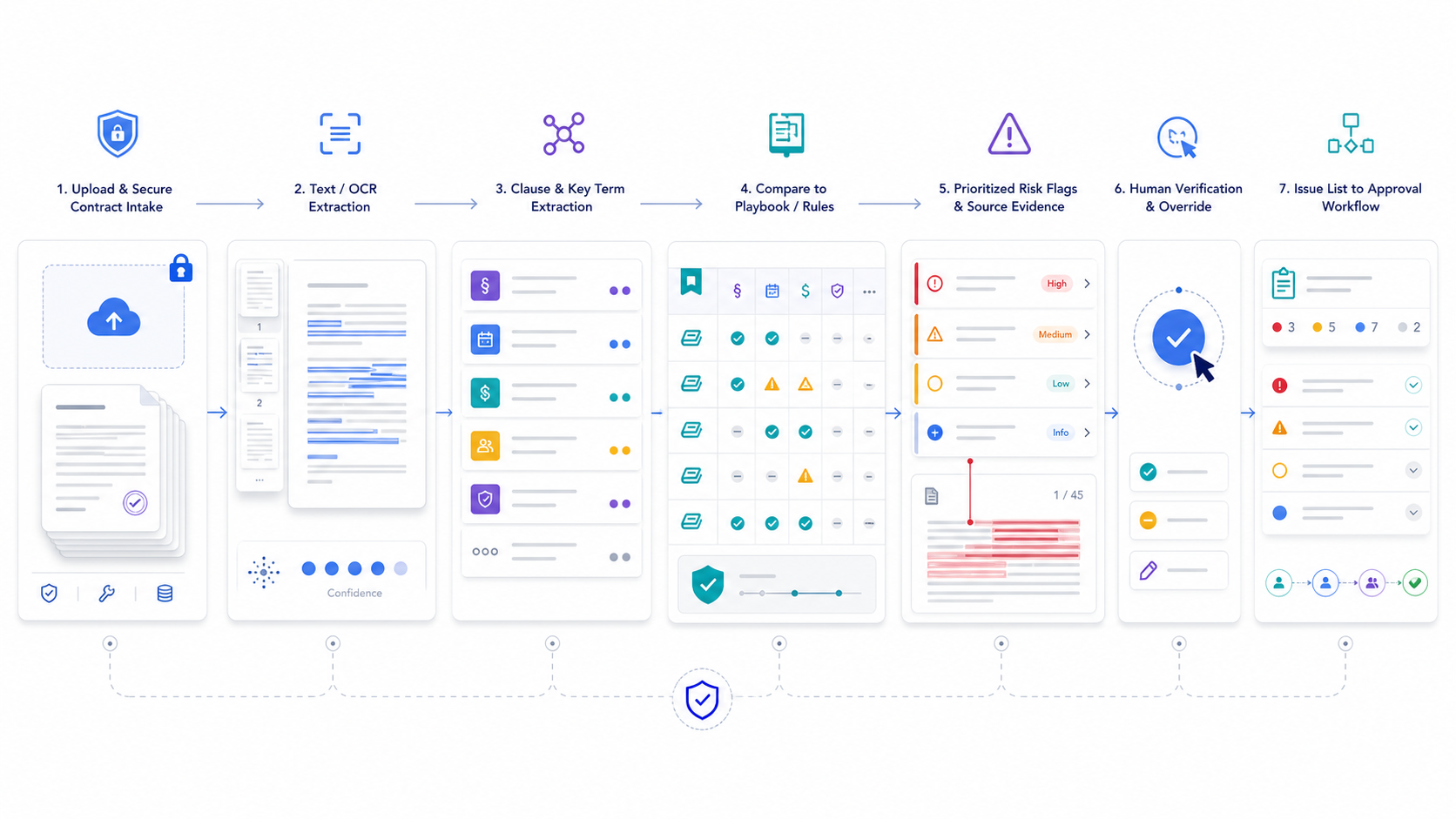
Run a seven-step evidence workflow运行七步证据工作流
- Ingest and identify.收件与识别。 Preserve originals, detect file and language, index pages, and reject unsupported or corrupt items. 保存原件,识别文件和语言,建立页码索引,并拒绝不支持或损坏的项目。
- Extract and normalize.提取与规范化。 Recover text, headings, tables, definitions, references, and version markers without losing location. 恢复文本、标题、表格、定义、引用和版本标记,同时保留位置。
- Classify contract content.分类合同内容。 Identify clause families, key terms, obligations, dates, amounts, parties, rights, and exceptions. 识别条款族、关键字段、义务、日期、金额、主体、权利和例外。
- Compare with controlled standards.对照受控标准。 Apply the correct template, playbook position, fallback, threshold, and transaction context. 应用正确模板、手册立场、退让方案、阈值和交易背景。
- Create cited findings.生成带引用的发现。 Link every flag to source evidence, the rule applied, severity rationale, uncertainty, and missing facts. 把每个标记连接到来源证据、所用规则、严重性理由、不确定性及缺失事实。
- Verify and decide.验证与决定。 A qualified reviewer confirms, edits, dismisses, escalates, or converts findings into a negotiation position. 由合格审核人确认、编辑、驳回、升级,或把发现转化为谈判立场。
- Handoff and learn.交接与学习。 Send verified issues into approval, preserve overrides, compare the final version, and feed adjudicated examples into controlled improvement. 把已验证问题送入审批、保存人工覆盖、比较最终版本,并将已裁定样本用于受控改进。
Treat extraction quality as a first-class control把提取质量作为一级控制
A clause checker cannot be better than the text and structure it receives. Test native PDFs, word-processing files, scans, rotated pages, handwriting, tracked changes, footnotes, multi-column layouts, headers, tables, schedules, and cross-references. Measure whether page and clause locations survive extraction. Low-confidence pages should be visible and routed for inspection; a missing clause must be distinguishable from a clause the system failed to read.
条款检查不能优于它接收的文本和结构。应测试原生 PDF、文字处理文件、扫描件、旋转页面、手写内容、修订痕迹、脚注、多栏布局、页眉、表格、附表及交叉引用,并衡量页码和条款位置能否保留。低置信页面应可见并被送去检查;合同本来缺少条款,必须与系统未能读取条款区分。
Require “not found,” “not readable,” and “outside scope” as separate outcomes. Sampling only clean templates hides the errors that matter in production. Your benchmark should reflect the real mixture of file types, languages, lengths, counterparties, and document quality.
要求把“未找到”“无法读取”和“超出范围”作为不同结果。只抽样干净模板会掩盖生产环境中重要错误。基准集应反映真实的文件类型、语言、长度、相对方和文档质量组合。
Turn the playbook into versioned, testable rules把审查手册转成有版本、可测试的规则
A useful rule names the agreement family, party role, clause concept, preferred position, acceptable range, fallback, prohibited language, escalation trigger, owner, and effective date. It explains whether the tool should detect presence, extract a value, compare wording, test a relationship, or ask a question. “Flag liability” is vague; “for supplier paper, flag a general cap above fees paid in the prior 12 months and route uncapped confidentiality exposure to legal” is testable.
有用规则应说明协议族、我方角色、条款概念、首选立场、可接受范围、退让方案、禁止文字、升级触发、负责人及生效日期,并解释工具是检测存在、提取数值、比较文字、检验关系还是提出问题。“标记责任”过于模糊;具体到供应商文本、上限阈值和升级对象才可测试。
Keep rule approval separate from tool administration. Record who changed a standard, why, when it applies, and which prior matters need reevaluation. A model prompt is not a substitute for a governed playbook.
规则审批应与工具管理分离。记录谁修改了标准、原因、适用时间,以及哪些历史事项需要重评。模型提示词不能替代受治理的审查手册。
Make every risk flag reviewable, not merely plausible让每个风险标记都可复核,而不只是听起来合理
Each finding should include a short issue statement, exact source excerpt or bounded location, document and version, clause concept, rule or threshold, severity, confidence, missing context, proposed owner, and recommended next action. Show related provisions when the conclusion depends on definitions, order of precedence, schedules, exclusions, remedies, or survival. A liability cap may look acceptable until an exclusion, indemnity, service credit, or data obligation changes the exposure.
每项发现应包含简短问题陈述、精确来源摘录或限定位置、文件与版本、条款概念、规则或阈值、严重性、置信、缺失背景、建议负责人和下一步。结论依赖定义、优先顺序、附表、除外、救济或存续时,应同时显示相关条款。责任上限表面合理,也可能被除外、赔偿、服务抵扣或数据义务改变。
Do not let fluent language hide weak evidence. Reviewers should be able to jump from the issue list to the source, see why the rule fired, correct the extraction, and preserve their disposition. These controls turn a generated answer into an auditable work product.
不要让流畅语言掩盖薄弱证据。审核人应能从问题清单跳到来源,查看规则触发原因,纠正提取并保存处置。这些控制把生成答案变成可审计工作成果。
Design human review around consequential decisions围绕重大决定设计人工复核
Assign an accountable reviewer for each matter and domain owners for legal, finance, tax, privacy, security, procurement, insurance, operations, or employment questions. Require human confirmation where the system identifies high severity, low confidence, missing evidence, conflicting provisions, novel wording, an out-of-policy term, or a decision affecting rights, money, data, safety, employment, or regulatory duties.
为每个事项指定可问责审核人,并为法律、财务、税务、隐私、安全、采购、保险、运营或劳动问题指定领域负责人。当系统发现高严重性、低置信、证据缺失、条款冲突、新颖文字、政策外条件,或影响权利、金钱、数据、安全、雇佣及监管义务的决定时,必须人工确认。
An override should capture the decision, reason, owner, timestamp, evidence, and whether it applies only to this matter or suggests a playbook change. The system may recommend a route; only an authorized person approves the business position. Connect verified exceptions to the contract approval workflow rather than treating a green indicator as approval.
人工覆盖应记录决定、理由、负责人、时间、证据,以及它仅适用于本事项还是提示手册变更。系统可以建议路径;只有获授权人员才能批准商业立场。应把已验证例外连接到合同审批工作流,而不是把绿色标记当作批准。
Evaluate the tool against evidence, control, and workflow围绕证据、控制与工作流评估工具
| Area领域 | Evidence to request应要求的证据 | Failure to test应测试的失败 |
|---|---|---|
| Input coverage输入覆盖 | Supported formats, languages, limits, OCR handling支持格式、语言、限制和 OCR 处理 | Unreadable pages treated as absent不可读页面被当成不存在 |
| Extraction提取 | Page-level citations, tables, definitions, amendments页级引用、表格、定义和修订 | Wrong value or lost qualifier数值错误或限定词丢失 |
| Rules规则 | Versioning, role context, thresholds, fallback logic版本、角色背景、阈值和退让逻辑 | Right rule applied to wrong agreement正确规则用于错误协议 |
| Review复核 | Source jump, edits, override, escalation, audit trail来源跳转、编辑、覆盖、升级和审计轨迹 | Unverified output reaches decision maker未经验证的输出到达决策人 |
| Security安全 | Access, retention, encryption, subprocessors, deletion访问、保留、加密、子处理者和删除 | Sensitive content persists unexpectedly敏感内容被意外保留 |
| Handoff交接 | Issue export, identifiers, versions, API and approval mapping问题导出、标识、版本、API 与审批映射 | Decision linked to stale draft决定连接到过期草案 |
Build a blind benchmark before judging a demonstration在评价演示前建立盲测基准
Select a representative, permissioned set of completed agreements and difficult negatives. Include clean files and scans, standard and negotiated language, short and long documents, amendments, missing clauses, conflicting definitions, tables, false friends, and out-of-scope examples. Qualified reviewers should adjudicate expected fields and findings before the tool sees the set. Hold back part of the benchmark to prevent tuning to every answer.
选择具有代表性且获授权的已完成协议和困难负样本,包括干净文件与扫描件、标准与谈判文字、短文档与长文档、修订、缺失条款、冲突定义、表格、易混淆表达和超范围示例。合格审核人应在工具看到数据前裁定预期字段与发现,并保留部分基准以避免针对所有答案调优。
Define success per task: required accuracy, maximum serious misses, acceptable false-alert burden, citation correctness, review time, and escalation behavior. Run the same set through the current manual method so the pilot compares outcomes and effort, not automation against perfection. Document configuration, reviewers, disagreements, and changed assumptions.
按任务定义成功:所需准确性、严重漏报上限、可接受误报负担、引用正确性、复核时间和升级行为。让相同数据经过当前人工方法,使试点比较结果与投入,而不是拿自动化与完美比较。记录配置、审核人、分歧和假设变化。
Measure misses, noise, citations, and reviewer effort衡量漏报、噪声、引用与审核投入
Recall asks how many expected items the system found; precision asks how many items it flagged were correct. Both matter. A high-recall system that floods reviewers with weak alerts can slow work, while a precise system that misses a critical termination or liability issue creates false reassurance. Weight errors by consequence and report results by document type, clause, language, scan quality, and risk level rather than one blended accuracy number.
召回率关注预期项目中系统找到多少;精确率关注系统标记中有多少正确。两者都重要。高召回但大量弱提示会拖慢审核;精确但漏掉关键终止或责任问题则制造虚假安全感。应按后果给错误加权,并按文档类型、条款、语言、扫描质量和风险等级报告,而不是只给一个混合准确率。
Also measure citation correctness, field accuracy, severity agreement, override rate, unresolved low-confidence items, minutes per reviewed matter, rework, approval reopenings, final-version discrepancies, user adoption, and incidents. Track quality drift after model, rule, integration, or document-population changes.
还应衡量引用正确性、字段准确性、严重性一致度、覆盖率、未解决低置信项目、每事项审核分钟数、返工、重新审批、最终版本差异、用户采用和事件,并在模型、规则、集成或文档群变化后跟踪质量漂移。
Ask what happens to every document, prompt, and output追问每份文档、提示与输出会发生什么
Map upload, storage, processing location, temporary files, logs, backups, exports, integrations, support access, subprocessors, model providers, retention, deletion, incident handling, and customer exit. Confirm tenant separation, identity controls, role-based access, encryption, key management, auditability, data-loss protections, and whether customer content is used to train or improve shared services. Obtain evidence appropriate to your organization; do not infer a control from marketing language.
映射上传、存储、处理位置、临时文件、日志、备份、导出、集成、支持访问、子处理者、模型提供商、保留、删除、事件处理和客户退出。确认租户隔离、身份控制、基于角色的访问、加密、密钥管理、审计、数据防泄漏,以及客户内容是否用于训练或改进共享服务。获取符合组织要求的证据,不要从营销文字推断控制。
Classify contracts before upload and prohibit unapproved tools. Test deletion and access revocation, not just policy statements. Decide which matters cannot enter the service, how privilege or confidentiality will be handled, and how a complete record is exported if the relationship ends.
上传前对合同分类,并禁止未获批准的工具。应测试删除和访问撤销,而不只阅读政策。决定哪些事项不能进入服务、如何处理特权或保密,以及关系终止时如何导出完整记录。
Preserve identity and version across every handoff在每次交接中保留标识与版本
Integrations should pass stable matter, document, version, clause, issue, user, rule, and approval identifiers. Export structured fields plus human-readable evidence, not a summary that loses provenance. Define the system of record for originals, playbooks, findings, reviewer dispositions, redlines, approvals, final agreements, and obligations. Test duplicate uploads, concurrent edits, failed jobs, retries, partial exports, revoked users, and a changed document after approval.
集成应传递稳定的事项、文档、版本、条款、问题、用户、规则和审批标识。导出结构化字段及人工可读证据,而不是丢失来源的摘要。明确原件、手册、发现、审核处置、红线、批准、最终协议和义务的记录系统,并测试重复上传、并发编辑、任务失败、重试、部分导出、用户撤销及批准后文档变化。
Route only verified issues forward. The approval record should identify the exact document and accepted deviations; a later clean copy must be compared before signature. Post-signature analytics may reuse validated fields, but it should not inherit unverified extraction as fact.
只有已验证问题才能向前流转。审批记录必须标识确切文档及已接受偏离;之后的清洁稿须在签署前比较。签署后分析可以复用已验证字段,但不应把未经验证的提取当作事实。
Keep adjacent automation categories separate把相邻自动化类别清楚区分
Reads received agreements, compares evidence with controlled standards, and prepares findings for verification.
读取收到的协议、将证据与受控标准比较,并准备待验证发现。
Uses approved templates and structured answers to assemble or generate documents. See legal document automation.
使用获批模板和结构化答案组装或生成文档。参见法律文档自动化。
Coordinates intake, roles, specialist work, redlines, negotiation, approval, final checks, and handoff whether tools are used or not.
无论是否使用工具,都协调收件、角色、专家工作、红线、谈判、审批、最终检查与交接。
Organize validated portfolio data and answer operational or management questions across agreements after reliable capture.
在可靠捕获后组织已验证的合同组合数据,并回答跨协议的运营或管理问题。
Move from one controlled use case to monitored production从单一受控场景走向受监控的生产环境
- Scope: name the agreement family, users, tasks, exclusions, decision boundary, owner, and success measures.
- 界定:明确协议族、用户、任务、排除项、决定边界、负责人和成功指标。
- Prepare: inventory data, approve handling, formalize the playbook, adjudicate a benchmark, and map the current process.
- 准备:盘点数据、批准处理方式、正式化手册、裁定基准并映射当前流程。
- Pilot: run blind tests, inspect serious misses, measure reviewer effort, test security and exports, and revise rules.
- 试点:运行盲测、检查严重漏报、衡量审核投入、测试安全与导出并修订规则。
- Release: train named users, require verification, configure access and escalation, document fallback, and limit the first production population.
- 发布:培训具名用户、要求验证、配置访问与升级、记录备用方案并限制首批生产范围。
- Monitor: review sampled outputs, overrides, incidents, drift, user feedback, rule changes, provider changes, and realized outcomes.
- 监控:复核抽样输出、人工覆盖、事件、漂移、用户反馈、规则变化、提供商变化及实际结果。
Set pause criteria before launch: for example, a serious miss, unexpected data exposure, citation failure, uncontrolled configuration change, or output reaching approval without human verification.
上线前设定暂停条件,例如严重漏报、意外数据暴露、引用失败、配置失控,或输出未经过人工验证便进入审批。
Example: first-pass review of supplier renewals示例:供应商续期的第一轮审查
A procurement team receives many supplier renewals in a six-week window. It defines a narrow automated pass for term, renewal, notice, pricing change, data access, security schedule, service level, liability cap, termination assistance, and incorporated documents. The system inventories files, extracts fields with citations, compares approved thresholds, and creates an issue list. Low-confidence pages, missing schedules, uncapped exposures, short notice windows, and nonstandard data terms route to named reviewers.
采购团队在六周内收到大量供应商续期。它界定了一个窄自动化范围,检查期限、续期、通知、价格变化、数据访问、安全附表、服务水平、责任上限、终止协助和纳入文件。系统盘点文件、带引用提取字段、比较批准阈值并建立问题清单;低置信页面、缺失附表、无限责任、短通知窗口和非标准数据条款被分流给具名审核人。
Reviewers correct extraction, resolve context, accept or reject findings, and prepare negotiation positions. Approved deviations flow to authorized approvers, and the final clean copy is compared with the approved version. The team measures serious misses, false alerts, citation correctness, reviewer time, reopened approvals, and renewal outcomes. Automation reduces evidence-gathering effort without converting recommendations into decisions.
审核人纠正提取、解决背景、接受或驳回发现,并准备谈判立场。批准的偏离流向获授权审批人,最终清洁稿与获批版本比较。团队衡量严重漏报、误报、引用正确性、审核时间、重新审批和续期结果。自动化减少证据收集投入,但不把建议变成决定。
Prevent automation from scaling weak review practices避免自动化放大薄弱审查实践
Common failures include buying from a polished demonstration, starting without a defined task, testing only standard templates, treating OCR failure as clause absence, using one playbook for every transaction role, showing flags without sources, hiding uncertainty, optimizing one accuracy number, accepting generated severity without rationale, allowing shared accounts, keeping uncontrolled rule changes, sending output directly to approval, and failing to compare the final version.
常见失败包括:根据精美演示采购、没有明确任务便开始、只测试标准模板、把 OCR 失败当作条款缺失、对所有交易角色使用同一手册、标记没有来源、隐藏不确定性、只优化一个准确率数字、无理由接受生成的严重性、使用共享账户、规则变更失控、输出直接进入审批,以及不比较最终版本。
Also watch for automation bias: reviewers may inspect flagged passages closely while ignoring unflagged text. Require full-scope sampling, serious-miss review, visible coverage limits, and a clear statement of what was not checked. Keep a manual fallback that preserves matter identity, versions, decisions, and later reconciliation during an outage.
还要警惕自动化偏见:审核人可能仔细检查被标记段落,却忽视未标记文本。应要求全范围抽样、严重漏报复核、可见的覆盖限制,并清楚说明未检查内容。保留人工备用方案,在中断期间保存事项标识、版本、决定及后续核对。
Use AI for structured preparation, then verify the evidence使用 AI 进行结构化准备,再验证证据
For a preliminary pass, collect the authoritative agreement and attachments, state your party role and business objective, identify the governing context, and provide the questions or approved standards you want checked. Ask for a document inventory, extracted terms, source locations, potential issues, missing information, and an explicit “not found” response where evidence is absent. Do not upload restricted material unless the service is approved for it.
进行初步审查时,收集权威协议及附件,说明我方角色与业务目标,确定适用背景,并提供要检查的问题或批准标准。要求输出文件清单、提取字段、来源位置、潜在问题、缺失信息,以及证据不存在时明确返回“未找到”。未经批准,不要上传受限材料。
The tool and this guide support information organization and pre-signature risk triage. They do not establish applicable law, determine enforceability, approve language, recommend signature, create a lawyer-client relationship, or replace qualified legal, financial, tax, privacy, security, employment, regulatory, or other professional advice. Accountable people must verify the complete package, facts, citations, interpretations, decisions, and final text.
本工具与本指南仅支持信息整理及签署前风险初筛,不确定适用法律、不判断可执行性、不批准文字、不建议签署、不建立律师—客户关系,也不替代合格的法律、财务、税务、隐私、安全、劳动、监管或其他专业意见。可问责人员必须验证完整文件包、事实、引用、解释、决定和最终文本。
Prepare a source-linked first pass准备一份连接来源的第一轮审查
Use a complete, authorized document package and specific review questions. Organize possible issues with AI, then require qualified reviewers to confirm material findings, missing evidence, negotiation positions, approvals, and the exact final version.
使用完整、获授权的文件包和具体审查问题。先用 AI 整理潜在问题,再由合格审核人确认重大发现、缺失证据、谈判立场、批准和确切最终版本。
Automated contract review FAQ自动化合同审查常见问题
What is automated contract review?
什么是自动化合同审查?
It is a controlled workflow that extracts contract evidence, applies defined checks, and prepares cited findings for human verification and decision-making.
它是一个受控工作流,提取合同证据、应用已定义检查,并准备带引用的发现供人工验证和决策。
Can automated contract review replace a lawyer?
自动化合同审查能否替代律师?
No. It can support repeatable evidence work, but qualified people must determine context, law, interpretation, materiality, negotiation, approval, and final language.
不能。它可支持可重复的证据工作,但背景、法律、解释、重大性、谈判、审批与最终文字仍须由合格人员决定。
How should an automated review tool be tested?
应该如何测试自动化审查工具?
Use a permissioned, representative blind benchmark with adjudicated expected results, difficult negatives, real file quality, explicit success thresholds, and comparison with the current process.
使用获授权、有代表性的盲测基准,包含已裁定预期结果、困难负样本、真实文件质量、明确成功阈值,并与当前流程比较。
Which metrics matter most?
哪些指标最重要?
Measure consequential misses, precision, recall, citation correctness, field accuracy, severity agreement, review time, overrides, rework, drift, and incidents by document and risk segment.
按文档和风险分组衡量重大漏报、精确率、召回率、引用正确性、字段准确性、严重性一致度、审核时间、覆盖、返工、漂移和事件。
How is automated review different from document automation?
自动化审查与文档自动化有何不同?
Automated review reads and checks received agreements. Document automation assembles new documents from approved templates and structured inputs.
自动化审查读取并检查收到的协议;文档自动化依据获批模板和结构化输入组装新文档。
Sources and Method来源与方法
- NIST — AI Risk Management Framework美国国家标准与技术研究院 — AI 风险管理框架
- NIST — Artificial Intelligence Risk Management Framework: Generative AI Profile美国国家标准与技术研究院 — 生成式 AI 风险管理框架画像
- UK Cabinet Office — The Contract Management Playbook英国内阁办公室 — 《合同管理手册》
- US National Archives — Records management language for contracts美国国家档案馆 — 合同记录管理条款