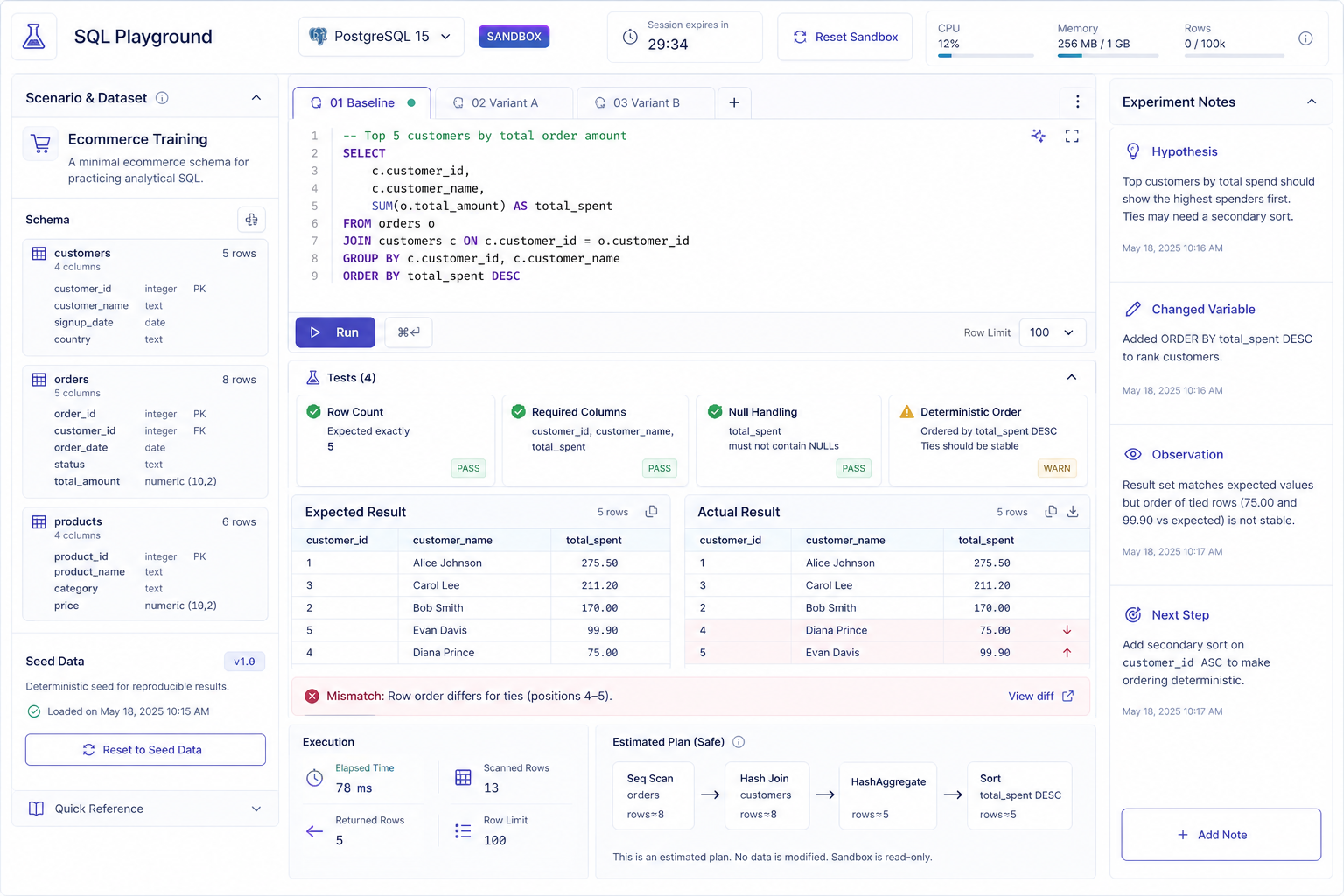
What is an SQL playground?
An SQL playground is an isolated environment for writing and running SQL against temporary, sample, local, or otherwise controlled data. Unlike a blank editor, a useful playground gives each experiment a known engine and version, schema, deterministic seed, query, parameters, expected outcome, resource boundary, reset path, and shareable evidence. It supports learning, debugging, comparison, interview practice, documentation examples, and pre-production verification without making a live production database the place where uncertainty is discovered.
The word “playground” describes a workflow, not a security guarantee. Some playgrounds execute WebAssembly entirely in the browser; some send SQL and data to a hosted service; some provision an ephemeral cloud database; some connect to a real account; and some only parse or transpile text. Before using one, identify where code and data run, what persists, who can access it, which statements are allowed, and how the environment is reset.
Open a SQL playground in the browser
An SQL playground you can use today is a page with a Run button, a sample database, and no local install. SQL Tutorial, RunSQL, Playcode, DB Fiddle, Coddy, SQLite Online, and Sqlime are that kind of page. This guide does not embed their editor. It tells you which one fits the engine you need, then how to keep the run off production data.
Pick the runner only after you know three things: which engine executes the SQL, whether the seed data stays in the browser or is uploaded, and whether a shared link includes the schema. A text box that only parses SQL is an online compiler, not a playground.
MySQL, PostgreSQL, SQLite, and SQL Server
| If you need | Start with | Stop rule |
|---|---|---|
| MySQL, PostgreSQL, and SQL Server in one tab | A multi-engine playground such as RunSQL or DB Fiddle | Pin the engine version in the snippet you share |
| SQLite only, including edits to the seed grid | A SQLite playground such as Coddy or Sqlime | Do not treat file-local SQLite timings as server timings |
| Lesson exercises with a built-in schema | A teaching playground such as SQL Tutorial | Finish the lesson, then rerun the same SQL on your target dialect |
| Chinook or Northwind sample data | A sandbox that already loads those databases, such as Playcode | Keep the sample; do not import a customer extract |
The same statement can be legal in PostgreSQL and rejected in MySQL. Record the engine next to the query before you compare results.
Sample databases to practice on
Chinook and Northwind are the usual SQL playground fixtures because they already contain customers, orders, and products. Use them to practice joins, aggregates, and NULL filters. They are not a model of your warehouse. Grain, keys, and time zones will differ. For copy-ready statements on one commerce schema, start with sql query examples.
- Chinook — artists, albums, tracks, invoices. Good for many-to-one joins and revenue by country.
- Northwind — customers, orders, order lines. Good for inner and outer joins and “customers with no orders.”
- Your own five-row seed — use this when the question depends on a NULL, a duplicate key, or a date boundary the sample database does not contain.
What a playground is allowed to run
Allow SELECT by default. Allow CREATE TABLE only inside the playground schema that resets with the session. Block DROP, grants, and any statement that reaches a database outside the sample. Cap rows returned, statement time, and concurrent sessions. A playground that can see production credentials is a SQL client, and it belongs under the client rules linked below.
Practice questions, not one memorized answer
Use the playground the way a data-engineering thread uses LeetCode: a small schema, a question, and more than one legal query. Write the expected row count and the sort order before you press Run. A query that returns rows is not finished until those rows match the oracle you wrote first.
Separate a playground from an editor, compiler, client, and tutorial
Search results blend several intents under “SQL playground.” A user may want a no-install query runner, a place to practice lessons, a database fiddle to share a bug, a dialect validator, or a temporary environment for comparing query variants. Products can combine these functions, but evaluating them separately prevents a convenient text box from being mistaken for a reproducible experiment system.
| Surface | Starts from | Primary outcome | Missing without a playground layer |
|---|---|---|---|
| SQL playground | Question, known fixture, and experiment contract | Repeatable observation that tests a hypothesis | Not applicable; it is the experiment layer |
| SQL editor | Statement text | Authored, formatted, reviewed, or executed SQL | Known seed, expected result, assertions, reset, experiment notes |
| Online SQL compiler | SQL text and selected dialect or engine | Parse, validate, translate, or execute feedback | Controlled learning loop and reproducibility bundle |
| SQL client | Connection and server session | Commands and results against a database | Isolation from real authority and resettable fixtures |
| Interactive tutorial | Curated lesson and constrained task | Guided concept mastery and feedback | Open-ended scenario design and variant comparison |
Read the same-batch online SQL compiler guide for parse and runtime distinctions, the SQL editor guide for authoring controls, and the SQL client guide for live connection and transaction safety. The same page is the SQL editor checklist. This page concentrates on experiment design and evidence.
Identify where the playground actually executes SQL
Two identical interfaces can have radically different data paths. A local WebAssembly engine may keep synthetic data on the device; a hosted runner sends scripts and fixtures to a provider; an ephemeral container may isolate each session but still log requests; a shared teaching database may allow cross-user interference; and a connected playground may possess real database privileges. “Runs in your browser” describes the interface unless architecture proves local execution.
| Model | Strength | Important limitation | Proof to request |
|---|---|---|---|
| Browser-local WebAssembly | Low setup, local synthetic data, fast reset, offline potential | Memory, threads, extensions, persistence, browser compatibility | Network trace, worker/runtime files, storage map, engine version |
| Hosted shared service | No install, collaboration, server-class engines | Provider receives SQL, schema, data, results, and identifiers | Isolation, region, logs, retention, deletion, rate and data limits |
| Ephemeral database or container | Closer engine fidelity with resettable infrastructure | Provisioning delay, expiry, hidden base image, network egress | Image/version digest, tenancy boundary, expiry, egress policy |
| Managed product sandbox | Real platform behavior with limited setup or billing | Feature, quota, storage, expiry, identity, and cost differences | Published limits, enabled features, quotas, billing and cleanup |
| Live connected database | Highest schema and optimizer fidelity | Real authority, data, cost, locks, audit, and production risk | Least privilege, network path, TLS, identity, limits, rollback |
DuckDB’s official WebAssembly overview states that DuckDB can run inside a browser and also documents browser memory and threading limits. SQLite maintains official WASM and JavaScript documentation for browser-capable SQLite. These technologies can support local playgrounds, but a particular website must still prove how it configures storage, networking, extensions, and telemetry.
Turn trial and error into a controlled SQL experiment
Unstructured trial and error changes multiple things at once, celebrates any plausible-looking result, and forgets the state that produced it. A controlled SQL experiment begins with a question and falsifiable expectation. It changes one variable where possible, holds the fixture and session constant, captures the actual result and diagnostics, compares them with an oracle, and records what the observation supports or contradicts.
Define the semantic, correctness, portability, or performance uncertainty.
Predict rows, types, ordering, error, or plan behavior before execution.
Pin engine, schema, seed, parameters, settings, and resource limits.
Change one clause, function, index, parameter, or dataset property.
Capture result, messages, plan, timing, rows scanned, and limits.
Compare with the oracle, explain mismatch, and choose the next test.
A playground should preserve baseline and variants side by side, label the changed variable, and make reset cheap. If each run mutates hidden state or silently changes seed data, the user is not comparing queries; they are comparing unknown environments.
Pin the SQL dialect, engine, and version
“SQL” is not a complete execution target. Identifiers, quoting, parameter markers, date arithmetic, string concatenation, regular expressions, JSON functions, arrays, null ordering, grouping rules, window frames, limit syntax, recursive queries, generated columns, type coercion, and error behavior vary. Even the same engine can change reserved words, functions, optimizer behavior, and defaults between versions.
| Dialect dimension | Minimal test | Evidence to save |
|---|---|---|
| Identifiers and case | Mixed case, reserved word, spaces, Unicode, qualification | DDL, query, resolved object, returned column names |
| Types and coercion | Decimal, timestamp, boolean, JSON, null, invalid cast | Source types, expression types, rendered and exported values |
| Aggregation and grouping | Non-grouped column, null group, empty input, distinct | Accepted or rejected syntax plus result |
| Ordering and limits | Ties, nulls, collation, offset, deterministic secondary key | Collation, query, repeated results, plan |
| Transactions and DDL | Begin, error, savepoint, rollback, schema change in disposable fixture | Transaction state, object state, messages, engine version |
PostgreSQL’s official SQL syntax documentation explicitly notes that rules and concepts are implemented inconsistently among databases or may be PostgreSQL-specific. A playground should never relabel one embedded engine as universal SQL. Display the exact runtime beside every result and shared link.
Begin with a decision-rich scenario, not random tables
A scenario gives SQL meaning. “Practice joins” is weaker than “identify orders that were paid but never shipped, without duplicating orders that have multiple payment attempts.” The second prompt defines entities, grain, business rules, edge cases, and a correctness target. Good playground scenarios resemble real analytical and application questions while using safe synthetic data.
Say whether one output row represents an order, customer, day, product, event, or cohort.
Specify timezone, inclusive boundaries, late data, event time versus processing time, and “current” date.
Identify test accounts, cancelled records, refunds, duplicates, soft deletes, unknown categories, and incomplete states.
Write expected rows, counts, columns, types, ordering, invariants, and acceptable error before querying.
Use one scenario to teach several techniques without changing the business meaning: a baseline query, a corrected join, a null-safe variant, a window-function variant, an indexed variant, and a dialect port. This creates a coherent experiment family rather than isolated snippets.
Design the smallest schema that can reveal the mistake
An oversized schema slows comprehension and makes mismatches hard to diagnose. An oversimplified schema creates false confidence because it omits composite keys, optional relationships, duplicate facts, temporal validity, status history, or many-to-many paths. Start with the smallest schema that expresses the relevant ambiguity, then add one complication at a time.
| Schema element | Why include it | Failure it can expose |
|---|---|---|
| Primary and composite keys | Define identity and grain | Duplicate rows, wrong join key, accidental aggregation |
| Optional foreign key | Represent missing relationships | Inner join silently drops valid base rows |
| One-to-many child | Represent attempts, events, lines, or history | Fact multiplication and inflated sums |
| Validity interval | Represent changing dimension or price | Overlap, gaps, boundary and current-row mistakes |
| Constraints and indexes | Make valid states and access paths explicit | Invalid fixture, unsupported assumption, misleading plan |
Show DDL as part of the experiment, not hidden setup. Preserve column types, defaults, nullability, constraints, and indexes. If the playground infers a schema from CSV or JSON, save the inferred result and compare it with the intended contract; inference can turn identifiers into numbers, timestamps into text, or empty values into nulls.
Build deterministic seed data with purposeful edge cases
Random data is useful for fuzzing, but poor as the only teaching or correctness fixture. When values change on every reset, expected rows become unstable and a learner cannot tell whether a query changed or the data did. Use a small deterministic core whose rows have documented purposes, then add seeded random or generated scale data as a separate layer.
| Seed row purpose | Example | Query behavior tested |
|---|---|---|
| Ordinary positive case | Customer with two completed orders | Baseline join, aggregation, and grouping |
| Missing relationship | Customer with no orders or order with no shipment | Outer join, anti-join, null predicate placement |
| One-to-many duplication | Order with two payment attempts and three lines | Fact multiplication, pre-aggregation, distinct misuse |
| Null and empty distinction | Null note, empty note, whitespace note | Three-valued logic, normalization, display fidelity |
| Boundary time | Events exactly before, at, and after midnight or period end | Inclusive range, timezone, date truncation |
| Tie and ordering case | Two customers with equal totals | Deterministic secondary sort and top-N stability |
| Invalid or prohibited state | Duplicate natural key rejected by constraint | Constraint behavior and setup validation |
Give every purposeful row a stable identifier and short comment in the fixture manifest. Avoid names or values that resemble real customers, credentials, account numbers, or confidential domains. Synthetic data should be obviously synthetic while still preserving distributions and relationships needed for the test.
Make reset semantics complete and observable
A Reset button can recreate rows while leaving schema changes, sequences, indexes, session variables, temporary tables, prepared statements, caches, extensions, permissions, or files intact. The next run then inherits hidden state. Define whether reset rolls back the active transaction, recreates the database, reloads DDL and seed data, clears browser storage, restarts the engine, or provisions a new instance.
| State layer | Reset expectation | Verification |
|---|---|---|
| Rows and sequences | Exact seed values and stable generated identifiers | Checksum ordered fixtures and next generated value |
| Schema and indexes | Original DDL, constraints, views, routines, and access paths | Catalog snapshot before change and after reset |
| Session and transaction | No open transaction, temporary object, altered setting, or role | Identity and session-state query after reset |
| Files and browser storage | Documented persistence for database files, history, and drafts | Inspect IndexedDB, origin storage, downloads, and caches |
| Runtime | Pinned engine, extension set, and configuration | Version and capability manifest after reset |
Provide two actions when necessary: Reset data for rapid iteration and Rebuild sandbox for a clean baseline. Display the fixture version and last reset time. A user should be able to prove that Baseline and Variant A ran against identical state.
Write an oracle before looking at the query result
A result can look reasonable while being wrong by one duplicated order, one excluded null, one timezone boundary, or one unstable tie. The oracle is the evidence used to judge correctness. It may be an exact result table, a set of invariants, independently calculated counts, a reference implementation, a known error code, or a relationship among outputs. Write it before execution to reduce confirmation bias.
| Oracle type | Use when | Example assertion |
|---|---|---|
| Exact ordered rows | Fixture is small and order is semantically required | Five rows with exact identifiers, values, and stable tie-breaker |
| Unordered set | Order is not part of the contract | Same typed rows regardless of presentation order |
| Aggregate invariant | Large result has independently known totals | Sum by status equals overall sum and no order contributes twice |
| Schema contract | Downstream code depends on names and types | Required columns, nullable flags, decimal precision, timestamp zone |
| Expected failure | Teaching constraints, invalid casts, or dialect limits | Specific error class at setup or execution phase |
| Differential oracle | Porting or comparing implementations | Reference query and candidate produce equivalent typed result |
Do not use the output of the query under test to create its own expected result. For important logic, derive the oracle manually from a tiny fixture, use a separate trusted implementation, or triangulate with independent invariants. A snapshot is useful only if someone reviewed how it was created.
Test more than row count
A correct row count can hide wrong membership, values, types, duplicates, or ordering. Build a layered assertion suite. Run cheap structural checks first, then exact or invariant checks, then dialect and performance observations. Each failure should identify the violated contract rather than merely report “result mismatch.”
Column count, names, order, types, nullability, row count, uniqueness.
Required rows present, forbidden rows absent, duplicates controlled.
Exact values, decimal tolerance, timezone, formatting-independent comparison.
Grain, totals, partition relationships, conservation, temporal validity.
Explicit sort keys, null position, collation, stable tie-breaker.
Expected warning or error, nonmutation, timeout, bounded work, repeatability.
Compare typed values rather than rendered strings. The display layer can round decimals, convert timestamps, truncate text, or make null resemble an empty string. When order is not specified by SQL, compare sets or multisets rather than treating incidental engine order as a contract.
Use an edge-case matrix that targets SQL semantics
| Dimension | Cases | Frequent defect |
|---|---|---|
| Cardinality | Zero, one, many, duplicate, many-to-many | Inner join loss, multiplication, wrong distinct |
| Null logic | Null input, null key, null comparison, all-null group | Unknown treated as false or equal |
| Numbers | Zero, negative, large, decimal boundary, division | Integer division, overflow, rounding, precision loss |
| Text | Empty, whitespace, mixed case, accents, Unicode, wildcard characters | Collation, trimming, case and pattern mismatch |
| Time | Boundary, timezone, daylight shift, leap day, missing period | Inclusive endpoint, conversion, calendar assumption |
| Ordering | Ties, nulls, duplicate sort keys, locale, pagination | Unstable top-N and rows moving between pages |
| Temporal state | Overlapping intervals, gap, late arrival, correction, soft delete | Double match, missing current row, future leakage |
Choose edge cases from the query’s semantics rather than adding every possible odd value. A customer-retention query needs cohort boundaries, late events, and duplicate identities; a financial allocation query needs precision, rounding, conservation, negative adjustments, and zero denominators. The matrix should explain why each row exists.
Structure exercises around reasoning, not syntax completion
A sequence of isolated syntax puzzles can teach keywords without teaching query correctness. Progressive exercises should retain a coherent scenario and add one reasoning challenge at a time. Feedback should explain the violated invariant, not reveal only a finished answer.
| Level | Reasoning objective | Evidence |
|---|---|---|
| 1. Inspect | Understand schema, grain, keys, types, and seed purpose | Annotated schema and row-purpose questions |
| 2. Select | Choose columns and predicates without changing grain | Exact membership and type assertions |
| 3. Relate | Choose join type and key; preserve unmatched base rows | Duplicate and missing-row fixtures |
| 4. Aggregate | Align group grain, avoid multiplication, handle empty groups | Totals, conservation, and group invariants |
| 5. Sequence | Use windows, temporal intervals, and deterministic ordering | Tie, boundary, gap, and overlap cases |
| 6. Explain | Defend assumptions, portability, cost, and limitations | Experiment note, alternative query, plan observation |
Allow a learner to inspect the failing fixture row, assertion, and query diff. Avoid scoring only exact query text: multiple queries can be semantically correct, and a reference query can itself contain an assumption. Grade behavior, explainability, and constraints.
Use synthetic context until the playground proves its boundary
SQL text can reveal table names, tenant identifiers, business metrics, fraud rules, access patterns, data classifications, comments, literals, and infrastructure details even when no rows are uploaded. Schema DDL can reveal product design and security relationships. Query results can contain personal, financial, health, employment, or confidential operational data. Treat every input and output as data that needs an approved purpose and boundary.
| Data surface | Potential exposure | Safer default |
|---|---|---|
| SQL text and comments | Internal identifiers, credentials, tokens, URLs, policy logic | Sanitized identifiers, parameters, no secrets, no sensitive comments |
| Schema and metadata | System structure, ownership, keys, classifications, vendors | Minimal synthetic schema preserving only relevant relationships |
| Seed or uploaded data | Direct, quasi, derived, or hidden personal and confidential values | Purpose-built synthetic or approved public fixture |
| Result and error | Rows, samples, stack traces, paths, connection details | Bounded output, redaction, no public sharing, controlled export |
| History and share link | Long-lived copies, indexed content, guessable identifiers, collaborators | Private by default, expiry, access control, revocation, verified deletion |
Inspect network requests, browser storage, cookies, service workers, crash reports, analytics, collaboration features, exports, and deletion. Local execution reduces one data path but does not automatically disable telemetry or cloud synchronization. If the architecture or terms are unclear, do not paste sensitive material.
Define which statements and side effects the sandbox permits
A learning environment may need temporary DDL and DML, while a query-testing environment may allow only read statements. “Read-only” must account for functions with side effects, external table access, file operations, extension loading, network access, procedure calls, resource-intensive functions, and commands that alter session or engine configuration. Keyword blocking alone is easy to bypass and does not understand runtime behavior.
| Capability | Typical playground policy | Control evidence |
|---|---|---|
| SELECT and CTE | Allowed with time, row, memory, and source limits | Final parsed statement, enforced runtime quotas |
| Temporary DDL and DML | Allowed only inside disposable namespace or instance | Isolation test, reset proof, no external authority |
| Persistent DDL and DML | Denied or explicitly confined to owned sandbox | Server role, storage boundary, teardown verification |
| Files, URLs, external sources | Denied by default; allowlisted synthetic sources only | Filesystem and network sandbox tests |
| Extensions and procedures | Pinned allowlist with version and capability review | Extension manifest, source, integrity, privilege tests |
| Configuration commands | Session-safe subset or denied | Effective settings before and after reset |
Use disposable infrastructure and least privilege as the boundary, then add parser and interface restrictions as defense in depth. When a statement is denied, explain the capability boundary without suggesting unsafe workarounds.
Bound time, rows, memory, storage, concurrency, and cost
A sandbox can still be exhausted by a Cartesian product, recursive query, explosive regular expression, huge series, broad scan, large sort, unbounded window, accidental cross join, or repeated parallel runs. Local execution can freeze the browser; hosted execution can consume shared capacity or billable resources. Display limits before execution and distinguish a client display limit from a server work limit.
| Limit | What it protects | Observable behavior |
|---|---|---|
| Statement wall time | User attention, shared runtime, cost, locks | Countdown, cancellation acknowledgement, clear timeout class |
| Rows returned | Transfer, renderer, browser memory, accidental exposure | Exact completeness state and query-level enforcement |
| Rows or bytes scanned | Engine work, warehouse cost, I/O | Estimate, hard quota, post-run actual usage |
| Memory and spill | Browser stability, worker process, shared host | Quota, spill policy, failure message, session recovery |
| Persistent storage | Origin quota, account quota, cleanup and privacy | Usage meter, expiry, delete and reset semantics |
| Concurrency and rate | Noisy neighbors, queue growth, abuse, duplicate execution | Queue status, per-session cap, retry guidance |
Google Cloud’s official BigQuery sandbox documentation publishes feature and quota limitations, including storage and processed-data allowances and unsupported capabilities. Every managed playground should expose equally concrete boundaries instead of relying on the word “free.”
Save every material input as one experiment bundle
A share link that contains only query text is not reproducible. Another person also needs the exact engine and version, capabilities, schema, seed, parameters, session settings, time assumptions, expected results, assertions, limits, execution mode, and reset procedure. Bundle these pieces and give the bundle a stable version or content hash.
| Bundle part | Required fields | Reason |
|---|---|---|
| Runtime manifest | Engine, version, build, extensions, locale, timezone, settings | Defines dialect and execution behavior |
| Fixture manifest | DDL, seed order, purpose, checksums, generator seed | Defines database state and edge cases |
| Query manifest | Baseline, variants, changed variable, parameters, selection boundary | Defines what was actually tested |
| Oracle and assertions | Expected rows, types, order, invariants, errors, tolerances | Defines pass and fail independently of appearance |
| Observation record | Timestamp, result hash, messages, plan, usage, notes, limitations | Supports review and comparison |
Export a human-readable README and machine-readable files. Avoid embedding credentials or private source data. If the runtime cannot be pinned, say so and record the observed version on each run; a moving hosted runtime weakens long-term reproducibility.
Compare query variants without changing the question
Two queries are comparable only if they target the same semantic contract, fixture, parameters, runtime, and session settings. A faster query that drops null rows or changes the grain is not an optimization. Label each variant with the changed mechanism and first test semantic equivalence; only then compare plans and resource behavior.
| Variant question | Hold constant | Compare |
|---|---|---|
| Correlated subquery versus join | Null semantics, duplicates, selected columns, predicates | Typed result, plan shape, repeated work, scanned rows |
| Window function versus grouped join | Partition grain, ties, ordering, filter phase | Row preservation, deterministic rank, sorts, memory |
| CTE versus inline expression | Reference count, materialization assumptions, output | Plan transformation, readability, repeated computation |
| Index or partition change | Data, statistics, query, cache protocol, hardware class | Plan, I/O, rows, memory, maintenance and write cost |
| Dialect port | Business semantics, fixture meaning, expected result | Syntax, types, nulls, functions, ordering, errors |
Keep the baseline immutable after review. Create a named variant rather than editing history in place. A side-by-side SQL diff should be accompanied by result and plan diffs, because a small textual change can have a large semantic effect and a large rewrite can be equivalent.
Use playground performance numbers as scoped observations
A browser or shared sandbox rarely represents production hardware, storage, concurrency, statistics, cache state, network, data distribution, or optimizer configuration. Timing is useful for detecting gross behavior and learning plans, but it is not a capacity forecast. Separate semantic testing on a tiny deterministic fixture from performance testing on generated scale data.
| Observation | Useful claim | Unsupported claim |
|---|---|---|
| Estimated plan | Planner considered a scan, join order, or access path under this state | Production will have the same plan or runtime |
| Repeated warm timing | Variant behavior after local caches under the test protocol | Cold start, concurrency, or storage throughput in production |
| Rows scanned or processed | Relative work for this fixture and engine instrumentation | Cost without production data distribution and pricing model |
| Memory or spill | Algorithm crossed a local resource threshold | Production memory requirement across all workloads |
PostgreSQL’s official EXPLAIN guide notes that estimated values can vary and that EXPLAIN ANALYZE actually runs the query, including side effects. A playground should label plan mode prominently and use disposable state before any runtime plan that may execute changes.
Debug by shrinking uncertainty, not by random rewrites
When a query fails, first classify the failure: setup, parse, bind, type, authorization, execution, resource, assertion, or presentation. Preserve the original error and experiment bundle. Then isolate the smallest failing clause or fixture row while keeping the oracle. A rewrite that removes the error but changes the question is not a fix.
Reset, run the pinned bundle, and confirm the same failure class.
Separate setup, statement range, parameters, runtime, result, and assertion.
Reduce schema, rows, columns, predicates, and expressions without losing failure.
Connect the failing case to dialect, type, grain, null, order, or state semantics.
Change one mechanism and add an assertion that would catch regression.
Run the full edge matrix and compare with the unchanged oracle.
Friendly AI explanations or automatic fixes can propose hypotheses, but keep the server or runtime error, exact query, dialect, fixture, and test evidence. Accept a fix only after it passes the full contract and does not introduce new assumptions.
Share immutable experiments, not unexplained snapshots
Collaboration is strongest when a recipient can inspect and rerun the exact bundle without receiving private credentials or production access. A shared artifact should show owner, purpose, visibility, engine, fixture version, query version, assertions, last verified time, expiry, and whether forks remain linked to the original. Public-by-default links create avoidable disclosure risk.
| Sharing feature | Required behavior | Failure to test |
|---|---|---|
| Link creation | Private default, explicit audience, expiry, unguessable identifier | Anonymous access, search indexing, referrer leakage |
| Fork | Immutable source reference plus visible changes and ownership | Source silently changes or fork inherits secret data |
| Comment and review | Comments attach to version, clause, assertion, or observation | Comment appears current after underlying query changes |
| Revocation | Owner can revoke link and active collaborator access | Cached copy, export, fork, or API remains accessible |
| Deletion | Defined behavior for histories, forks, backups, indexes, and audit | Deleted experiment remains available through old URL |
If a shared experiment uses a moving hosted runtime, display when it was last reverified and whether the current rerun differs. Preserve the prior observation rather than overwriting history; reproducibility includes knowing that an environment changed.
Assess SQL reasoning without rewarding one memorized answer
A good assessment checks whether the query satisfies a semantic contract across visible and hidden edge cases, not whether it matches a reference string. Learners should be able to explain grain, join choice, null behavior, ordering, assumptions, and trade-offs. Hidden tests should protect against hard-coded output while remaining aligned with the stated problem.
| Assessment dimension | Evidence | Poor proxy |
|---|---|---|
| Correctness | Typed result, edge matrix, invariants, expected errors | Query runs once without error |
| Reasoning | Explanation of grain, relationships, nulls, time, order, assumptions | Uses advanced syntax or many CTEs |
| Robustness | Passes new aligned fixtures and avoids hard-coded values | Matches visible sample rows exactly |
| Clarity | Names, structure, comments about why, readable predicates | Shortest query or automated style score alone |
| Safety | Bounded execution, non-sensitive fixture, no unnecessary mutation | Finishes quickly in one sandbox |
Disclose grading categories, dialect, schema, and allowed features. Hidden cases should vary values and cardinalities, not introduce an undisclosed business rule. Offer diagnostic feedback by contract—duplicate grain, missing null case, unstable order—without immediately revealing a copyable final query.
Evaluate AI-generated SQL with fixtures, not confidence
An NL2SQL system can produce fluent, valid SQL that answers the wrong question. Typical errors include the wrong table, join key, grain, date field, timezone, status filter, null behavior, aggregation level, tie handling, or dialect. A playground supplies a minimal synthetic schema and oracle so generated statements can be tested without granting the model production access.
Write metric, grain, dimensions, filters, time rule, exclusions, and output.
Preserve relevant qualified objects, types, keys, and relationships only.
Add duplicates, missing relationships, nulls, ties, and time boundaries.
Require target dialect, object rationale, ambiguity list, and parameter plan.
Compare typed result, invariants, expected errors, and repeated ordering.
Inspect exact SQL, plan safely, document limits, and move only approved code.
Create an NL2SQL candidate for your playground fixture
Use the InfiniSynapse NL2SQL Query Tester with a sanitized schema and explicit intent, then verify the generated candidate against deterministic fixtures and assertions before any live database use.
Open NL2SQL Query Tester Use synthetic or approved de-identified metadata. Never paste credentials, personal data, secrets, or unrestricted production samples.Score a SQL playground by evidence, not visual polish
A useful scorecard begins with nonnegotiable gates: the execution path is known, sensitive data is not required, runtime and dialect are explicit, state can be reset, limits are enforced, results disclose completeness, and shared artifacts can be controlled. Weight the remaining criteria according to learning, debugging, portability, or pre-production testing goals.
| Criterion | Weight | Evidence task | Gate? |
|---|---|---|---|
| Execution and data boundary | 15% | Trace network, storage, runtime, isolation, logging, deletion | Yes |
| Dialect and runtime fidelity | 12% | Run identifier, type, null, date, grouping, transaction fixtures | Yes |
| Fixture and reset quality | 15% | Mutate every state layer and prove clean deterministic rebuild | Yes |
| Oracle and assertion depth | 15% | Inject membership, value, type, duplicate, null, and order defects | Yes |
| Resource and statement controls | 12% | Exercise timeout, row, scan, memory, storage, concurrency, side effects | Yes |
| Reproducibility and variants | 12% | Export bundle, rerun elsewhere, compare baseline and one-variable fork | No |
| Teaching and diagnostics | 10% | Explain failed contract without relying on exact query string | No |
| Sharing lifecycle and accessibility | 9% | Test private link, expiry, fork, revoke, delete, keyboard and mobile | No |
Score from 0 to 4: absent, claimed, demonstrated once, repeatably verified, or policy-enforced and monitored. Attach versioned evidence. Reassess when the website, runtime, engine, browser, storage model, sharing behavior, or privacy terms change.
Use a twelve-step SQL playground workflow
State grain, metric, filters, time rule, exclusions, output, and owner.
Pin engine, version, extensions, execution location, and allowed features.
Check network, storage, isolation, retention, sharing, and deletion with synthetic data.
Include only objects, keys, types, constraints, and relationships needed to expose uncertainty.
Add ordinary, missing, duplicate, null, boundary, tie, and invalid cases deliberately.
Define expected typed rows, invariants, errors, order, and tolerances before execution.
Save exact SQL, parameters, settings, selection boundary, limits, and notes.
Compare shape, membership, values, semantics, order, errors, and nonmutation.
Label the changed clause, mechanism, index, parameter, dialect, or dataset property.
Capture results, mismatch, errors, plan mode, time, scanned rows, memory, and limits.
Prove the baseline state, rerun, and investigate nondeterminism rather than averaging it away.
Export sanitized runtime, fixture, query, oracle, observation, conclusion, and limitations.
Stop when the execution location is unknown, sensitive context is required, the runtime cannot be identified, reset leaves hidden state, the oracle was derived from the candidate itself, limits are unenforced, result completeness is ambiguous, or a shared artifact cannot be revoked.
Avoid common SQL playground failure patterns
| Pattern | Why it fails | Better practice |
|---|---|---|
| Treating “playground” as safe by definition | Execution, storage, sharing, and authority may still be external or persistent | Trace architecture with synthetic data before use |
| Testing only a happy-path row | Join, null, duplicate, time, and ordering defects remain invisible | Purposeful deterministic edge matrix |
| Accepting a plausible grid | No independent oracle defines correctness | Prewritten typed results and invariants |
| Changing query and data together | Observation cannot be attributed to one variable | Immutable baseline, deterministic reset, named one-variable fork |
| Benchmarking a toy sandbox as production | Hardware, data, statistics, caches, concurrency, and cost differ | Label scoped observations and validate in representative staging |
| Sharing query text alone | Runtime, fixture, parameters, settings, and oracle are missing | Versioned reproducibility bundle |
Frequently asked questions about SQL playgrounds
What is an SQL playground?
It is an isolated environment for running SQL against temporary, sample, local, or controlled data. The strongest playgrounds include a pinned runtime, resettable fixture, expected result, assertions, limits, variants, and reproducibility evidence.
How is a playground different from an online compiler?
A compiler-oriented tool mainly parses, validates, translates, or executes SQL. A playground adds an experiment contract: known data, reset, hypothesis, baseline, variants, oracle, assertions, observations, and notes.
Can I upload a production database or CSV?
Do not do so by default. Use synthetic or approved de-identified fixtures. First verify execution location, storage, access, logging, retention, sharing, deletion, and the organization’s approved purpose.
Which dialect should I choose?
Choose the target database’s dialect and exact version. Use generic SQL only for explicitly portable concepts, then test identifier, type, null, date, grouping, ordering, limit, and transaction behavior in the target engine.
What makes an experiment reproducible?
Pin engine, version, schema, seed, query, parameters, session settings, oracle, assertions, resource limits, and reset procedure. Save them together with the observed result and content hash.
Can a playground prove production performance?
Usually not. It can reveal relative behavior under a documented test protocol and help explain plans. Production requires representative data, statistics, hardware, concurrency, network, storage, configuration, cost, and workload validation.
Final SQL playground readiness checklist
Execution, storage, networking, isolation, logging, retention, sharing, and deletion are known and tested.
Engine, version, dialect, extensions, configuration, allowed statements, and limits are explicit.
Schema is minimal but realistic; seed is deterministic, synthetic, purposeful, and resettable.
Expected typed rows, invariants, errors, order, and tolerances are independent of the candidate.
Question, hypothesis, immutable baseline, one-variable variants, observations, and limitations are recorded.
A sanitized, versioned bundle can be rerun; results disclose completeness, runtime, state, and resource use.
A SQL playground is valuable when it shortens the path from uncertainty to trustworthy evidence. The goal is not to execute more snippets; it is to make assumptions visible, mistakes reproducible, corrections testable, and promotion to a live environment deliberate.