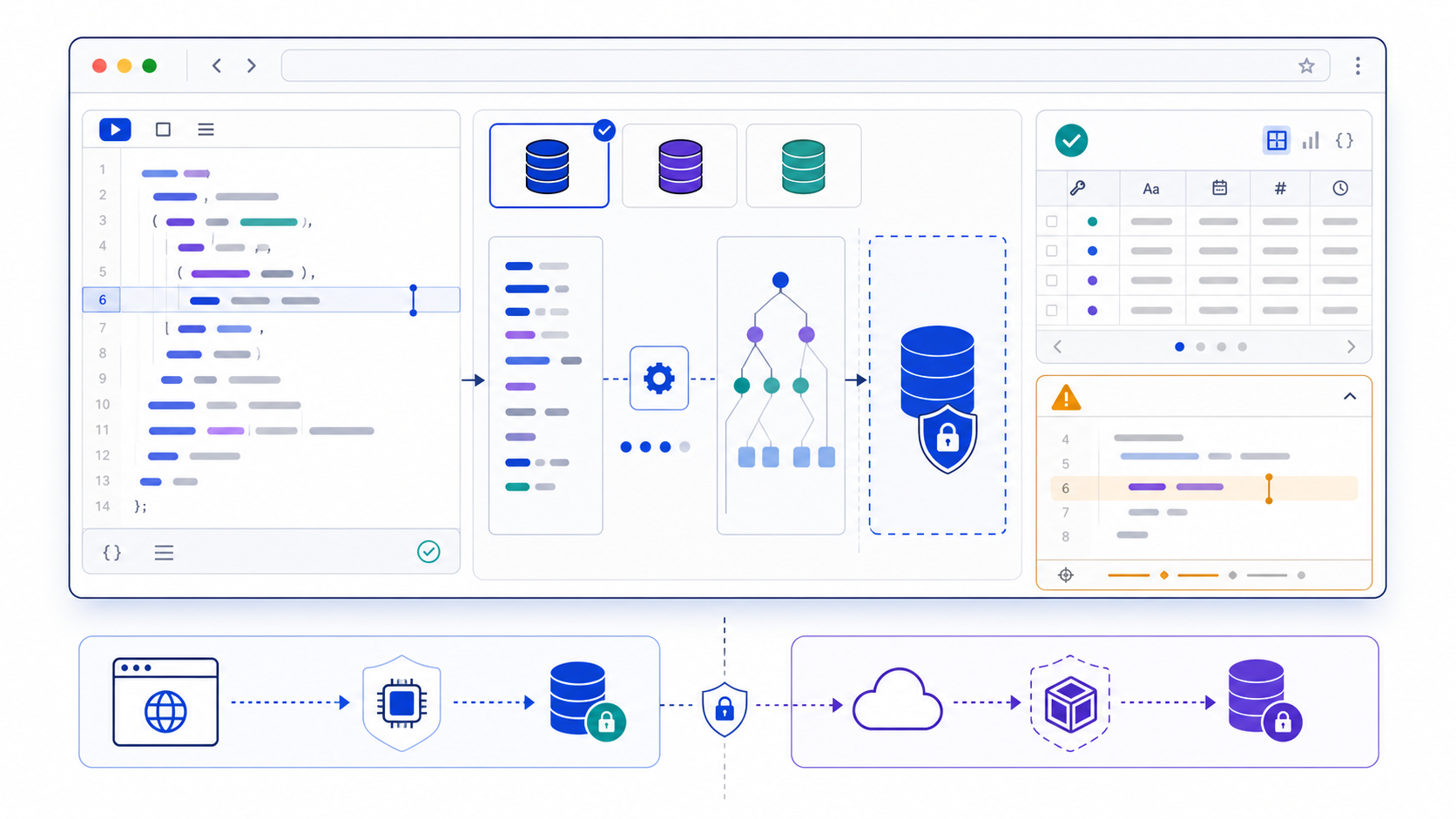
What is an online SQL compiler?
An online SQL compiler is a browser-accessible environment that parses SQL and may execute it against an embedded browser database or a remote sandbox, then returns syntax errors, runtime errors, or query results without requiring local installation. Authoring controls live on the SQL editor page. The label “compiler” is convenient rather than precise: a useful tool must disclose which engine and version interpret the statement, where execution occurs, how state is created, and what happens to the SQL and data.
Use one for learning syntax, building a minimal reproducible example, checking a small transformation, comparing dialect behavior, testing generated SQL on synthetic data, or sharing a disposable demonstration. Do not assume that a successful browser run proves production compatibility, correct business meaning, acceptable performance, authorization, or safe handling of sensitive context.
Understand what “compile SQL online” actually means
SQL is declarative: the statement describes a desired relation or change, while a database engine decides how to obtain it. Engines generally tokenize and parse the text, resolve identifiers and types against a catalog, transform or optimize the logical expression, produce an execution plan, and then run that plan. An online compiler may expose only the parser, a full embedded engine, or a service that sends the statement to a remote database container.
| Stage | Question answered | Typical failure | Context required |
|---|---|---|---|
| Tokenize and parse | Does text form a statement in this grammar? | Unexpected token, unmatched quote, missing delimiter | Dialect, version, statement boundary |
| Bind and resolve | Do referenced objects, functions, and types exist? | Unknown table, ambiguous column, incompatible type | Catalog, schema, search path, extensions |
| Plan and optimize | How might the engine execute the expression? | Unsupported operation or unacceptable estimate | Statistics, indexes, settings, parameter values |
| Execute | What rows, effects, errors, time, and resources result? | Constraint, permission, timeout, memory, or runtime error | Data, identity, transaction, workload, limits |
PostgreSQL’s official lexical-structure documentation shows how commands are sequences of tokens and how quoting and delimiters affect interpretation. That is one dialect’s behavior, not a promise that every online tool or target engine treats the same text identically.
Distinguish browser-local engines from remote SQL sandboxes
The most important architectural question is where parsing and execution occur. A browser-local tool can load an engine compiled to WebAssembly and keep a small database in memory or browser storage. A remote tool sends statements—and sometimes schema or data—to a service that provisions a database or shared execution environment. A hybrid may parse locally but execute remotely.
| Architecture | Strength | Limitation | Evidence to request |
|---|---|---|---|
| Parser only | Fast syntax diagnostics without a database | Cannot resolve real objects or prove runtime behavior | Grammar, dialect version, parser version, diagnostic model |
| Browser WebAssembly | Zero-install execution can remain on the device | Browser memory, threading, storage, extension, and CORS limits | Network trace, engine build, storage behavior, reset semantics |
| Remote isolated sandbox | Can run native engines and multiple server dialects | SQL and supplied data leave the browser; quotas and queues apply | Isolation, region, logging, retention, deletion, subprocessors |
| Connected database | Tests the actual catalog, types, privileges, and optimizer | Highest credential, data, cost, and side-effect risk | Identity, network path, policy enforcement, limits, audit |
SQLite publishes an official WebAssembly and JavaScript API documentation index. DuckDB likewise documents that DuckDB-Wasm runs inside a browser, while noting limits such as available memory and default threading. These references prove that browser-local databases are possible; they do not prove that an arbitrary online compiler uses that architecture.
Select the target SQL dialect before pressing Run
An online compiler’s default engine is part of the result. SQLite, PostgreSQL, MySQL, DuckDB, BigQuery, Snowflake, SQL Server, and other systems differ in quoting, data types, date functions, boolean handling, JSON and array syntax, generated columns, conflict handling, procedural SQL, DDL, and optimizer behavior. “ANSI SQL” is not a substitute for the actual reuse target.
An online Oracle SQL compiler needs a named Oracle engine and version, including PL/SQL if that is the job. This page does not host one. A SQLite or PostgreSQL sandbox is not Oracle. Use Oracle’s browser SQL practice environment when you need that dialect. Do not paste production SQL.
Choose the same engine family and, when behavior changed, the same major version. Record extensions and compatibility modes.
Recreate schema names, column types, constraints, collation, time zone, and representative indexes that affect interpretation.
Preserve placeholder style and types. Replacing parameters with convenient literals can hide binding and coercion defects.
Document search path, SQL mode, locale, time zone, transaction isolation, and settings that change semantics.
If the target engine is unavailable, label the online run as a structural experiment. List every untested difference, then repeat parsing, object resolution, result tests, and plan checks on the real target before promotion. Passing on a “similar” dialect is evidence about that sandbox only.
Prepare a minimal SQL test packet before compiling online
A query without schema and expected behavior is an incomplete test. Build a small, self-contained packet that another person can paste into a fresh session and run in the same order. Keep every row purposeful: each fixture should exercise a rule, boundary, or known failure.
| Artifact | Include | Why it matters |
|---|---|---|
| Context header | Engine, version, dialect, session settings, date, tool URL | Prevents an unlabeled result from being reused elsewhere |
| DDL | Tables, types, keys, nullability, defaults, constraints, indexes if relevant | Makes object and type behavior reproducible |
| Fixtures | Normal, null, duplicate, empty, boundary, and contradictory rows | Exercises logic beyond the happy path |
| Query under test | Exact statement, parameters and types, comments, expected grain | Separates submitted SQL from prose or editor state |
| Expected result | Columns, types, row keys, ordering rule, expected values, tolerances | Turns a successful run into a falsifiable test |
| Limitations | Features, scale, permissions, plans, and production context not represented | Stops a narrow demonstration from becoming broad proof |
Use synthetic names and values. Preserve the structure needed to reproduce the defect without copying customer identifiers, proprietary table names, credentials, access tokens, incident payloads, or production samples. If anonymization changes the behavior—such as collation, length, skew, or Unicode handling—create purpose-built synthetic values that reproduce that property.
Run an online SQL compiler in nine evidence-producing steps
- Define the question. Write the intended relation or change, output grain, definitions, exclusions, and expected result shape before editing SQL.
- Choose architecture. Decide whether a parser, browser-local engine, remote sandbox, or connected target is appropriate for the sensitivity and consequence.
- Declare the engine. Record engine family, version, extensions, compatibility mode, and session settings visible in the tool.
- Reset the session. Start from a clean database or explicitly inventory existing objects so hidden state cannot influence the test.
- Create schema and fixtures. Run DDL first, load purposeful rows, and verify setup counts and constraints before the query under test.
- Parse before executing. Read the first error, its engine code and position; do not randomly change multiple clauses at once.
- Execute within limits. Confirm selected text, statement class, timeout, row limit, memory or quota, and transaction behavior before Run.
- Validate the result. Compare keys, types, values, nulls, duplicates, ordering, totals, and negative cases against the expected table.
- Export a reproduction. Save SQL, setup order, engine context, expected result, actual result, errors, and limitations; then repeat in a clean session.
The clean-session repeat is essential. A query may succeed only because a previous tab created a table, changed a setting, loaded an extension, or left uncommitted state. A sharable URL is useful only if it captures every dependency or clearly says what the recipient must recreate.
Build a self-checking online SQL example
The following compact example tests a common requirement: return one row per customer with paid revenue in a date window, including customers with no paid orders. The fixtures intentionally include a customer with no orders, an unpaid order, a null amount, and an order on the exclusive upper boundary.
CREATE TABLE customers (
  customer_id INTEGER PRIMARY KEY,
  customer_name VARCHAR(40) NOT NULL
);

CREATE TABLE orders (
  order_id INTEGER PRIMARY KEY,
  customer_id INTEGER NOT NULL,
  ordered_at DATE NOT NULL,
  status VARCHAR(12) NOT NULL,
  amount DECIMAL(10, 2),
  FOREIGN KEY (customer_id) REFERENCES customers(customer_id)
);

INSERT INTO customers VALUES
  (1, 'Atlas'), (2, 'Birch'), (3, 'Cedar');

INSERT INTO orders VALUES
  (101, 1, DATE '2026-01-02', 'paid', 40.00),
  (102, 1, DATE '2026-01-03', 'pending', 90.00),
  (103, 2, DATE '2026-01-04', 'paid', NULL),
  (104, 2, DATE '2026-02-01', 'paid', 25.00);

SELECT c.customer_id,
       c.customer_name,
       COALESCE(SUM(CASE
         WHEN o.status = 'paid'
          AND o.ordered_at >= DATE '2026-01-01'
          AND o.ordered_at <  DATE '2026-02-01'
         THEN o.amount
         ELSE 0
       END), 0) AS paid_revenue
FROM customers AS c
LEFT JOIN orders AS o
  ON o.customer_id = c.customer_id
GROUP BY c.customer_id, c.customer_name
ORDER BY c.customer_id;| customer_id | customer_name | paid_revenue | Reason |
|---|---|---|---|
| 1 | Atlas | 40.00 | Paid January order counts; pending order does not |
| 2 | Birch | 0.00 | Null amount contributes no known revenue; February boundary is excluded |
| 3 | Cedar | 0.00 | LEFT JOIN preserves a customer with no orders |
This example is intentionally dialect-sensitive: the typed date literal and decimal display may differ between engines. If the compiler rejects it, diagnose whether the issue is grammar, data type, setup order, or feature support. Do not rewrite the logic until the failure class is known. After a successful run, add negative assertions: three output rows, unique customer IDs, no negative revenue, and no contribution from order 104.
Read online SQL compiler errors by phase
An error marker often points where the parser became unable to continue, not where the defect began. Preserve the original text and make one hypothesis-driven change at a time. Record the exact engine message, code, line and column, rendered statement, and selected execution range.
| Error class | First checks | Misleading shortcut |
|---|---|---|
| Lexical or parse | Dialect, previous quote or parenthesis, delimiter, comment, copied character | Deleting the highlighted token without reading preceding context |
| Object resolution | DDL ran successfully, schema qualifier, case folding, alias scope, setup order | Changing an object name to match autocomplete from stale state |
| Type or function | Argument types, implicit casts, null type, function signature, engine version | Casting everything to text until it runs |
| Constraint | Fixture order, primary and foreign keys, nullability, check condition, transaction | Removing the constraint that exposed a bad fixture |
| Resource or timeout | Row explosion, recursive termination, cross join, input size, quota, browser memory | Repeatedly pressing Run or only adding a display LIMIT |
| Client display | Truncation, pagination, formatting, timezone conversion, null rendering, export | Assuming visible cells equal the complete typed result |
Reduce a failure into the smallest statement that still fails, but retain the context that triggers it. Replace real identifiers and values with synthetic equivalents. If removing a CTE, parameter, collation, or constraint makes the defect disappear, that removed element is evidence and belongs in the reproduction.
Do not stop when an online SQL query returns rows
“Query succeeded” means the selected engine completed one execution. It does not mean the result answers the intended question. Validate the relation at its declared grain. Compare typed values by stable keys, not by screenshot position or a copied text checksum. Check both what appears and what must not appear.
| Validation | Question | Example assertion |
|---|---|---|
| Shape | Are columns, types, and row grain correct? | One unique row per customer; revenue is decimal |
| Inclusion | Are expected normal and boundary cases present? | Customer without orders remains with zero revenue |
| Exclusion | Are forbidden statuses, dates, tenants, or rows absent? | Upper-bound date and pending status contribute nothing |
| Null semantics | Are unknown, absent, and zero distinguished intentionally? | Null amount follows the documented business rule |
| Reconciliation | Do detail and total values reconcile to an independent calculation? | Sum of customer totals equals eligible order total |
| Ordering | Is order required and fully deterministic? | Tie-breaking key is included when pagination depends on order |
A compiler may display only the first N rows or convert types for presentation. Record whether row counts are complete, whether values were truncated, how null is rendered, and whether exports preserve types and ordering. Revalidate using the target driver or application path when serialization behavior matters.
Control session state, transactions, and destructive statements
Online environments differ in persistence. Some reset on refresh; some retain an in-memory database while the tab remains open; some save browser storage; some keep a remote project or sharable session. “Reset” may clear editor text without dropping database objects. Test the lifecycle rather than inferring it from the interface.
| Test | Procedure | Record |
|---|---|---|
| Fresh start | Open a private session or reset, then query a known prior object | Which state survives tab, refresh, browser restart, or shared link |
| Transaction | Begin, write, inspect, roll back, and inspect again | Autocommit, supported isolation, DDL transaction behavior |
| Multi-statement | Run setup plus test query and deliberately fail the middle statement | Whether later statements run and whether earlier effects remain |
| Cancellation | Start bounded long work, cancel, then inspect connection and state | Server or worker termination, rollback, reusable session |
| Destructive action | Use only disposable synthetic objects to test DROP or DELETE handling | Warnings, confirmation, authorization, rollback, reset |
Never test destructive behavior against a connected real database simply to discover the interface’s safeguards. Enforcement belongs in a disposable environment, read-only identity, database privileges, transaction policy, and server-side limits—not in a confirmation dialog alone.
Test the semantic edges that simple SQL demos hide
Small compiler demos often use integers and short text, so they miss the behaviors that break real queries: decimal precision, integer division, overflow, implicit casts, collation, trailing spaces, Unicode normalization, timestamp zones, daylight-saving transitions, null comparison, three-valued logic, NaN, JSON typing, and duplicate keys.
Test division, rounding point, decimal scale, very large values, negative values, and aggregation overflow using explicit expected types.
Test case, accents, emoji, composed and decomposed Unicode, empty string, whitespace, and locale-sensitive ordering.
Declare storage zone and business zone; test inclusive lower and exclusive upper bounds, month ends, leap days, and daylight shifts.
Distinguish unknown, missing row, zero, empty text, false, and invalid. Test joins, aggregates, predicates, and defaulting separately.
Document whether the online result grid preserves native types or renders strings. A visual “2026-01-01” may originate from a date, timestamp, or text value. When type identity matters, inspect metadata or run an engine-specific type expression rather than trusting display formatting.
Use online compiler timing as a diagnostic, not a benchmark
Browser and shared sandbox timing includes startup, engine download, WebAssembly compilation, worker scheduling, remote queueing, cold caches, result serialization, network transfer, and UI rendering. It usually lacks production data volume, statistics, indexes, hardware, concurrency, configuration, and cache state. A faster online run does not identify the faster production query.
| Measure | Useful for | Not evidence of |
|---|---|---|
| Parse latency | Finding pathological syntax or editor feedback delay | Target-engine end-to-end latency |
| Tiny fixture runtime | Detecting nontermination, accidental cross join, or gross regression | Scale behavior on skewed production data |
| Rows returned | Checking expected fixture cardinality | Rows scanned, shuffled, sorted, or billed |
| Browser memory | Determining whether the local demonstration remains usable | Native server memory requirement |
| Sandbox plan | Learning plan structure for that engine and test schema | The production plan with different statistics and indexes |
Use the online environment to formulate a hypothesis, such as “this join multiplies rows” or “this predicate prevents pruning.” Validate the hypothesis on the target engine with representative schema, statistics, parameters, plan output, resource budgets, and controlled load. The SQL query guide explains the wider execution and validation lifecycle.
Inspect data flow before pasting SQL into a web tool
SQL text can reveal table names, column names, business logic, security predicates, customer identifiers, infrastructure, and incident details even without result rows. DDL and sample data can be more sensitive. Treat the tool as an external processor until architecture and organizational approval prove otherwise.
| Question | Acceptable evidence | Safe default if unknown |
|---|---|---|
| Where does execution occur? | Documented architecture plus network inspection for the tested build | Assume SQL and inputs leave the device |
| What is retained? | Logging, storage, analytics, model-use, retention, and deletion terms | Use no confidential text or data |
| Who can access it? | Identity, authorization, share-link controls, tenant isolation, support access | Treat links and projects as public |
| Can it reach a database? | Network path, credential boundary, allowed destinations, server-side policy | Do not provide credentials or open a network path |
| Can code load resources? | Extension, file, URL, import, CORS, and filesystem controls | Assume imported files and URLs may be transmitted |
If a connected database is involved, use a dedicated least-privilege identity, approved network path, time and resource limits, export controls, and audit correlation. OWASP’s official SQL Injection Prevention Cheat Sheet recommends parameterized queries as a primary defense and least privilege as defense in depth. An online editor does not replace either control.
Match online SQL compiler depth to the task
| Use case | Good online test | Required follow-up |
|---|---|---|
| Learn SQL syntax | Small synthetic schema, immediate errors, expected result table | Repeat in the dialect used by the course or job |
| Interview practice | Timed query plus edge-case fixtures and explanation | Explain grain, complexity, alternatives, and assumptions without the tool |
| Debug a syntax error | Minimal statement under the exact dialect parser | Confirm object and runtime behavior on the target engine |
| Reproduce a data bug | Purpose-built fixtures and old/new result comparison | Test target types, collation, timezone, scale, permissions, and plan |
| Compare dialects | Run the same intent and fixtures on named engines | Document semantic differences, not only syntax rewrites |
| Review AI-generated SQL | Synthetic schema, grounded candidate, assertions, and failure cases | Human review, target-engine validation, policy and cost controls |
| Production performance tuning | Only a structural hypothesis or tiny correctness reproduction | Representative engine, data, statistics, load, plans, and budgets |
This page is narrower than the SQL tools guide, which covers the broader authoring, formatting, linting, testing, planning, and governed-execution toolchain. It is also distinct from a future SQL playground page: a playground emphasizes guided experimentation and learning, while this page emphasizes how an online compiler interprets and runs a reproducible SQL case.
Compare online SQL compilers with evidence, not feature counts
Evaluate the complete path from a blank browser session to a reproducible result. A tool with many dialect labels may use approximations; a tool with a polished grid may hide truncation; a tool claiming local processing may still send telemetry or imported files. Define must-pass gates before scoring convenience.
| Criterion | Illustrative weight | Evidence |
|---|---|---|
| Engine and dialect fidelity | 20% | Named engine/version and corpus results for required constructs |
| Reproducible state | 15% | Clean reset, ordered setup, versioned share or export, deterministic rerun |
| Diagnostics | 13% | Engine message, error code, line/column, statement range, runtime details |
| Result evidence | 14% | Types, nulls, complete row counts, truncation, ordering, export fidelity |
| Privacy and architecture | 18% | Verified processing location, network behavior, retention, access, deletion |
| Execution controls | 12% | Isolation, quotas, timeout, cancellation, statement and import boundaries |
| Usability and accessibility | 8% | Keyboard operation, clear context, mobile behavior, readable errors and results |
Security, prohibited data transfer, unsupported target dialect, or missing reset behavior may be gates rather than weighted criteria. Reweight by use case: a classroom tool can prioritize accessibility and fixtures, while a bug-reproduction service should emphasize fidelity, versioned state, diagnostics, privacy, and share controls.
Test an online SQL compiler with adversarial cases
A demo query selected by the tool is not an evaluation. Prepare the same frozen pack for each candidate and score observable outcomes. Include valid queries, intentionally invalid queries, semantic traps, state transitions, and privacy checks. Use synthetic data throughout.
| Scenario | Injected challenge | Pass condition |
|---|---|---|
| Dialect | Quoted identifiers, date literal, window frame, JSON, vendor function | Behavior matches declared engine or limitation is explicit |
| Diagnostics | Unclosed quote before the highlighted line and an unknown column | Parser and resolver errors are distinguishable and reproducible |
| Correctness | Many-to-many join, null amount, duplicate key, boundary timestamp | Expected table and negative assertions catch wrong variants |
| State | Failed middle statement, rollback, refresh, reset, shared link | Persistence and transaction behavior match documentation |
| Resource | Bounded recursive query, large result, cancellation, import limit | Limits activate cleanly without freezing or leaking state |
| Privacy | Observe network during edit, run, import, save, share, and reset | Observed data flow matches the claim and approved boundary |
Repeat the trial in a fresh browser profile and on a second device if browser-local behavior matters. Record browser version, hardware constraints, network state, and tool build date. A proof of concept should expose what the compiler cannot represent, not merely confirm that SELECT 1 works.
Test AI-generated SQL without turning the compiler into an oracle
A natural-language-to-SQL system can produce a plausible candidate quickly. An online compiler can reveal whether that candidate parses and behaves on a synthetic case. Neither component knows automatically whether the business question, schema selection, join grain, metric definition, authorization, or production cost is correct.
| Artifact | Review question | Promotion gate |
|---|---|---|
| Natural-language request | Are grain, time, definitions, exclusions, and result shape explicit? | Material ambiguities are resolved or listed |
| Schema context | Are objects, relationships, types, constraints, and allowed scope current? | Every reference is grounded and authorized |
| Candidate SQL | What assumptions, statement class, functions, and dialect features appear? | Human can explain every clause and side effect |
| Compiler run | Does it parse and match expected synthetic results and failure cases? | Assertions pass in a clean, declared sandbox |
| Target validation | Do catalog, permissions, types, plan, cost, and results hold on target? | Consequence-appropriate review and controls pass |
Use the InfiniSynapse NL2SQL Query Tester to generate and inspect SQL examples from a plain-English question using built-in synthetic schemas. The public tool states that generation runs client-side and that users should validate generated queries against their own database before production use. Prepare the question and expected result first, inspect every clause, then move the candidate into a declared compiler test packet.
Avoid false confidence from an online SQL compiler
| Mistake | Why it fails | Better practice |
|---|---|---|
| Running before choosing a dialect | Default syntax and semantics may differ from the target | Declare engine, version, extensions, and session settings |
| Testing only the query text | Objects, types, constraints, fixtures, and expected behavior are absent | Build a self-contained DDL, fixture, query, assertion packet |
| Treating rows as correctness | Wrong joins and filters can return plausible data | Check grain, types, expected values, exclusions, and reconciliation |
| Pasting a production query unchanged | Text may expose proprietary logic, identifiers, and security context | Reduce and synthesize before using an approved tool |
| Using the sandbox as a benchmark | Engine, data, hardware, statistics, concurrency, and caches differ | Use it for hypotheses, then test representative target conditions |
| Sharing a mutable link as evidence | Content, engine, state, visibility, or retention may change | Export or version the complete reproduction and expected result |
| Trusting AI SQL after one run | A plausible result can use wrong tables, grain, time, or authorization | Ground, review, test, validate on target, and enforce controls |
The recurring error is scope inflation: evidence from one synthetic run becomes a claim about every dataset, engine, workload, or user. Label the exact scope of each observation and list the next validation required before reuse.
Use this online SQL compiler checklist
- The intended question, output grain, definitions, exclusions, and expected result shape are written before SQL execution.
- The tool’s parser-only, browser-local, remote-sandbox, hybrid, or connected architecture is documented and verified.
- Engine family, version, dialect, extensions, compatibility mode, and relevant session settings are declared.
- Only synthetic or approved data, identifiers, literals, and SQL are supplied; no credentials or secrets are pasted.
- A clean session can recreate DDL, constraints, indexes when relevant, fixtures, query, and assertions in a documented order.
- Errors retain engine message, code, position, submitted statement, and selected execution range.
- Results are checked for typed shape, grain, keys, nulls, duplicates, boundary cases, exclusions, totals, and deterministic ordering.
- Session persistence, reset, transactions, multi-statement failures, cancellation, and destructive behavior are understood.
- Timeout, row, memory, quota, import, and sharing limits are tested without relying on a display LIMIT.
- Network, logging, retention, third-party access, model use, deletion, and share visibility match the approved privacy boundary.
- Performance observations are labeled as sandbox diagnostics and are not reused as production benchmarks.
- Before production reuse, the query is revalidated on the target catalog, types, permissions, data, plan, cost, and application path.
Generate a candidate SQL query for your compiler test packet
Prepare a precise question and expected result before generating SQL. Use the InfiniSynapse NL2SQL Query Tester with its built-in synthetic schemas to inspect joins, filters, subqueries, windows, and aggregations in the generated example. Then copy the reviewed candidate—not credentials or production data—into an online compiler with a declared engine, synthetic fixtures, assertions, and execution limits.
Frequently asked questions about online SQL compilers
Does this page host an online Oracle SQL compiler?
No. This page is the method for an online SQL compiler: declare the engine, use synthetic fixtures, and treat a sandbox pass as evidence about that sandbox only. Oracle and PL/SQL need a named Oracle engine. Official browser practice is Oracle FreeSQL.
What is an online SQL compiler?
It is a browser-accessible environment that parses SQL and may execute it against an embedded browser database or a remote sandbox, then returns errors or results without requiring local installation.
Does SQL really get compiled?
Database engines normally parse SQL, resolve objects and types, optimize a logical expression, create an execution plan, and execute it. Online tools use compiler as a convenient label, so verify their actual pipeline and engine.
Which SQL dialect should I select?
Select the same engine family and version as the environment where the query will be reused. Generic or different engines may accept syntax, functions, quoting, types, or null behavior that the target rejects or interprets differently.
Is it safe to paste production SQL into an online compiler?
Not by default. Verify whether processing is local or remote, what is logged or retained, and whether third parties receive data. Use synthetic schemas and literals until architecture and organizational approval are confirmed.
Can an online compiler prove that a query is correct?
No. A successful run proves only that one statement executed in one environment with one dataset. Correctness also requires intended grain, definitions, representative fixtures, edge cases, result checks, authorization, and target-engine validation.
Can I use AI-generated SQL in an online compiler?
Yes, with synthetic context and review. Record the question, schema, dialect, assumptions, and expected result shape, then parse, test, inspect, and validate the generated SQL before using it with real data.
Primary sources and evaluation method
This guide uses primary technical references: PostgreSQL’s SQL lexical structure; SQLite’s WebAssembly and JavaScript documentation; DuckDB’s Wasm overview, which describes browser execution and resource limitations; and OWASP’s SQL injection prevention guidance. The InfiniSynapse tool description was checked against its live public page on July 24, 2026.
The evaluation method is evidence-led: define intent, declare architecture and engine, create synthetic state, run known positive and negative cases, validate typed results, exercise state and resource boundaries, inspect privacy behavior, and repeat from a clean session. This improves review quality but does not guarantee indexing, ranking, query correctness, security, compatibility, or production performance.