SEO Health Check vs Site Audit: One URL or 50–500
By William Zhu · Cofounder, InfiniSynapse · Last updated: 2026-09-10 · Last verified: 2026-09-10 · Methods: Compared one-URL eight-module lights with sitemap samples of 50–500 pages at aimeetup.center. Not an official Google score. Observed CLI contract 2026-09-10 on
infinitegrowth@0.1.1:seo-health check --format jsoncan exit 0 whileissues[].statusiserror.
Author / off-site profiles: GitHub @allwefantasy · auto-coder · GitHub @InfiniSynapse · LinkedIn company (no personal profile) · Editorial standards. No personal LinkedIn or vendor badge. Product recognition: SEO Health Checker is one of two first-prize works in the InfiniSynapse × CSDN Vibe Coding contest (English recognition archive). InfiniSynapse co-hosted the contest. That list is not a review of this article.
Reviewed by: InfiniSynapse Data Team · method review 2026-09-10. First-party method review, not a third-party award.
Trust / COI: About · Corrections · Publishing principles · Privacy · Terms. SEO Health is commercial. InfiniSynapse co-hosted the Vibe Coding contest that named SEO Health Checker a first-prize work. The issues[] table below is observed. Topic desks stay illustrative. The InfiniSynapse Data Team publishes this desk method.
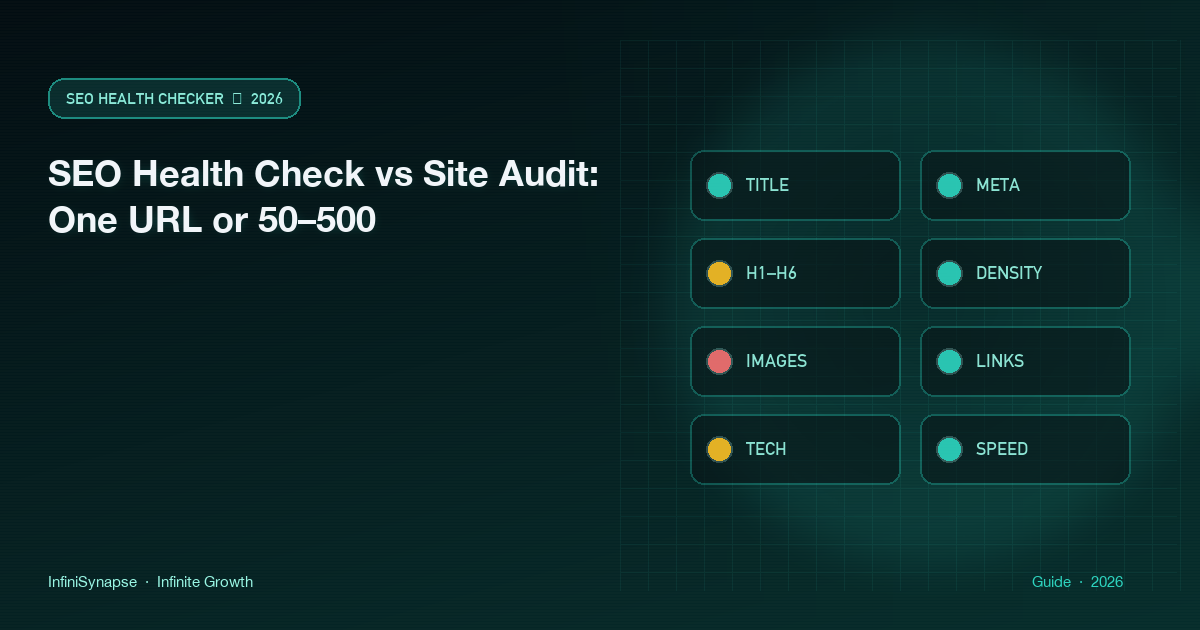
Table of Contents
- TL;DR
- What SEO health check vs site audit actually means
- The scope framework: one URL or a slice
- When to pick each instrument
- Landscape in 2026: checkers, samples, and desktop crawls
- How to choose and run the right pass
- Desk sample: one URL versus a fifty-page slice
- Selection scorecard
- Failure modes that mix the two jobs
- Cluster guides for this pillar
- Frequently Asked Questions
- Conclusion
TL;DR
Direct answer: **SEO health check vs site audit** is a scope choice. The check reads one public URL and returns eight traffic lights — title, meta, headings, density, images, links, tech, and speed — in about 30 seconds. The audit samples 50–500 sitemap URLs. It is not Screaming Frog and not a Google 100.
What you will learn: when one URL is enough; when a 50–500 slice is the job; how SEO health check vs site audit fails if you mix rooms; an illustrative two-dimension desk table; four steps.
Open https://aimeetup.center/seo-tools#check and paste the live URL you will ship. For older one-page diagnosis language, use the on-page SEO tool page.
We evaluate SEO health check vs site audit hands-on as the InfiniSynapse Data Team. We build InfiniSynapse only if the user starts EEAT or visibility on that URL (credits).
What SEO health check vs site audit actually means
Key Definition: SEO health check vs site audit compares a one-URL eight-light pass with a sitemap sample of 50–500 pages. The check answers what is wrong on this URL. The sample answers what repeats across a slice of the host.
Observed page CLI (2026-09-10, infinitegrowth@0.1.1): seo-health check https://infinisynapse.com/apps/cartgenie --format json --lang en exited 0. issues[].status listed Title Length (warning), Meta Description (warning). Process exit 0 is not a clean page.
issues[].name | issues[].status |
|---|---|
| Title Length | warning |
| Meta Description | warning |
| H1 Tag | good |
| URL | good |
| Robots.txt | good |
| Sitemap.xml | good |
| Image Alt Text | good |
| Page Structure | good |
The topic desk below stays illustrative.
Independent citation: According to [website](https://en.wikipedia.org/wiki/Website), a website is a collection of related web pages under a common host. Wikipedia's website page is the third-party rule this write-up holds to. Illustrative desks below are not that rule.
People search SEO health check vs site audit after a title change, a template ship, or a meeting that asked for “a full audit.” Those are not the same ticket.
A website is a set of pages a visitor can request without a private login, which is why both jobs start from public hosts you can stand behind. Neither job reprints an official Google health number.
If you only need the older one-page diagnosis vocabulary, continue on the on-page SEO checker. This page stays on SEO health check vs site audit as scope.
Eight lights on a single public URL
The one-URL side of SEO health check vs site audit is the free board at aimeetup.center. Paste one canonical URL. Wait about 30 seconds. Read red, then amber, then green.
Title and meta describe the URL to a result page. Headings, density, images, and links flag missing H1s, stuffing, missing alt, and empty hrefs. Tech and speed read robots hints, canonicals, HTTPS, and a coarse load signal — not a lab Core Web Vitals certificate. Treat green as “this module did not fail the rule we shipped.”
The pillar hub for that board is the SEO health checker. Use it when the page you edited is the only page in the ticket.
What a sitemap sample is not
The audit side of SEO health check vs site audit is a sitemap sample, not a million-page desktop crawl. SEO Health pulls 50–500 URLs and scores the same eight modules on each row. It does not clone Screaming Frog.
The sample hub is SEO website audit. Open that hub when the same template ships across dozens of URLs and one paste cannot see URL 187.
A sample will not tell you in 30 seconds that today’s hero has no alt. A one-URL pass will not find a 404 that exists only on page 187. That split is SEO health check vs site audit.
The scope framework: one URL or a slice
Run SEO health check vs site audit as two rooms with one shared light engine. Do not average them into a fake host score.
| Room | Input | Output | Time | Login |
|---|---|---|---|---|
| One-URL check | One public URL | Eight lights | About 30 seconds | No |
| Sitemap sample | Sitemap + 50–500 cap | Rows of the same eight modules | Minutes, plus render quota | No for the crawl; credits if you start a deep write-up |
Eight-module lights stay in SEO Health in both rooms.
Eight modules stay on the pasted URL
On the check side of SEO health check vs site audit, the unit is the URL you pasted. Chrome can finish basic modules locally. The CLI is seo-health check after npm i -g infinitegrowth. None of those paths call InfiniSynapse for the eight lights.
If you later want EEAT notes or AI visibility on that same URL, start that action on purpose. Those paths need a login and credits.
Fifty to five hundred is a different job
On the sample side of SEO health check vs site audit, the unit is a slice. seo-health audit --pages 50-500 spends render quota. A credited narrative can summarize the slice. It still must not invent a Google 100.
The Yale Spider text-to-SQL benchmark scores models on a held-out set of databases, not on one lucky query, which is why a sitemap sample exists beside a one-URL board. One green title is not the host.
Do not treat “50 to 500” as this page’s target. That phrase belongs to the audit pillar. Here it is only the product cap.
When to pick each instrument
Pick the check when you changed a title, a hero, or a canonical on one URL. Pick the sample when the same header ships on 80 product pages.
SEO health check vs site audit is a sequencing rule, not a brand fight. Run the URL you are editing first. Sample after the template is honest.
Punch list versus sample rows
A punch list has eight rows and one owner per red module. A sample has eight modules times N URLs. If nobody will assign those rows, do not start the sample. SEO health check vs site audit wastes a week when the work was one meta string.
The BIRD benchmark stresses realistic databases because one clean example does not prove the system, just as one green density light does not prove a host.
If you need the click-by-click paste, open how to run an SEO health check. That sibling stays on the one-URL loop. This page stays on SEO health check vs site audit.
Landscape in 2026: checkers, samples, and desktop crawls
Suites sell a 100. Desktop crawlers sell a site file. SEO health check vs site audit on this stack sells two honest scopes: one URL, or 50–500. A desktop crawl can be the right tool for a different team. This product does not pretend to be that file.
The Databricks documentation describes a workspace that holds many tables and jobs, not a single pasted cell, so treat a 50–500 sample as that wider room and the one-URL board as one cell.
Browser, CLI, and Chrome
Three doors, one light engine. The browser form teaches the check. The CLI repeats seo-health check or seo-health audit. Chrome stays local unless you start AI EEAT. Do not paste cookies, preview tokens, or admin URLs into either room of SEO health check vs site audit.
Cortex Analyst answers questions against warehouse data you already loaded; it does not replace a one-page HTML board. Keep narrative jobs behind an explicit start. Keep lights in SEO Health.
How to choose and run the right pass
Eight-module lights stay in SEO Health. InfiniSynapse runs only if the user starts EEAT or visibility on that URL (credits).
That boundary is the method. SEO health check vs site audit in the next four steps is a scope choice, then a run, then a re-run of the same instrument.
The Databricks Genie data-agents post is about agents over data estates, which is the wrong metaphor for eight lights on one URL. Use an agent write-up only after you start that job.
Step 1 — Name the job before you paste
Write one sentence: “this URL” or “this template across N URLs.” If you cannot name N, you are not ready for the sample side of SEO health check vs site audit.
If the sentence is “we shipped a title,” stay on one URL. If the sentence is “the listing template lost H1s,” plan a 50–500 sample after you fix one canonical example.
Step 2 — Run the one-URL board
Open https://aimeetup.center/seo-tools#check. Paste the canonical public URL. Wait for title, meta, headings, density, images, links, tech, and speed.
Write every red module, then amber. Assign each row. This is still SEO health check vs site audit if you never open the sample. Most tickets should stop here.
Step 3 — Sample only when the template repeats
If the same failure will exist on dozens of URLs, start seo-health audit with a page cap you can afford. Read module × URL rows. Do not invent a host 100.
SEO health check vs site audit fails when the sample is a way to avoid assigning the first red title. Fix the example. Then sample to see whether the class followed.
Step 4 — Re-run the same instrument
Ship the edit. If you used the check, paste the same URL. If you used the sample, run the same cap. Compare lights.
After a release, the sibling that times the one-URL board is SEO health check after deploy. Full pipeline wiring belongs on the CI pillar, not on SEO health check vs site audit.
Independent citation 2: According to [Databricks Genie data-agents post](https://www.databricks.com/blog/pushing-frontier-data-agents-genie), Databricks's official page on Databricks Genie data-agents post is an independent third-party reference for that term, not a first-party traffic forecast. A second independent source, from Databricks, keeps this page claim from resting only on first-party lights.
Desk sample: one URL versus a fifty-page slice
The table is an illustrative desk composite, not a customer win. It records how SEO health check vs site audit looked at the InfiniSynapse desk on 2026-09-08 (DESK-IG104-20260908A) across two dimensions: job × module reds.
| Job (illustrative) | Title reds | Heading reds | Image reds | Tech reds |
|---|---|---|---|---|
| One-URL check | 1 | 0 | 1 | 0 |
| 50-URL sample | 6 | 11 | 9 | 2 |
Two dimensions: job type × module. The one-URL row is 0 or 1. The sample row is a count of URLs that failed that module. Not a percentage uplift.
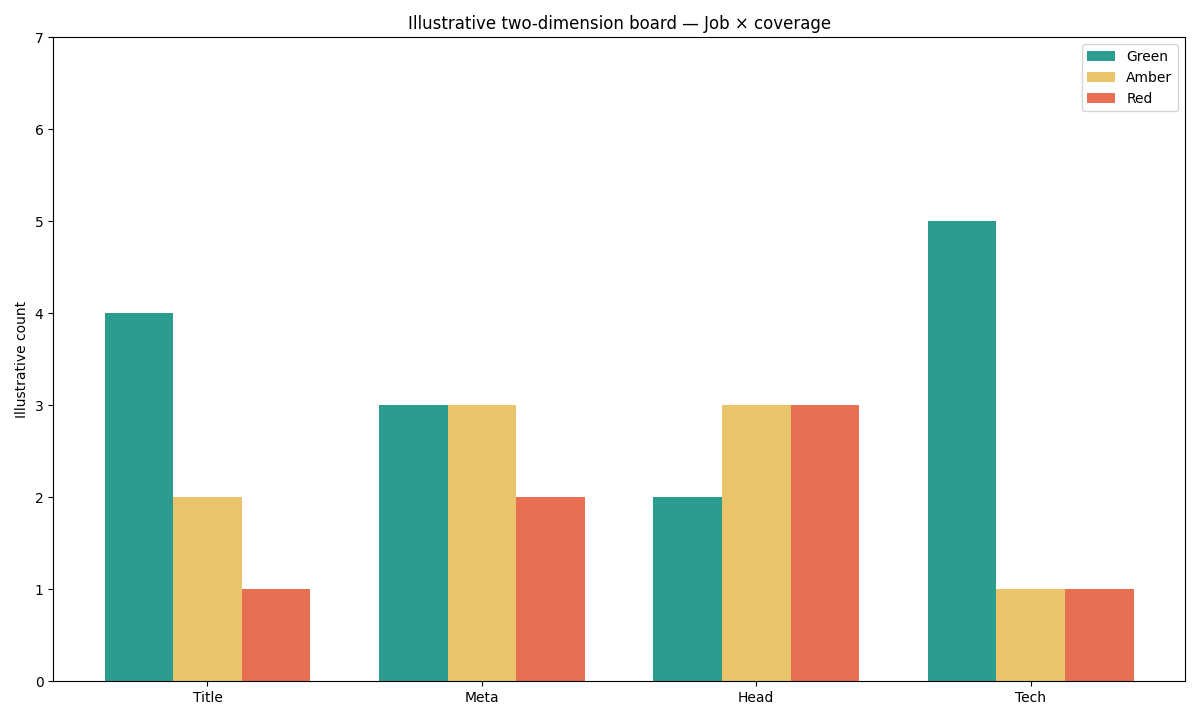
Figure: illustrative grouped bars — job type × module reds. Two dimensions. Not a Google score and not a customer lift.
How to read the two-dimension table
The one-URL title red means fix that title today. The sample’s eleven heading reds mean the template is the ticket, not a single hero. SEO health check vs site audit is the act of reading which row you are in.
If your run differs, trust your run. The figure teaches the axes. Social cut: ./images/og-cover.png.
Selection scorecard
Score each row 0–2 when someone asks for SEO health check vs site audit today.
| Question | 0 | 1 | 2 |
|---|---|---|---|
| Can you name one public URL? | No URL, or a secret host | Staging with a public share | Live canonical URL |
| Is the bug on one page or a class? | Unknown, so “audit everything” | A guessed template | A named template or a named URL |
| Do you need lights in 30 seconds? | You need a week-long crawl | You can wait for a sample | You need the board now |
| Can you assign each red? | No owner | Shared inbox | Named owner per module |
| Will you re-run the same instrument? | One screenshot | Maybe next sprint | Same URL or same cap, same day |
Under 6 means you have not chosen. 8–10 on the URL column means paste. 8–10 on the class column means sample 50–500. SEO health check vs site audit is that fork.
Failure modes that mix the two jobs
The first failure is calling a one-URL paste “the site audit.” That screenshot does not speak for URL 187. SEO health check vs site audit exists so that sentence dies in the ticket.
The second failure is sampling 500 URLs because a meeting said “audit,” then ignoring the first red title you already had.
The third failure is treating either board as a Google 100.
The fourth failure is starting EEAT by accident and then complaining about credits. The eight lights are free. The long write-up is not.
The fifth failure is checking a draft and sampling production. Re-run the instrument on the host you shipped.
Cluster guides for this pillar
This page is the scope fork. Use the table as a routing sheet.
| Job you actually have | Guide to open next | What this page will not do |
|---|---|---|
| Paste one URL and learn the board | SEO health checker (hub) | Retarget the hub phrase as this page’s keyword |
| Click-by-click one-URL loop | How to run an SEO health check | Replace the scope decision |
| Re-check after a release | SEO health check after deploy | Wire your CI runner here |
| Sample 50–500 sitemap URLs | SEO website audit (audit hub) | Clone a desktop crawl |
| Older one-page diagnosis words | On-page SEO tool / checker | Reuse those old English targets |
Open one row when you have that job. Keep SEO health check vs site audit as the question that sent you there.
Paste one URL before you sample fifty
Run the eight-light board on the public URL you will ship, then sample 50–500 only if the same template repeats.
Run SEO Health CheckerFrequently Asked Questions
Is the one-URL board a Google score?
Bottom line: No. The check is a first-party rule board with eight traffic lights. Google does not publish a page health number that this product reprints. SEO health check vs site audit does not create a host trophy either.
When should I sample 50–500 pages?
Bottom line: When the same template or header will fail as a class. One paste cannot see URL 187. A sitemap sample can. Stay inside a cap you can assign. Do not treat the cap as a desktop crawl.
Is this the same as a desktop crawl?
Bottom line: No. The audit room on this stack is a 50–500 sitemap sample. It is not Screaming Frog and not a million-page file. If you need that file, use the desktop tool. Do not ask SEO Health to pretend.
Do credits change the eight lights?
Bottom line: No. Credits buy optional narrative after you start EEAT or visibility, not a new light engine. Both rooms of SEO health check vs site audit keep deterministic scoring in SEO Health.
Conclusion
SEO health check vs site audit is one public URL with eight lights versus a 50–500 sitemap sample. Paste, read red, assign, re-run. Sample only when the template repeats. Neither room is a Google score or a desktop crawl.
Keep the board in SEO Health. If you later want a credited write-up on the same URL, start that action from the InfiniSynapse web app after the lights are honest. Until then, name the room before you paste.