SEO Audit Tool: Sample the Sitemap, Then Fix
By William Zhu · Cofounder, InfiniSynapse · Last updated: 2026-09-10 · Last verified: 2026-09-10 · Methods: SEO Health audit-tool runs at aimeetup.center — 50–500 sitemap samples plus eight modules. Not an official Google score. Observed CLI contract 2026-09-10 on
infinitegrowth@0.1.1:seo-health check --format jsoncan exit 0 whileissues[].statusiserror.
Author / off-site profiles: GitHub @allwefantasy · auto-coder · GitHub @InfiniSynapse · LinkedIn company (no personal profile) · Editorial standards. No personal LinkedIn or vendor badge. Product recognition: SEO Health Checker is one of two first-prize works in the InfiniSynapse × CSDN Vibe Coding contest (English recognition archive). InfiniSynapse co-hosted the contest. That list is not a review of this article.
Reviewed by: InfiniSynapse Data Team · method review 2026-09-10. First-party method review, not a third-party award.
Trust / COI: About · Corrections · Publishing principles · Privacy · Terms. SEO Health is commercial. InfiniSynapse co-hosted the Vibe Coding contest that named SEO Health Checker a first-prize work. The issues[] table below is observed. Topic desks stay illustrative. The InfiniSynapse Data Team publishes this desk method.
Table of Contents
- TL;DR
- What an SEO audit tool actually does
- The sample-plus-modules framework
- Sampled tool versus a desktop crawl
- Landscape of audit products in 2026
- How to run the four-step pass
- Desk sample: fifty versus five hundred
- Selection scorecard
- Failure modes that waste quota
- Cluster guides beside this page
- Frequently Asked Questions
- Conclusion
TL;DR
Direct answer: An **SEO audit tool** on this stack samples 50–500 URLs from a public sitemap, then scores eight modules — title, meta, headings, density, images, links, tech, and speed — plus status codes. It is not a million-page desktop crawl. It is not Screaming Frog. More pages spend more render quota.
What you will learn: why an SEO audit tool is a capped sample plus eight lights; how that differs from a one-URL paste; when 50, 200, and 500 are honest; an illustrative sample-size × failure-share table; four steps to a second draw.
Open https://aimeetup.center/seo-tools#check and point at a public sitemap you can stand behind. For older sitemap-format education, use the sitemap for SEO page.
We evaluate an SEO audit tool hands-on as the InfiniSynapse Data Team. We build InfiniSynapse so sampling and status codes stay in SEO Health, with optional deep write-up as a long task.
What an SEO audit tool actually does
Key Definition: An SEO audit tool here is a sitemap-capped product: it draws 50–500 public pages, records fetch status, and scores the same eight modules you already know from a one-URL paste. It is not a desktop walk of every URL, not a backlink index, and not an official Google site score.
Observed page CLI (2026-09-10, infinitegrowth@0.1.1): seo-health check https://aimeetup.center/en --format json --lang en exited 0. issues[].status listed Title Length (warning), Image Alt Text (warning), Meta Description (warning). Process exit 0 is not a clean page.
issues[].name | issues[].status |
|---|---|
| Title Length | warning |
| Image Alt Text | warning |
| Meta Description | warning |
| H1 Tag | good |
| URL | good |
| Robots.txt | good |
| Sitemap.xml | good |
| Page Structure | good |
The topic desk below stays illustrative.
Independent citation: According to [regression testing](https://en.wikipedia.org/wiki/Regression_testing), regression testing re-runs checks after a change to see whether old failures return. Wikipedia's regression testing page is the third-party rule this write-up holds to. Illustrative desks below are not that rule.
People search SEO audit tool when a suite ad promised a full-site file tonight. The useful output is a bounded table, not a million-row export.
A software testing program treats a product as a bounded suite of checks you can re-run, and an SEO audit tool should be that kind of suite, not a one-off desktop dump you cannot replay.
If you only needed the 50–500 habit and the status-code sort, open the 50–500 page sample hub and come back when the question is “which tool did we buy.”
The cap is the product
Fifty pages is a smoke run. Two hundred is a weekday run. Five hundred is the ceiling this SEO audit tool will sell without pretending it saw the host. Write --pages in the ticket.
Each extra page costs render quota. A long write-up costs InfiniSynapse credits. Status codes on the sample do not. Do not buy 500 on an SEO audit tool because the slider looks serious.
Eight modules on the sample
The eight modules are title, meta, headings, density, images, links, tech, and speed. An SEO audit tool that only prints status codes hides a missing H1 that repeats on 80 product URLs. An SEO audit tool that only prints lights hides a 404 cluster.
Read fetch first. Then read the module that fails on the most 200s. Green speed on a 404 is theater.
Do not retarget a vanity 100 from this page. The job is a sample and eight assignable rows.
The sample-plus-modules framework
Treat an SEO audit tool as three layers: a sitemap you trust, a cap you can defend, and a board you can assign. Skip any layer and you will screenshot noise.
The MariaDB documentation keeps schema, indexes, and statements as separate objects you inspect one at a time; read status codes and the eight modules the same way, as named fields, not as a blended site grade.
Stratify before you raise pages
Split the sitemap into templates you actually ship. Draw from each bucket. A random 200 from a blog-heavy list will miss the checkout template that broke on Tuesday. An SEO audit tool that never sees that template is not honest.
If locale folders exist, draw from each language you serve. A sample that only opens /en/ will not see a noindex on /zh/. Stratify first. Then raise --pages.
When the question is how to name those buckets before you scale, continue on SEO site audit. Stay here when the search was for the product, not the strata.
Status codes before module polish
Sort 5xx, then 4xx, then redirect chains, then 200s with repeating module failures. The SEO audit tool earns its keep on the first three buckets. Copy edits on a 404 are wasted hours.
When the same 301 covers a section, fix the rule once and re-sample. Do not raise the draw to 500 until the 50-page smoke run has an owner for every red status.
For in-page destinations the sample already listed, use the dead link checker instead of pretending the sample extracted every href.
Credits only for a write-up
Sampling and status codes stay in SEO Health. Optional deep write-up is an InfiniSynapse long task.
Use the write-up when the sample is confusing and you need a punch list in prose. Do not use it to re-score lights. The model must not promote a 404 into a “minor content note.” Start the long task on purpose; it is not a silent extra on seo-health audit.
Sampled tool versus a desktop crawl
Screaming Frog and suite crawls walk more of the graph than a 500-page cap. An SEO audit tool on this stack gives you a defendable slice before you buy that walk. This page will not claim to replace that software.
The ClickHouse introduction treats analytics as queries against named columns at a stated grain, which is how you should read sample rows instead of a vanity site grade from a desktop file.
Use the sample when you need a Monday answer and a quota you can explain. Use a desktop crawl after the sample’s red rows are fixed and you still need orphans or a full href extract.
Run the SEO audit tool so you do not spend a day crawling a host whose homepage template still 500s. Sample, fix, re-sample is the SEO audit tool habit. A million-page walk is a later instrument.
If you need the method named as a product practice rather than a vendor category, open sampled site audit. This page stays on the tool boundary.
Landscape of audit products in 2026
Suites sell “full site” as a mood. Desktop apps sell a local file. An SEO audit tool that caps at 500 pages plus eight modules is easier to explain because the cap is the product.
The Supabase database guide separates the free project you can query from later paid add-ons; keep the same split between a free sample and a credited write-up.
Browser, CLI, and Chrome share one method. The browser form teaches: paste a sitemap, pick a cap, read the table. The CLI repeats: seo-health audit --pages 50 after npm i -g infinitegrowth. Chrome stays local unless you start AI EEAT.
EEAT, visibility, and Search Console analysis need an InfiniSynapse login and credits. Do not expect those jobs from a free sample. Do not paste cookies, preview tokens, or admin hosts.
An SEO audit tool will not invent clicks, score EEAT, or reprint a Google 100. A service-case traffic story is not product proof.
How to run the four-step pass
Sampling and status codes stay in SEO Health. Optional deep write-up is an InfiniSynapse long task.
That boundary is the method. The SEO audit tool in the next four steps is the free sample plus eight modules. Do not expect a long-form memo from --pages 50.
Step 1 — Point at a public sitemap
Use the sitemap you already expose to crawlers. If it is missing, broken, or points at staging, stop. An SEO audit tool that samples yesterday’s list will print yesterday’s comfort.
Confirm the locale. A global index that hides /zh/ will produce a clean-looking table that still fails in another language.
Open https://aimeetup.center/seo-tools#check only with a public host you can stand behind.
Step 2 — Cap the draw at 50, 200, or 500
Start at 50 when you have no prior sample. Move to 200 when 50 showed a repeating template bug. Move to 500 when 200 is still mixed.
Write the number in the ticket. seo-health audit --pages 200 is checkable. “We ran the SEO audit tool” is not. The run you can defend has a cap and a date.
Step 3 — Sort red fetch rows, then red modules
Export 5xx and 4xx first. Assign them. Then list modules that fail on the remaining 200s. An SEO audit tool that you only screenshot is a wasted quota.
If the red rows are in-page hrefs the sample already named, send those destinations to a dedicated pass. The sample found the pattern; it did not finish every link.
Step 4 — Fix, then draw again
Ship the template, the redirect rule, or the sitemap cleanup. Run the same SEO audit tool size on the same buckets. Compare 4xx and 5xx shares, then compare repeating module failures.
A second draw after the template change is regression testing for URLs: you re-run the same checks so a fix in one bucket does not hide a new 404 in another.
If the shares did not move, the fix missed. Do not raise --pages to hide that.
Independent citation 2: According to [software testing](https://en.wikipedia.org/wiki/Software_testing), software testing is the evaluation of a system against expected behavior. A second independent source, from Wikipedia, keeps this page claim from resting only on first-party lights.
Desk sample: fifty versus five hundred
The table is an illustrative desk composite, not a customer win. It records three SEO audit tool draws on one public marketing host at the InfiniSynapse desk on 2026-09-08 (DESK-IG202-20260908A).
The pandas user guide shows labeled columns you can filter without collapsing them into one average, which is why this desk keeps sample size × failure share and refuses a fake site grade.
| Sample size | Red-module share | Red-status share |
|---|---|---|
| 50 | 36% | 12% |
| 200 | 31% | 17% |
| 500 | 31% | 18% |
Two dimensions: sample size × failure share. The smoke run looked cleaner on status codes. The larger draws found leftover 404s. Module-red share stayed high because the same title template failed across buckets.
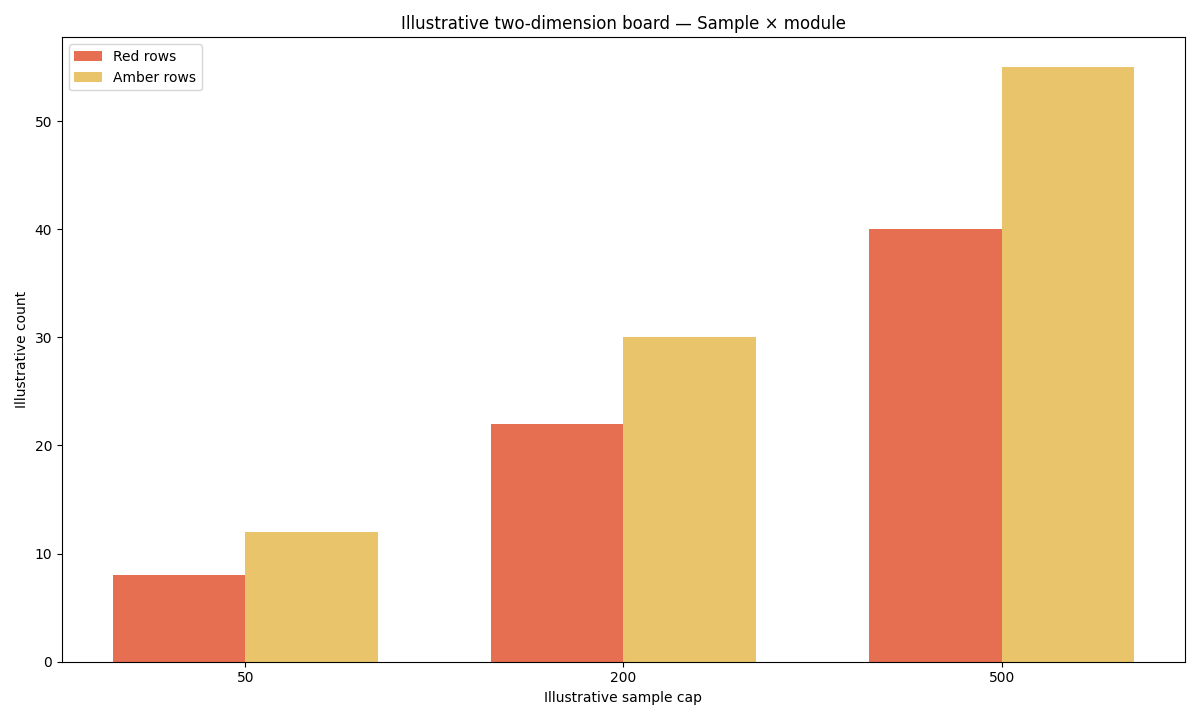
Figure: illustrative grouped bars — two dimensions, sample size × red-module share and red-status share. Not a Google score and not a customer lift.
How to read the grouped bars
Each cluster is a sample size. Each bar is a failure family. If red-status share grows as the draw grows, the 50-page smoke run was optimistic.
If your SEO audit tool run differs, trust your run. The figure teaches the axes.
Selection scorecard
Score each row 0–2 when someone asks whether an SEO audit tool is the right instrument today.
| Question | 0 | 1 | 2 |
|---|---|---|---|
| Do you have a public sitemap you trust? | No sitemap, or it lists admin URLs | Partial, one locale | Current, stratified |
| Is 50–500 the honest size? | You need a million-page walk | You might need a desktop crawl later | A cap is enough to start |
| Do you need eight modules on the sample? | Status codes alone, or a vanity 100 | You also want a later desktop file | Title through speed on the draw |
| Will red rows get an owner? | No owner | Shared inbox | Named owner |
| Will you re-sample after the fix? | Screenshot and done | Next quarter | Same cap, same week |
Under 6 means you want a desktop crawl or a one-URL board. 8–10 means set --pages and draw. The SEO audit tool is a slice plus eight lights, not a monument.
Failure modes that waste quota
The first failure is sampling a stale sitemap. Refresh the list, then run the SEO audit tool.
The second failure is treating 500 as a trophy. If 50 already proved the category template 404s, fix that template.
The third failure is asking for a credited write-up so you can avoid reading status codes. The write-up will still say 404 if the sample said 404.
The fourth failure is pasting a host that needs a staff cookie. Chrome can finish basic modules locally. Do not upload an admin URL and then complain about credits.
The fifth failure is chasing a competitor 100 because their SEO audit tool printed one. Ask which modules that 100 hid. Then draw your own 50.
Cluster guides beside this page
This page is the product boundary: 50–500 plus eight modules. Use the table as a routing sheet.
| Job you actually have | Guide to open next | What this page will not do |
|---|---|---|
| Name template buckets, then scale | SEO site audit | Finish the strata lesson |
| Defend the sample as a method | Sampled site audit | Restate every cap rule |
| Walk more of the graph later | SEO crawler | Replace a desktop crawl |
| Print an assignable file | SEO audit report | Draft the memo for you |
| Compare Frog without cloning it | Screaming Frog alternative | Claim feature parity |
Open one row when you have that job.
Sample fifty pages, then read eight modules
Point SEO Health at a public sitemap, cap the draw at 50–500, and fix red status codes plus repeating module failures before you buy a desktop walk.
Run SEO Health CheckerFrequently Asked Questions
Is this a million-page desktop crawl?
Bottom line: No. An SEO audit tool on this stack samples 50–500 sitemap URLs and scores eight modules. It is not Screaming Frog and not a million-page crawl. Use a desktop crawler later if the sample is clean and you still need the rest of the graph.
Do more pages cost more quota?
Bottom line: Yes. A larger draw spends more render quota. An optional deep write-up spends InfiniSynapse credits. Status codes on the sample do not require a login.
Do I need a login for status codes?
Bottom line: No. The sample and the eight lights run without an account. InfiniSynapse login and credits start only if you begin EEAT, visibility, GSC analysis, or a deep write-up on that draw.
When should I pay for a write-up?
Bottom line: When the table is confusing and a prose punch list would change the next ticket. Do not buy a write-up to avoid reading red rows the SEO audit tool already named.
Conclusion
An SEO audit tool is a 50–500 page sample plus eight modules, then a fix, then a second sample. Cap the draw. Sort status codes first. Spend credits only when a write-up would change the next ticket.
Keep the fetch graph in SEO Health. If you want the long task on that sample, start it on purpose from the InfiniSynapse web app after the red rows have owners. Until then, the useful number is --pages, not a monument.