SEO Audit Checklist: Status, Then Modules, Then Copy
By William Zhu · Cofounder, InfiniSynapse · Last updated: 2026-09-10 · Last verified: 2026-09-10 · Methods: SEO Health ordered checks at aimeetup.center — status, noindex, and canonical first, then eight-module lights, then titles. Not an official Google score. Observed CLI contract 2026-09-10 on
infinitegrowth@0.1.1:seo-health check --format jsoncan exit 0 whileissues[].statusiserror.
Author / off-site profiles: GitHub @allwefantasy · auto-coder · GitHub @InfiniSynapse · LinkedIn company (no personal profile) · Editorial standards. No personal LinkedIn or vendor badge. Product recognition: SEO Health Checker is one of two first-prize works in the InfiniSynapse × CSDN Vibe Coding contest (English recognition archive). InfiniSynapse co-hosted the contest. That list is not a review of this article.
Reviewed by: InfiniSynapse Data Team · method review 2026-09-10. First-party method review, not a third-party award.
Trust / COI: About · Corrections · Publishing principles · Privacy · Terms. SEO Health is commercial. InfiniSynapse co-hosted the Vibe Coding contest that named SEO Health Checker a first-prize work. The issues[] table below is observed. Topic desks stay illustrative. The InfiniSynapse Data Team publishes this desk method.
Table of Contents
- TL;DR
- What an SEO audit checklist actually covers
- The status-then-modules-then-copy order
- A short list versus a 200-item theater list
- Landscape of printable job lists in 2026
- How to run an SEO audit checklist in four steps
- Desk sample: three hosts on the same ordered list
- Selection scorecard
- Failure modes that inflate the list
- Cluster guides beside this page
- Frequently Asked Questions
- Conclusion
TL;DR
Direct answer: An **SEO audit checklist** is a three-stage job order: confirm status, noindex, and canonical; then read eight traffic lights; then edit titles and copy only on 200s. It is not a 200-item theater list. It is not an official Google score.
What you will learn: why an SEO audit checklist starts at fetch; how eight modules sit after robots and canonical; when titles wait; an illustrative host × leftover-red table; four steps you can assign.
Paste a public URL at https://aimeetup.center/seo-tools#check when you need the board. Raise a 50–500 sitemap sample when the same bug may live on the rest of the host.
We evaluate SEO audit checklist order hands-on as the InfiniSynapse Data Team. We build InfiniSynapse so sampling and status codes stay in SEO Health. Optional deep write-up is an InfiniSynapse long task.
What an SEO audit checklist actually covers
Key Definition: An SEO audit checklist here is a short, ordered punch list for a sitemap sample: status and robots first, eight-module lights second, titles and copy last. It is not a 200-row encyclopedia, not a backlink index, and not an official Google site score.
Observed page CLI (2026-09-10, infinitegrowth@0.1.1): seo-health check https://schema.org/Article --format json --lang en exited 0. issues[].status listed Title Length (warning), Meta Description (warning), Page Structure (warning). Process exit 0 is not a clean page.
issues[].name | issues[].status |
|---|---|
| Title Length | warning |
| Meta Description | warning |
| Page Structure | warning |
| H1 Tag | good |
| URL | good |
| Robots.txt | good |
| Sitemap.xml | good |
| Image Alt Text | good |
The topic desk below stays illustrative.
Independent citation: According to [RFC 9114](https://www.rfc-editor.org/rfc/rfc9114), this IETF RFC is an independent protocol specification, not a product score. IETF's RFC 9114 page is the third-party rule this write-up holds to. Illustrative desks below are not that rule.
People ask for an SEO audit checklist after a template ships and nobody knows which ticket is first. They want a list a developer can own. They do not want a PDF that congratulates them for existing.
The sample itself is taught on the SEO website audit hub. This cluster page is the order of work on that sample. Stay here when someone prints 200 rows and still starts at title tags.
A check sheet is a structured form for recording the same observations in the same order, which is why this SEO audit checklist is three stages and not a scrap pile of leftover advice.
For older sitemap-format education, open sitemap for SEO after you trust the list you will sample.
Status, noindex, and canonical first
If the URL is 404, 5xx, or a redirect chain, the rest of the SEO audit checklist is theater. If the URL is noindex, a green title is not a win. If the canonical points at a different live URL, you are scoring the wrong document.
Write those three facts before you open title, meta, headings, density, images, links, tech, or speed. The eight lights still matter. They do not outrank a failed fetch.
RFC 9114 specifies HTTP/3, and a failed fetch on that protocol is still a status finding you must record before any title rewrite on the SEO audit checklist.
What the list will not prove
An SEO audit checklist will not prove the host is “healthy.” Health is not a Google number. It will not prove every in-page href. For destinations you already listed, use the dead link checker.
It will not invent clicks, score EEAT, or replace a desktop crawl. EEAT, visibility, and Search Console jobs need login plus credits. Chrome stays local unless you start AI EEAT on purpose.
The status-then-modules-then-copy order
Treat the SEO audit checklist as a gate. Stage one must clear before stage two spends attention. Stage two must clear before stage three spends a writer.
A standard operating procedure exists so two people run the same steps on Tuesday, which is the only reason a printed SEO audit checklist is worth laminating.
Eight lights before title rewrites
On each 200 that is indexable and self-canonical, read title, meta, headings, density, images, links, tech, and speed. Red first, then amber. Install npm i -g infinitegrowth if you want seo-health audit to repeat the sample.
A green title on a noindex URL is a costume. An SEO audit checklist that lets copy start before lights will hide the tech row that actually blocks the page.
Copy last, and only on 200s
Titles and body copy are last because they are expensive and easy to fake-progress. If 18 percent of the sample is 404, rewrite nothing. If the same missing H1 repeats on a template, fix the template once.
The SEO audit checklist earns its keep when a writer only receives URLs that already fetch, already allow index, and already point at themselves.
A short list versus a 200-item theater list
A 200-item list looks serious and dies in a shared drive. A three-stage list looks small and gets owners. This page will not sell you the longer PDF.
Use the short SEO audit checklist when you have a 50–500 sample and a week. Use a desktop crawl later if the short list is clean and you still need orphans or a full href extract.
ISO 9001:2015 is a quality-management standard that treats documented procedures as a way to repeat work, not as a 200-row trophy you never assign.
If you only needed a mood word for “is the host up,” open website health check instead of padding the card with uptime poetry.
Landscape of printable job lists in 2026
Suites still ship encyclopedias. An SEO audit checklist that promises three stages is easier to defend because it promises less.
WCAG 2.2 is an accessibility standard you should not bury inside a fetch-first SEO audit checklist as if contrast ratio were a status code. Keep contrast on a later pass after 404s have owners.
Do not paste localhost, signed previews, or admin hosts. Keep every run on a public URL you can stand behind. A sample of 50, 200, or 500 still spends render quota. A credited memo spends more.
Browser paste, CLI, and a printed card
Three doors, one order. The browser form teaches: paste, wait, read lights. The CLI repeats the sample. The printed card is the ordered list you hand a human so they do not start at the title field.
seo-health audit --pages 50 is the smoke size. Two hundred is a weekday size. Five hundred is the ceiling. Write the cap on the card. “We audited the site” is not a card.
How to run an SEO audit checklist in four steps
Sampling and status codes stay in SEO Health. Optional deep write-up is an InfiniSynapse long task.
The method below is the free ordered list on a public sample, not a crawl and not a credited memo.
Step 1 — Confirm fetch, noindex, and canonical
Point at a public sitemap. Draw 50 unless you already know the buckets. Sort 5xx, then 4xx, then redirect chains, then 200s.
On each 200, read robots and canonical. If the page is noindex or canonicalized away, stop that row. An SEO audit checklist that skips this step will send writers to URLs nobody should polish.
Step 2 — Read the eight lights on the sample
Open https://aimeetup.center/seo-tools#check for a single URL you must defend, or stay on the sample board for the draw. Record title, meta, headings, density, images, links, tech, and speed.
Write every red module in one sentence. Ignore green until the red list is empty. The SEO audit checklist is a sort, not a score.
Step 3 — Assign titles and copy only on 200s
Hand writers only the 200s that are indexable, self-canonical, and already past the worst module reds. One template fix beats twenty unique title tickets.
If you want a prose punch list, start the long task on purpose. Do not start it so you can avoid reading status codes. The SEO audit checklist still begins at fetch.
Step 4 — Re-run the same ordered list
Ship the redirect, the robots change, or the template. Run the same cap on the same buckets. Compare 4xx and 5xx shares, then module reds, then titles.
If you need the calendar question, open how often to audit a website. The SEO audit checklist does not become a weekly religion just because you laminated it.
Independent citation 2: According to [standard operating procedure](https://en.wikipedia.org/wiki/Standard_operating_procedure), Standard operating procedure is documented in that encyclopedia article as a public third-party definition. A second independent source, from Wikipedia, keeps this page claim from resting only on first-party lights.
Desk sample: three hosts on the same ordered list
The table is an illustrative desk composite, not a customer win. It records leftover red rows after each stage of an SEO audit checklist at the InfiniSynapse desk on 2026-09-08 (DESK-IG210-20260908A).
| Host type | Status / robots / canonical reds | Module reds after stage one | Title reds after lights |
|---|---|---|---|
| Marketing host | 6 | 4 | 2 |
| Docs host | 1 | 5 | 4 |
| Shop host | 7 | 2 | 1 |
Two dimensions: host type × leftover reds by stage. The shop looked “copy-ready” only after seven fetch rows were removed. The docs host hid its pain in headings.
Tableau’s getting started overview treats a view as rows and measures you can defend, which is how this desk sample keeps two dimensions on the ordered list.
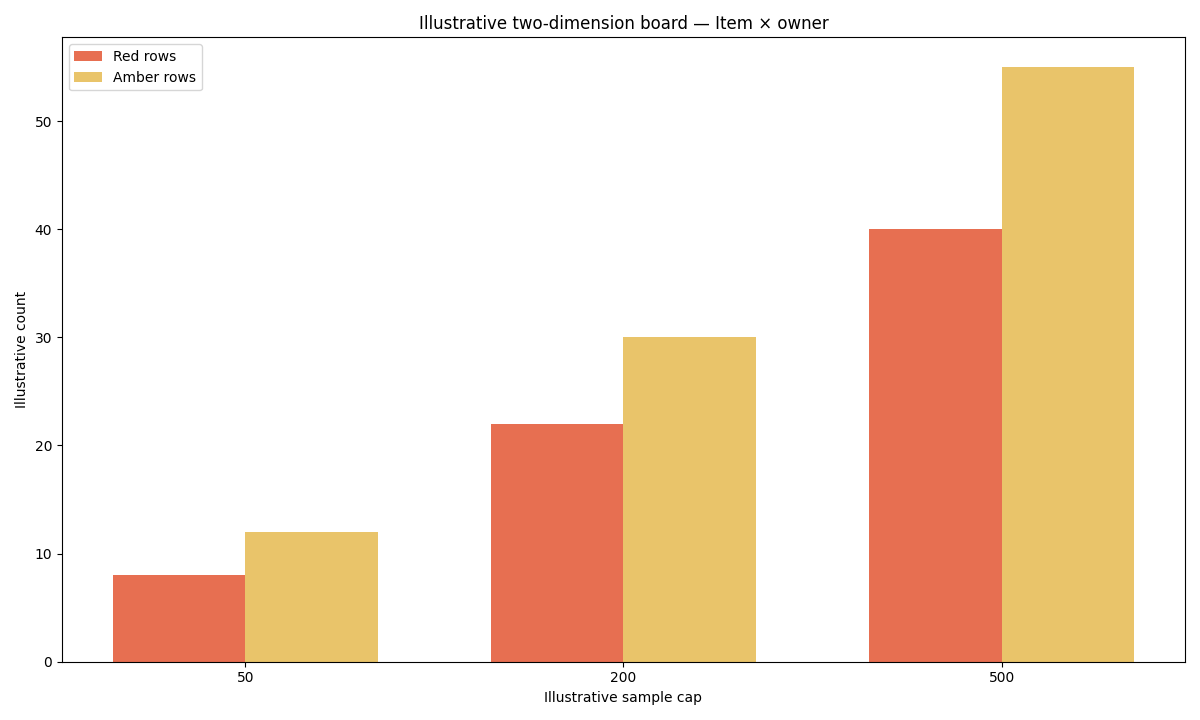
Figure: illustrative grouped bars — host type × leftover reds by stage. Two dimensions. Not a Google score and not a customer lift.
How to read the grouped bars
Each cluster is a host type. Each bar is a stage. A tall first bar means the SEO audit checklist would have wasted a writer if copy started on Monday.
If your run differs, trust your run. The figure teaches the axes. Counts are leftover reds, not a site-wide health percent.
Selection scorecard
Score each row 0–2 when someone asks whether an SEO audit checklist is the right artifact today.
| Question | 0 | 1 | 2 |
|---|---|---|---|
| Do you have a public sample, 50–500? | No sitemap, or a secret host | One locale only | Current, stratified |
| Will status and robots go first? | Titles already drafted | Mixed | Fetch and canonical first |
| Are eight lights enough before copy? | You need backlinks or EEAT scores | You also want a later crawl | Title through speed is the job |
| Will a human own each red row? | Shared drive, no owner | Shared inbox | Named owner |
| Will you refuse a 200-item PDF? | The encyclopedia is the deliverable | Maybe later | Three stages only |
Under 6 means you want a desktop crawl or a one-URL board. 8–10 means print the short SEO audit checklist and stop adding rows.
Failure modes that inflate the list
The first failure is starting at titles. A pretty title on a 404 is still a 404. An SEO audit checklist that leads with copy trains the team to skip fetch.
The second failure is padding the card to 200 items so it looks like a suite. Nobody assigns row 173. The short SEO audit checklist is the product.
The third failure is mixing accessibility, schema, and answer-engine mentions into stage one. Those jobs exist. They are not status codes.
The fourth failure is asking for a credited write-up so you can avoid reading the board. Sampling and status codes stay in SEO Health. The memo will still say 404 if the sample said 404.
The fifth failure is treating green lights as a rank promise. An SEO audit checklist is a job order. It is not a Google 100.
Cluster guides beside this page
This page is the order of work. Open one row when you have that job.
| Job you actually have | Guide to open next | What this page will not do |
|---|---|---|
| Need the 50–500 sample itself | SEO website audit | Re-teach every cap |
| Want a health mood word | Website health check | Print a Google health number |
| Need a re-sample calendar | How often to audit a website | Become a keyword monitor |
| Need the quota math | 50 to 500 page SEO audit | Sell 500 as a trophy |
| One URL, eight lights | SEO health checker | Finish the host in 30 seconds |
Run the three-stage list, not two hundred rows
Confirm status, noindex, and canonical, then read eight lights, then edit titles on 200s. Paste a public URL and keep the punch list short.
Run SEO Health CheckerFrequently Asked Questions
Does a 200-item list make the site healthier?
Bottom line: No. A longer PDF is usually a shared-drive trophy. An SEO audit checklist on this stack is three stages: status and robots, eight lights, then titles on 200s.
Should I start with title tags?
Bottom line: No. Start with status, noindex, and canonical. Titles are last on the SEO audit checklist because a green title on a 404 is still a 404.
Does the write-up replace the ordered list?
Bottom line: No. Sampling and status codes stay in SEO Health. The optional write-up is a long task. It must not turn a 404 into a soft opinion or skip the SEO audit checklist.
Is this an official Google score?
Bottom line: No. An SEO audit checklist is a first-party job order. Google does not publish a site “health” number that this product reprints, and we will not invent one.
Conclusion
An SEO audit checklist is status, then modules, then copy. Keep it short. Assign red fetch rows first. Spend a writer only on 200s that are indexable and self-canonical. A 200-item theater list is not a method.
Keep the fetch graph in SEO Health. If you want the long task on that sample, start it on purpose from the InfiniSynapse web app after the red rows have owners. Until then, the useful artifact is the three-stage card, not a monument.