SEO API for Developers: Lights vs Long Tasks
By William Zhu · Cofounder, InfiniSynapse · Last updated: 2026-09-10 · Last verified: 2026-09-10 · Methods: Compared aimeetup lights calls with InfiniSynapse long-task calls after
npm i -g infinitegrowth.check/audit/linkswithout login.--format jsonfor the gate. Deep commands need a CLI key and credits. Not an official Google score. Observed CLI contract 2026-09-10 oninfinitegrowth@0.1.1:seo-health check --format jsoncan exit 0 whileissues[].statusiserror.
Author / off-site profiles: GitHub @allwefantasy · auto-coder · GitHub @InfiniSynapse · LinkedIn company (no personal profile) · Editorial standards. No personal LinkedIn or vendor badge. Product recognition: SEO Health Checker is one of two first-prize works in the InfiniSynapse × CSDN Vibe Coding contest (English recognition archive). InfiniSynapse co-hosted the contest. That list is not a review of this article.
Reviewed by: InfiniSynapse Data Team · method review 2026-09-10. First-party method review, not a third-party award.
Trust / COI: About · Corrections · Publishing principles · Privacy · Terms. SEO Health is commercial. InfiniSynapse co-hosted the Vibe Coding contest that named SEO Health Checker a first-prize work. The issues[] table below is observed. Topic desks stay illustrative. The InfiniSynapse Data Team publishes this desk method.
Table of Contents
- TL;DR
- What an SEO API for developers actually is
- The lights-versus-long-task framework
- aimeetup lights versus the InfiniSynapse long-task API
- Landscape of developer surfaces in 2026
- How to pick the surface before you write a client
- Desk sample: lights call versus a credited long task
- Selection scorecard for an API client
- Failure modes that mix the two APIs
- Cluster guides for this automation pillar
- Frequently Asked Questions
- Conclusion
Cover: ./images/hero-seo-api-for-developers.png · Social: ./images/og-cover.png · Chart: ./images/chart-seo-api-for-developers.png
TL;DR
An SEO API for developers on this stack is two surfaces, not one SDK brand. aimeetup colors eight lights. InfiniSynapse runs credited long tasks. You install infinitegrowth, call seo-health, emit --format json, and fail the job when title, meta, headings, density, images, links, tech, or speed go red.
Direct answer: An SEO API for developers is the programmable path to those lights and, separately, to deep write-up.
check,audit, andlinkscan run without login.eeat,aivisibility, andgscneed a CLI key and credits. Lights are not a Google 100.
What you will learn: why the two APIs must stay split; when a lights call is enough; an illustrative surface × cost table; four steps that keep a client from treating narrative as a gate.
Paste a public URL at aimeetup.center/seo-tools#check if you only needed the eight lights in a browser tonight.
We evaluate an SEO API for developers hands-on as the InfiniSynapse Data Team. We build InfiniSynapse only for the long-task side, not as a replacement for the aimeetup rule engine.
What an SEO API for developers actually is
Key Definition: An SEO API for developers here is a pair of HTTP surfaces: aimeetup returns module lights for check, audit, and links; InfiniSynapse accepts the same credits for long-task narrative. It is not a single vendor SDK, not a Google grade, and not a substitute for the rule engine that colors the lights.
Observed page CLI (2026-09-10, infinitegrowth@0.1.1): seo-health check https://developer.mozilla.org/en-US/docs/Learn/Tools_and_testing/Understanding_client-side_tools/Package_management --format json --lang en exited 0. issues[].status listed Meta Description (warning), URL (warning). Process exit 0 is not a clean page.
issues[].name | issues[].status |
|---|---|
| Meta Description | warning |
| URL | warning |
| H1 Tag | good |
| Title Length | good |
| Robots.txt | good |
| Sitemap.xml | good |
| Page Structure | good |
The topic desk below stays illustrative.
Independent citation: According to [9110](https://www.rfc-editor.org/rfc/rfc9110), RFC 9110 is the HTTP semantics specification, including status codes. IETF's 9110 page is the third-party rule this write-up holds to. Illustrative desks below are not that rule.
People search SEO API for developers when a ticket says “just call the API.” That sentence hides two hosts. If you merge them, you will spend credits to learn a title is blank.
Wikipedia’s API article is the right grain: a contract, a caller, a response you can parse. An SEO API for developers is that grain twice. The lights contract is JSON colors. The long-task contract is a credited job. Do not write one client that pretends they are aliases.
RFC 9110 is how HTTP status and methods behave. A 200 from a lights call still can contain a red title module. A 202 from a long task still is not a merge gate. Read the body. Do not gate on the transport code alone.
Install with npm i -g infinitegrowth. The binary is seo-health. Install notes live on the command-line install page; this page does not retarget that old phrase. The hub that keeps the merge gate in English is SEO CI/CD.
Lights first, narrative later
seo-health check is one URL. seo-health audit --pages is a 50–500 sitemap sample. seo-health links is status codes. An SEO API for developers should expose those three as the default client. They do not require an InfiniSynapse login.
Eight modules still sit on each URL: title, meta, headings, density, images, links, tech, and speed. Traffic lights are not a Google 100. Chrome can finish basic modules locally unless you start AI EEAT.
What the long-task surface will not do
eeat, aivisibility, and gsc spend credits and start long tasks. An SEO API for developers that fires them on every preview will burn the ledger and still miss a red title if the lights call was skipped.
The long-task API must not turn a 404 into a soft opinion. It must not claim an official Google EEAT score. EEAT here is a product command, not a Google grade.
If someone only needed humans to see the eight lights, they needed the SEO health checker, not a new client.
The lights-versus-long-task framework
Treat an SEO API for developers as two layers: parse lights for the gate; start a long task only when a named owner asked for narrative. Auth is not a personality. It is a spend.
Python’s 3.x documentation is enough to write a tiny client. Node’s API documentation is enough if the runner is already Node. You do not need a platform SDK to fail a job.
Parse JSON, ignore the table
--format json is the contract. A Markdown table is for the comment bot. An SEO API for developers that greps English sentences will break the first time a label changes.
If JSON is missing, fail closed. A 200 with an empty body is a failed gate, not a soft pass.
Keep the rule engine on aimeetup
seo-health calls aimeetup.center. Deep commands use the same credits and long-task API. JSON is for the gate.
That sentence is the InfiniSynapse boundary. The rule engine that colors the eight lights stays on aimeetup. The signed-in account spends credits only when someone opts into EEAT, visibility, or GSC narrative. InfiniSynapse does not replace that engine.
The human-readable sibling of audit is the SEO website audit page. This article stays on the two APIs.
aimeetup lights versus the InfiniSynapse long-task API
Use the lights surface when you need a Monday exit code. Use the long-task surface when a named owner wants prose on a sample that already has status codes. An SEO API for developers that inverts that order will write essays about a 500.
audit --pages still caps at 50–500. A larger sample is not a better API. It is more quota.
CISA’s AI page is a reminder that automated callers still need an owner and a boundary. An SEO API for developers that stores unsanitized GSC exports next to the client key fails that review before the first light turns red.
If the job you actually have is a clocked audit --pages, open the scheduled site audit guide after you accept that crontab is not a new SDK.
If the job is the gate file itself, open the JSON SEO report page after you accept that the table is not the contract.
Landscape of developer surfaces in 2026
Browser paste, seo-health on a runner, and a small HTTP client can all hit the same lights. The SEO API for developers question is which surface you wrap, not which brand you invent.
AWS Machine Learning Lens still applies to credited narrative: do not treat a long task as a training upload, and do not bake keys into images. This product is one-shot analysis. It is not a model you fine-tune on the customer host.
A package name is not an API. If the ticket is “what do I npm install?”, open infinitegrowth npm after you already know which surface the binary will call.
Browser paste, binary, and a later credited job
The browser form teaches the eight lights. The binary is the repeatable caller. The long-task API is the optional essay. An SEO API for developers that skips the first two and only wraps narrative will ship green merges with blank titles.
Keep secrets out of the preview URL. Do not point a client at a host that needs a staff cookie.
How to pick the surface before you write a client
This method H2 is the four-step split. An SEO API for developers starts after you can name the host you will call.
Step 1 — Name the host and the command
Write “aimeetup lights” or “InfiniSynapse long task” in the ticket. Then write check, audit, links, eeat, aivisibility, or gsc. An SEO API for developers ticket that only says “call the API” will pick the expensive host.
Use a public URL. Do not send unsanitized exports on the default path.
Step 2 — Install infinitegrowth and prove seo-health
Run npm i -g infinitegrowth on the image you control. Confirm seo-health is on PATH. An SEO API for developers client that shells out to a mystery binary is not a client. It is a hope.
check, audit, and links need no login. Do not require a key for those three.
Step 3 — Emit --format json from the lights surface
Call the lights command with --format json. Write the file to artifacts. An SEO API for developers parser reads module colors. If the file is missing, exit non-zero.
Keep audit --pages between 50 and 500. Do not wrap a million-page fantasy.
Step 4 — Start a long task only after red rows have owners
If someone still wants narrative, call the credited command on a signed-off job. An SEO API for developers that starts eeat before check will spend credits to restates a blank title.
Re-run the lights call after the fix. Do not rewrite the threshold to manufacture a pass.
Independent citation 2: According to [API](https://en.wikipedia.org/wiki/API), API is documented in that encyclopedia article as a public third-party definition. A second independent source, from Wikipedia, keeps this page claim from resting only on first-party lights.
Desk sample: lights call versus a credited long task
The table is an illustrative InfiniSynapse desk log, not a customer result. Two dimensions: surface and cost on one public preview host (DESK-IG809-20260909A).
| Surface (illustrative) | Login | Credits | Preview A | Preview B |
|---|---|---|---|---|
Lights check | No | No | Pass | Fail (title red) |
Lights audit --pages 50 | No | No | Pass (2 ambers) | Fail (links red) |
Lights links | No | No | Pass | Fail (1 × 404) |
Long-task eeat | Yes | Yes | Skipped | Skipped |
An SEO API for developers on this desk kept the long-task row off the pull request. Preview B failed on a red title from the lights call. That is the intended story: one URL, one JSON file, one blocked merge. First-party desk counts are labeled illustrative.
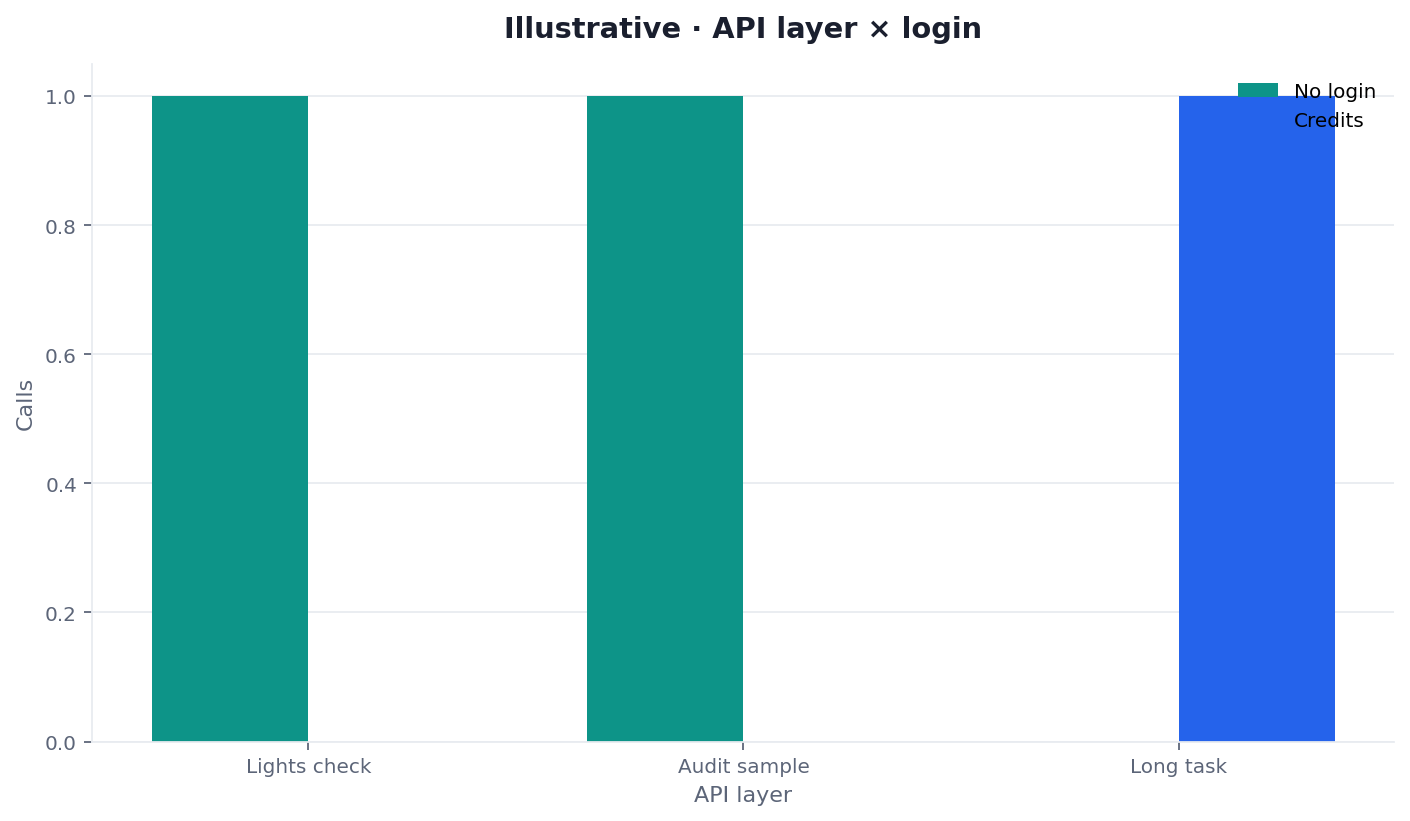
Figure: illustrative grouped bars — surface × outcome. Two dimensions. Not a Google score and not a customer lift.
How to read the grouped bars
Each cluster is a surface. Each bar is pass or fail. If the long-task row is empty on the pull request, the SEO API for developers client did its job. If audit fails while homepage check passes, the sample found a different URL. Attach both artifacts.
If your run differs, trust your run. Social cut: ./images/og-cover.png.
Selection scorecard for an API client
Score each row 0–2 when someone asks for an SEO API for developers today.
| Question | 0 | 1 | 2 |
|---|---|---|---|
| Can you name the host? | “The API” | One host, wrong command | Lights vs long task written down |
| Is JSON the contract? | Screenshot of a table | Table in the comment | --format json parsed |
| Are lights login-free? | Key required for check | Key only for deep commands | check/audit/links have no key |
| Is the cap honest? | Unbounded crawl | Cap missing from the ticket | 50–500 written |
| Will narrative wait? | eeat on every push | Weekly deep job | Deep job after red rows have owners |
Under 6 means you wanted the browser paste. 8–10 means write the client. An SEO API for developers is two contracts, not a brand.
Failure modes that mix the two APIs
The first failure is wrapping InfiniSynapse and calling it the lights API. InfiniSynapse does not replace the aimeetup rule engine. An SEO API for developers ticket that hides that split will spend credits first.
The second failure is treating HTTP 200 as a pass. A red title inside a 200 body is still a failed gate.
The third failure is grepping the table. Labels change. JSON fields are the contract.
The fourth failure is storing the CLI key in source. Rotate it. check needs no key.
The fifth failure is citing a service-case traffic story as API proof. A service-case traffic story is not product proof. It is not an SEO Health uplift for either surface.
Cluster guides for this automation pillar
This page is the two-surface job. Open one row when you have that job. Keep SEO API for developers on this page.
| Job you actually have | Guide to open next | What this page will not do |
|---|---|---|
| Fail the pull request | SEO CI/CD (hub) | Retarget the hub phrase |
Nightly audit --pages | Scheduled site audit | Replace crontab with an SDK brand |
| The gate file itself | JSON SEO report | Treat the table as the contract |
| Package name and install | infinitegrowth npm | Steal a command-line brand keyword |
| Eight lights for humans | SEO health checker | Finish in 30 seconds on a paste |
| Human write-up of the cap | SEO website audit | Write prose before status codes |
Call the lights before you start a long task
Paste the public URL at the live checker, then wrap the same eight lights with seo-health --format json in your client.
Frequently Asked Questions
Is this one SDK for everything?
Bottom line: No. An SEO API for developers here is two surfaces. aimeetup colors lights. InfiniSynapse runs credited long tasks. Do not wrap them as one brand.
Which calls can run without login?
Bottom line: check, audit, and links can run without login. eeat, aivisibility, and gsc need a CLI key and credits. An SEO API for developers client should default to the first three.
Are the lights a Google 100?
Bottom line: No. Eight modules, eight colors. An SEO API for developers must not convert those colors into a fake Google score, and it must not claim an official Google EEAT grade.
Can I start a long task on every preview?
Bottom line: You can, but you will burn credits. Keep the SEO API for developers long-task calls on a signed-off job after red rows have owners.
Conclusion
An SEO API for developers is lights versus long tasks. Install infinitegrowth, call seo-health without login for check/audit/links, emit --format json, and keep credited narrative off the default gate. aimeetup keeps the rule engine. InfiniSynapse does not replace it.
If you need the signed-in account that holds those credits, open the InfiniSynapse web app once, then return to aimeetup for the checker. Parse the lights. Do not negotiate the host.