 InfiniSynapse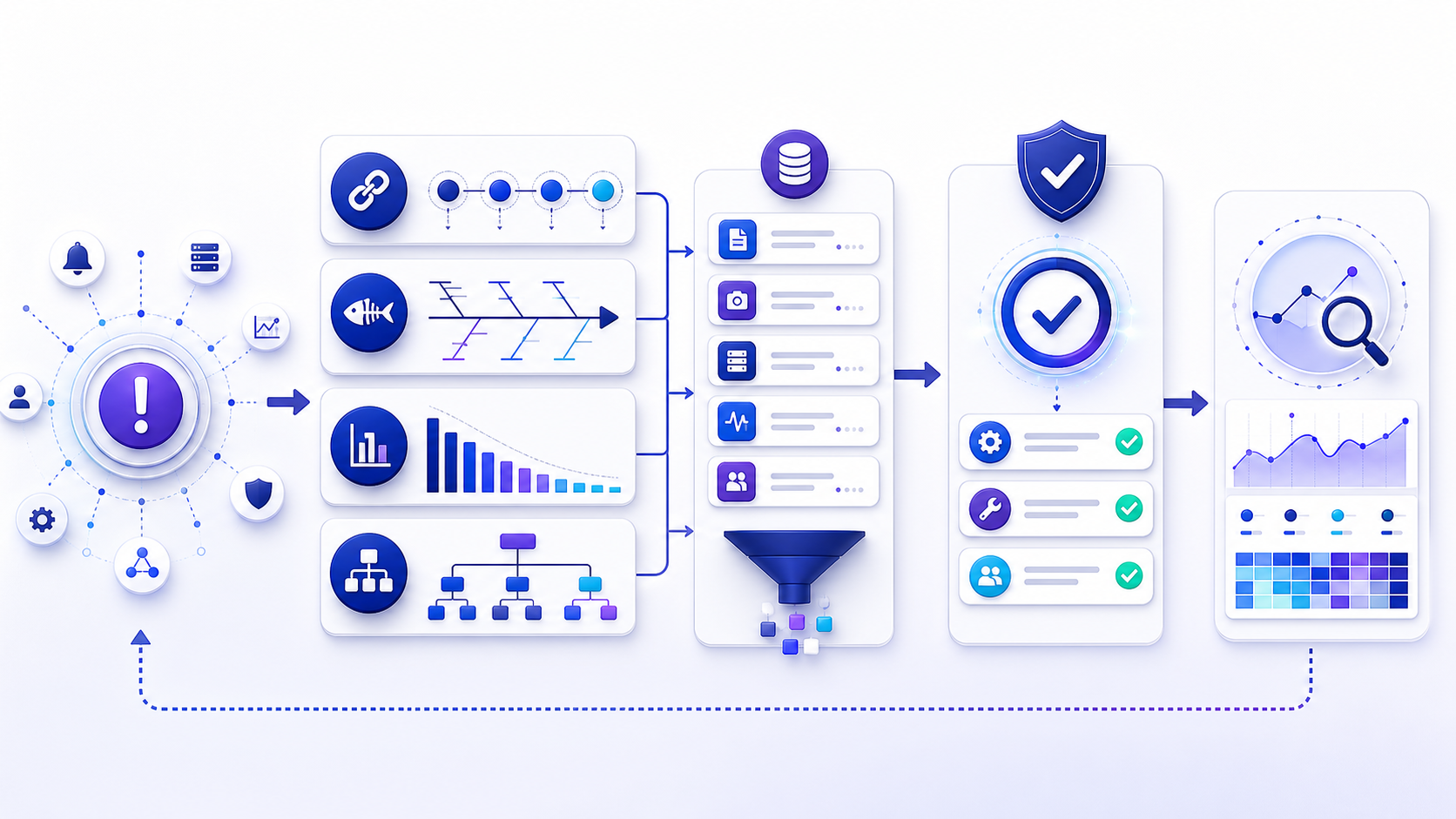
What are RCA tools?什么是 RCA tools 根因分析工具?
Place this specific workflow in context with the anomaly detection and root cause analysis guide, which connects the definitions, alternatives, validation steps, and related implementation guides. See what product categories detect anomaly signals before you open a tool list.
可通过异常检测与根因分析指南理解本专题在整体流程中的位置;该指南串联了定义、替代方案、验证步骤与相关实施文章。
RCA tools are structured methods and software used to move from an observed problem to evidence-supported causes, corrective actions, and verification. Common choices include 5 Whys, fishbone diagrams, Pareto analysis, fault tree analysis, timelines, change analysis, barrier analysis, and case-management software. No tool proves a cause by itself: it organizes questions, evidence, decisions, or collaboration.
RCA tools 是用于把已观察到的问题推进到有证据支持的原因、纠正措施和效果验证的一组结构化方法与软件。常见选择包括五问法、鱼骨图、帕累托分析、故障树、时间线、变更分析、屏障分析以及调查管理软件。任何工具都不能自行证明原因;它们只是组织问题、证据、决策或协作。
Search results for “RCA tools” mix two intentions: people want a method they can use immediately, and they want software that preserves evidence, diagrams, assignments, and follow-up. This guide covers both. It also separates brainstorming from confirmation, because a plausible story is not a verified root cause.
“RCA tools”的搜索结果混合了两类意图:一类用户希望立即使用某种分析方法,另一类用户希望寻找能够保存证据、图表、任务和跟进记录的软件。本指南同时覆盖两者,并明确区分头脑风暴与原因确认,因为听起来合理的故事并不等于已经验证的根因。
Prepare the evidence before choosing an RCA tool选择 RCA 工具前先准备证据
Start with a neutral problem statement: what happened, where, when, how large the deviation was, who or what was affected, and what is outside scope. Avoid embedding a cause such as “operator error” in the statement. Freeze volatile evidence when appropriate, preserve original timestamps and units, and record who collected each item.
首先编写中性问题陈述:发生了什么、在哪里、何时发生、偏差有多大、谁或什么受到影响,以及哪些内容不在范围内。不要在陈述中提前写入“操作员错误”之类的原因。必要时冻结易消失证据,保留原始时间戳和单位,并记录每项材料的采集人。
Incident description, baseline or expected state, event timeline, measurements, logs or records, recent changes, interviews, and prior similar cases.
事件描述、基线或预期状态、事件时间线、测量值、日志或记录、近期变更、访谈以及历史相似案例。
Scope, decision owner, reviewers, access controls, retention requirements, due date, risk classification, and the evidence standard required to close the case.
调查范围、决策负责人、复核人、访问权限、保留要求、截止日期、风险等级以及结案所需证据标准。
For safety, healthcare, legal, financial, or regulated decisions, use the organization’s approved procedure and qualified reviewers. A general RCA guide does not replace incident-command, clinical, engineering, quality, or regulatory obligations.
涉及安全、医疗、法律、金融或监管决策时,应使用组织批准的程序和合格复核人员。通用 RCA 指南不能替代事件指挥、临床、工程、质量或监管义务。
Compare RCA tools by the problem they solve按问题类型比较 RCA tools
| Tool工具 | Best use适用情况 | Output输出 | Main limit主要局限 |
|---|---|---|---|
| 5 Whys | Narrow, mostly linear problem with process knowledge较窄、近似线性且参与者熟悉流程的问题 | Traceable causal chain可追踪因果链 | Can stop early or follow one favored story可能过早停止或只追随偏好的解释 |
| Fishbone diagram鱼骨图 | Multi-cause problem needing cross-functional exploration需要跨团队探索的多原因问题 | Categorized hypothesis map分类候选原因图 | Brainstormed branches are not evidence头脑风暴分支不是证据 |
| Pareto analysis帕累托分析 | Prioritizing frequent or costly categories按频次或成本确定类别优先级 | Ranked contribution chart贡献度排序图 | Prioritizes where to look, not why it happened说明先查哪里,不直接说明为何发生 |
| Fault tree analysis故障树分析 | Logic-driven, safety-critical, multi-path failure逻辑驱动、安全关键、多路径故障 | AND/OR failure logicAND/OR 故障逻辑 | Requires system expertise and disciplined assumptions需要系统专家与严格假设 |
| Timeline and change analysis时间线与变更分析 | Incidents with deployments, configuration, staffing, or environment shifts涉及发布、配置、人员或环境变化的事件 | Before/after evidence and temporal sequence变更前后证据与时序 | Temporal order alone does not prove causation时间先后本身不能证明因果 |
| Barrier analysis屏障分析 | Controls that failed, were absent, or were bypassed控制措施失效、缺失或被绕过 | Prevention and detection control gaps预防与检测控制缺口 | Needs an accurate control model依赖准确的控制模型 |
These methods are complementary. A team might use Pareto analysis to choose a defect family, a fishbone diagram to map hypotheses, 5 Whys to deepen one supported branch, and a fault tree or barrier analysis when interactions and safeguards matter. The sequence should follow evidence, not a ritual requirement to use every tool.
这些方法可以互补使用。团队可先用帕累托分析选择缺陷类别,再用鱼骨图梳理候选原因,用五问法深入某个有证据支持的分支;当交互关系和安全屏障重要时,再使用故障树或屏障分析。顺序应由证据决定,而不是仪式化地把每种工具都使用一遍。
A repeatable RCA tools workflow可重复执行的 RCA tools 工作流
- Define and bound the problem.定义并限定问题。State the observed gap, affected process, start and end time, impact, and exclusions. Assign a case owner and evidence custodian.说明已观察到的偏差、受影响流程、起止时间、影响和排除项,并指定调查负责人和证据保管人。
- Build the timeline and evidence register.建立时间线与证据登记表。Link each assertion to a measurement, record, interview, photograph, log, or controlled observation. Mark missing and conflicting evidence.把每项判断链接到测量、记录、访谈、照片、日志或受控观察,并标注缺失与冲突证据。
- Choose the primary method.选择主要方法。Match the method to linearity, number of contributors, system logic, data availability, consequences, and required review.根据线性程度、影响因素数量、系统逻辑、数据可用性、后果和复核要求选择方法。
- Generate competing hypotheses.生成相互竞争的假设。Separate direct cause, contributing condition, failed control, detection gap, and organizational factor. Include an explicit “not yet known” state.区分直接原因、促成条件、失效控制、检测缺口和组织因素,并保留“尚不确定”状态。
- Test and eliminate.检验并排除。Ask what evidence each hypothesis predicts, inspect counterexamples, reproduce the condition when safe, and document why alternatives were rejected.明确每个假设应预测何种证据,检查反例,在安全时复现条件,并记录排除其他解释的理由。
- Correct, verify, and monitor.纠正、验证并监控。Assign actions to confirmed causes or control gaps, define success measures and side-effect checks, then monitor for recurrence over a meaningful window.针对已确认原因或控制缺口分配措施,定义成功指标和副作用检查,并在有意义的时间窗口内监控复发。
Example: investigating a recurring data-pipeline delay示例:调查反复出现的数据管道延迟
Hypothetical example: a daily pipeline normally finishes before 06:00 but exceeded that target on four Mondays. The team first writes the problem without assuming a database fault. A timeline shows the delay begins after a weekend source export. Pareto analysis places most excess runtime in one ingestion stage; a fishbone session maps data volume, schema, infrastructure, scheduling, and process hypotheses.
假设示例:某每日数据管道通常在 06:00 前完成,但连续四个星期一超时。团队先在不假设数据库故障的前提下写明问题。时间线显示延迟始于周末源系统导出之后;帕累托分析把大部分额外耗时定位到一个摄取阶段;鱼骨图会议从数据量、模式、基础设施、调度和流程等类别梳理候选原因。
Logs show that one file changed from incremental to full export. The team tests competing explanations: network throughput remained normal, compute capacity had headroom, and replaying the full file reproduced the delay while an incremental file did not. The verified finding is not merely “the file was large.” It includes the upstream configuration change, the absent size guardrail, and the alert that detected lateness only after the service target was missed.
日志显示其中一个文件从增量导出变为全量导出。团队继续检验其他解释:网络吞吐正常、计算容量仍有余量;回放全量文件可复现延迟,而增量文件不会。最终结论不能只写“文件太大”,还应包括上游配置变更、缺失的文件大小防护以及只能在服务目标已经错过后才发现迟延的告警缺口。
Corrective actions therefore restore incremental export, add a maximum-size preflight check, and alert on abnormal input growth before ingestion. Success is measured across subsequent Monday runs, with data completeness checked so a faster pipeline does not silently drop records. The numbers and system are illustrative, not an InfiniSynapse customer or performance claim.
因此,纠正措施包括恢复增量导出、增加最大文件大小预检,并在摄取前对异常输入增长告警。团队在后续多个星期一运行中验证效果,同时检查数据完整性,避免为了提速而静默丢失记录。此处数字与系统仅用于说明,不代表 InfiniSynapse 客户案例或性能声明。
How to evaluate RCA software and AI assistance如何评估 RCA software 与 AI 辅助分析
RCA software should reduce coordination loss without turning an investigation into a form-filling exercise. Evaluate the product against the work your team must preserve and review, not the number of diagram templates on a sales page.
RCA 软件应减少协作损耗,而不是把调查变成填写表格的流程。评估重点应是团队必须保存和复核的工作,而不是销售页面上模板数量的多少。
| Criterion标准 | Questions to test需要测试的问题 |
|---|---|
| Evidence traceability证据可追踪性 | Can every claim link to its source, collector, timestamp, and version?每项判断能否链接到来源、采集人、时间戳和版本? |
| Method flexibility方法灵活性 | Can teams combine timelines, 5 Whys, cause maps, tests, and actions without forcing one template?团队能否组合时间线、五问法、原因图、检验与措施,而不被一种模板限制? |
| Workflow and control流程与控制 | Are owners, approvals, due dates, permissions, audit history, and reopening supported?是否支持负责人、审批、截止日期、权限、审计历史与重新开启? |
| Integration集成 | Can the software reference relevant metrics, logs, files, records, and operational systems without losing provenance?软件能否引用相关指标、日志、文件、记录和业务系统,同时保留来源? |
| Verification验证 | Can success criteria, baseline, follow-up measurements, side effects, and recurrence be tracked?能否跟踪成功标准、基线、后续测量、副作用和复发? |
AI root cause analysis can accelerate evidence retrieval, cluster similar incidents, summarize timelines, or rank hypotheses. Treat generated explanations as leads. Require citations to source material, make uncertainty visible, restrict sensitive data appropriately, and keep a human decision owner. Correlation, feature importance, or fluent text may be useful signals, but none establishes causal responsibility alone.
AI 根因分析可以加速证据检索、聚类相似事件、总结时间线或排序候选原因,但生成的解释只能作为线索。系统应引用来源材料、显示不确定性、适当限制敏感数据,并保留人工决策负责人。相关性、特征重要性或流畅文字都可能是有用信号,但任何一种都不能单独确定因果责任。
Analyze RCA evidence across connected data and files跨关联数据与文件分析 RCA 证据
Prepare a scoped case folder, stable record IDs, a timeline, relevant measurements, logs, documents, source references, and candidate questions. InfiniSynapse is an AI-powered workspace for analysis across connected databases, files, documents, audio, and video; it is not presented here as a dedicated certified RCA package. Use it to explore supporting evidence and relationships, then document and verify consequential findings through your approved process.
请准备范围明确的案件文件夹、稳定记录 ID、时间线、相关测量、日志、文档、来源引用和候选问题。InfiniSynapse 是用于分析关联数据库、文件、文档、音频和视频的 AI 辅助工作区;本页不把它描述为专用或经过认证的 RCA 软件。可用它探索支持证据与关系,再通过组织批准的流程记录并验证重要结论。
Open InfiniSynapse for connected evidence analysis打开 InfiniSynapse 分析关联证据Common RCA mistakes, limits, and risk controls常见 RCA 误区、局限与风险控制
- Stopping at human error: ask what conditions, controls, interfaces, training, workload, or incentives made the error possible and detectable.停在“人为错误”:继续检查哪些条件、控制、界面、培训、工作负荷或激励使错误成为可能,以及为何没有及时检测。
- Confusing correlation with cause: a variable that changes near an incident may be a consequence, proxy, or shared effect.把相关当因果:事件附近发生变化的变量可能是结果、代理变量或共同影响。
- Choosing one cause too early: keep competing explanations until evidence differentiates them.过早选择单一原因:在证据能够区分之前,应保留相互竞争的解释。
- Correcting the symptom: restarting a service, reworking a part, or retraining one person may restore operation without preventing recurrence.只纠正症状:重启服务、返工零件或重新培训某个人可能恢复运行,却不一定防止复发。
- Closing without verification: an assigned action is not an effective action until outcome and side-effect measures support it.未经验证就结案:措施被分配并不代表措施有效,必须由结果指标和副作用检查支持。
Important limitation: RCA looks backward from an event and is vulnerable to hindsight bias, incomplete records, organizational pressure, and overly simple causal stories. Record uncertainty and minority views, protect participants from blame-driven questioning, and reopen cases when new evidence or recurrence contradicts the conclusion.
重要局限:RCA 从事件结果向后追溯,容易受到后见之明偏差、记录不完整、组织压力和过度简化因果故事的影响。应记录不确定性与少数意见,避免以归责为导向的提问;当新证据或复发与原结论冲突时,应重新开启案件。
How to verify the cause and corrective action如何验证根因与纠正措施
Before accepting a root cause, ask four questions. Does it explain the timing, scope, and mechanism? Does it predict evidence that was not used to invent it? Have reasonable alternatives been tested? If the cause is controlled, should the event stop or materially change? Stronger investigations specify disconfirming evidence—the observation that would make the team abandon its favored explanation.
接受某个根因前,应提出四个问题:它是否解释时间、范围和机制?它能否预测提出假设时尚未使用的证据?合理的替代解释是否已经检验?控制该原因后,事件是否应停止或显著变化?更可靠的调查还会预先写明反证条件,即出现何种观察结果时团队必须放弃偏好的解释。
For the corrective action, record a baseline, target, measurement definition, owner, implementation date, verification window, review frequency, and possible side effects. Distinguish completion from effectiveness. If the target improves only because reporting, sampling, or demand changed, the result is not comparable. Monitor leading controls as well as lagging recurrence, and preserve enough history to audit the decision.
对纠正措施,应记录基线、目标、测量定义、负责人、实施日期、验证窗口、复核频率和可能副作用。必须区分“已完成”与“有效”。如果指标改善只是因为报告方式、抽样或需求发生变化,结果就不可比较。除滞后的复发指标外,还应监控前置控制,并保留足够历史以审计决策。
Best practices and next steps for RCA teamsRCA 团队最佳实践与下一步
- Use a factual problem statement and a versioned evidence register before diagramming causes.绘制原因图前,先建立事实性问题陈述和带版本的证据登记表。
- Select methods by problem shape and consequence; combine tools only when each adds a distinct analytical function.按问题形态和后果选择方法;只有每种工具都提供不同分析功能时才组合使用。
- Keep hypotheses, evidence, tests, findings, actions, and verification as separate record types.把假设、证据、检验、结论、措施和验证作为不同记录类型管理。
- Review recurring events together to find systemic patterns that single-case RCA can miss.联合复核重复事件,发现单案件 RCA 可能遗漏的系统性模式。
- Use anomaly alerts and change evidence as investigation triggers, not automatic proof of a cause. Related InfiniSynapse guides explain data lineage for traceable evidence and AI-assisted operations analysis.把异常告警和变更证据用作调查触发器,而不是原因的自动证明。InfiniSynapse 的相关指南介绍了用于证据追踪的数据血缘与AI 辅助运维分析。
Frequently asked questions about RCA toolsRCA tools 常见问题
What are the most common RCA tools?最常见的 RCA 工具有哪些?
Common RCA tools include 5 Whys, fishbone diagrams, Pareto analysis, fault tree analysis, change analysis, timelines, barrier analysis, and RCA software. The right choice depends on problem complexity, available evidence, risk, and the output the investigation must produce.
常见 RCA 工具包括五问法、鱼骨图、帕累托分析、故障树、变更分析、时间线、屏障分析与 RCA 软件。正确选择取决于问题复杂度、可用证据、风险以及调查必须产出的结果。
How do I choose between 5 Whys and a fishbone diagram?五问法与鱼骨图应如何选择?
Use 5 Whys for a narrow causal path with knowledgeable participants and evidence for each step. Use a fishbone diagram when several cause categories or perspectives must be explored, then test the strongest branches rather than treating brainstormed ideas as findings.
当因果路径较窄、参与者熟悉流程且每一步都有证据时使用五问法;当需要探索多个原因类别或不同视角时使用鱼骨图,随后检验最强分支,不要把头脑风暴想法直接当作结论。
What should RCA software record?RCA 软件应记录什么?
Record the problem statement, scope, timeline, evidence sources, candidate causes, tests, contributing factors, corrective actions, owners, due dates, approvals, and post-change verification. Version history and permissions matter when investigations are consequential.
应记录问题陈述、范围、时间线、证据来源、候选原因、检验、促成因素、纠正措施、负责人、截止日期、审批与变更后验证。调查后果重大时,版本历史和权限也很重要。
Can AI perform root cause analysis automatically?AI 能否自动执行根因分析?
AI can correlate signals, retrieve evidence, summarize timelines, and rank hypotheses, but correlation and plausible language do not prove causation. Domain review, source inspection, competing-hypothesis tests, and post-intervention verification remain necessary.
AI 可以关联信号、检索证据、总结时间线并排序假设,但相关性和看似合理的语言不能证明因果。领域复核、来源检查、竞争假设检验与干预后验证仍然必要。
How do you verify a root cause?如何验证根因?
A verified cause must explain the evidence, survive tests against alternatives, predict what should change when controlled, and lead to a corrective action whose effect can be measured. If recurrence continues, reopen the investigation rather than relabeling the symptom.
已验证原因必须解释证据、经受替代解释检验、预测控制后应发生的变化,并导向效果可测量的纠正措施。如果仍然复发,应重新开启调查,而不是给症状换一个标签。
Official sources and verification notes官方来源与验证说明
These sources support the method definitions and structured investigation cautions used here. The selection matrix and hypothetical example are editorial synthesis. External methods, standards, software capabilities, and organizational requirements may change; verify current primary documentation and the procedure governing your case before consequential use.
这些来源支持本文采用的方法定义和结构化调查注意事项。选择矩阵与假设示例属于编辑整理。外部方法、标准、软件能力和组织要求可能变化;重要用途前应核对最新一手文档及案件适用程序。