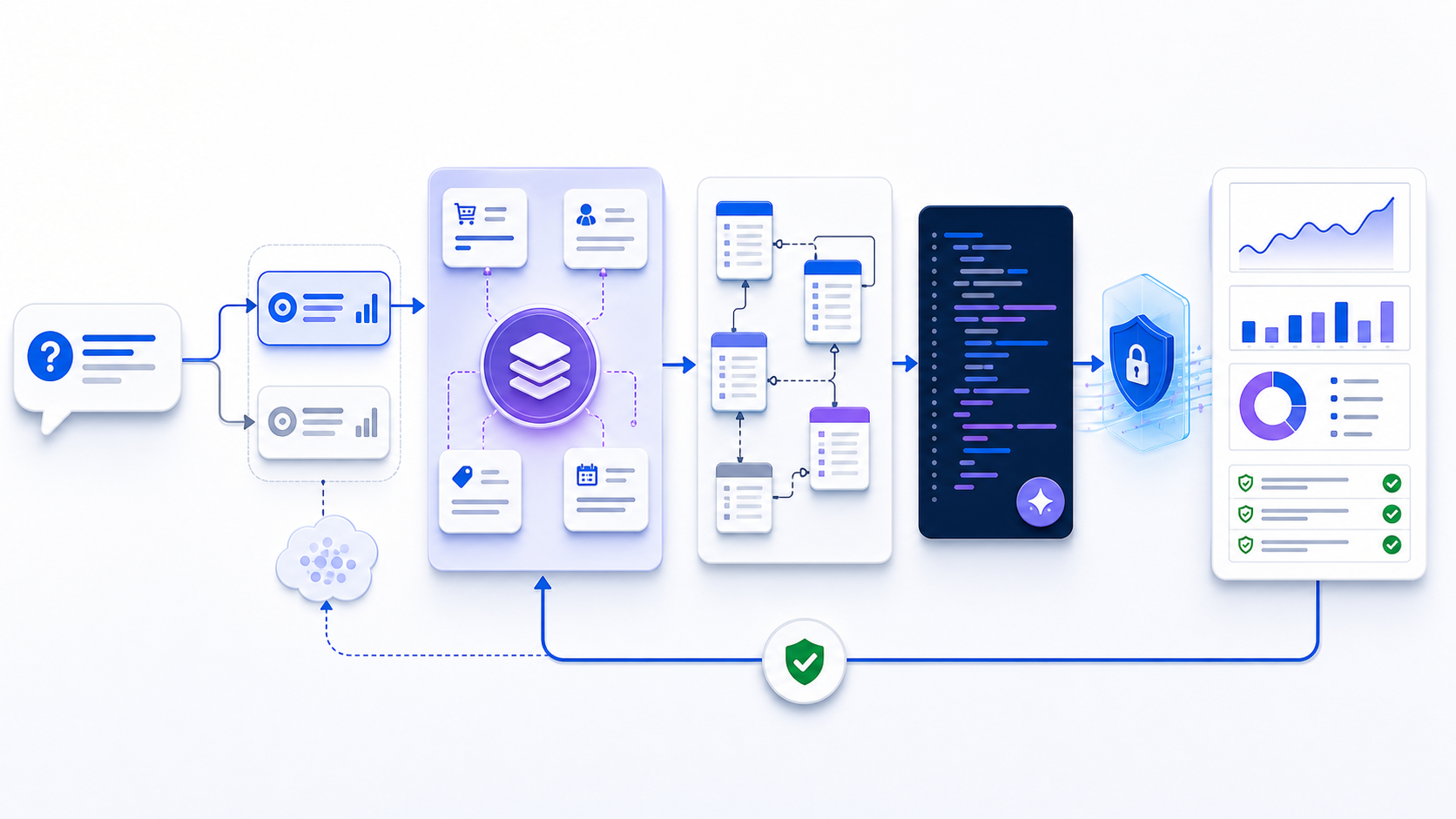
What is a natural language query?
A natural language query is a data request written or spoken in everyday language that a system converts into a structured operation and answer. For relational data, that operation may be SQL. A complete system must also decide what the words mean, which governed data may be used, whether clarification is required, how the operation can run safely, and what evidence supports the result.
The phrase “show revenue for our best customers last quarter” looks simple but leaves at least five unresolved decisions: revenue before or after refunds, “best” by revenue or margin, customer versus account grain, calendar versus fiscal quarter, and reporting versus transaction currency. A system that silently chooses defaults may produce polished SQL and the wrong decision.
Separate natural language query from search and text-to-SQL
Natural language query, or NLQ, describes the user interface and intent layer: a person asks for information without writing the underlying formal language. Text-to-SQL is one implementation path. Keyword search and semantic search retrieve existing documents or records; conversational analytics can maintain context across several questions; a BI Q&A interface may compile a question into a semantic-model expression rather than exposing SQL.
| Approach | Primary output | Best suited to | Main failure mode |
|---|---|---|---|
| Keyword search | Matching documents or records | Known terms and indexed text | Vocabulary mismatch |
| Semantic search | Conceptually similar content | Discovery over unstructured material | Relevant text mistaken for a computed answer |
| Text-to-SQL | SQL statement | Relational data with known schema | Valid syntax with wrong semantics |
| Semantic-model NLQ | Governed measure and dimensions | Repeated business metrics | Incomplete model or missing synonym |
| Conversational analytics | Multi-step analysis and explanation | Exploration with follow-up questions | Stale or incorrectly inherited context |
A production experience may combine several approaches. The important design rule is to expose the answer path: whether the result came from retrieved text, computed data, a governed metric, or a generated query. Users should not infer calculation evidence from a fluent narrative.
Build natural language query as a controlled pipeline
Treat NLQ as a system, not a single model call. Each stage should have an explicit input, output, policy, telemetry record, and failure behavior. A strong system can ask for clarification or decline a request instead of forcing every prompt into executable SQL.
- Authenticate and establish scope. Resolve user identity, role, permitted domains, geography, and session policy before retrieving schema context.
- Normalize the request. Detect language, entities, comparison, time, grain, desired output, and any references to earlier turns.
- Detect ambiguity and risk. Identify undefined metrics, competing time fields, missing populations, sensitive outputs, and potentially expensive operations.
- Ground in governed meaning. Retrieve approved metrics, dimensions, synonyms, relationships, policies, verified examples, and representative values.
- Plan the answer. Select sources, define result grain, choose joins and filters, decide whether clarification is mandatory, and state assumptions.
- Compile and validate the operation. Generate dialect-specific SQL or another query form, parse it, resolve referenced objects, and apply static policy and cost checks.
- Execute inside a sandboxed boundary. Use least privilege, read-only mode, parameter binding, row and time limits, workload isolation, and governed exports.
- Validate and present evidence. Check invariants and result shape, then show definitions, filters, time range, source freshness, assumptions, SQL, and warnings beside the answer.
- Capture feedback without auto-promoting it. Store reviewed corrections as candidates for semantic-model or verified-query changes under human approval.
Resolve meaning before generating SQL
Consider the request: “Which enterprise customers grew the most last quarter?” A weak pipeline immediately searches for tables containing customer, enterprise, and revenue. A governed pipeline first produces an interpretation record.
| Question component | Competing interpretations | Resolution |
|---|---|---|
| Enterprise customer | Current CRM segment, contract tier at period end, or historical segment during each transaction | Use governed segment definition or ask |
| Growth | Absolute change, percentage change, recurring revenue, gross revenue, margin, or usage | Select an approved metric and label the unit |
| Last quarter | Calendar, fiscal, regional fiscal calendar, or rolling 90 days | Resolve from tenant policy and user timezone |
| Comparison period | Previous quarter or same quarter last year | Ask when no default is governed |
| “Most” | Top N, threshold, all positive growers, or statistically meaningful change | Request N or apply a disclosed report policy |
| Eligibility | Include new customers, churned customers, mergers, zero baselines, and currency changes? | State cohort and exceptional-case rules |
Better clarification: “Should growth mean the absolute change in recognized net revenue versus the previous fiscal quarter, and should new customers without a prior-quarter baseline be listed separately?” This asks one decision-rich question instead of exposing internal table names.
After clarification, record the result contract: one row per governed customer account; recognized net revenue in reporting currency; current and comparison fiscal-quarter boundaries; minimum baseline rule; deterministic ranking; and separate treatment for new accounts. Only then should the system select schema objects and generate SQL.
Give the system a minimal, governed context packet
More context is not automatically better. Dumping an entire warehouse catalog into a prompt increases noise, disclosure risk, and the chance of selecting similarly named but unrelated objects. Retrieve only the authorized domain context needed for the request, and include both meaning and structure.
User role, tenant, permitted domains, data classifications, row policies, export rules, and execution tier.
Database engine and version, default catalog and schema, timezone, locale, and supported functions.
Approved metrics, dimensions, synonyms, default filters, units, currencies, calendars, and owners.
Authorized tables and columns, types, keys, cardinality, effective dates, constraints, and freshness.
Sanitized categorical examples and ranges that help map user terms without exposing sensitive rows.
Reviewed question, interpretation, query, expected result properties, and applicability boundary.
Version the context packet and log which version produced an answer. When a metric, table, synonym, or policy changes, re-run the affected evaluation set before promotion. A generated query without traceable context cannot be reproduced reliably.
Use a semantic layer to govern business meaning
A database schema describes storage; it rarely defines every business concept. A column named revenue may be booked, billed, recognized, gross, net, local-currency, or converted. A semantic layer gives natural language stable objects to target and gives reviewers an owner for each definition.
| Semantic element | Required content | Example validation |
|---|---|---|
| Metric | Formula, eligible population, grain, unit, time basis, owner, version | Reconcile to an approved control period |
| Dimension | Business meaning, values, hierarchy, null policy, effective dating | Check coverage, uniqueness, and history overlap |
| Relationship | Keys, direction, cardinality, required scope, time condition | Measure match loss and row multiplication |
| Synonym | Allowed phrase, locale, mapped concept, ambiguity exclusions | Paraphrase tests across user groups |
| Default | Timezone, calendar, currency, population, display precision | Show the applied default beside every answer |
| Policy | Roles, objects, row filters, sensitive fields, output restrictions | Authorization tests with denied and allowed cases |
Do not let a language model silently rewrite governed definitions. It may suggest missing synonyms, descriptions, metrics, or verified examples, but a domain owner should review and version the change. The Snowflake Cortex Analyst evaluation documentation provides one current example of evaluating semantic views with verified question-and-query pairs and result comparison.
Link user concepts to the correct schema and grain
Schema linking maps phrases to tables, columns, values, keys, and relationships. Retrieval by name alone is insufficient: account_id can mean billing account, product workspace, legal entity, or CRM account, and different domains may contain identically named date and amount fields.
- Retrieve by governed domain. Narrow candidates using user role, intent, metric owner, and approved subject area before comparing names.
- Resolve values as well as columns. “EMEA” may map to a region code, hierarchy node, sales territory, or a maintained list of countries.
- Construct complete relationship paths. Include tenant, effective-date, version, and bridge conditions—not merely similarly named IDs.
- Predict cardinality. Declare whether each edge is one-to-one, many-to-one, one-to-many, or many-to-many at the requested grain.
- Score confidence and alternatives. Keep the top plausible mappings and trigger clarification when differences would change the answer materially.
Do not expose unauthorized schema through clarification. Ask in business terms—“billing customer or product workspace?”—instead of listing hidden tables and fields. Authorization must filter retrieval and error messages, not only final execution.
Generate a query plan before generating SQL text
A structured intermediate plan makes generation reviewable. It should state the target population, output grain, measures, dimensions, time range, joins, filters, null rules, ranking, parameters, and expected result shape. SQL is then a compilation target rather than the only record of intent.
{
  "population": "governed enterprise accounts",
  "grain": "one row per account",
  "metric": "recognized_net_revenue",
  "current_period": "previous_fiscal_quarter",
  "comparison": "preceding_fiscal_quarter",
  "new_account_rule": "separate cohort",
  "ranking": "absolute change desc, account_id",
  "limit": 10,
  "execution": "read_only_preview"
}
Validate this record before compilation: every concept must map to an approved definition; every source must be authorized; every join path must have a declared cardinality; time boundaries must be materialized as typed parameters; and any unresolved choice must be displayed or clarified.
WITH quarterly_revenue AS (
  SELECT
    r.account_id,
    CASE
      WHEN r.posted_at >= :current_start
       AND r.posted_at < :current_end THEN 'current'
      WHEN r.posted_at >= :prior_start
       AND r.posted_at < :prior_end THEN 'prior'
    END AS period_name,
    SUM(r.reporting_net_revenue) AS revenue
  FROM recognized_revenue r
  JOIN governed_account_segment s
    ON s.tenant_id = r.tenant_id
   AND s.account_id = r.account_id
   AND r.posted_at >= s.valid_from
   AND r.posted_at < s.valid_to
  WHERE s.segment_code = :enterprise_segment
    AND r.posted_at >= :prior_start
    AND r.posted_at < :current_end
  GROUP BY r.account_id, period_name
)
SELECT
  account_id,
  MAX(revenue) FILTER (WHERE period_name = 'current') AS current_revenue,
  MAX(revenue) FILTER (WHERE period_name = 'prior') AS prior_revenue
FROM quarterly_revenue
GROUP BY account_id;
This PostgreSQL-oriented draft deliberately stops before ranking because the “new account” cohort still needs explicit treatment. A production compiler should not quietly coerce a null prior-period value to zero and rank new accounts as infinite growth. It should encode the agreed cohort rule and then test it.
Ask fewer, higher-value clarification questions
Clarification has a cost: every extra question interrupts the user. Silence also has a cost when the system chooses a consequential definition. Ask only when plausible interpretations would materially change population, measure, grain, time, security, or action.
| Situation | Preferred behavior | Example |
|---|---|---|
| One governed default exists | Apply and disclose it | “Using the company fiscal calendar.” |
| Two material interpretations | Ask a choice in business language | “Recognized revenue or invoiced amount?” |
| Minor display ambiguity | Choose reversible presentation and disclose | Default to a table with an optional chart |
| Unauthorized alternative | Do not reveal it; answer within authorized scope or decline | Do not list restricted payroll fields |
| No defensible interpretation | Abstain and state what is missing | No approved definition for “engaged customer” |
Track clarification quality as an evaluation dimension. A system can generate the correct query after asking ten unnecessary questions and still be unusable. Measure clarification rate, user completion rate, correction rate after clarification, and the share of consequential ambiguities that were missed.
Represent conversational context as explicit state
Follow-up questions such as “only Europe,” “compare that with last year,” or “now show margin” depend on prior state. Do not rely on an unstructured transcript alone. Maintain a structured state containing population, metric, dimensions, filters, time range, grain, ordering, presentation, assumptions, source version, and authorization scope.
“Show margin” may replace revenue, while “also show margin” adds a measure. Preserve the distinction.
Keep prior filters only when the user can see them and the follow-up does not reset scope.
Re-evaluate policy on every turn; a session change or requested domain can invalidate prior context.
Expire or reconfirm long-lived assumptions when data, metric versions, or reporting periods change.
Show a compact “current interpretation” panel before execution so users can inspect inherited state. Include a one-click reset. Conversation should reduce repeated work without creating invisible filters that make an answer impossible to explain.
Enforce security before, during, and after generation
Natural language query adds an expressive interface to data access; it must not create a parallel authorization system. A model may help interpret intent, but deterministic policy should control which metadata can be retrieved, which operations can be generated, which credentials execute them, and which results can be disclosed or exported.
| Control point | Required controls | Failure prevented |
|---|---|---|
| Context retrieval | Identity-aware metadata filters, domain allow-list, sensitive-name redaction | Schema and policy disclosure |
| Interpretation | Risk classification, sensitive-intent detection, mandatory clarification rules | Hidden expansion of scope |
| Query compilation | Statement and function allow-lists, object resolution, parameter binding, parser checks | Injection and unauthorized operations |
| Pre-execution | Read-only transaction, plan inspection, estimated row and cost threshold, timeout | Resource exhaustion and writes |
| Database execution | Least-privilege role, row and column policy, workload isolation, audited connection | Privilege bypass and noisy-neighbor impact |
| Result handling | Row limits, aggregation thresholds, masking, download policy, safe rendering | Sensitive output and downstream injection |
| Logging and feedback | Data minimization, retention controls, access logs, reviewed promotion workflow | Sensitive prompts in logs and poisoned examples |
Generated SQL should use bind parameters for values. Dynamic identifiers require an allow-list mapping to known objects; raw user text must not become a table name, sort expression, or SQL fragment. A read-only role reduces impact but does not prevent expensive scans or sensitive exports, so resource and output controls remain necessary.
Use the OWASP GenAI Security Project as a threat-model input, then translate general model risks into database-specific tests: unauthorized schema discovery, instruction injection through stored text, excessive agency, sensitive result disclosure, unsafe output rendering, and unreviewed feedback becoming trusted context.
Evaluate the answer path, not only the SQL string
Exact string match is a useful diagnostic but a poor standalone accuracy measure. SQL can differ in aliases, join order, subquery structure, equivalent predicates, or aggregation layout while returning the same correct result. Conversely, a query can match a stored reference closely and still be wrong after schema, data, metric, or time-policy changes.
| Metric | What it measures | Limitation |
|---|---|---|
| Parse success | SQL is syntactically valid for the target dialect | Says nothing about meaning or permissions |
| Object grounding | Referenced objects and functions are approved and exist | Correct objects can still be joined incorrectly |
| Execution success | The query runs inside the test boundary | A wrong query often runs successfully |
| Result equivalence | Returned rows or aggregates equal an expected result | A small fixture may not expose hidden defects |
| Semantic acceptance | Population, grain, metric, time, and decision match the reviewed intent | Requires explicit business rules and expert review |
| Clarification quality | The system asks when needed and avoids needless interruption | Must be evaluated with ambiguous questions |
| Safe abstention | Unsupported or unauthorized requests are declined correctly | Over-abstention can make the system unusable |
| Operational quality | Latency, cost, scanned data, timeouts, and concurrency impact | Fast answers are not necessarily correct |
A release decision should combine these metrics by risk tier. For low-risk exploration, users may inspect a non-executed SQL draft. For governed self-service, require result-equivalence and policy tests. For an automated operational action, require much stronger evidence, change control, monitoring, and a safe fallback.
Build a versioned natural language query evaluation set
An evaluation item should contain more than a question and one SQL string. Store the user role, authorized domain, question, conversation state, required clarifications, accepted interpretation, semantic definitions, expected result properties, one or more valid queries, fixture or snapshot version, security outcome, and maximum operational budget.
High-frequency metrics, dimensions, filters, comparisons, and standard time ranges.
Multi-table joins, effective-dated dimensions, bridges, deduplication, subqueries, and windows.
Competing metrics, vague periods, missing populations, unclear ranking, and underspecified follow-ups.
Nulls, zero denominators, ties, empty results, late data, currency changes, new and churned entities.
Unauthorized schema, sensitive attributes, prompt injection in stored text, writes, and oversized exports.
Paraphrases, abbreviations, typos, multilingual terms, domain jargon, and adversarial wording.
Split verified examples used for runtime guidance from held-out evaluation items. Otherwise, the system may reproduce memorized query patterns without demonstrating generalization. The Snowflake evaluation workflow explicitly removes selected verified queries from the semantic view during an evaluation so they cannot guide the generation being measured.
Public text-to-SQL benchmarks are useful for research comparability but do not replace a private evaluation set reflecting your schema, policies, business definitions, user language, and operational constraints. Spider 2.0, for example, focuses on more realistic enterprise text-to-SQL workflows; production acceptance still requires organization-specific evidence.
Test whether equivalent questions stay equivalent
A trustworthy NLQ system should preserve meaning across harmless wording changes and change behavior when the user changes a material condition. Build metamorphic tests: transformations where the expected relationship between outputs is known even if a single exact SQL string is not.
| Transformation | Expected property | Failure revealed |
|---|---|---|
| Paraphrase with same entities and period | Same interpretation and equivalent result | Vocabulary brittleness |
| Change one region filter | Only the region predicate and dependent result change | Entangled intent or stale context |
| Add “including zero activity” | Population expands without changing the metric definition | Incorrect join direction or null policy |
| Swap calendar and fiscal quarter | Typed boundaries change according to governed calendars | Hard-coded dates or ignored terminology |
| Ask an unauthorized equivalent | Policy outcome remains denial without schema leakage | Prompt-based authorization bypass |
| Rename or deprecate a source field | Evaluation fails safely until context is updated | Stale schema grounding |
Run these tests across model, prompt, semantic-model, schema, driver, and database-version changes. A passing average can hide severe regressions in one high-value metric or user group, so report results by domain, complexity, language, ambiguity, and risk tier.
Log enough to reproduce an answer without over-collecting
A production trace should connect the question to its interpretation, context versions, policy decisions, generated operation, execution evidence, and displayed answer. It should not indiscriminately store sensitive prompts, raw rows, credentials, or full schemas.
- Request and conversation identifiers, user role or pseudonymous authorization class, and declared purpose.
- Normalized intent, selected metric and dimensions, filters, time range, grain, assumptions, and clarifications.
- Semantic-model, schema, policy, prompt, model, and application versions.
- Retrieved object identifiers and confidence—not unauthorized object contents.
- Query fingerprint, parsed objects, statement class, static-policy outcome, and bound-parameter types.
- Plan or cost summary, execution role, elapsed time, rows scanned and returned, timeout, and error class.
- Validation checks, warnings, user correction, reviewer disposition, and whether the result was exported or acted upon.
Define retention, redaction, and access rules before collecting telemetry. Use sampled or tokenized values when the exact literal is unnecessary. The audit trail should explain a decision without becoming a second uncontrolled data warehouse.
Match automation to the consequence of a wrong answer
Do not apply one release threshold to every natural language query. A draft used by an analyst for exploration has a different consequence from a query that allocates inventory, changes prices, files a regulatory report, or triggers customer communication.
| Tier | Permitted experience | Minimum controls | Example |
|---|---|---|---|
| 1 · Learn | Generate SQL against synthetic schemas without execution | No secrets, clear demo disclosure, visible assumptions | Public NL2SQL tester |
| 2 · Explore | Read-only preview in a sandbox or curated dataset | Least privilege, row and time limits, SQL and definition visibility | Analyst discovery |
| 3 · Governed self-service | Execute approved question classes over production read replicas | Semantic layer, evaluation gates, policy enforcement, audit, feedback review | Recurring BI questions |
| 4 · Decision support | Provide reviewed evidence for high-impact human decisions | Named owner, independent controls, mandatory review, reproducible snapshot | Finance or capacity planning |
| 5 · Automated action | Trigger a bounded operational workflow only after separate authorization | Deterministic guardrails, approval or dual control, rollback, monitoring, kill switch | Strictly limited exception handling |
Moving up a tier requires stronger evidence, not merely a higher average accuracy score. Review the worst credible failure, the number of people and records affected, detectability, reversibility, and the time available to intervene.
Write natural language queries as compact result contracts
Users should not need SQL vocabulary, but a few concrete details dramatically improve interpretation. A useful question identifies the population, measure, grouping, period, comparison, exception rules, desired output, and any known dialect or dataset constraint.
“Show weekly recognized net revenue for active enterprise accounts in EMEA for the last 13 complete weeks, in reporting currency, including zero-revenue weeks.”
“Compare 30-day activation rates for customers first onboarded in Q1 versus Q2; define activation as one successful production workflow.”
“For each region, list the five products with highest net margin last complete month; include all products tied at fifth place.”
“Find posted invoices with no active account mapping at posting time; return counts by legal entity and a 20-row sanitized sample.”
“Keep the same population and time range, replace revenue with gross margin, and group by account owner instead of region.”
“Also return total eligible accounts, unmatched segment mappings, data freshness, and the SQL used so I can review the result.”
If the user gives a short question, the system can help construct this contract through targeted clarification and disclosed defaults. Do not force users to know physical table names or memorize metric IDs; that is the semantic layer's job.
Diagnose natural language query failures by stage
| Observed symptom | Likely stage | Evidence to inspect | Corrective direction |
|---|---|---|---|
| Wrong metric but plausible answer | Intent or semantic grounding | Selected definition, synonyms, ambiguity candidates, applied defaults | Clarify or improve governed metric descriptions |
| Invented table or column | Schema retrieval or generation | Retrieved object set, version, parser, catalog resolution | Constrain generation to resolved object IDs |
| Totals inflated | Relationship planning | Join path, key uniqueness, row growth, output grain | Add cardinality metadata and join invariants |
| Correct SQL, misleading explanation | Result narration | Returned rows, narrative claims, unit and period labels | Generate narrative only from validated result metadata |
| First turn correct, follow-up wrong | Conversation state | Before-and-after structured state and reset behavior | Separate replace, refine, and reset operations |
| Slow or unsafe query | Compilation and execution policy | Plan estimate, statement class, functions, limits, execution role | Tighten policy gate and workload isolation |
| Regression after model update | Release process | Held-out evaluation by domain and changed components | Canary, rollback, and targeted context changes |
Fix the narrowest causal layer. Adding prompt instructions is not a universal remedy: a duplicated dimension belongs in data quality or the relationship model; missing row security belongs in policy; a stale metric belongs in semantic governance; an expensive plan may need a curated aggregate or workload rule.
Roll out natural language query in measured stages
- Choose one bounded domain. Start with named owners, stable metrics, documented schema, representative users, and reversible decisions.
- Create the context and evaluation set together. Every semantic definition should have positive, boundary, ambiguity, and authorization tests.
- Begin with non-executed drafts. Let analysts inspect interpretation and SQL, record corrections, and identify missing model elements.
- Add sandboxed read-only execution. Apply policies, plan checks, budgets, validated result shapes, and independent reconciliation.
- Run a shadow pilot. Compare system answers with the existing analyst workflow without letting results drive decisions.
- Promote by question class. Approve specific metrics, dimensions, and patterns that pass thresholds; keep unsupported classes behind review.
- Monitor and roll back. Watch correction, abstention, policy, latency, cost, and domain regressions with versioned rollback paths.
Go-live evidence: publish the approved question classes, unsupported requests, metric and schema owners, evaluation date, pass thresholds, known limitations, escalation path, and rollback owner. “The model looked good in a demo” is not a release criterion.
Inspect how a plain-English question becomes SQL
Use the InfiniSynapse NL2SQL Query Tester with its built-in synthetic examples. Review the visible planning steps and generated SQL structure without connecting a database. Treat the output as an educational draft, then validate every object, definition, join, filter, dialect rule, and expected result in your own governed environment.
Open NL2SQL Query Tester The free tester uses synthetic schemas and runs in the browser. Do not submit credentials, personal data, secrets, or sensitive schema details.Natural language query frequently asked questions
It is a request expressed in everyday language that a system maps to a structured data operation and answer. The underlying operation may be SQL, a semantic-model query, search, an API call, or a combination.
No. Text-to-SQL is one implementation for relational databases. A broader NLQ system may clarify ambiguity, use a semantic layer, call non-SQL sources, create visualizations, explain evidence, and maintain conversation state.
Language is ambiguous, schema names do not fully define business meaning, relationships may be incomplete, and fluent SQL can encode the wrong population, metric, grain, or time boundary. Permissions, data quality, stale context, and narration can add further errors.
Use a versioned evaluation set and measure execution success, result equivalence, semantic acceptance, clarification quality, safe abstention, latency, cost, and regressions. Exact SQL match alone is insufficient.
Provide target dialect, approved objects, keys and relationships, metrics, synonyms, time and timezone rules, result grain, security policy, representative values, verified examples, and the user's authorization scope.
Do not assume it is safe or correct. Start with synthetic examples and read-only environments, then apply allow-lists, limits, least privilege, plan checks, output controls, result validation, and human review according to impact.
Natural language query sources and evaluation references
- Snowflake: Cortex Analyst REST API
- Snowflake: Cortex Analyst Evaluations
- Microsoft Learn: Power BI Q&A Limitations
- Spider: Cross-Domain Text-to-SQL Benchmark
- Spider 2.0: Real-World Enterprise Text-to-SQL Workflows
- OWASP GenAI Security Project
Product documentation describes specific implementations, and public benchmarks support comparative research. Neither proves suitability for a particular organization. Validate natural language query behavior against the actual schema, data, business definitions, language, policy, workload, and decision consequence.