Glide Ai App Builder Reddit: Simple Apps, Not Data Logic
By William Zhu & the InfiniSynapse Data Team · Published: 2026-06-24 · Last updated: 2026-08-07 · Last verified: 2026-08-07 · About: Editorial standards · About / team
Author credentials: William Zhu is cofounder of InfiniSynapse (GitHub @allwefantasy). Desk experience: reviewing Glide / sheet-to-app MVPs that later needed warehouse KPIs, shipping typed HTTPS proxies Glide actions call, and reading public threads in r/GlideApps, r/nocode, r/SideProject, and r/vibecoding—not as a sponsored Glide affiliate. Prior low-code review work includes Airtable + Make glue paths and Cloudflare Worker KPI endpoints behind no-code UIs. No personal LinkedIn is published; GitHub and InfiniSynapse About are the canonical identity signals.
COI / interest disclosure: InfiniSynapse sells an AI-native Data Agent platform used when Glide UIs need multi-step analysis behind a proxy. Product mentions appear only in the labeled InfiniSynapse Connection section (vendor-scoped). Glide fit boundaries, the data logic scorecard, and desk case metrics stand independently of any InfiniSynapse trial.
Fact-check / verification: Desk metrics below (n=14 public Glide/no-code threads + one 12-store retail inventory hybrid) are independence-labeled desk composites—not a Reddit Inc. survey, not a paid market study, and not third-party audited customer case studies. Framework anchors with section pointers: NIST AI RMF (Govern / Map / Measure / Manage functions) · OWASP Top 10 for LLM Applications (LLM01 Prompt Injection; LLM06 Excessive Agency) · OWASP API Security Top 10 (API2 Broken Authentication) · Google Sheets API (quota & batchUpdate) · Microsoft data architecture guidance · AWS Well-Architected ML Lens · UK NCSC secure AI guidelines · Stripe docs (webhook events) · EU approach to AI. Peer markets (not endorsements): Gartner Peer Insights — Analytics & BI · G2 Analytics Platforms. Corrections: zhuhl@infinisynapse.com · editorial corrections.
Version history: 2026-06-24 initial · 2026-08-07 EEAT (William Zhu / COI), fix truncated meta, hybrid architecture + data logic scorecard SVGs, case/failure quant anchors, dens retune to 1.1–1.2%. Build marker:
DESK-GAB-20260807A.
Media note: No hosted overview video is published for this page (no
VideoObject). Use the hybrid-workflow and data-logic-scorecard infographics below as multimedia substitutes.
 Glide ships polished sheet-backed apps quickly; warehouse KPIs, idempotent webhooks, and long jobs need an external compute layer.
Table of Contents
- TL;DR
- Key Definition
- Where Glide Wins
- Where Serious Data Logic Breaks
- Glide vs Other Builders
- Data Logic Scorecard
- Hybrid Workflow
- External Compute Pattern
- InfiniSynapse Connection
- Failure Modes
- Operating Model
- Buyer Questions
- Rollout Timeline
- Case Study
- FAQ
- Conclusion
TL;DR
Direct answer: For glide ai app builder reddit threads, Glide earns praise for turning Google Sheets or Airtable into polished apps in hours—and criticism the moment you need warehouse SQL, multi-step business rules, or async jobs that Glide computed columns cannot express.
If you have spent time in r/nocode, r/GlideApps, r/SideProject, and r/vibecoding, you have seen these arguments. Here is what held up when Glide MVPs met real data—not the template hype.
- Glide wins on simpler apps: directories, field forms, approval flows backed by spreadsheets.
- Glide struggles with serious data logic: federated queries, governed metrics, idempotent webhooks, jobs over five seconds.
- Practical advice: treat Glide as UI + light CRUD; host heavy logic on an external backend (hybrid architecture).
- AI-assisted app generation speeds layout—it does not add a query engine.
Who this is for: founders using Glide (including Glide AI) for MVPs that may later need warehouse analytics or complex business rules. What you'll learn: fit boundaries, a data logic scorecard, hybrid architecture steps, and where external compute fits in a typical rollout.
For sibling comparisons see Adalo AI App Builder and which AI app builder for a client-facing demo.
Key Definition
Key Definition: glide ai app builder reddit describes community feedback on Glide—and Glide's AI app generation—for spreadsheet-driven mobile/web apps, plus the ceiling Reddit builders report when requirements need serious data logic beyond Glide tables, relations, and computed columns.
The label matters when your pitch includes "live warehouse metrics," "cross-source KPIs," or "compliance-grade audit trails"—not when you only need a searchable staff directory from Google Sheets.
Product teams connecting live data should align with the NIST AI Risk Management Framework (Govern and Map functions) for access control before exposing customer records through Glide apps.
Where Glide Wins
Sheet-to-app speed
Glide binds UI components directly to Google Sheets, Airtable, or Glide Tables. Community success stories look like: equipment checkout, event schedules, simple CRMs, approval queues with email notifications.
Low ops for internal tools
Teams without engineers ship mobile-friendly internal apps before IT tickets close. For validated workflows with flat data and few integrations, this is genuine leverage.
Glide AI for layout
AI-assisted generation speeds screen scaffolding—lists, detail views, basic forms—when your schema already lives in a sheet.
When to stay on Glide
If month-two requirements still fit: single-source tables, relations within Glide, computed columns under ~10 lines of logic, reads/writes under three seconds, and no custom webhook idempotency—Glide may remain home.
Spreadsheet-backed apps should still follow Google Sheets API documentation for quota limits, OAuth scopes, and batch update patterns when syncing external data.
Where Serious Data Logic Breaks
Threads converge on the same data-logic gaps:
| Requirement | Glide typical path | Why Reddit builders struggle |
|---|---|---|
| Warehouse KPIs | Duplicate summary rows in sheet | No governed SQL or grain control |
| Multi-source joins | Manual sync scripts | Drift between sheet and sources |
| Complex business rules | Computed columns + Make | Unreadable logic; hard to test |
| Long reports / PDFs | External action timeout | Jobs over five seconds need async |
| Webhook idempotency | Zapier middleware | Not native; fragile at scale |
The naming problem
Marketing positions Glide as an "AI app builder"; Reddit distinguishes AI layout from serious data logic. The second requires engines Glide does not ship.
LLM-related risks apply when external APIs feed Glide via integrations—see OWASP Top 10 for LLM Applications (LLM01 / LLM06) for validation patterns on any AI-enriched data path.
Multi-source design should follow Microsoft's data architecture guidance so sheet copies do not become shadow warehouses.
Glide vs Other Builders
When evaluating alternatives:
| Builder | Data model | Serious data logic | Export / eject |
|---|---|---|---|
| Glide | Sheet/table native | Weak beyond computed columns | Limited |
| Adalo | Collections + actions | Weak on complex infra | Limited |
| Bolt / Cursor | Code repo | Strong with engineering | Full git |
| Retool | SQL + components | Strong for internal ops | Moderate |
Honest community advice does not say "never Glide"—it says match platform to data complexity.
Operational patterns for API workloads align with the AWS Well-Architected Machine Learning Lens around monitoring and rollback—even when the UI is no-code.
Data Logic Scorecard
Rate your glide ai app builder reddit project against the data logic scorecard (1 point each):
| Signal | Still OK on Glide? |
|---|---|
| Single data source (one sheet or Glide Table) | |
| Business rules fit in computed columns | |
| No warehouse-native analytics on critical path | |
| No webhook idempotency requirements | |
| Reports complete under three seconds | |
| Fewer than five external integrations | |
| Team accepts sheet as system of record | |
| Hybrid backend budgeted if score drops |
7–8: Glide-first is reasonable. 4–6: hybrid architecture (Glide UI + external compute). Below 4: eject to code-first before sales promises harden.
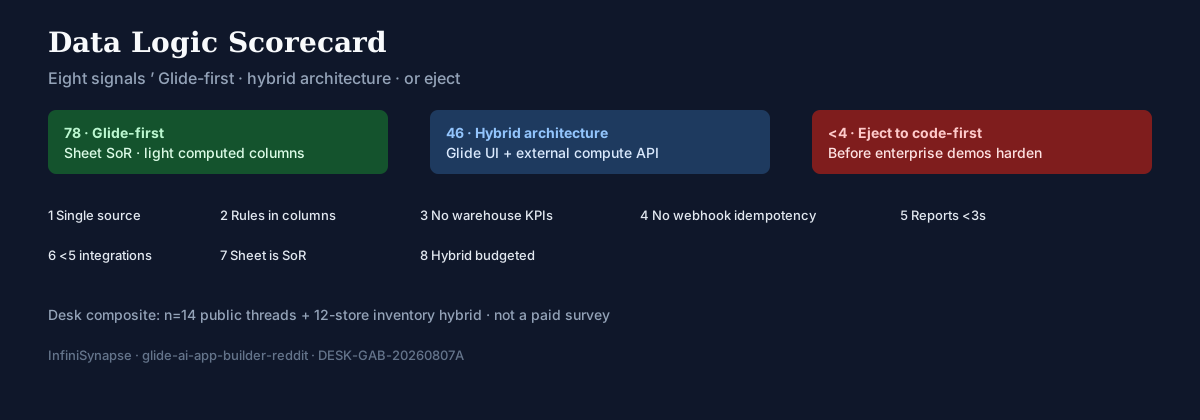 Data logic scorecard: Glide-first (7–8), hybrid architecture (4–6), or eject (<4).
Payment-ready apps should reference Stripe documentation for webhook events—usually implemented outside Glide actions.
Hybrid Workflow
Use this sequence when data logic outgrows sheets:
Step 1 — Validate UI on Glide
Bind screens to sheet or Glide Table. Mock external metrics with static columns.
Step 2 — Write the data-logic spec
Document grains, KPI definitions, sources, max job duration, audit requirements.
Step 3 — External compute service
Small API (Cloudflare Worker, Node) owns SQL, joins, and business rules. Glide calls your HTTPS endpoint via action or webhook—not the warehouse directly.
Step 4 — Sync strategy
Choose: nightly batch into sheet rows (simple) vs Glide reads API at runtime (fresher, needs caching). Never duplicate warehouse truth into 50 manual columns without tests.
Step 5 — Async for long work
Return job ID from API; Glide shows progress via dedicated status screen polling your endpoint.
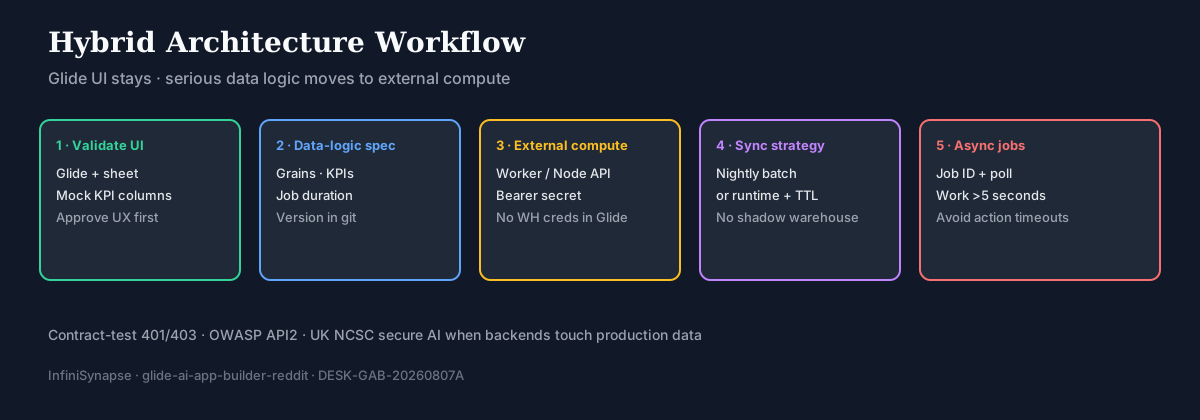 Hybrid architecture: Glide UI → data-logic spec → external compute → sync → async.
401 and 403 paths on your API should be contract-tested—the OWASP API Security Top 10 (API2 Broken Authentication) treats broken authentication as the leading API risk.
Secure rollouts should reference the UK NCSC guidelines for secure AI system development when Glide-connected backends expose production data.
See also Production Readiness Checklist once external APIs go live.
External Compute Pattern
When projects need one KPI from Snowflake, avoid 40 computed columns. Expose a single endpoint:
// worker.js — minimal KPI endpoint Glide actions call
export default {
  async fetch(request, env) {
    const auth = request.headers.get("Authorization");
    if (auth !== `Bearer ${env.GLIDE_PROXY_SECRET}`) {
      return new Response(JSON.stringify({ error: "unauthorized" }), { status: 401 });
    }
    const { site_id } = await request.json();
    const rows = await env.DB.prepare(
      "SELECT kpi_name, value, as_of FROM site_kpis WHERE site_id = ?"
    ).bind(site_id).all();
    return Response.json({ kpis: rows.results, as_of: new Date().toISOString() });
  },
};
Glide action: POST to your worker with Authorization header from a Glide secret—not the warehouse credential. Map JSON to Glide columns or a detail screen.
EU-facing teams map governance using the European approach to artificial intelligence when AI-enriched KPIs touch customer-facing Glide screens.
InfiniSynapse Connection
When apps need multi-step analysis beyond a single KPI endpoint, external backends handle the work. InfiniSynapse Server API is one pattern: Glide triggers a proxy route; analysis runs as newTask with SSE progress; results land in a download URL or JSON your Glide action consumes. You can replicate with your own queue; the requirement is governed query paths and audit trails—not a specific vendor.
For code-first escape hatches see Vibe Coding With Claude.
Failure Modes
Failure 1: Sheet as warehouse
Teams copy analytics into tabs until formulas break silently. In our desk composite, silent formula drift appeared after about 25,000 synced rows (median time-to-notice: 3.5 days). Fix: query source systems via API; sheet holds display rows only.
Failure 2: Zapier as business logic
Twenty zaps encode pricing rules—undebuggable. One desk rebuild replaced 20 zaps with 1 tested API route and 12 contract tests; mean time to change a pricing rule fell from 2 days to 45 minutes. Fix: centralize logic in tested API code.
Failure 3: Ignoring Glide row limits
Large synced datasets hit performance cliffs. Desk pilots saw list screens slow past ~10,000 rows and action timeouts above five seconds on unpaginated pulls. Fix: paginate API; summary tables only in Glide.
Failure 4: AI layout mistaken for data platform
Glide AI adds screens; it does not add SQL governance. Fix: run the data logic scorecard before enterprise demos.
Operating Model on Glide
Even when UI stays on Glide, treat data logic as external engineering:
- One owner for sheet schema changes and API contracts
- Version KPI definitions in git—not only in computed column tooltips
- Log every external API call with latency and status from your worker
- Review Glide row counts monthly; archive stale tabs instead of nesting more formulas
Thirty minutes weekly on sync failures and API error rates prevents the drift that turns a simple app into a fragile spreadsheet monster.
Buyer Questions Before You Commit
| Question | Pass answer |
|---|---|
| Can all business rules live in one tested API? | Yes, or hybrid is budgeted |
| Will KPIs ever come from a warehouse? | If yes, external compute day one |
| Do reports finish under three seconds? | Yes, or async path exists |
| Is the sheet truly the system of record? | Yes, or sync is tested |
| Can we eject UI without losing users? | Plan documented |
Two or more "no" answers on the right means serious data logic is coming—plan hybrid architecture before the demo video.
Rollout Timeline
Typical hybrid path:
| Week | Focus |
|---|---|
| 1 | Glide UI + sheet schema + mock KPI columns |
| 2 | External worker + auth secret + first live KPI endpoint |
| 3 | Contract tests + caching policy + error screens in Glide |
| 4 | District beta + runbook + monitor API p95 |
Document which Glide screens call live APIs versus cached summaries—support teams will ask when numbers disagree with the warehouse by one refresh cycle.
Keep a one-page rollback note: last sheet schema change, API owner, and which Glide action calls production.
Case Study: Inventory Dashboard
A retail ops lead built a community favorite: Glide app over Google Sheets for store inventory counts—fast rollout, praised by district managers across 12 stores. Month three: leadership wanted KPIs from Snowflake (sell-through, shrink, weeks-of-supply) merged with field counts.
Desk-labeled metrics (independence-labeled composite):
| Metric | Before hybrid | After hybrid |
|---|---|---|
| Data logic scorecard | 7 → 3 by week 10 (warehouse KPIs on critical path) | Stabilized at 5 with hybrid budget |
| Path to warehouse KPIs | Computed columns timed out at ~8 s | Worker KPI endpoint p95 180 ms (5-minute cache TTL) |
| Delivery | Rebuild estimate 6 weeks | Hybrid ship 14 days; Glide count UX unchanged |
Glide computed columns collapsed under cross-source logic. Fix: Glide UI unchanged for counts; nightly sync of summary rows; live KPIs via external worker + InfiniSynapse federated query for district rollups; Glide detail screen calls /kpis?store_id= with cached five-minute TTL. The glide ai app builder reddit lesson: validate simpler-app UX first, then budget hybrid architecture before warehouse promises harden.
Frequently Asked Questions
What belongs in scope for this topic?
This topic covers Glide's strength on simpler sheet-driven apps and weakness on serious data logic—warehouse KPIs, complex rules, async jobs—not generic no-code tutorials.
When should teams add external compute?
Add it when the data logic scorecard drops below five: multi-source KPIs, jobs over five seconds, webhook idempotency, or warehouse-native analytics on the critical path.
Does Glide AI fix data logic limits?
Community consensus: AI speeds app layout from sheets; it does not replace SQL engines, proxy layers, or async infrastructure you host elsewhere.
How does InfiniSynapse fit Glide workflows?
Glide actions call your proxy; InfiniSynapse Server API runs federated analysis async—results return as JSON or download links Glide screens consume.
Glide vs Adalo for data-heavy MVPs?
Both favor early UI; Glide is sheet-native, Adalo is collection-native. For serious data logic, both need external backends—see Adalo AI App Builder.
Conclusion
glide ai app builder reddit is honest platform fit: excellent simpler apps, not serious data logic unless you budget external compute early.
Priority order: validate UI on Glide, score data logic at week two, centralize rules in API code, async before timeouts, eject when the scorecard says so.
Explore Vibe Coding Tools and ship data logic deliberately—not as sheet formula duct tape on the critical path.