Github Copilot For Vibe Coding Reddit: Same Integration Gap
By William Zhu & the InfiniSynapse Data Team · Published: 2026-06-23 · Last updated and verified: 2026-09-24 · Editorial standards
Evidence boundary: This is a documented-capability comparison and a reproducible acceptance suite, not a claim that InfiniSynapse ran a controlled benchmark of every product. Product behavior changes; verify current controls in each vendor's official documentation and run the same tests in your repository before choosing.
COI disclosure: InfiniSynapse builds data-agent software, not an IDE copilot or webhook relay. No vendor paid for placement. The acceptance suite reflects our experience reviewing generated API and integration code; the scorecard does not invent performance results.
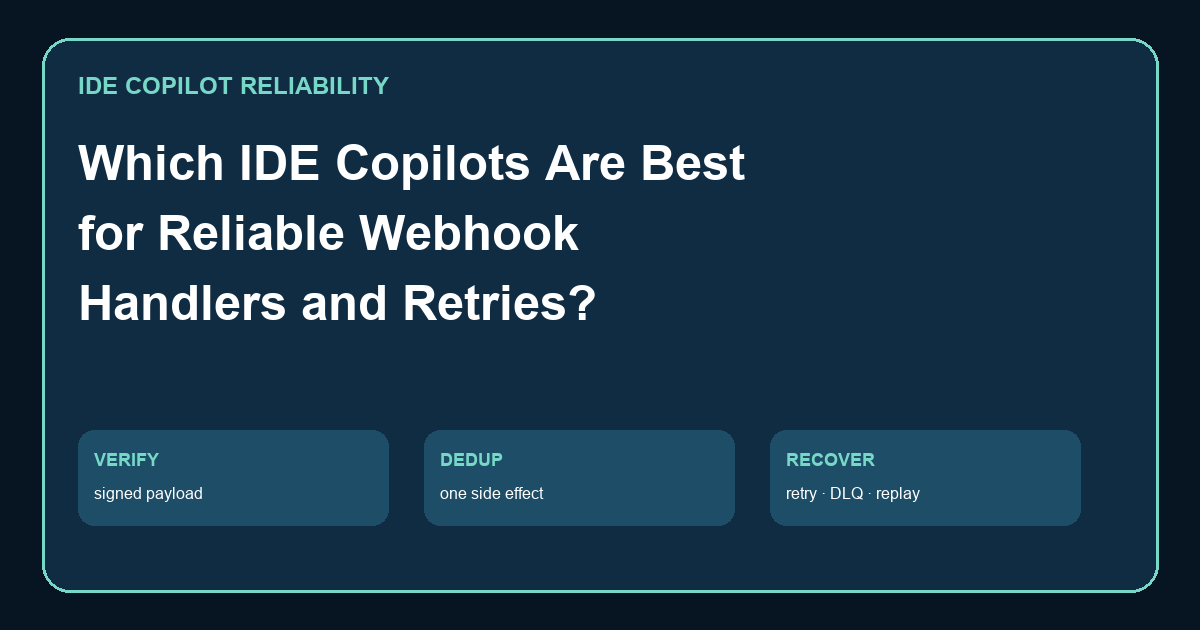 Choose an IDE copilot by the failure cases its output can pass, not by how quickly it generates the happy path.
TL;DR
Direct answer: For teams already centered on VS Code and GitHub, GitHub Copilot is the strongest default for instruction files, local edits, and pull-request workflow. Cursor is the stronger candidate for repository-wide implementation and repeated test-repair loops. JetBrains AI Assistant fits teams that must remain inside IntelliJ-based IDEs, while Windsurf is another agentic editor worth validating. None is reliable by default: the best IDE copilot is the one whose generated handler passes signature, duplicate-delivery, ordering, queue, retry, dead-letter, and replay tests in your repository.
The query which IDE copilots are best for writing reliable webhook handlers and retries asks for a task-specific decision, not a generic AI coding leaderboard. A polished route that accepts one valid JSON request proves almost nothing. Webhook code runs at a distributed-system boundary where the producer can retry, events can arrive out of order, payloads can be forged, and downstream services can fail after the endpoint acknowledges receipt.
This guide therefore compares documented workflow fit and supplies a reproducible acceptance suite. It does not award an unsupported universal winner.
What “Best” Means for Webhook Code
The receiver and sender are different systems
A webhook receiver verifies an incoming request, records an event, acknowledges it quickly, and processes it asynchronously. A webhook sender schedules delivery attempts, applies backoff, respects rate limits, records receipts, and exposes replay. Asking an assistant to “add retries” without naming the side often produces a loop in the HTTP handler—the wrong place for durable delivery.
Reliability is an acceptance test
The best assistant should help a developer preserve invariants across files: raw-body verification before parsing, one side effect per event ID, atomic state transitions, bounded retry, observable failures, and safe replay. Hookdeck's account of webhooks at scale reaches the same architectural conclusion: queue-first processing, idempotency, observability, dead-letter handling, and replay matter more than a route that merely returns 200.
Generation speed is secondary
Autocomplete latency and attractive diffs are useful, but they are not webhook reliability metrics. Count unresolved defects, repair turns, test coverage, and the amount of human correction required before merge.
IDE Copilots Compared by Workflow Fit
GitHub Copilot: best default for GitHub-centered teams
GitHub Copilot is the practical default when developers already use VS Code, GitHub pull requests, repository instructions, and GitHub-native review. Its value is workflow proximity: the team can keep constraints beside the code and review generated changes through familiar diffs. Use GitHub's current Copilot documentation to verify which instruction and agent features are available in your plan.
That does not make its first webhook draft production-ready. Require Copilot to run the acceptance suite, show changed files, and explain how duplicates and partial failures are handled.
Cursor: best candidate for repo-wide test-repair loops
Cursor is the stronger candidate when the task spans route handlers, persistence, queues, fixtures, and integration tests. Repository rules can keep webhook invariants visible while the agent edits multiple files. Cursor's project rules documentation is the source of truth for persistent repository guidance.
This is a workflow-fit judgment, not a measured quality score. A team deciding between Cursor and Copilot should give both the same branch and failing tests, then compare defects and repair turns.
JetBrains AI Assistant: best fit for IntelliJ ecosystems
Teams working in Java, Kotlin, Spring, or other IntelliJ-centered stacks may value remaining inside the IDE that already understands their project model. Review the current JetBrains AI Assistant documentation, then test whether it can update controller, transaction, queue, and test layers without weakening framework conventions.
Windsurf/Devin Desktop: validate the agentic workflow, not the demo
The product formerly centered on Windsurf and Cascade is now documented under Devin Desktop, with legacy Windsurf paths retained during migration. Its current rules and memories documentation recommends version-controlled rules or AGENTS.md for durable constraints. The relevant question is whether those constraints survive several repair turns—not whether the first prompt produces more code.
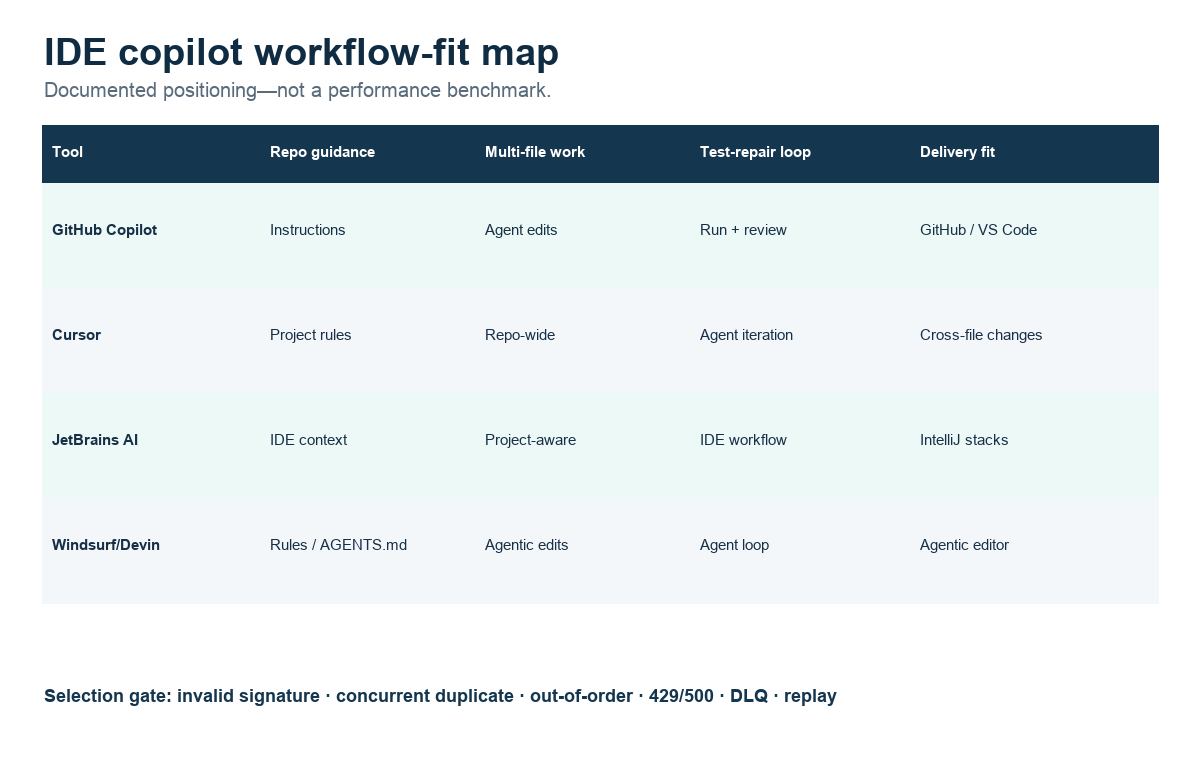 Documented workflow map, not a performance benchmark. Validate current product behavior and run the same repository tests.
Run the Same Webhook Acceptance Suite
Use one repository and one specification
Create one clean branch per assistant. Pin the runtime, dependencies, webhook contract, database schema, queue interface, and test command. Give every assistant the same requirement: receive a signed event, persist it once, acknowledge quickly, process it asynchronously, retry transient downstream failures, and support replay without duplicating the side effect.
Record the initial output, prompts, changed files, test results, repair turns, elapsed review time, and remaining defects. Without that record, “best” is an impression.
Test 1: reject an invalid signature
Signature verification must use the raw request bytes when the provider requires them. GitHub's guide to validating webhook deliveries demonstrates the boundary; Stripe similarly warns that signature verification needs the original request body. Send a valid payload, a modified payload, an old timestamp, and a request signed with the previous secret during rotation.
Test 2: deliver the same event twice
Send two concurrent requests with the same provider event ID. The correct result is two safe acknowledgements and one business side effect. A “check then insert” sequence without a unique constraint or transaction can still race.
Test 3: deliver events out of order
Send subscription.updated before subscription.created, or an older version after a newer one. The handler should follow an explicit version, timestamp, or reconciliation policy instead of assuming arrival order.
Test 4: fail after persistence
Persist the receipt, then force the downstream operation to fail. The event must remain recoverable. It should not be marked complete, silently lost, or processed twice after a worker restart.
Test 5: exhaust retry and replay
Return transient failures until the maximum attempt count is reached. Confirm exponential backoff with jitter, a terminal dead-letter state, enough diagnostic context, and an operator-controlled replay path. AWS explains why synchronized retries amplify outages in its guidance on timeouts, retries, and backoff with jitter.
The Production Handler Pattern
Verify, record, acknowledge
Keep the HTTP path short:
raw request
  → validate timestamp and signature
  → derive provider + event_id
  → insert inbox row under a unique constraint
  → enqueue durable work in the same transaction or via outbox
  → return 2xx
Do not call email, billing, analytics, or fulfillment services before acknowledging the provider. A slow dependency turns into repeated deliveries and request pileups.
Process asynchronously
The worker claims the recorded event, validates its schema, applies the business transition, and commits the result. Store attempt count, next attempt time, last error class, first-seen time, and terminal status. These fields make retry behavior inspectable instead of magical.
Separate transient and permanent failures
Retry network timeouts, selected 5xx responses, and explicit throttling. Do not repeatedly retry an invalid signature, malformed schema, revoked tenant, or business-rule rejection. Honor Retry-After where applicable, cap attempts, and avoid unbounded loops.
Idempotency and Ordering
Enforce identity in storage
Use a unique key such as (provider, account_id, event_id). The insert itself decides whether the event is new. Do not rely only on an in-memory cache or a preliminary SELECT.
Make the side effect idempotent
Deduplicating receipt is necessary but not always sufficient. If the worker crashes after charging or sending but before recording completion, replay can repeat the effect. Pass an idempotency key to downstream services that support it, or model the local state transition so a repeated command becomes a no-op.
Document the ordering policy
Providers commonly offer at-least-once delivery, not strict global ordering. Define whether the consumer rejects stale versions, reconciles from the provider API, or applies commutative updates. An IDE copilot cannot choose the business policy safely without being told.
Retry, Dead-Letter, and Replay Design
Backoff needs limits and jitter
A retry schedule needs a base delay, multiplier, randomization, cap, and maximum attempts. The assistant should place scheduling in durable queue infrastructure, not setTimeout inside an ephemeral request process.
Dead-letter is a state, not a trash can
A dead-letter record needs event identity, redacted payload reference, error class, attempt history, code version, and next operator action. Alert on rate and age rather than paging on every individual failure.
Replay must remain safe
Replay should create a traceable new attempt against the same immutable event identity. It must pass through authorization and idempotency controls. Bulk replay needs rate limiting so recovery does not recreate the outage.
PR Merge Gate for AI-Generated Webhooks
Security gate
- Signature is checked before trusting parsed fields.
- Secrets remain server-side and support rotation.
- Logs redact signatures, tokens, and sensitive payload fields.
- Invalid requests fail closed.
The OWASP API Security Top 10 provides the broader API threat model; provider documentation remains authoritative for each signature scheme.
Reliability gate
- Duplicate concurrent deliveries create one side effect.
- HTTP acknowledgement does not wait on slow business processing.
- Inbox/outbox or equivalent durability closes the persistence-to-queue gap.
- Retry is bounded, jittered, and classified.
- DLQ records can be inspected and replayed safely.
- Out-of-order behavior is specified and tested.
Observability gate
Log provider, event type, event ID hash, receipt status, processing status, attempt, latency, and trace ID. Monitor queue age, duplicate rate, signature failures, retry exhaustion, and replay outcomes. A copilot that adds retries without telemetry has added hidden state.
Prompt Template for Any IDE Copilot
Implement the webhook contract in docs/webhooks.md.

Constraints:
- Verify the provider signature against the raw body before JSON parsing.
- Enforce UNIQUE(provider, account_id, event_id).
- Record and enqueue durably, then acknowledge within 2 seconds.
- Process in a worker; never retry inside the HTTP request.
- Retry only classified transient failures with capped exponential backoff and jitter.
- Move exhausted events to a replayable dead-letter state.
- Preserve newer entity versions when events arrive out of order.
- Add tests for invalid signatures, concurrent duplicates, worker crash,
  429/500 retry, retry exhaustion, replay, and out-of-order delivery.

Before editing, list the files and invariants. After editing, run the tests
and report any requirement not proven by a test.
This prompt is intentionally tool-neutral. Use it with GitHub Copilot, Cursor, JetBrains AI Assistant, or Windsurf on separate branches. Compare evidence, not prose confidence.
How This Changes the Existing Copilot Workflow
The original GitHub Copilot guidance on this URL remains valid: open the relevant files, keep repository instructions under review, inspect every diff, and use a server-side proxy. The new acceptance suite makes the webhook requirement testable.
For a wider category map, the vibe coding tools guide explains where IDE assistants sit beside app builders and workflow tools. If the choice is specifically Cursor versus Copilot, the Cursor repository workflow provides the sibling implementation model. For the integration boundary itself, API data integration covers contracts and asynchronous work.
Frequently Asked Questions
Which IDE copilots are best for writing reliable webhook handlers and retries?
GitHub Copilot is the strongest default for VS Code and GitHub-centered teams; Cursor is the stronger candidate for repository-wide implementation and test-repair loops. JetBrains AI Assistant fits IntelliJ ecosystems, and Windsurf is another agentic editor to validate. No tool is reliable by default—run the same signature, duplicate, ordering, retry, DLQ, and replay tests.
Can GitHub Copilot generate an idempotent webhook handler?
It can draft one, but the repository must define event identity, transaction boundaries, queue semantics, and tests. A generated lookup before insert is not enough; enforce uniqueness in storage and test concurrent duplicate deliveries.
Is Cursor better than Copilot for webhook testing?
Cursor may fit repo-wide test-repair work better, while Copilot fits GitHub-centered workflows. That is not a universal quality result. Compare them on identical branches and record first-pass defects, repair turns, test results, and review time.
Should retries run inside the webhook HTTP handler?
No. Verify and durably record the event, enqueue work, and acknowledge quickly. A durable worker should classify failures and schedule bounded retries with jitter.
What must pass before AI-generated webhook code is merged?
At minimum: invalid signature, stale timestamp, concurrent duplicate, out-of-order event, worker crash after persistence, transient 429/500, retry exhaustion, DLQ inspection, and safe replay.
Conclusion
The useful answer to which IDE copilots are best for writing reliable webhook handlers and retries is conditional. GitHub Copilot fits GitHub-native delivery; Cursor fits broad repository repair; JetBrains AI Assistant fits IntelliJ stacks; Windsurf deserves the same controlled trial. Reliability comes from the contract, durable architecture, acceptance suite, and human review—not the name on the autocomplete box.