Customer journey analytics: the quick answer客户旅程分析:快速回答
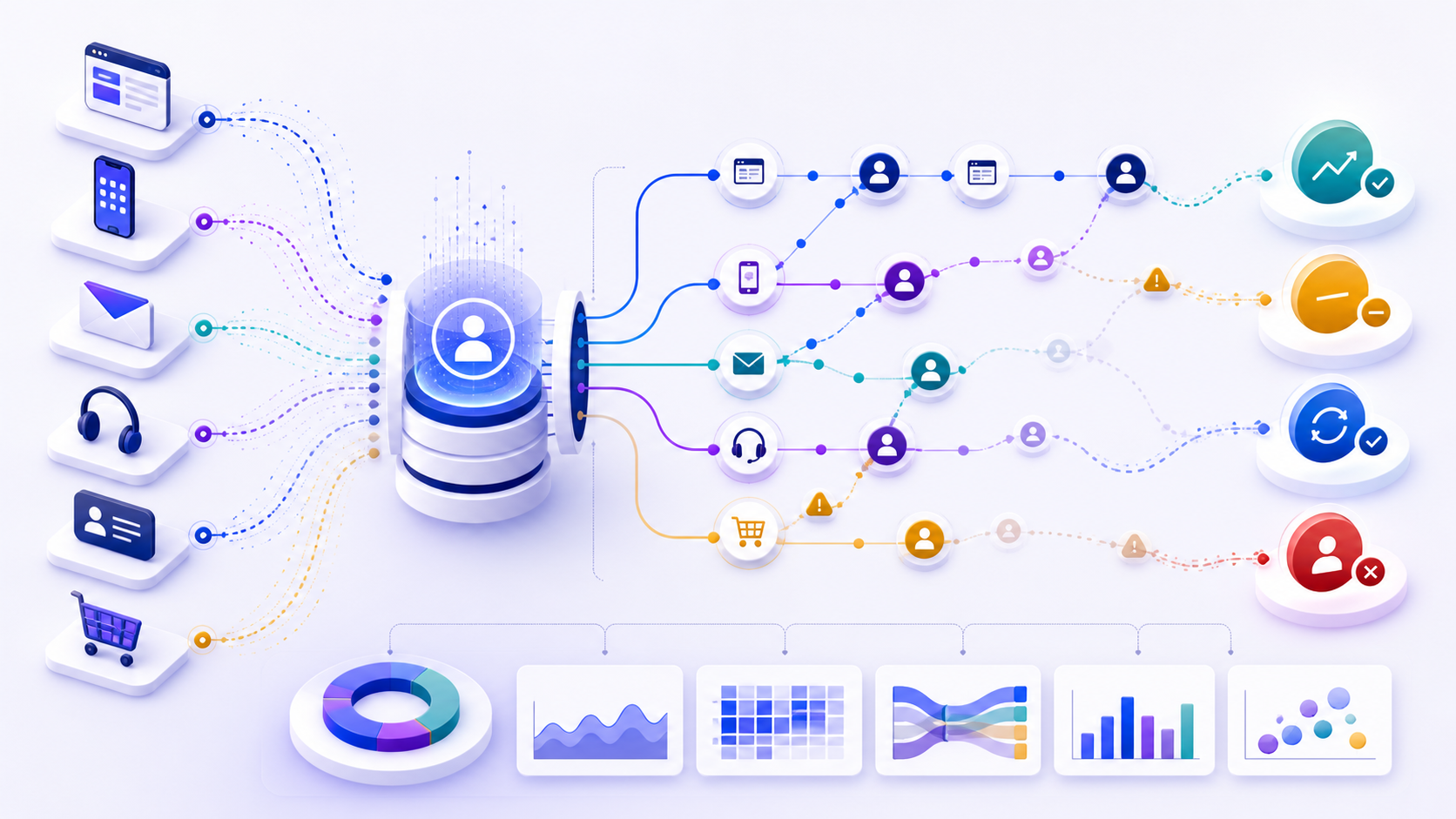
Customer journey analytics is the measurement of time-ordered customer interactions across channels, sessions, and systems so teams can compare paths, locate friction, and connect behavior to outcomes. It goes beyond a stage diagram: it uses observed events, a defensible identity rule, and explicit outcome windows to test how customers actually move from discovery through activation, purchase, retention, support, or churn.
客户旅程分析是对跨渠道、跨会话和跨系统的客户时序交互进行度量,使团队能够比较路径、定位摩擦并把行为与结果关联起来。它不止绘制阶段图,而是使用真实事件、可辩护的身份规则和明确的结果时间窗,检验客户如何从发现走向激活、购买、留存、支持或流失。
The useful output is not one “average journey.” It is a set of segment-specific patterns with denominators, time boundaries, and uncertainty: common successful paths, frequent loops, dead ends, delayed conversions, and behaviors that precede retention or churn. Those patterns guide questions and experiments; they do not automatically prove causation. Mobile replay and the other app jobs are in the mobile app experience analytics tools comparison.
有用的结果不是一条“平均旅程”,而是一组带有分母、时间边界与不确定性的分群模式:常见成功路径、反复循环、死胡同、延迟转化,以及在留存或流失前出现的行为。这些模式用于指导问题与实验,但不能自动证明因果关系。
Why customer journey analytics matters为什么客户旅程分析重要
Channel reports are optimized for their own boundaries. An ad platform explains clicks; a product tool explains in-app events; a CRM records opportunities; billing records payment; support records issues. A customer experiences one relationship, but the organization often sees five unrelated rows. Journey analytics creates an analytical layer across those rows without pretending every touchpoint has the same meaning.
渠道报表通常只优化自身边界:广告平台解释点击,产品工具解释应用内事件,CRM 记录商机,计费系统记录付款,支持系统记录问题。客户体验的是一段连续关系,组织看到的却可能是五条互不相干的记录。旅程分析在这些记录之上建立分析层,同时不假设每个触点具有相同意义。
A decision depends on sequence, elapsed time, repeated attempts, cross-channel behavior, or an outcome that occurs after the first session.
当决策依赖行为顺序、耗时、重复尝试、跨渠道行为,或结果发生在首次会话之后时。
A simple aggregate answers the question, tracking is too incomplete to establish order, or the team has not agreed on the outcome and unit of analysis.
当简单汇总即可回答、追踪缺失到无法确定顺序,或团队尚未统一结果定义和分析单位时。
Which sequences reach activation? Where do qualified users stall? Which support loops precede churn? How do paths differ by cohort or acquisition source?
哪些序列到达激活?合格用户在哪里停滞?哪些支持循环发生在流失之前?不同 cohort 或获客来源的路径有何差异?
Whether a touchpoint caused the outcome, why a person felt frustrated, or what would happen under a policy the data never observed.
某触点是否导致结果、用户为何感到受挫,或在历史数据从未出现的政策下会发生什么。
Customer journey mapping vs analytics, funnels, and attribution客户旅程地图、旅程分析、漏斗与归因的区别
These methods overlap, but they answer different questions. Treating them as interchangeable creates false confidence. Journey mapping describes a designed or researched experience; customer journey analytics measures observed sequences. Funnel analysis constrains behavior to ordered steps. Path analysis explores more possible sequences. Attribution assigns credit under a chosen rule. Cohort analysis compares groups anchored to a shared start event.
这些方法彼此重叠,但回答的问题不同。把它们混为一谈会制造虚假确定性。旅程地图描述设计或调研得到的体验;客户旅程分析度量真实序列;漏斗分析把行为约束为有序步骤;路径分析探索更多可能序列;归因在选定规则下分配贡献;cohort 分析比较以共同起点事件为基准的群体。
| Method方法 | Primary question核心问题 | Best evidence主要证据 | Main limitation主要限制 |
|---|---|---|---|
| Journey mapping旅程地图 | What stages, needs, and emotions should we consider?应考虑哪些阶段、需求与情绪? | Research, interviews, service design研究、访谈、服务设计 | May represent assumptions rather than frequency可能表达假设而非真实频率 |
| Journey analytics旅程分析 | What paths occur, for whom, and with what outcome?哪些路径真实发生、发生在谁身上、结果如何? | Time-ordered cross-source events跨源时序事件 | Identity and instrumentation bias身份与埋点偏差 |
| Funnel analysis漏斗分析 | Where do users fail between defined steps?用户在预定义步骤间哪里流失? | Step entry, completion, and denominator步骤进入、完成与分母 | Misses unmodeled detours and loops忽略未建模的绕行与循环 |
| Attribution归因 | How should credit be allocated?应如何分配贡献? | Touchpoints, outcome, and explicit model触点、结果与明确模型 | Credit rules are not causal proof贡献规则并非因果证明 |
Prepare the data foundation before analyzing journeys分析旅程前先准备数据基础
Begin with a decision, not a dashboard. Write one outcome, one population, and one time horizon: for example, “Among newly created workspaces in Q2, which first-14-day sequences are associated with 90-day renewal?” This sentence fixes the unit (workspace), cohort, observation window, and outcome window. Without those boundaries, the analysis quietly mixes prospects, users, accounts, and customers.
从决策开始,而不是从仪表盘开始。写出一个结果、一个人群和一个时间范围,例如:“在第二季度新建的工作区中,哪些前 14 天行为序列与 90 天续费相关?”这句话确定了分析单位(工作区)、cohort、观察窗与结果窗。缺少这些边界,分析会悄悄混合潜客、用户、账户和客户。
A practical event model contains a pseudonymous subject key, event timestamp with timezone, event name and version, source system, channel, session or interaction ID when applicable, milestone, and relevant attributes. Keep raw events immutable; transform them into a documented canonical model. Record late-arriving data, duplicate policy, bot filtering, deleted identities, and consent state.
实用事件模型包含假名化主体键、带时区的事件时间、事件名称与版本、来源系统、渠道、适用时的会话或交互 ID、里程碑及相关属性。保留不可变原始事件,再转换为有文档的规范模型。同时记录迟到数据、去重策略、机器人过滤、已删除身份与同意状态。
Identity stitching is a model choice, not clerical cleanup. A login ID can connect devices for authenticated activity; a device ID cannot reliably identify the same person across devices. Never merge on unstable fields such as display name. Track match rate, ambiguity, and the share of events left anonymous. Google Analytics documents User-ID, device ID, and modeling as distinct identity spaces; Adobe likewise documents common-identifier stitching for cross-channel analysis.
身份拼接是一项模型选择,不是简单的数据清洗。登录 ID 可以连接认证后的跨设备活动,而设备 ID 无法可靠识别跨设备的同一人。不要使用显示名称等不稳定字段合并。应跟踪匹配率、歧义率和仍保持匿名的事件占比。Google Analytics 把 User-ID、设备 ID 与建模记录为不同身份空间;Adobe 也记录了用于跨渠道分析的共同标识符拼接。
How to perform customer journey analytics in seven steps如何用七个步骤执行客户旅程分析
- Frame a decision and falsifiable question定义决策与可证伪问题Name the owner, action, population, unit, observation window, outcome, and comparison. “Why is conversion down?” is too broad; “Which path changes explain the mobile trial-to-paid decline after release 4.2?” is testable.写明负责人、动作、人群、单位、观察窗、结果与对照。“为什么转化下降”过于宽泛;“4.2 版本后哪些路径变化解释了移动端试用到付费下降”才可检验。
- Define milestones without forcing a linear story定义里程碑但不强迫线性故事Use business-meaningful milestones such as qualified visit, account creation, first value, purchase, repeat use, support escalation, renewal, or cancellation. Preserve lower-level events for investigation.使用合格访问、开户、首次价值、购买、重复使用、支持升级、续费或取消等有业务意义的里程碑,并保留底层事件供调查。
- Build and audit the identity rule建立并审计身份规则Choose person or account grain, specify deterministic and permitted probabilistic links, handle anonymous-to-known transitions, and publish match-quality metrics. Compare stitched and unstitched results.选择个人或账户粒度,规定确定性及允许的概率链接,处理匿名到已知身份转换,发布匹配质量指标,并比较拼接前后结果。
- Normalize sequence and time规范序列与时间Convert timezones, deduplicate retries, resolve simultaneous events, set inactivity/session rules, and cap the journey window. Keep ingestion time separate from event time.统一时区、去除重试重复、处理同时事件、设定不活跃/会话规则并限制旅程窗口。采集时间与事件时间分开保存。
- Explore paths, funnels, transitions, and cohorts探索路径、漏斗、转移与 cohortStart with path frequency and transition matrices, then use funnels for known hypotheses, cohorts for time-based comparison, and segments to expose averages that hide different behaviors.先看路径频率与转移矩阵,再用漏斗检验已知假设、用 cohort 做时间比较、用分群揭示被平均值掩盖的差异。
- Connect paths to outcomes cautiously谨慎关联路径与结果Report conversion, retention, time-to-value, support burden, or churn by path with counts and confidence intervals where appropriate. Control obvious confounders; label association as association.按路径报告转化、留存、价值实现时间、支持负担或流失,并给出计数及适用时的置信区间。控制明显混杂因素,明确标注关联而非因果。
- Turn insight into a measured intervention把洞察转为可度量干预Choose one controllable friction point, define guardrails, instrument the change, and run an experiment or staged rollout. Re-run the journey view to check displacement: improving one step can move friction downstream.选择一个可控摩擦点,定义护栏指标,埋点记录变更并运行实验或分阶段发布。重新分析旅程以检查位移效应:改善一个步骤可能把摩擦推向下游。
Customer journey analytics metrics that support decisions支持决策的客户旅程分析指标
Choose metrics around transitions and outcomes, not a decorative scorecard. Always show the eligible population and event definition. A step conversion rate is completed transitions divided by eligible entrants, not all visitors. Journey completion requires a defined terminal outcome and window. Time-to-value starts at a consistent origin. Loop rate measures repeated transitions. Path entropy can indicate fragmentation but is hard to interpret alone.
围绕转移与结果选择指标,而不是制作装饰性记分卡。始终展示合格人群与事件定义。步骤转化率是完成转移者除以合格进入者,而不是全部访客。旅程完成率需要明确的终点结果与时间窗;价值实现时间需要一致起点;循环率度量重复转移;路径熵可提示碎片化,但单独解释较困难。
| Metric指标 | Definition定义 | Diagnostic use诊断用途 | Caution注意 |
|---|---|---|---|
| Step conversion步骤转化 | Eligible users reaching next milestone / eligible entrants到达下一里程碑的合格用户 / 合格进入者 | Locate stage friction定位阶段摩擦 | Eligibility and window change the rate资格与时间窗会改变比率 |
| Time to value价值实现时间 | Elapsed time from entry to first-value event从进入到首次价值事件的耗时 | Find delays and long tails发现延迟与长尾 | Use medians and percentiles, not only means使用中位数与分位数,不只看均值 |
| Loop rate循环率 | Share repeating a transition or stage重复某转移或阶段的占比 | Detect retries, confusion, or required recurrence发现重试、困惑或必要重复 | A loop can be healthy in support or learning支持或学习中的循环可能健康 |
| Outcome by path按路径结果 | Conversion or retention for a defined path family定义路径族的转化或留存 | Prioritize path hypotheses确定路径假设优先级 | Selection bias prevents causal claims选择偏差阻止因果断言 |
| Identity coverage身份覆盖率 | Events or subjects linked under the identity rule按身份规则连接的事件或主体占比 | Assess journey completeness评估旅程完整性 | High coverage can still contain wrong merges高覆盖仍可能包含错误合并 |
Worked example: diagnosing activation without inventing a story示例:不编故事地诊断激活问题
Hypothetical example: a subscription product defines activation as connecting a data source and saving a first analysis within 14 days. The team observes that a release cohort has lower 30-day retention. The following numbers are illustrative, not InfiniSynapse customer data.
假设示例:某订阅产品把激活定义为在 14 天内连接数据源并保存第一次分析。团队观察到某版本 cohort 的 30 日留存较低。以下数字仅用于说明,不是 InfiniSynapse 客户数据。
After deduplication, 10,000 eligible workspaces remain. The team compares paths and sees that workspaces entering a permission-error loop before connection have a 28% activation rate, versus 61% for otherwise similar workspaces that connect without the loop. The loop is more common on one connector version. This is a useful association and a plausible mechanism, but it does not prove the error caused non-activation: workspace size, administrator availability, and source complexity may affect both the error and outcome.
去重后剩余 10,000 个合格工作区。团队比较路径发现,在连接前进入权限错误循环的工作区激活率为 28%,而其他特征相近且未进入循环的工作区为 61%。该循环在某个连接器版本中更常见。这是一项有用关联,也存在合理机制,但不能证明错误导致未激活:工作区规模、管理员可用性与数据源复杂度可能同时影响错误和结果。
A defensible next step is to verify logging, segment by connector and account size, inspect a sample of traces, then test a clearer permission pre-check for eligible traffic. Success criteria should include activation and time-to-connect, with guardrails for connection failures and support tickets. If the change improves only the first step while saved-analysis completion falls, the intervention moved friction rather than removing it.
可辩护的下一步是验证日志,按连接器与账户规模分群,抽样检查追踪,再对合格流量测试更清晰的权限预检。成功标准应包含激活与连接耗时,同时用连接失败和支持工单作为护栏。如果变更只改善第一步,但保存分析的完成率下降,则说明干预只是移动而非消除摩擦。
Use InfiniSynapse for cross-source journey investigation使用 InfiniSynapse 调查跨源客户旅程
InfiniSynapse fits the analysis layer when journey evidence spans a product event database, CRM, billing or order data, support records, and files. Its public product describes direct connections to databases and warehouses, multi-source analysis, natural-language questions, and inspectable analytical output. It is not a CRM, customer data platform, journey orchestrator, consent manager, or automatic experimentation system.
当旅程证据分散在产品事件数据库、CRM、计费或订单数据、支持记录与文件中时,InfiniSynapse 适合作为分析层。其公开产品信息描述了数据库与仓库直连、多源分析、自然语言提问和可检查的分析输出。它不是 CRM、客户数据平台、旅程编排器、同意管理器或自动实验系统。
Before opening the tool, identify your subject key, event timestamp, milestone definitions, outcome window, and permitted data sources. Then use the InfiniSynapse AI Data Analyst to investigate cross-source paths in plain language and review the generated evidence. Human owners remain responsible for definitions, privacy, and high-stakes decisions.
打开工具前,请确认主体键、事件时间、里程碑定义、结果时间窗和允许使用的数据源。随后可使用 InfiniSynapse AI Data Analyst 以自然语言调查跨源路径并审查生成的证据。人类负责人仍需对定义、隐私与高风险决策负责。
Analyze journey data with InfiniSynapse使用 InfiniSynapse 分析旅程数据A useful prompt is: “For workspaces created in Q2, compare the first-14-day milestone sequences for those that renewed at day 90 versus those that did not. Show counts, denominators, median elapsed time between milestones, identity coverage, and connector segment. Flag data-quality limitations and do not interpret association as causation.” Adapt table and field names to your governed schema.
一个实用提示词是:“对于第二季度创建的工作区,比较 90 天续费与未续费群体在前 14 天的里程碑序列。展示计数、分母、里程碑间中位耗时、身份覆盖率和连接器分群。标注数据质量限制,不要把关联解释为因果。”请根据受治理 schema 调整表与字段名称。
Common customer journey analytics mistakes and risks客户旅程分析的常见错误与风险
Collapsing millions of sequences into one path erases segments, rare high-value routes, and long tails. Report coverage and path families.
把数百万序列压缩成一条路径会抹掉分群、罕见高价值路线与长尾。应报告覆盖率与路径族。
Over-stitching combines people; under-stitching splits one person. Run sensitivity checks and honor deletion and consent rules.
过度拼接会合并不同人,拼接不足会拆分同一人。需做敏感性检查并遵守删除与同意规则。
Studying only converted customers hides abandoned and never-observed paths. Define the eligible population before the outcome.
只研究已转化客户会隐藏放弃和未观察路径。应在结果发生前定义合格人群。
Do not use events occurring after the outcome to explain it. Freeze feature and observation windows before analysis.
不要用结果发生后的事件解释结果。分析前应冻结特征窗与观察窗。
An event rename or release can appear as behavior change. Version schemas and annotate deployments.
事件改名或发布可能看似行为变化。应版本化 schema 并标注部署。
High-converting paths may be selected by motivated users. Use journey analysis to form hypotheses, then test interventions.
高转化路径可能由高动机用户选择。用旅程分析形成假设,再测试干预。
Privacy is a design constraint. Minimize attributes, pseudonymize identifiers, restrict access, document retention, and obtain appropriate legal review for the markets and data involved. Analytics capability does not itself create permission to combine data. Avoid exposing individual paths when aggregated results answer the decision.
隐私是设计约束。应最小化属性、对标识符假名化、限制访问、记录保留期限,并针对所涉市场与数据取得适当法律审查。具备分析能力并不自动产生合并数据的权限。当聚合结果足以回答决策时,不应暴露个人路径。
Validate journey findings before acting行动前验证旅程结论
- Reconcile totals: compare source-system counts, canonical events, eligible subjects, and analysis output for the same window.核对总数:在同一时间窗比较来源系统计数、规范事件、合格主体与分析输出。
- Inspect samples: manually trace representative successful, failed, looped, and anonymous journeys against source records.抽样检查:把代表性的成功、失败、循环与匿名旅程手工回溯到来源记录。
- Test definitions: rerun with alternate session gaps, journey windows, milestone groupings, and identity rules.测试定义:用不同会话间隔、旅程窗、里程碑分组与身份规则重新运行。
- Check stability: compare cohorts, devices, regions, acquisition sources, plans, and account sizes; do not ship a global fix for a local pattern.检查稳定性:比较 cohort、设备、地区、获客来源、套餐与账户规模;不要为局部模式发布全局修复。
- Review missingness: quantify unmatched identities, blocked tracking, late events, and channels with unavailable data.审查缺失:量化未匹配身份、被阻止的追踪、迟到事件与不可用渠道。
- Pre-register action criteria: define the expected improvement, guardrails, decision threshold, and rollback condition before reading experiment results.预先登记行动标准:在读取实验结果前定义预期提升、护栏、决策阈值与回滚条件。
Version the analysis contract—population, unit, definitions, identity logic, windows, filters, query, and source snapshots—so another analyst can reproduce the result. A visually compelling path diagram without this contract is an illustration, not decision-grade evidence.
对分析契约进行版本管理,包括人群、单位、定义、身份逻辑、时间窗、过滤器、查询与来源快照,使另一位分析师能够复现结果。缺少这些契约的精美路径图只是插图,不是可用于决策的证据。
Customer journey analytics FAQ客户旅程分析常见问题
What is customer journey analytics?
什么是客户旅程分析?
Customer journey analytics connects time-ordered interactions across channels and identities, then measures how different paths relate to outcomes such as activation, conversion, retention, support demand, and churn.
客户旅程分析连接跨渠道和跨身份的时序交互,再度量不同路径与激活、转化、留存、支持需求和流失等结果之间的关系。
How is customer journey analytics different from journey mapping?
客户旅程分析与旅程地图有何不同?
Journey mapping is a designed representation of stages, needs, and emotions; journey analytics tests observed event sequences and outcomes. Use the map to frame hypotheses and analytics to verify or revise them.
旅程地图是对阶段、需求与情绪的设计性表达;旅程分析检验真实事件序列和结果。用地图提出假设,再用分析验证或修正。
What data is needed for customer journey analytics?
客户旅程分析需要哪些数据?
Start with a person or account key, timestamp, event name, channel, journey milestone, and outcome. Add campaign, product, transaction, support, and consent attributes only when they answer a defined question.
从个人或账户键、时间戳、事件名称、渠道、旅程里程碑与结果开始。只有在服务明确问题时,才增加活动、产品、交易、支持与同意属性。
Can customer journey analytics prove causation?
客户旅程分析能证明因果关系吗?
No. Journey patterns are observational associations. Use experiments, holdouts, or credible quasi-experimental designs before claiming that a touchpoint caused an outcome.
不能。旅程模式属于观察性关联。在声称某触点导致结果前,应使用实验、留出组或可信的准实验设计。
How often should journey analysis be updated?
客户旅程分析应多久更新一次?
Refresh on a cadence that matches the decision and data latency, and rerun after tracking changes, major releases, channel changes, or identity-rule changes. Version definitions so comparisons remain valid.
按决策节奏与数据延迟刷新,并在追踪变更、重大版本、渠道或身份规则变化后重跑。对定义进行版本管理,确保比较仍有效。
Official sources and practical next steps权威来源与实用下一步
For implementation details, review Google Analytics reporting identity documentation, which distinguishes User-ID, device ID, and modeling; Adobe Customer Journey Analytics identity stitching documentation, which explains common-identifier stitching for cross-channel analysis; and the Adobe Customer Journey Analytics guide for online and offline data analysis concepts. Vendor documentation describes each product's behavior; it is not an independent claim that any one platform fits every organization.
关于实施细节,可阅读 Google Analytics 报告身份文档,了解 User-ID、设备 ID 与建模的区别;阅读 Adobe Customer Journey Analytics 身份拼接文档,了解用于跨渠道分析的共同标识符拼接;并参考 Adobe Customer Journey Analytics 指南了解线上与线下数据分析概念。供应商文档说明各自产品行为,并不独立证明某个平台适合所有组织。
For cross-channel source planning, use the marketing data analysis guide. For open-ended analysis across multiple sources, use the data agent guide. Behavior on those touchpoints is customer engagement metrics.
跨渠道数据源规划可参考营销数据分析指南;跨多个来源开展开放式分析可参考数据智能体指南。这些触点上的行为是客户参与度指标。