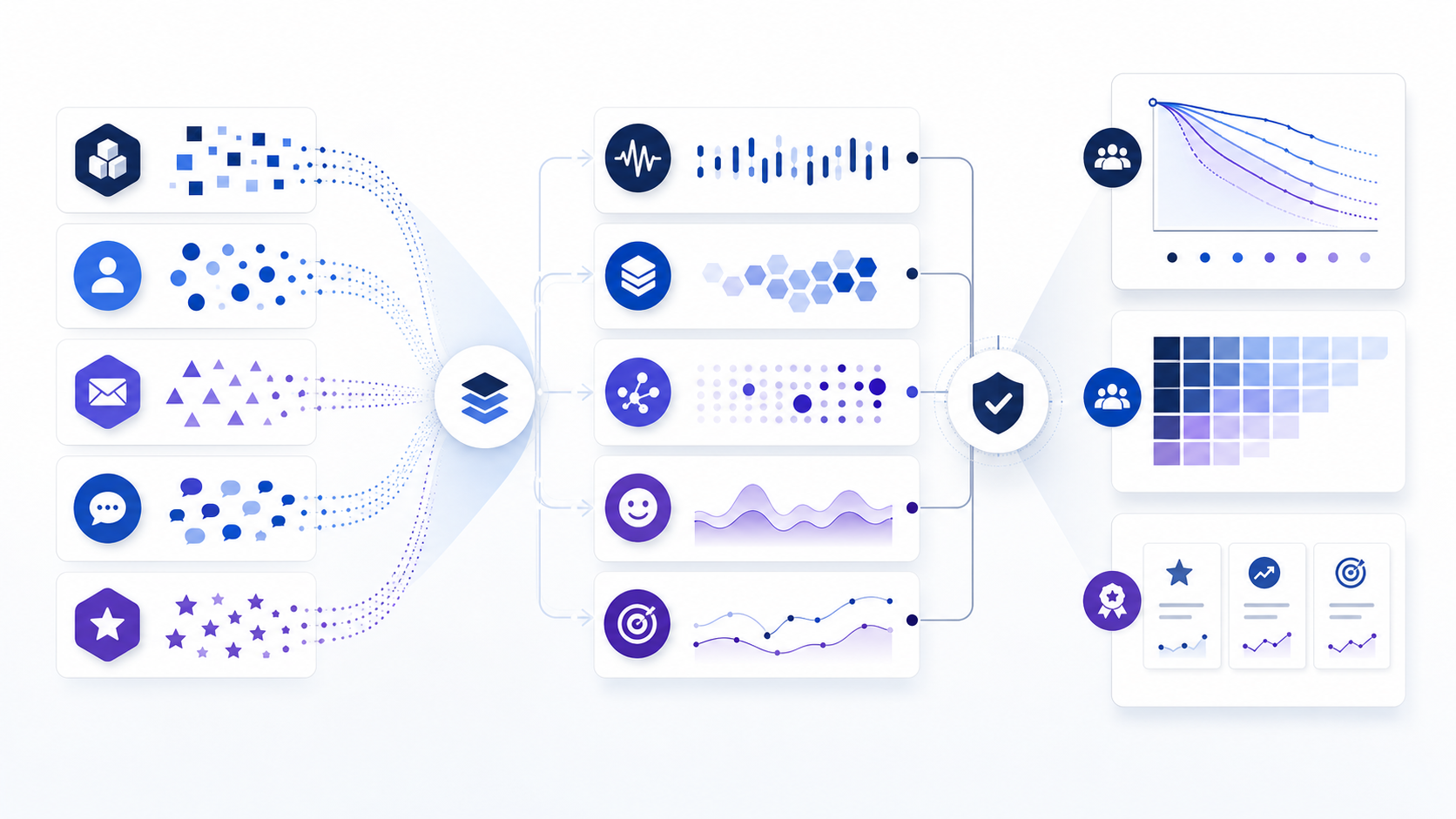
Customer engagement metrics: quick answer客户参与度指标:快速回答
Customer engagement metrics quantify the frequency, depth, breadth, and quality of customer interactions, then test whether those interactions predict a defined outcome such as activation, retention, renewal, or expansion. A useful scorecard combines observed behavior with one outcome guardrail; survey and channel metrics explain context but should not substitute for value-producing behavior. Track four first: engagement rate, stickiness, feature adoption, and retention.
客户参与度指标用于量化客户互动的频率、深度、广度和质量,并检验这些互动是否能预测激活、留存、续约或扩张等明确结果。一套有用的指标体系应把可观察行为与一个结果护栏结合起来;调查和渠道指标用于解释背景,但不能替代能够产生价值的真实行为。先跟踪四项:参与率、粘性、功能采用和留存。
There is no universal “engagement score.” A streaming service, B2B analytics product, marketplace, retailer, and support organization create value through different actions and time cycles. The correct metric begins with a customer job and a decision, not with whatever is easiest to count.
并不存在通用的“参与度得分”。流媒体服务、B2B 分析产品、交易平台、零售商和客服组织通过不同动作、以不同周期创造价值。正确的指标应从客户任务和待做决策出发,而不是从最容易统计的数据出发。
Four customer engagement metrics to track first先跟踪的四项客户参与度指标
The four names in the opening are the short list. The formula table below is the full menu.
开篇点名的四项是短名单。下方公式表是完整菜单。
| Metric指标 | What to count统计什么 | Outcome it can be tested against可对照的结果 |
|---|---|---|
| Engagement rate参与率 | Eligible customers who did one defined value action完成一次已定义价值动作的合格客户 | Activation or repeat use激活或再次使用 |
| Stickiness粘性 | DAU ÷ MAU, or WAU ÷ MAU, when the product has a natural cadence产品有自然使用节奏时,用 DAU ÷ MAU 或 WAU ÷ MAU | Habit on the product's own cadence按产品自身节奏形成的习惯 |
| Feature adoption功能采用 | Eligible users who reach the defined adoption event. The whole-product check is a product adoption test.达到已定义采用事件的合格用户。整产品的检验是产品采用检验。 | Breadth of the job, past the first click任务覆盖面,超过第一次点击 |
| Retention留存 | Returning cohort members ÷ the original cohort回访同期群成员 ÷ 原始同期群 | Sustained value on a complete window完整窗口上的持续价值 |
Add renewal or repeat purchase as the commercial guardrail. Add NPS or CSAT only beside observed behavior.
把续约或复购作为商业护栏。NPS 或 CSAT 只放在可观察行为旁边。
A framework for meaningful customer engagement metrics构建有意义的客户参与度指标框架
Treat engagement as a chain of evidence. An interaction is only a signal. Repeated or deeper interaction can indicate value, but it may also indicate confusion, an unresolved support problem, or forced workflow. The outcome tells you whether the signal deserves to be promoted into a KPI.
应把参与度看成一条证据链。一次互动只是信号;重复或更深入的互动可能代表价值,也可能代表困惑、未解决的客服问题或被迫完成的流程。只有结果才能帮助你判断该信号是否值得升级为 KPI。
How often an eligible customer returns or performs a qualifying action in a defined window.
符合条件的客户在明确时间窗口内返回或执行合格动作的次数。
How much value-bearing work occurs in a session, workflow, or account—not merely elapsed time.
一次会话、工作流或账户中完成了多少具有价值的工作,而不仅是停留时长。
How many relevant features, workflows, roles, or channels an account uses without rewarding random exploration.
一个账户使用了多少相关功能、工作流、角色或渠道,同时避免奖励无目的探索。
What customers report through NPS, CSAT, CES, qualitative feedback, or support conversation signals.
客户通过 NPS、CSAT、CES、定性反馈或客服对话信号表达的感受。
Whether engagement is followed by activation, retention, renewal, expansion, purchase, or successful task completion.
互动之后是否出现激活、留存、续约、扩张、购买或任务成功完成。
Customer lifecycle, plan, role, acquisition source, device, geography, and other attributes needed for fair comparison.
为了公平比较所需的客户生命周期、套餐、角色、获客来源、设备、地区等属性。
Customer versus user engagement. User engagement usually focuses on product behavior by an individual user. Customer engagement can span users and account-level touchpoints: product usage, onboarding, support, email, community, surveys, purchases, and renewals. For B2B analysis, preserve both user and account identifiers.
客户参与度与用户参与度。用户参与度通常聚焦单个用户的产品行为;客户参与度则可能跨越多个用户和账户级触点,包括产品使用、入驻、客服、邮件、社区、调查、购买与续约。B2B 分析应同时保留用户标识和账户标识。
Core customer engagement metrics and formulas核心客户参与度指标与计算公式
Use the table as a menu, not a mandate. Select the smallest set that represents value for your customer journey. State the numerator, denominator, eligible population, qualifying event, and time window in the metric definition.
请把下表当作选择菜单,而不是强制清单。只选择能够代表客户旅程价值的最小指标集合,并在指标定义中写清分子、分母、合格人群、合格事件和时间窗口。
| Metric指标 | Formula or definition公式或定义 | Best use最佳用途 | Main caution主要注意事项 |
|---|---|---|---|
| Customer engagement rate客户参与率 | Engaged customers ÷ eligible customers × 100参与客户数 ÷ 合格客户数 × 100 | Reach of one defined value action衡量某个价值动作的覆盖面 | “Engaged” must be explicit and stable“参与”定义必须明确且稳定 |
| Active customer rate活跃客户率 | Active customers ÷ eligible customers × 100活跃客户数 ÷ 合格客户数 × 100 | Account-level product use账户级产品使用 | Login alone rarely proves value仅登录通常不能证明价值 |
| Stickiness使用黏性 | DAU ÷ MAU × 100 (or WAU ÷ MAU)DAU ÷ MAU × 100(或 WAU ÷ MAU) | Products with a known natural cadence具有明确自然使用周期的产品 | Daily use is not desirable for every product并非所有产品都需要每日使用 |
| Engaged sessions per active user每位活跃用户的参与会话数 | Engaged sessions ÷ active users参与会话数 ÷ 活跃用户数 | Web and app interaction frequency网站与应用互动频率 | Platform definitions may differ不同平台的定义可能不同 |
| Feature adoption rate功能采用率 | Feature adopters ÷ eligible users × 100采用该功能的用户 ÷ 合格用户 × 100 | Measuring discovery and repeated value衡量功能发现与重复价值 | Define adoption beyond first click采用不能只定义为首次点击 |
| Key-action frequency关键动作频率 | Qualifying actions ÷ active customers合格动作数 ÷ 活跃客户数 | Repeated workflow completion重复完成核心工作流 | Heavy users can distort the mean重度用户可能扭曲平均值 |
| Breadth of adoption采用广度 | Relevant features used ÷ relevant features available已使用的相关功能 ÷ 可用相关功能 | Multi-workflow or multi-role products多工作流或多角色产品 | More features is not always more value使用更多功能不一定创造更多价值 |
| Retention rate留存率 | Returning cohort members ÷ original cohort × 100返回的同期群成员 ÷ 原始同期群 × 100 | Testing sustained value over time检验价值是否持续 | Use complete, comparable cohorts必须使用完整且可比的同期群 |
| Renewal or repeat-purchase rate续约率或复购率 | Renewed customers ÷ customers due × 100已续约客户 ÷ 到期客户 × 100 | Commercial outcome guardrail商业结果护栏 | Lagging and affected by price or contracts属于滞后指标,且受价格或合同影响 |
| NPS净推荐值(NPS) | % promoters − % detractors推荐者占比 − 贬损者占比 | Relationship sentiment关系层面的情感 | Survey response bias; not behavior存在调查响应偏差,且不等于行为 |
| CSAT客户满意度(CSAT) | Satisfied responses ÷ valid responses × 100满意回答数 ÷ 有效回答数 × 100 | A specific interaction or support case特定互动或客服工单 | Momentary satisfaction can miss long-term value瞬时满意可能无法反映长期价值 |
| Support engagement客服互动指标 | Resolution, reopen, effort, and contact patterns解决、重开、费力度与联系模式 | Diagnosing friction and assistance needs诊断摩擦与协助需求 | More contacts may mean problems, not loyalty联系更多可能代表问题,而非忠诚 |
Google Analytics defines an engaged session as one lasting longer than ten seconds, containing a key event, or containing at least two page or screen views. That definition is useful inside GA4, but it is not a universal customer engagement standard. Preserve the source-specific rule in your semantic layer instead of silently mixing it with product or account definitions.
Google Analytics 将参与会话定义为持续超过十秒、包含关键事件,或至少包含两次页面/屏幕浏览的会话。这个定义适用于 GA4,但不是通用的客户参与度标准。应在语义层中保留来源特定的规则,不要把它与产品或账户定义悄然混用。
How to choose the right engagement KPIs如何选择正确的客户参与度 KPI
Start with the decision the team must make. “Improve engagement” is not a decision. “Identify newly activated accounts likely to miss renewal readiness” is. Work backward from that outcome to a value-producing behavior and then to diagnostic context.
从团队必须作出的决策开始。“提升参与度”不是决策;“识别已经激活但可能无法达到续约准备度的新账户”才是。应从结果反推创造价值的行为,再补充诊断上下文。
- Name the customer job and outcome.明确客户任务与结果。 Write one sentence linking a completed customer job to activation, retention, purchase, renewal, or expansion.用一句话把完成的客户任务与激活、留存、购买、续约或扩张联系起来。
- Choose one primary behavior.选择一个主要行为。 Prefer a repeated value action over a generic login, page view, message open, or time-spent measure.优先选择重复出现的价值动作,而不是泛化的登录、页面浏览、消息打开或停留时间。
- Add one outcome guardrail.增加一个结果护栏。 Use retention, renewal, task success, repeat purchase, or another outcome to test whether higher activity is genuinely useful.用留存、续约、任务成功、复购或其他结果检验更高活动是否真的有用。
- Select diagnostic slices.选择诊断切片。 Lifecycle stage, plan, role, acquisition source, device, and geography often explain an aggregate movement.生命周期阶段、套餐、角色、获客来源、设备和地区通常能够解释汇总指标变化。
- Write the metric contract.编写指标契约。 Record owner, source tables, identity rules, qualifying events, exclusions, time zone, window, formula, refresh cadence, and tests.记录负责人、来源表、身份规则、合格事件、排除条件、时区、窗口、公式、刷新频率和测试。
Decision rule: keep a metric when a team can name the decision it changes, the population it represents, and the failure condition that would make it misleading. Otherwise, treat it as an exploratory diagnostic rather than a KPI.
决策规则:当团队能够说明某指标会改变什么决策、代表什么人群,以及什么失败条件会使它产生误导时,才把它保留为 KPI;否则应把它视为探索性诊断指标。
Data and prerequisites before measurement开始衡量前的数据与准备条件
A metric is only as trustworthy as its identity model and instrumentation. Before calculating a score, assemble a minimal analysis dataset and document what each row means.
指标的可信度取决于身份模型和埋点质量。在计算得分前,应准备最小可分析数据集,并说明每一行数据代表什么。
- Identity: a stable user ID and, for B2B or household models, a stable customer/account ID plus a dated membership table.身份:稳定的用户 ID;对于 B2B 或家庭模型,还需要稳定的客户/账户 ID 与带生效日期的成员关系表。
- Interaction events: event name, timestamp, actor, account, object, channel, properties, and ingestion time. Separate client time from server time.互动事件:事件名称、时间戳、执行者、账户、对象、渠道、属性和入库时间;客户端时间与服务器时间应分开。
- Eligibility: plan dates, activation dates, consent, geography, test accounts, employee accounts, and product availability.合格范围:套餐日期、激活日期、同意状态、地区、测试账户、员工账户和产品可用范围。
- Touchpoints: support cases, onboarding milestones, email or message events, community activity, and survey responses with their own source semantics.触点:客服工单、入驻里程碑、邮件或消息事件、社区活动和调查回答,并保留各来源自身语义。
- Outcomes: task completion, retention, renewal eligibility and result, repeat purchase, expansion, cancellation, or another governed business outcome.结果:任务完成、留存、续约资格与结果、复购、扩张、取消或其他受治理的业务结果。
Deduplicate retries, bots, monitoring traffic, internal users, and repeated webhooks. Define late-arriving event handling. If identities cannot be joined safely across systems, report source-level metrics separately rather than inventing a “unified customer.”
需要去重重试、机器人、监控流量、内部用户和重复 Webhook,并定义迟到事件的处理方式。如果不同系统之间无法安全合并身份,应分别报告来源级指标,而不是虚构一个“统一客户”。
A repeatable customer engagement measurement workflow可重复执行的客户参与度衡量工作流
- Define the analysis question.定义分析问题。 Specify population, period, comparison, outcome, and the decision owner. Example: “Which first-30-day behaviors distinguish accounts that renew?”写明人群、周期、比较对象、结果和决策负责人。例如:“哪些前 30 天行为能够区分会续约的账户?”
- Audit tracking and identity joins.审计埋点与身份连接。 Check missing IDs, duplicate events, clock skew, event-volume breaks, account membership changes, and coverage by platform version.检查缺失 ID、重复事件、时钟偏差、事件量断点、账户成员变化和各平台版本覆盖率。
- Build eligible cohorts.构建合格同期群。 Anchor cohorts on activation, first purchase, contract start, or another comparable starting event. Exclude customers without enough observation time.以激活、首次购买、合同开始或其他可比起点构建同期群,并排除观察时间不足的客户。
- Calculate distributions, not only averages.计算分布,而不仅是平均值。 Report median, percentiles, zero-activity share, and account-weighted versus user-weighted values. Heavy users often hide broad disengagement.报告中位数、分位数、零活动占比,以及账户加权与用户加权结果;重度用户常会掩盖广泛的低参与。
- Segment before explaining.先分群,再解释。 Compare lifecycle, plan, role, source, device, and region. Confirm that a mix shift is not creating the aggregate trend.比较生命周期、套餐、角色、来源、设备和地区,确认汇总趋势不是由人群结构变化造成。
- Link leading behavior to outcomes.把领先行为与结果联系起来。 Use completed cohorts and an appropriate lag. Association is evidence for prioritization, not proof that the behavior caused the outcome.使用已完成的同期群和适当滞后期。相关性可以支持优先级判断,但不能证明该行为导致了结果。
- Validate and operationalize.验证并运营化。 Reconcile totals to source systems, review sample records, document caveats, assign owners, and monitor definition or instrumentation changes.将总量与来源系统核对,抽查记录,记录限制条件,分配负责人,并监控定义或埋点变化。
Worked example: an account engagement scorecard完整示例:账户参与度记分卡
Hypothetical example—not a customer case or benchmark. A B2B analytics product wants to understand renewal readiness for newly activated accounts. Its customer job is “complete and share a verified analysis.” The team chooses completed analyses per active account as the primary behavior, 60-day return as an early outcome, and renewal as a later outcome.
以下是假设示例,不是客户案例或行业基准。某 B2B 分析产品希望了解新激活账户的续约准备度。客户任务是“完成并分享一份经过验证的分析”。团队选择“每个活跃账户完成的分析数”作为主要行为,60 天返回作为早期结果,续约作为较晚结果。
| Layer层级 | Illustrative definition示例定义 | Why it is included纳入原因 |
|---|---|---|
| Primary behavior主要行为 | Median verified analyses per eligible active account in days 8–30激活后第 8–30 天,每个合格活跃账户完成的验证分析数中位数 | Represents repeated customer value, not opening the application代表重复客户价值,而不是仅打开应用 |
| Breadth diagnostic广度诊断 | Share of accounts with two or more contributing members至少有两名成员参与的账户占比 | Tests whether value spreads across the account检验价值是否在账户内扩散 |
| Friction diagnostic摩擦诊断 | Share of analyses reopened because of source or definition errors因来源或定义错误而重新打开的分析占比 | Prevents extra activity from being misread as healthy engagement避免把因错误产生的额外活动误判为健康参与 |
| Early outcome早期结果 | Account returns and completes a value action in days 31–60账户在第 31–60 天返回并完成价值动作 | Tests sustained value on a completed window在完整窗口内检验持续价值 |
| Commercial outcome商业结果 | Renewed eligible accounts divided by accounts due for renewal已续约合格账户数除以到期应续约账户数 | Provides the business guardrail with an acknowledged lag在承认滞后性的前提下提供业务护栏 |
Suppose the illustrative dataset contains 200 eligible accounts. Do not compare “high-score” and “low-score” renewal immediately: newer accounts may not have reached renewal. First freeze a completed acquisition cohort, check plan and company-size mix, examine the full behavior distribution, and then compare outcomes. If the relationship survives these checks, the score can prioritize investigation or outreach; it still does not prove that forcing more actions will cause renewal.
假设示例数据包含 200 个合格账户,不应立即比较“高分”和“低分”账户的续约,因为较新的账户可能尚未到达续约期。应先冻结一个观察完整的获客同期群,检查套餐与公司规模构成,查看完整行为分布,再比较结果。如果关系经这些检查后仍然存在,该得分可以用于安排调查或触达优先级;但它仍不能证明强迫客户执行更多动作就会导致续约。
How to interpret engagement changes without fooling yourself如何解读参与度变化并避免误判
| Observed pattern观察到的模式 | Possible explanations可能解释 | Next check下一步检查 |
|---|---|---|
| Activity rises; retention is flat活动上升但留存持平 | Low-value events, campaign-driven visits, friction, or an immature cohort低价值事件、活动带来的访问、流程摩擦或同期群尚未成熟 | Key-action share, source mix, completed cohorts, support contacts关键动作占比、来源构成、完整同期群、客服联系 |
| Time spent rises; task success falls停留时间上升但任务成功下降 | Workflow difficulty, performance problems, or confusing navigation工作流困难、性能问题或导航混乱 | Completion time distribution, errors, replay or qualitative research完成时长分布、错误、回放或定性研究 |
| NPS rises; observed use fallsNPS 上升但实际使用下降 | Response bias, customer mix shift, seasonality, or a smaller respondent base响应偏差、客户构成变化、季节性或回答样本缩小 | Response rate, respondent versus nonrespondent behavior, weighting回答率、回答者与未回答者行为、加权方式 |
| Account activity rises; users per account fall账户活动上升但每账户用户数下降 | Power-user concentration or seat contraction活动集中于重度用户或席位收缩 | User-level distribution, role coverage, account breadth用户级分布、角色覆盖和账户广度 |
Always separate observation from inference. “Median key actions fell 12%” is an observation if the query and denominator are verified. “Customers find the workflow less valuable” is an inference that requires segmentation, qualitative evidence, and preferably an experiment. A dashboard should label that distinction.
必须区分观察与推断。“关键动作中位数下降 12%”在查询和分母经验证后属于观察;“客户认为该工作流价值降低”则是推断,需要分群、定性证据,最好还需要实验。仪表板应清楚标记二者差异。
Common mistakes, limitations, and risks常见错误、局限与风险
- Vanity activity: page views, opens, raw sessions, and total messages can grow without customer value. Tie them to a job or demote them to diagnostics.虚荣活动:页面浏览、打开、原始会话和消息总数可能在客户价值没有增长时上升;应把它们与客户任务关联,否则降级为诊断指标。
- Denominator drift: using all registered customers one month and eligible active customers the next makes the trend meaningless.分母漂移:一个月使用全部注册客户,另一个月使用合格活跃客户,会使趋势失去意义。
- Incomplete cohorts: Day-30 retention for a cohort only 12 days old is not zero; it is not observable yet.同期群不完整:一个只有 12 天历史的同期群,其第 30 天留存并不是零,而是尚不可观察。
- Identity inflation: cookies, devices, guests, merged accounts, and shared logins can overcount or undercount customers.身份膨胀:Cookie、设备、访客、合并账户和共享登录都可能造成客户高估或低估。
- Average-only reporting: a small power-user group can raise the mean while most customers disengage. Show distributions and zero-activity share.只报告平均值:少量重度用户可能抬高平均值,同时大多数客户参与下降;应展示分布和零活动占比。
- Survey overreach: NPS and CSAT capture responses from respondents. They do not automatically represent silent customers or observed behavior.调查过度解释:NPS 与 CSAT 只反映回答者,不会自动代表沉默客户或实际行为。
- Correlation as causation: engaged customers may already differ in size, need, maturity, or plan. Use experiments or careful quasi-experimental designs for causal claims.把相关当因果:高参与客户可能本就具有不同规模、需求、成熟度或套餐;因果结论需要实验或严谨的准实验设计。
- Privacy and minimization: collect only data necessary for a defined purpose, respect consent and access rules, and avoid sensitive attributes unless justified and governed.隐私与最小化:只收集明确目的所需的数据,遵守同意与访问规则;除非理由充分并受治理,否则避免使用敏感属性。
Analyze customer engagement across structured data跨结构化数据分析客户参与度
Prepare a read-only connection or files containing customer/account IDs, timestamped interaction events, eligibility dates, and one governed outcome. Also prepare a short metric contract defining “eligible,” “engaged,” and the observation window.
请准备只读数据连接或文件,其中包含客户/账户 ID、带时间戳的互动事件、合格日期和一个受治理的结果;同时准备一份简短指标契约,定义“合格”“参与”和观察窗口。
Use the InfiniSynapse online data analysis application to ask a plain-language question over connected structured data, then review the plan, queries, evidence, and resulting tables or visualizations. It supports analysis; it does not replace your CRM, product instrumentation, support system, or metric governance.
使用 InfiniSynapse 在线数据分析应用,对已连接的结构化数据提出自然语言问题,然后审查分析计划、查询、证据以及生成的表格或可视化。它用于分析,不会替代 CRM、产品埋点、客服系统或指标治理。
Analyze structured customer data online在线分析结构化客户数据A suitable first question is: “For accounts activated last quarter, compare verified value actions during days 8–30 with 60-day return, segmented by plan and acquisition source; show cohort completeness and the SQL behind each result.” A steady executive KPI dashboard may still be better served by BI; InfiniSynapse is relevant when the question is ad hoc, cross-source, and needs an evidence trail.
适合的第一个问题是:“针对上季度激活的账户,比较第 8–30 天完成的验证价值动作与 60 天返回情况,并按套餐和获客来源分群;同时显示同期群完整性和每个结果背后的 SQL。”稳定的管理层 KPI 看板仍可能更适合 BI;当问题是临时提出、跨多个数据源且需要证据链时,InfiniSynapse 更相关。
Validate the metric before using it for decisions在用于决策前验证指标
- Recalculate a small sample manually and reconcile totals to the source interface or ledger.手工重算一个小样本,并把总量与来源界面或账本核对。
- Confirm unique-user and unique-account logic across devices, merged accounts, guests, and role changes.确认跨设备、合并账户、访客和角色变化下的唯一用户与唯一账户逻辑。
- Check event volume, missing properties, duplicate rates, and schema changes by date and platform version.按日期和平台版本检查事件量、缺失属性、重复率和 Schema 变化。
- Verify the denominator, eligibility dates, exclusions, time zone, and late-arriving event policy.验证分母、合格日期、排除项、时区和迟到事件政策。
- Compare median, percentiles, and zero-activity share; inspect both user- and account-weighted results.比较中位数、分位数和零活动占比,并检查用户加权与账户加权结果。
- Use complete cohorts, state observation windows, and avoid comparing groups with materially different exposure.使用完整同期群,注明观察窗口,并避免比较暴露时间实质不同的群体。
- Label hypothetical thresholds and unproven causal explanations; assign a metric owner and review date.标记假设阈值和未经证实的因果解释,并指定指标负责人和复核日期。
Customer engagement metrics FAQ客户参与度指标常见问题
Customer engagement metrics quantify how often, how deeply, and how broadly customers interact with a product or brand, how they feel about those interactions, and whether engagement leads to retention or another defined outcome.
客户参与度指标量化客户与产品或品牌互动的频率、深度和广度、客户对互动的感受,以及参与是否带来留存或其他明确结果。
There is no universal best metric. Choose one value-linked behavior as the primary measure, add a retention or outcome guardrail, and use sentiment or channel measures as diagnostics.
没有通用的最佳指标。选择一个与价值相关的行为作为主要指标,增加留存或结果护栏,再把情感或渠道指标用于诊断。
Define a qualifying engagement event first, then divide customers who performed it during the period by eligible customers during the same period and multiply by 100. Keep the event, denominator, and window fixed for comparisons.
先定义合格参与事件,再用周期内执行该事件的客户数除以同期合格客户数并乘以 100。比较时必须保持事件、分母和窗口不变。
Match cadence to the decision: operational signals may be reviewed daily or weekly, while retention cohorts and account outcomes usually need monthly or quarterly windows. Never read a partial cohort as if it were complete.
复核频率应匹配决策:运营信号可以每日或每周检查,而留存同期群与账户结果通常需要月度或季度窗口。绝不能把不完整同期群当作完整结果解读。
They are sentiment measures related to engagement, not direct records of behavior. Pair survey responses with observed product, support, or purchase behavior and report response bias and sample size.
它们是与参与相关的情感指标,不是行为的直接记录。应把调查回答与实际产品、客服或购买行为结合,并报告响应偏差和样本量。
Official sources and related analysis guides权威来源与相关分析指南
Definitions vary by system, so preserve source semantics and document every adaptation. For platform-specific facts, consult the Google Analytics definition of engagement rate and engaged sessions, the Google Analytics retention overview and cohort definitions, and Bain's Net Promoter Score calculation reference.
不同系统的定义并不相同,因此要保留来源语义并记录每次调整。对于平台特定事实,可参考 Google Analytics 对参与率与参与会话的定义、Google Analytics 留存概览与同期群定义,以及 Bain 的 净推荐值计算参考。
For the supporting technical pattern, read how a data agent analyzes structured sources with a reviewable evidence trail, compare options in the data analytics software guide, and see a cross-source example in marketing data analysis workflows.
关于相关技术模式,可阅读数据智能体如何通过可审查证据链分析结构化数据、在数据分析软件指南中比较方案,并查看营销数据分析工作流中的跨源示例。