 InfiniSynapse
Churn rate formula: the quick answer 流失率公式:快速答案
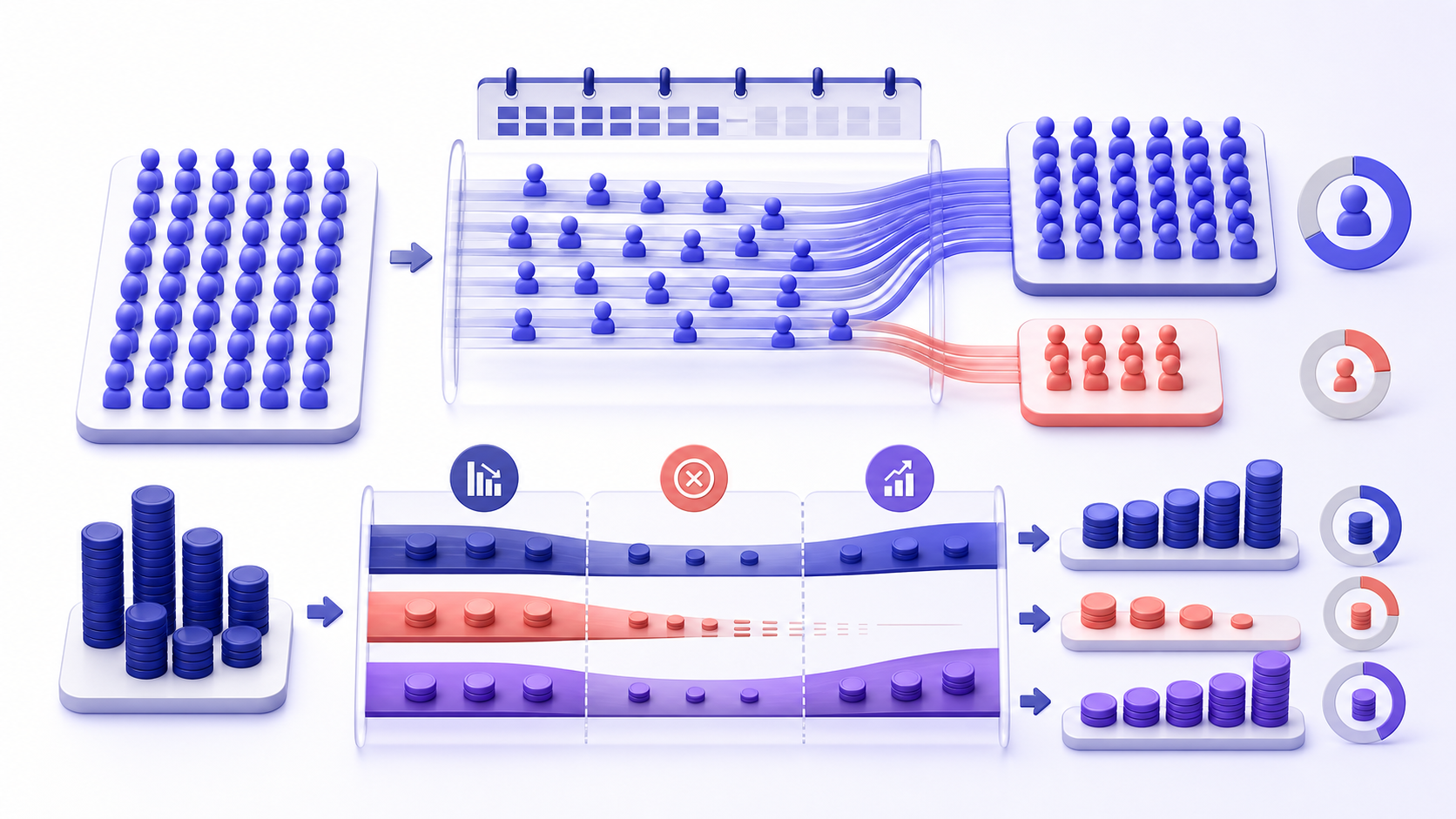
Customer churn rate equals customers lost during a period divided by customers active at the start of that period, multiplied by 100. If 20 of 500 starting customers cancel, customer churn is 4% for that period. Count only losses from the starting base; customers acquired later do not belong in the denominator.
客户流失率等于某一周期内流失的客户数除以该周期开始时的活跃客户数,再乘以 100。如果期初 500 个客户中有 20 个取消,则该周期客户流失率为 4%。分子只统计期初客户中的流失,期间新增客户不应进入分母。
The arithmetic is simple; the measurement contract is not. You must define the unit being lost, the exact period, who was eligible at the start, which event proves churn, and how reactivations, pauses, failed payments, refunds, and account mergers are treated. Without those rules, two correct queries can report different churn rates.
算术很简单,但指标契约并不简单。你必须定义流失的单位、准确周期、期初哪些对象合格、哪个事件证明流失,以及如何处理重新激活、暂停、支付失败、退款和账户合并。缺少这些规则时,两条都没有语法错误的查询也可能报告不同流失率。
Choose customer, gross revenue, or net revenue churn 选择客户流失、总收入流失或净收入流失
“Churn rate” can refer to a count of customers, a count of subscriptions, or recurring revenue. Select the formula that matches the decision. Customer churn answers how many relationships ended. Revenue churn answers how much recurring value disappeared. Track both when account values vary.
“流失率”可以指客户数量、订阅数量或经常性收入。应根据决策选择公式:客户流失回答有多少客户关系结束,收入流失回答有多少经常性价值消失。当账户价值差异明显时,两者都应跟踪。
| Metric 指标 | Formula 公式 | Best for 适用场景 | Key caution 关键注意事项 |
|---|---|---|---|
| Customer churn 客户流失率 | Lost starting customers ÷ starting customers × 100 期初客户中的流失数 ÷ 期初客户数 × 100 | Logo or subscriber loss 客户或订阅者数量流失 | Each customer has equal weight 每个客户权重相同 |
| Gross revenue churn 总收入流失率 | Cancelled MRR + contraction MRR ÷ starting MRR × 100 取消 MRR + 降级 MRR ÷ 期初 MRR × 100 | Recurring revenue lost before expansion 扩张收入抵消前的经常性收入损失 | Keep MRR with MRR and ARR with ARR MRR 必须与 MRR 对比,ARR 必须与 ARR 对比 |
| Net revenue churn 净收入流失率 | Cancelled MRR + contraction MRR − expansion MRR ÷ starting MRR × 100 取消 MRR + 降级 MRR − 扩张 MRR ÷ 期初 MRR × 100 | Net movement within the starting base 期初客户群内部的净变化 | A negative result can hide real gross losses 负值可能掩盖真实的总损失 |
| Voluntary / involuntary churn 主动/被动流失 | Relevant churn reason subset ÷ starting base × 100 对应原因的流失子集 ÷ 期初基数 × 100 | Separating cancellations from payment failure 区分主动取消与支付失败 | Reason codes need stable governance 原因代码必须保持稳定治理 |
Do not calculate customer churn as “starting customers minus ending customers.” That shortcut breaks when new customers join, accounts reactivate, or mergers change the population. Use explicit status transitions for members of the starting base.
不要直接用“期初客户数减去期末客户数”计算客户流失。新增客户、账户重新激活或账户合并都会破坏这个捷径。应针对期初客户群使用明确的状态转换记录。
Inputs required before you calculate churn rate 计算流失率前需要准备的输入
Prepare a customer or subscription ledger that can reconstruct status at both boundaries. A current-state export alone is usually insufficient because it cannot show whether an account was active at the start or exactly when it left.
请准备能够重建两个边界时点状态的客户或订阅台账。仅有当前状态导出通常不够,因为它无法证明某个账户期初是否活跃,也无法说明其准确流失时间。
Use a governed customer, account, or subscription ID. Document merges, parent-child accounts, shared subscriptions, and duplicate records.
使用受治理的客户、账户或订阅 ID,并记录账户合并、父子账户、共享订阅和重复记录。
Record timestamps, reporting timezone, start inclusion, end inclusion, late events, and whether the month follows calendar or billing dates.
记录时间戳、报告时区、起止边界是否包含、迟到事件,以及月份按自然日还是账单日划分。
Choose cancellation effective date, contract nonrenewal, service termination, or another observable rule. A risk score is not an observed churn event.
选择取消生效日、合同不续约、服务终止或其他可观察规则。风险评分并不是已经发生的流失事件。
For revenue churn, retain starting MRR or ARR and classify cancellation, contraction, expansion, reactivation, currency, credits, and refunds consistently.
计算收入流失时,保留期初 MRR 或 ARR,并一致分类取消、降级、扩张、重新激活、币种、抵扣和退款。
Metric contract: “Monthly customer churn is the percentage of paying customer accounts active at 00:00 UTC on the first day of the calendar month whose subscription becomes inactive before 00:00 UTC on the first day of the next month, excluding fraud closures and account mergers.” Adapt this hypothetical definition to your business; do not copy it blindly.
指标契约示例:“月度客户流失率是指在自然月第一天 00:00 UTC 处于付费活跃状态的客户账户中,其订阅在下月第一天 00:00 UTC 之前变为非活跃状态的比例;欺诈关闭与账户合并不计入。”这是需要按业务调整的假设定义,不能直接照搬。
How to calculate churn rate step by step 如何逐步计算流失率
- Name the unit and decision. 明确单位与决策。 Decide whether the output is customer, subscription, gross revenue, or net revenue churn and who will use it. 确定输出是客户、订阅、总收入还是净收入流失,以及谁会使用该指标。
- Freeze the period and starting base. 冻结周期与期初基数。 Materialize the eligible population at the opening boundary. Store its IDs and starting recurring revenue so later data changes cannot rewrite history silently. 在开始边界生成合格人群快照,保存 ID 与期初经常性收入,避免后续数据变化悄悄改写历史。
- Classify movements for starting members. 分类期初成员的变动。 Within the period, label cancellation, contraction, expansion, reactivation, pause, migration, and exclusion events using mutually understandable rules. 在周期内按一致规则标记取消、降级、扩张、重新激活、暂停、迁移和排除事件。
- Apply the matching formula. 应用匹配的公式。 Use starting customers for customer churn and starting recurring revenue for revenue churn. Keep the unrounded numerator, denominator, and result. 客户流失使用期初客户数作分母,收入流失使用期初经常性收入作分母,并保留未四舍五入的分子、分母和结果。
- Reconcile and segment. 对账并分群。 Reconcile beginning balance plus additions, losses, and adjustments to ending balance. Then compare plan, tenure, acquisition cohort, geography, and product-use segments without exposing tiny groups. 用期初余额加新增、减损失并考虑调整后与期末余额对账,再按套餐、客户年龄、获客同期群、地区和产品使用分群,同时避免暴露过小群体。
- Publish the contract with the metric. 随指标发布口径。 Show the period, unit, eligibility, churn event, exclusions, data freshness, query version, and reviewer. A percentage without provenance is not decision-ready. 展示周期、单位、资格、流失事件、排除项、数据新鲜度、查询版本和审核者。没有来源链的百分比不适合直接决策。
Worked SaaS churn rate formula example SaaS 流失率公式计算示例
Hypothetical example: a subscription business starts April with 500 active customer accounts and $50,000 MRR. During April, 20 starting accounts cancel. Those cancellations remove $3,000 MRR, downgrades from retained starting accounts remove $1,000 MRR, and upgrades from retained starting accounts add $2,000 MRR. New customers acquired in April are excluded from all starting-base denominators.
假设示例:一家订阅业务在 4 月初有 500 个活跃客户账户和 50,000 美元 MRR。4 月期间,期初客户中有 20 个取消,造成 3,000 美元 MRR 损失;仍然留存的期初客户发生降级,减少 1,000 美元 MRR;另有升级增加 2,000 美元 MRR。4 月新增客户不进入任何期初基数分母。
The customer and net revenue churn rates happen to match at 4%, but they describe different quantities. Gross revenue churn is 8%, showing that expansion replaced half the lost recurring revenue. Reporting only the net figure would hide the cancellation and downgrade pressure. Reporting only customer churn would hide that the lost accounts carried different revenue weights.
客户流失率和净收入流失率在本例中恰好都是 4%,但它们描述的是不同数量。总收入流失率为 8%,说明扩张收入抵消了一半经常性收入损失。如果只报告净值,会掩盖取消和降级压力;如果只报告客户流失,又会忽略流失账户的收入权重差异。
Monthly churn rate formula and annual conversion 月度流失率公式与年度换算
A monthly churn rate is not converted to annual churn by multiplying by 12 because the at-risk base changes after each month. Under the simplifying assumption that the same monthly churn probability remains constant and independent, use compounding:
月度流失率不能简单乘以 12 得到年度流失率,因为每个月之后面临风险的客户基数都会变化。在“每月流失概率恒定且相互独立”的简化假设下,应使用复利换算:
For the hypothetical 4% monthly customer churn above, the modeled annual churn is 1 − 0.9612 = approximately 38.73%, not 48%. The corresponding modeled annual retention is approximately 61.27%. This conversion assumes stable risk; seasonality, annual renewals, customer aging, price changes, and cohort mix can make observed annual churn very different.
以上述假设的 4% 月度客户流失率为例,模型化年度流失率为 1 − 0.9612,约等于 38.73%,而不是 48%;相应的模型化年度留存率约为 61.27%。这一换算假设风险稳定,但季节性、年度续约、客户年龄、价格变化和同期群构成都可能使实际年度流失明显不同。
Prefer directly observed annual cohorts when enough history exists. If you must compare rates reported at different cadences, disclose the conversion formula and assumption. Never compare a monthly percentage with an annual percentage as though the periods were identical.
当历史数据足够时,应优先使用直接观察的年度同期群。如果必须比较不同频率报告的流失率,应披露换算公式与假设。绝不能把月度百分比与年度百分比当作相同周期直接比较。
Interpret churn with cohorts and segments 用同期群与分群解读流失
An aggregate churn rate tells you what changed, not why. Break it down only along dimensions tied to a plausible decision: acquisition cohort, plan, tenure, contract term, geography, product adoption, support history, payment method, and voluntary versus involuntary reason. Preserve the same metric contract across segments.
汇总流失率告诉你发生了什么,却不能直接说明原因。只沿着与决策有关的维度分解,例如获客同期群、套餐、客户年龄、合同期限、地区、产品采用、客服历史、支付方式,以及主动或被动流失原因,并在所有分群中保持相同指标契约。
| Observed pattern 观察模式 | Possible interpretation 可能解释 | Next check 下一步检查 |
|---|---|---|
| Customer churn rises; revenue churn stays flat 客户流失上升,收入流失持平 | More lower-value accounts may be leaving 可能有更多低价值账户流失 | Plan mix, account MRR distribution, acquisition cohort 套餐构成、账户 MRR 分布、获客同期群 |
| Gross revenue churn rises; customer churn stays flat 总收入流失上升,客户流失持平 | Larger accounts may be cancelling or downgrading 较大账户可能取消或降级 | Top-account movement, contraction reasons, renewal calendar 大客户变动、降级原因、续约日历 |
| Net churn improves; gross churn worsens 净流失改善,总流失恶化 | Expansion is masking growing losses 扩张收入正在掩盖不断增长的损失 | Report gross loss and expansion separately 分别报告总损失与扩张 |
| A recent cohort looks unusually good 最近同期群看起来异常优秀 | Its renewal or observation window may be incomplete 续约或观察窗口可能尚未完整 | Compare cohorts at equal age; mark right-censored periods 在相同年龄比较同期群,并标记右删失周期 |
Keep observation separate from inference. “Gross revenue churn increased from 3.1% to 4.0% under the documented query” is an observation after verification. “Customers left because onboarding worsened” is a hypothesis requiring event evidence, interviews, controlled testing, or another credible causal design.
应把观察与推断分开。“在已记录查询口径下,总收入流失率从 3.1% 上升到 4.0%”在验证后属于观察;“客户因为入门体验变差而离开”则是需要事件证据、访谈、对照测试或其他可信因果设计支持的假设。
Common churn calculation mistakes and limitations 常见流失率计算错误与局限
- Using ending customers as the denominator: the ending base already reflects churn and acquisition, so it changes the question and can inflate the percentage.
- 使用期末客户作分母:期末基数已经受到流失和新增影响,会改变问题并可能抬高百分比。
- Mixing new customers into the starting base: acquisition during the period was not exposed for the whole period and should not dilute starting-base churn.
- 把新增客户混入期初基数:周期内新增客户没有经历完整观察期,不应稀释期初客户流失。
- Counting scheduled cancellation too early: decide whether churn occurs on request, service end, access end, or contract nonrenewal and apply the rule consistently.
- 过早统计计划取消:应明确流失发生在提出请求、服务结束、访问终止还是合同不续约,并一致执行。
- Combining MRR and ARR: numerator and denominator need the same recurring-revenue basis, currency treatment, and period.
- 混合 MRR 与 ARR:分子和分母必须使用相同的经常性收入基准、币种处理和周期。
- Hiding gross loss with expansion: negative net revenue churn can coexist with damaging cancellations. Publish gross churn, expansion, and net churn together.
- 用扩张掩盖总损失:负的净收入流失仍可能伴随严重取消。应同时发布总流失、扩张和净流失。
- Comparing unlike periods: calendar month length, billing cycles, annual renewals, and seasonal exposure can make simple comparisons misleading.
- 比较不同周期:自然月天数、账单周期、年度续约和季节性暴露都会使简单比较产生误导。
- Treating churn as causal evidence: the metric describes loss. It does not prove which product, price, support, market, or customer factor caused it.
- 把流失当作因果证据:该指标描述损失,却不能证明是产品、价格、客服、市场还是客户因素造成。
- Ignoring privacy and small groups: minimize personal data, control access, and suppress or aggregate tiny segments that could identify customers.
- 忽略隐私与小群体:应最小化个人数据、控制访问,并隐藏或聚合可能识别客户的过小分群。
Churn also has a survivorship boundary: you can observe only customers represented in your systems. Missing cancellations, failed identity stitching, offline contracts, deleted history, and migration gaps can all bias the result. Document coverage before interpreting trends.
流失分析还存在数据覆盖边界:你只能观察系统中被记录的客户。遗漏取消、身份拼接失败、线下合同、已删除历史和迁移缺口都可能造成偏差。解读趋势前应说明数据覆盖范围。
Validate the churn result before publishing it 发布前验证流失率结果
- The metric name specifies customer, subscription, gross revenue, or net revenue churn.
- 指标名称明确写出客户、订阅、总收入或净收入流失。
- Start and end timestamps, timezone, calendar or billing basis, and data freshness are visible.
- 起止时间戳、时区、自然日或账单周期以及数据新鲜度清晰可见。
- The starting-base ID list and starting MRR or ARR can be reproduced.
- 期初基数 ID 清单以及期初 MRR 或 ARR 可以复现。
- Cancellation, contraction, expansion, reactivation, exclusion, and merge rules are documented.
- 取消、降级、扩张、重新激活、排除和合并规则均有记录。
- Beginning balance reconciles to ending balance after additions, losses, and adjustments.
- 期初余额在加入新增、损失和调整后可以与期末余额对账。
- Duplicate identities, join multiplication, currency conversion, and late-arriving events have been tested.
- 已测试重复身份、关联膨胀、币种转换和迟到事件。
- Unrounded values are stored; display rounding is applied only at the final presentation layer.
- 保存未四舍五入的数值,只在最终展示层应用舍入。
- Cohorts are compared at equal age, and incomplete or right-censored periods are labeled.
- 同期群在相同年龄比较,不完整或右删失周期有明确标记。
- A reviewer can trace each total to a saved query and governed source extract.
- 审核者能够把每个汇总值追溯到已保存查询和受治理的数据提取。
Analyze churn across connected structured data 跨已连接的结构化数据分析流失
Before opening the tool, prepare read-only customer or subscription data with stable IDs, status timestamps, starting MRR or ARR, cancellation and downgrade movements, expansion movements, and a short metric contract. Use the InfiniSynapse online data analysis application to ask a plain-language question, then review the generated plan, queries, evidence, tables, and visualizations. It supports analysis; it does not replace billing, CRM, event collection, metric governance, or causal validation.
打开工具前,请准备只读客户或订阅数据,其中包含稳定 ID、状态时间戳、期初 MRR 或 ARR、取消与降级变动、扩张变动,以及一份简短指标契约。使用 InfiniSynapse 在线数据分析应用以自然语言提问,再审查生成的计划、查询、证据、表格和可视化。它用于支持分析,不会替代计费系统、CRM、事件采集、指标治理或因果验证。
Analyze structured churn data online 在线分析结构化流失数据Churn rate formula FAQ 流失率公式常见问题
What is the churn rate formula?
流失率公式是什么?
Customer churn rate equals customers lost during a period divided by customers active at the start of that period, multiplied by 100. Define the unit, period, eligibility rules, and churn event before calculating it.
客户流失率等于某一周期内流失的客户数除以期初活跃客户数,再乘以 100。计算前必须定义单位、周期、资格规则和流失事件。
How do you calculate customer churn when new customers join?
期间有新增客户时如何计算客户流失?
Use customers active at the start as the denominator and count only starting members who churn. Do not add new customers to the denominator. Reconcile acquisition separately to explain the ending balance.
用期初活跃客户作分母,只统计期初成员中的流失。不要把新增客户加入分母;新增应单独对账,用于解释期末余额。
What is the difference between customer churn and revenue churn?
客户流失与收入流失有什么区别?
Customer churn weights every customer equally. Revenue churn weights losses by recurring revenue, so cancellation or downgrade from a high-value account has more impact. Use both when account value varies.
客户流失对每个客户赋予相同权重;收入流失按经常性收入加权,因此高价值账户取消或降级影响更大。账户价值不同时应同时使用两者。
How do you convert monthly churn to annual churn?
如何把月度流失率换算为年度流失率?
If monthly risk is assumed constant and independent, modeled annual churn equals 1 − (1 − monthly churn)12. This is an assumption-based conversion, not a replacement for an observed annual cohort.
如果假设月度风险恒定且相互独立,模型化年度流失率等于 1 −(1 − 月度流失率)12。这是基于假设的换算,不能替代实际观察的年度同期群。
Can net revenue churn be negative?
净收入流失率可以为负吗?
Yes. It becomes negative when expansion recurring revenue from retained starting customers exceeds recurring revenue lost to cancellations and downgrades. Report gross revenue churn and expansion alongside it so losses remain visible.
可以。当期初留存客户的扩张经常性收入超过取消和降级造成的损失时,净收入流失率为负。应同时报告总收入流失与扩张,避免真实损失被隐藏。
Authoritative sources and related analysis guides 权威来源与相关分析指南
For the standard customer formula and calculation sequence, consult Stripe's first-party guide on how to calculate customer churn rates. For the operational distinction between customer and revenue churn, see Salesforce's churn rate analysis guide. Definitions differ across systems, so preserve your source semantics and document every adaptation.
标准客户流失公式与计算顺序可参考 Stripe 第一方的客户流失率计算指南。客户流失与收入流失的运营区别可参考 Salesforce 的流失率分析指南。不同系统定义可能不同,因此要保留来源语义并记录每次调整。
For broader implementation patterns, read how an InfiniSynapse data agent analyzes structured sources with reviewable evidence and compare workflows in the data analytics software guide. Use churn as one outcome measure alongside activation, engagement, support, and cohort evidence; do not treat it as a complete diagnosis by itself.
更广泛的实施模式可参考 InfiniSynapse 数据智能体如何用可审查证据分析结构化数据,并在数据分析软件指南中比较工作流。应把流失作为一个结果指标,并结合激活、参与、客服和同期群证据;不要把它单独视为完整诊断。