Batch SEO URL Check: Loop check, Do Not Crawl Blind
By William Zhu · Cofounder, InfiniSynapse · Last updated: 2026-09-10 · Last verified: 2026-09-10 · Methods: Loop
seo-health checkover a named URL list at aimeetup.center — not a 500-page blind crawl.check/audit/linkswithout login.--format jsonper URL for the gate. Deep commands need a CLI key and credits. Not an official Google score. Observed CLI contract 2026-09-10 oninfinitegrowth@0.1.1:seo-health check --format jsoncan exit 0 whileissues[].statusiserror.
Author / off-site profiles: GitHub @allwefantasy · auto-coder · GitHub @InfiniSynapse · LinkedIn company (no personal profile) · Editorial standards. No personal LinkedIn or vendor badge. Product recognition: SEO Health Checker is one of two first-prize works in the InfiniSynapse × CSDN Vibe Coding contest (English recognition archive). InfiniSynapse co-hosted the contest. That list is not a review of this article.
Reviewed by: InfiniSynapse Data Team · method review 2026-09-10. First-party method review, not a third-party award.
Trust / COI: About · Corrections · Publishing principles · Privacy · Terms. SEO Health is commercial. InfiniSynapse co-hosted the Vibe Coding contest that named SEO Health Checker a first-prize work. The issues[] table below is observed. Topic desks stay illustrative. The InfiniSynapse Data Team publishes this desk method.
Table of Contents
- TL;DR
- What a batch SEO URL check actually is
- A named-list loop framework
- Batch SEO URL check versus a sitemap sample
- Landscape of list jobs in 2026
- How to loop check without crawling blind
- Desk sample: list size versus command
- Selection scorecard
- Failure modes that turn the loop into a crawl
- Cluster guides for this pillar
- Frequently Asked Questions
- Conclusion
Cover: ./images/hero-batch-seo-url-check.png · Social: ./images/og-cover.png · Chart: ./images/chart-batch-seo-url-check.png
TL;DR
A batch SEO URL check is a loop of seo-health check over a URL list you already named. Each URL gets --format json. The job fails when a required light goes red. It is not audit --pages 500 pointed at a sitemap you did not read. Write the list. Loop check. Do not crawl blind.
Direct answer: A **batch SEO URL check** means you chose the URLs. `check`, `audit`, and `links` run without login. `eeat`, `aivisibility`, and `gsc` need a CLI key plus credits. Traffic lights are not a Google 100. A longer list is not a healthier site.
Paste a public URL at aimeetup.center/seo-tools#check if you only needed the eight lights on one page tonight.
We evaluate a batch SEO URL check hands-on as the InfiniSynapse Data Team. We build InfiniSynapse only for credited deep commands, not for the default list loop.
What a batch SEO URL check actually is
Key Definition: A batch SEO URL check is a loop that runs seo-health check on each public URL in a list you maintain, emits --format json per URL, and exits non-zero if a required module is red. It is not a sitemap crawl, not a 50–500 audit sample unless you chose that command, and not an official Google health score.
Observed page CLI (2026-09-10, infinitegrowth@0.1.1): seo-health check https://en.wikipedia.org/wiki/Search_engine_optimization --format json --lang en exited 0. issues[].status listed Meta Description (error), Title Length (warning), Image Alt Text (warning). Process exit 0 is not a clean page.
issues[].name | issues[].status |
|---|---|
| Meta Description | error |
| Title Length | warning |
| Image Alt Text | warning |
| H1 Tag | good |
| URL | good |
| Robots.txt | good |
| Sitemap.xml | good |
| Page Structure | good |
The topic desk below stays illustrative.
Independent citation: According to [extract, transform, load](https://en.wikipedia.org/wiki/Extract,_transform,_load), ETL is the process of extracting, transforming, and loading data between systems. Wikipedia's extract, transform, load page is the third-party rule this write-up holds to. Illustrative desks below are not that rule.
People search batch SEO URL check when they have twelve templates, not twelve thousand pages. Name those twelve. Loop check. Do not hide the list inside a crawl because the word “batch” felt large.
Wikipedia’s web crawler article is the machine you are not running. A crawler discovers URLs. A batch SEO URL check consumes URLs you already wrote down. If you cannot paste the list into the ticket, you do not have a batch. You have a hope.
Install with npm i -g infinitegrowth. The binary is seo-health. The install notes live on the command-line install page; this page does not retarget that old phrase. If you only need a human pass on one URL, the SEO health checker hub is the browser sibling, not the loop.
A list you can read
A batch SEO URL check list is a file: homepage, category template, article template, help template, the locale you ship. Fifty named URLs is still a list. Five hundred unnamed sitemap rows is an audit, and that is a different command.
Do not point the loop at hosts that need a staff cookie. Do not add admin URLs because they were in last quarter’s export.
Eight lights, once per URL
Each iteration of a batch SEO URL check inherits title, meta, headings, density, images, links, tech, and speed. Chrome can finish the local modules unless you start AI EEAT. The job’s extra duty is to fail if any required URL is red.
A spreadsheet of screenshots cannot fail a job. Per-URL JSON can.
A named-list loop framework
Treat a batch SEO URL check as three layers: the list you maintain, the loop that calls check, and the parser that fails the job on a red. Skip the list and you will call the loop a crawl. Skip the parser and you will attach twenty green tables nobody reads.
Apache Spark’s RDD guide treats a dataset as a collection you define, partition, and reuse. A batch SEO URL check is that grain: a defined collection. It is not a cluster that will eventually cover the host.
seo-health calls aimeetup.center. Deep commands use the same credits and long-task API. JSON is for the gate.
That is the InfiniSynapse boundary. The rule engine that colors the eight lights stays on aimeetup. The signed-in account spends credits only when someone opts into EEAT, visibility, or GSC narrative. The loop must not send unsanitized exports or secrets.
The pillar hub that keeps the merge rule as the product is the SEO CI/CD page. This article stays on the batch SEO URL check question: loop check, do not crawl blind.
Why the list is the product
OpenTelemetry instrumentation is how you observe a system you already run. Instrument the URLs you named. A batch SEO URL check that “discovers” URLs mid-job is a crawl you refused to admit.
If you wanted a scheduled 50–500 sitemap sample, open the scheduled site audit guide after you accept the cap. That is audit, not this loop.
Why each URL gets its own JSON
Apache Airflow’s DAG concepts describe a graph with a clear start and downstream. Your DAG here is list → check → JSON → fail. A batch SEO URL check that concatenates twenty tables into one comment will hide the red URL in the middle.
If you need the file-shape vocabulary, open the JSON SEO report guide after you accept one artifact per URL.
Batch SEO URL check versus a sitemap sample
seo-health audit --pages 50–500 draws from a sitemap. A batch SEO URL check does not draw. You picked the rows. Those are different products. Do not sell the loop as a cheaper crawl.
Use a batch SEO URL check when you can name the templates that ship this week. Use audit when you need a stratified sitemap sample and you are ready to spend render quota. Do not run both on day one “to be thorough.”
Wikipedia’s extract, transform, load article is a reminder that extract has a source. For a batch SEO URL check, the source is your list. For audit, the source is the sitemap. Write the source in the ticket.
If you need the 50–500 cap as the product, open the SEO website audit hub. This page will not retarget that phrase.
Landscape of list jobs in 2026
Lists sell honesty. A list that grows to 400 “just in case” URLs is an audit you are too proud to rename. Cap the list at the templates you own this sprint.
Eight modules still sit on each URL. Traffic lights are not a Google 100. links reports status codes if the leftover job is dead hrefs, not a reason to skip check.
Kubernetes cluster administration is about operating a cluster you already own, not about pretending one node is the cluster. A batch SEO URL check is the nodes you named. Do not file it as the cluster.
Preview list versus production list
Point the batch SEO URL check at public preview URLs the change actually touched. Do not loop last month’s production homepage because it is easy to copy. Do not loop a cookie-gated staging host.
If the list lives in GitHub Actions, read the GitHub Actions SEO audit page for the YAML and the secret store. This page stays on the loop, not the runner brand.
If pages are not in the index, no loop will invent impressions. Read website indexation before you treat a green check as traffic.
How to loop check without crawling blind
This method H2 is the four-step batch SEO URL check. The list must exist before step 2.
Step 1 — Write the URL list in the ticket
Name each URL. Name why it is on the list. A batch SEO URL check you can defend has owners. “All important pages” is not a list.
Use public URLs only. Remove anything that needs a staff cookie. Remove anything you cannot open in a logged-out browser.
Step 2 — Install infinitegrowth once
Run npm i -g infinitegrowth on the machine or runner that will loop. Confirm seo-health is on PATH. A batch SEO URL check does not require login for check. Do not commit a personal CLI key into the list file.
If you must call a credited command later, put the key in a secret store, not next to the URLs.
Step 3 — Loop seo-health check --format json
For each URL, call seo-health check <url> --format json and write one file. Use the same eight modules the browser paste uses at aimeetup.center/seo-tools#check. Do not switch to audit --pages 500 mid-loop because the list felt short.
Keep links for a nightly dead-link pass if the leftover job is status codes. Keep eeat, aivisibility, and gsc off the default loop.
Step 4 — Fail the job if any required URL is red
Map required red lights to a non-zero exit. The loop is finished when one red title on a named template blocks the merge or the nightly job. A zip of twenty JSON files with no parser is not a gate.
Re-run the same list after the fix. Do not add fifty bonus URLs to manufacture a more impressive pass.
Independent citation 2: According to [web crawler](https://en.wikipedia.org/wiki/Web_crawler), Web crawler is documented in that encyclopedia article as a public third-party definition. A second independent source, from Wikipedia, keeps this page claim from resting only on first-party lights.
Desk sample: list size versus command
The table is an illustrative InfiniSynapse desk log, not a customer result. Two dimensions: list size × command on one public host (DESK-IG807-20260909A).
| List size (illustrative) | Command | URLs named? | Preview A | Preview B |
|---|---|---|---|---|
| 8 templates | batch SEO URL check (check loop) | Yes | Pass | Fail (title red on help) |
| 50 sitemap rows | audit --pages 50 | No — drawn | 2 ambers | Fail (links red) |
| 500 sitemap rows | audit --pages 500 | No — drawn | Quota spent | Quota spent |
8 templates + eeat | credited loop | Yes | Skipped in default | Skipped in default |
A batch SEO URL check on this desk stayed at eight named templates. Preview B failed on the help URL. The 500-row row spent quota without naming a template. That is the intended story: loop check, do not crawl blind. First-party desk counts are labeled illustrative.
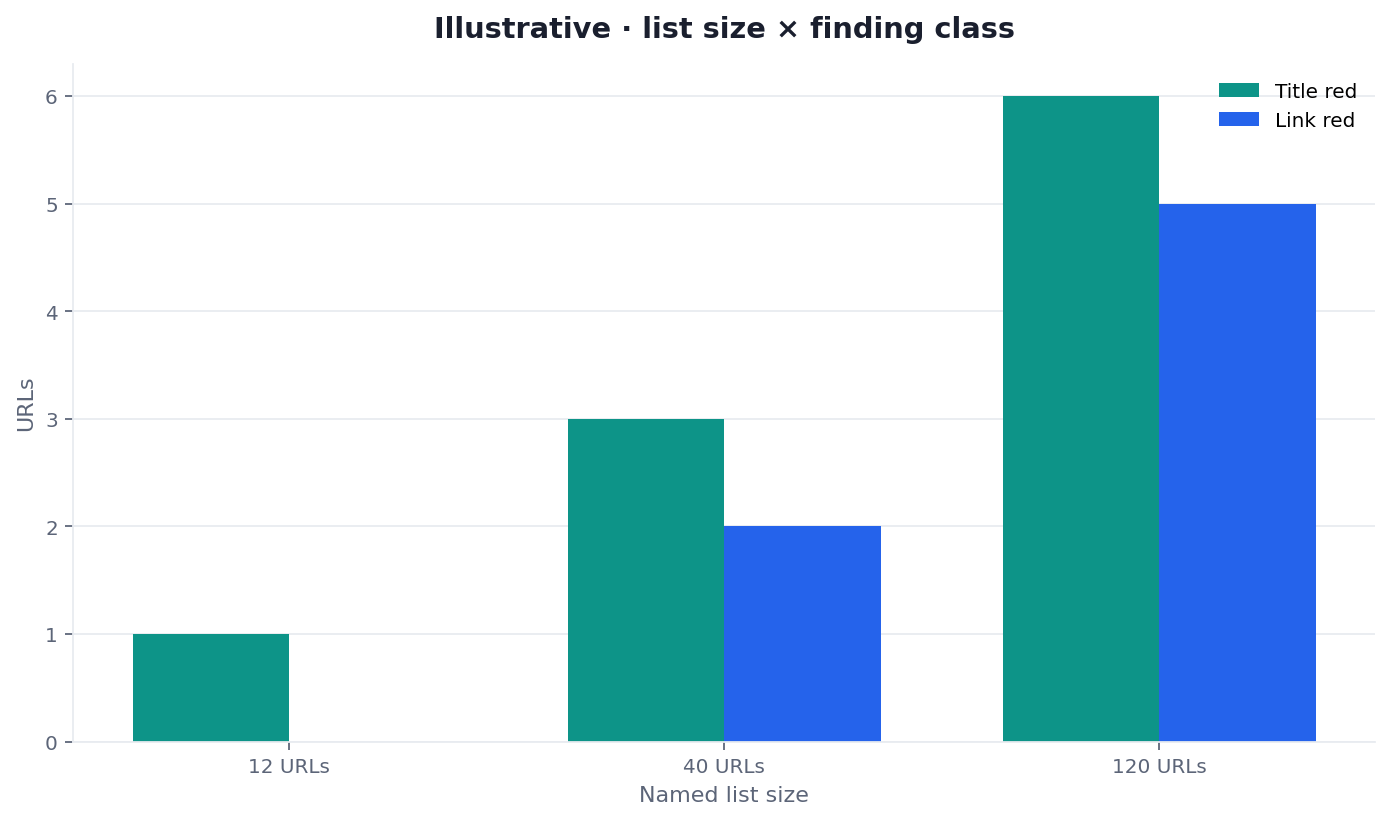
Figure: illustrative grouped bars — list size × command outcome. Two dimensions. Not a Google score and not a customer lift.
How to read the grouped bars
Each cluster is a list size. Each bar is a command outcome. If the eight-URL batch SEO URL check is red and the 500-row audit is “quota spent,” you already know which job to keep on the pull request.
If your run differs, trust your run. Social cut: ./images/og-cover.png.
Selection scorecard
Score each row 0–2 when someone asks for a batch SEO URL check today.
| Question | 0 | 1 | 2 |
|---|---|---|---|
| Can you paste the URL list? | “The sitemap” | Partial, one locale | Named templates, current |
Is the command seo-health check per URL? | Blind audit --pages 500 | Mix of check and crawl | Loop check only |
Is --format json parsed per URL? | One screenshot zip | JSON attached, always green | JSON parsed, any required red fails |
| Are deep commands off the loop? | eeat on every URL | Deep commands on every release | Deep commands scheduled |
| Will one red template block the job? | Comment only | Required, ignored | Required, enforced |
Under 6 means you want a crawl, or you only needed one URL. 8–10 means write the list and loop. A service-case traffic story is not product proof for this loop.
Failure modes that turn the loop into a crawl
The first failure is selling a batch SEO URL check as a 500-page walk. The list is the product. Say the names in the first sentence of the ticket.
The second failure is growing the list until it looks like audit. If you need a sitemap sample, say audit --pages and cap it. Do not launder a crawl through a loop.
Looping production because preview is hard
A batch SEO URL check that only hits production will merge this week’s blank preview title. Point the loop at the URLs the change actually shipped.
Calling audit inside the check loop
audit --pages is a sample. A batch SEO URL check that shells out to audit mid-loop is two products in one script. Split them. Keep the list honest.
If the leftover job is a nightly sample, that is a scheduled site audit, not a reason to delete the named list.
Cluster guides for this pillar
This page is the named-list loop. Open one row when you have that job.
| Job you actually have | Guide to open next | What this page will not do |
|---|---|---|
| Learn the merge gate as the product | SEO CI/CD (hub) | Retarget the hub phrase as this page’s keyword |
| Need the loop inside Actions YAML | GitHub Actions SEO audit | Clone the YAML here |
| Need a nightly 50–500 sample | scheduled site audit | Run 500 pages on every commit |
| Need the 50–500 cap as the product | SEO website audit | Pretend the loop saw the whole host |
| Need the file-shape vocabulary | JSON SEO report | Merge twenty tables into one comment |
Keep the batch SEO URL check as a loop of check, not a blind crawl.
Loop the named URLs, then fail on any required red
Paste one public URL at the live checker, then put the same eight lights behind a seo-health check --format json loop on the list you can name.
Frequently Asked Questions
Is this a 500-page crawl?
Bottom line: No. The loop runs seo-health check over a list you named. audit --pages 50–500 is a different command. Do not crawl blind and call it a batch.
Does the loop need a login for check?
Bottom line: No. The loop can run seo-health check without login. audit and links also run without login. eeat, aivisibility, and gsc need a CLI key and credits. Do not fire credited commands on every URL in the list.
How many URLs belong on the list?
Bottom line: As many templates as you can name and own this sprint. Eight honest URLs beat a 400-row list nobody will fix. Raise the count when a new template ships.
Is the light an official Google score?
Bottom line: No. The loop emits traffic lights for eight modules on each URL. Those lights are not a Google 100 and not an official EEAT grade. Do not average them into a fake score.
Conclusion
A batch SEO URL check is a loop of seo-health check on URLs you named. Write the list. Install infinitegrowth. Emit --format json per URL. Fail the job on a required red. Do not swap in a 500-page crawl because the word “batch” felt large. Keep credit commands off the default loop. Keep Google scores out of the badge.
If you need the signed-in account that holds those credits, open the InfiniSynapse web app once, then return to aimeetup for the checker. Fail the job. Do not negotiate the light.