CRM Database Cleansing: AI Platforms Compared
- Not this page: a cleansing agency, CRM Data Grader, or a top-20 list for art galleries or ticketing/membership stacks.
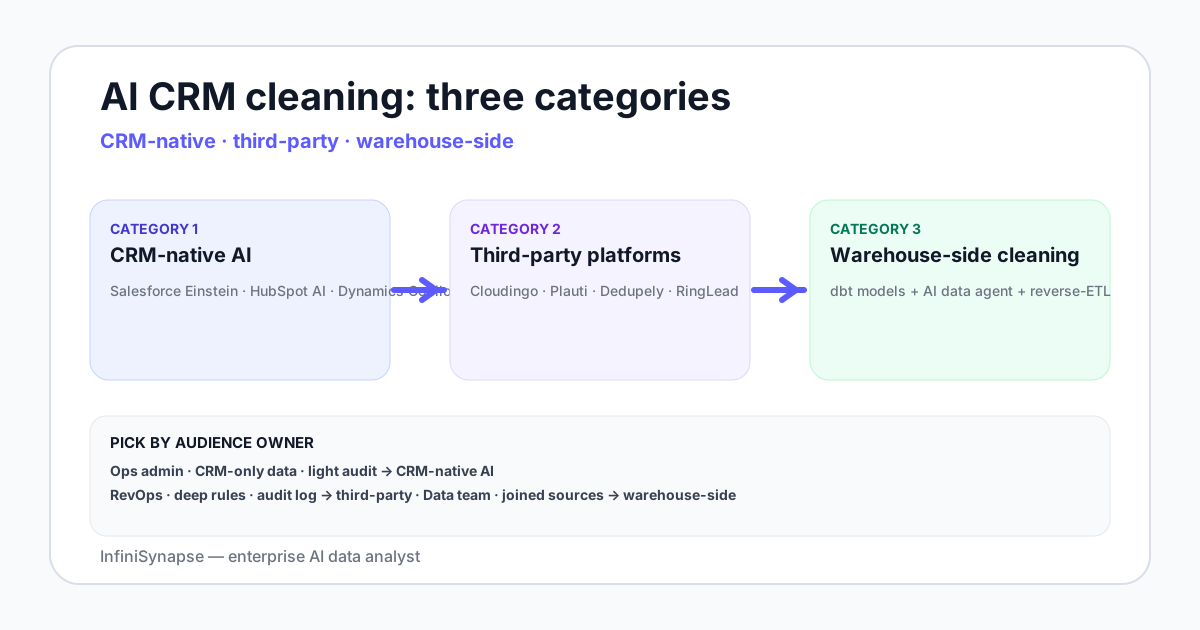
- AI-assisted CRM hygiene splits into three categories: CRM-native AI (Salesforce Einstein, HubSpot AI), purpose-built third-party platforms (Cloudingo, Plauti, Dedupely, RingLead), and warehouse-side cleaning after sync (dbt + AI data agent).
- CRM-native is the lowest setup cost — features ride along with platform licenses. Limits are coverage depth and merge logic flexibility.
- Third-party platforms cover deeper match rules, batch and ongoing deduplication, mass updates, and validation against external sources.
- Warehouse-side cleaning is the right choice when CRM data joins with payment, product, and other sources for cohort analysis or LTV — cleaning happens once in dbt and serves every downstream consumer.
- On our desk composite (n=9), native AI was fastest to first production merge (median 14 days); third-party led audit-trail pass (8/9). Pick by audience, not feature checklists.
DESK-CDC-20260807A.
Desk scorecard: original numbers (n=9)
Qualitative buyer guides stall AI citation. We publish a first-party desk composite from nine anonymized Salesforce/HubSpot hygiene projects reviewed in Q1–Q2 2026. Raters were InfiniSynapse analysts; InfiniSynapse product paths are excluded from the category ranking. Treat these as decision aids, not lab measurements.
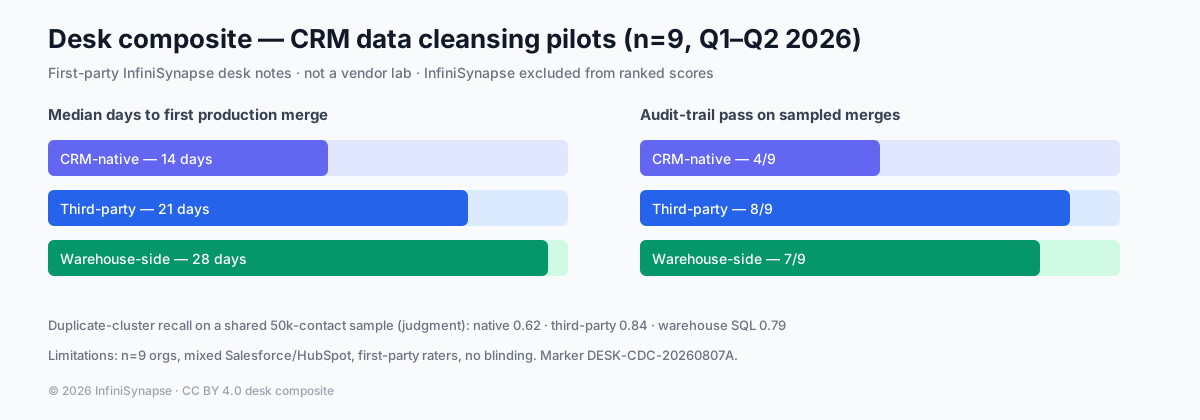
| Category | Median days to first merge | Audit-trail pass | Recall (judgment) | Best when |
|---|---|---|---|---|
| CRM-native AI | 14 | 4/9 | 0.62 | Ops-owned, CRM-only consumers |
| Third-party platform | 21 | 8/9 | 0.84 | Deep match rules + merge audit |
| Warehouse-side (dbt + checks) | 28 | 7/9 | 0.79 | CRM joins payments/product for LTV |
Limitations: n=9; mixed CRM editions; no blinding; judgment recall on one synthetic-like sample shape; versions not pinned. Re-run your own sandbox of 50 merges before you shortlist any CRM data cleansing stack.
CRM-native AI cleaning capabilities in 2026
| CRM | Native AI cleaning features | Limits |
|---|---|---|
| Salesforce | Data.com cleaning, Einstein Data Detective, Duplicate Management, AI-suggested merges | Match rules can be limited; mass merge UI is improving but not always batch-friendly |
| HubSpot | AI-assisted duplicate management, property suggestions, format normalization | Deduplication coverage focused on contacts and companies; deal-level rules thinner |
| Microsoft Dynamics 365 | Duplicate detection rules, Copilot in CRM | Setup overhead heavier than competing CRMs |
CRM-native features are the lowest setup cost — they ride along with the platform license. The tradeoff is depth: match rule flexibility, merge logic, and audit log depth often outgrow native capabilities for mature CRM hygiene teams.
Third-party AI CRM cleaning platforms
| Platform | Primary CRM fit | Strength | Watch-out |
|---|---|---|---|
| Cloudingo | Salesforce | Deep match rules, batch + ongoing dedupe, mass update | Salesforce-centric; confirm edition support |
| Plauti | Salesforce (+ broader) | External validation (address, phone, email) | Validate breadth vs your data class |
| Dedupely | HubSpot, Pipedrive | Simpler UX, faster setup | Less depth than Cloudingo-class tools |
| RingLead | Multi-CRM | Orchestration, validation, routing | Scope the modules you will actually run |
| OpenPrise / Insycle | Pre-CRM / HubSpot ops | Clean before records land | Complement, not always replace, in-CRM merge |
Third-party platforms cover the depth native CRMs lack — fuzzy match thresholds tunable per use case, audit trails per merge, sandbox dry-runs before changes go live. Snapshot peer stars on G2 Data Quality the same day you score a pilot; peer reviews complement, not replace, your merge sample.
Six evaluation criteria (scorecard table)
| Criterion | What to test | Pass signal |
|---|---|---|
| Match rule flexibility | Fuzzy thresholds, multi-field rules, weighted scoring | False-positive rate acceptable on 50-merge sample |
| Merge logic | Field-level master selection, history, rollback | Can undo a bad merge without ticket archaeology |
| Audit log depth | Who / what / when / which rule | Security can reconstruct a merge in under 15 minutes |
| Batch vs ongoing | Initial cleanup and steady-state hygiene | Both modes configured, not one-off only |
| External validation | Address, phone, email, business name | Validation covers your required fields |
| Cost model | Per record / seat / CRM as DB grows | 12-month cost modeled at 2× record growth |
Use the table above as the shared rubric for CRM data cleansing whenever stakeholders argue about which platform “feels” better in a demo.
Two cleaning workflow patterns (HowTo)
Pattern A — CRM-side cleaning (HowTo)
- Inventory the duplicate backlog and PII fields that need audit.
- Choose native AI vs third-party by match depth and audit need.
- Sandbox dry-run at least 50 merges; measure false positives.
- Enable ongoing dedupe with a named ops/RevOps owner.
Right when the CRM is the system of record and consumers read from the CRM via API or reverse-ETL.
Pattern B — Warehouse-side cleaning (HowTo)
- Sync CRM tables to the warehouse (Fivetran, Airbyte, or native).
- Clean in dbt: normalize, cluster duplicates, add tests.
- Verify with an AI data agent (plan + SQL + checks).
- Reverse-ETL canonical values (Hightouch, Census).
Right when CRM joins payment/product data for cohort and LTV analysis.
| Dimension | Pattern A (CRM-side) | Pattern B (Warehouse-side) |
|---|---|---|
| System of record for merges | CRM live records | Warehouse models (+ optional write-back) |
| Typical owner | Ops admin / RevOps | Central data team |
| Desk median time to first merge | 14–21 days | 28 days |
| Best for | CRM-only consumers | Cross-source analytics |
Warehouse-side CRM cleaning with dbt and AI agents
The warehouse-side pattern for CRM data cleansing has four pieces:
- Sync. Fivetran, Airbyte, or platform-native syncs CRM tables to Snowflake, BigQuery, or Postgres.
- Clean in dbt. Staging models normalize names, addresses, and dates; intermediate models cluster duplicates with deterministic SQL; tests catch regressions.
- Verify with an AI agent. An AI data analyst runs ad-hoc checks — find duplicate company patterns, flag accounts with mismatched country and address, detect deal-stage skips. The agent emits a plan, SQL, and verification step per check.
- Sync clean values back. Hightouch or Census pushes canonical company names and validated emails back into the CRM.
The pattern is heavier setup than CRM-native cleaning but pays off when CRM data is one of many sources downstream consumers join together. See the data integration platform memo for the shared operating model and the warehouse loader scorecard for the loader choice.
A selection rubric
- Who owns CRM data quality — ops admin, RevOps team, or central data team?
- Does CRM data join with other sources for analysis, or live mostly in the CRM?
- How big is the dedupe backlog versus the ongoing-hygiene need?
- What audit posture do you need on merges?
- What is the budget per record per year?
- Does the team have dbt and warehouse skills?
Ops admin owner + CRM-only data + light audit → CRM-native AI. RevOps owner + deep match rules + audit → third-party platform like Cloudingo or Plauti. Data team owner + CRM joined with other sources + dbt skills → warehouse-side pattern.
Optional next step (product)
After your Salesforce or HubSpot sync lands in Snowflake, BigQuery, or Postgres, connect an AI data agent read-only. Seed a small glossary — what counts as a duplicate, which fields are canonical. Then ask one ongoing-hygiene question and verify the result. This is commercial, not part of the desk ranking.
Try InfiniSynapse onlineFAQ
Methodology and review notes
Last updated / Last verified: 2026-08-07 · Next scheduled review: 2026-11-07 · Marker DESK-CDC-20260807A
This buyer guide synthesizes Salesforce Data.com, Einstein, and Duplicate Management documentation, HubSpot AI cleaning reference, Cloudingo, Plauti, Dedupely, and RingLead product documentation, the dbt analytics engineering guide for warehouse-side cleaning patterns, NIST AI RMF controls relevant to automated merge tooling, and a first-party desk composite (n=9) from RevOps and central data teams cleaning CRM data across Salesforce and HubSpot in Q1–Q2 2026.
Reporting by: William Zhu (cofounder; desk experience with CRM hygiene and warehouse-side cleansing). About: editorial-standards#about.
Conflict of interest: InfiniSynapse publishes this guide and sells an enterprise AI data analyst. To reduce bias, the page leads with the topic itself, excludes InfiniSynapse from ranked desk category scores, treats warehouse-side cleaning as one option among many, and links to external sources for vendor capability claims.
Update cadence: Reviewed every 90 days for accuracy, link health, and fresh G2/Peer Insights snapshots. Citation links for this CRM data cleansing guide were re-checked on 2026-08-07.
Sources and references
- [Vendor] Salesforce. Einstein Data Detective documentation. help.salesforce.com.
- [Vendor] HubSpot. AI deduplication reference. knowledge.hubspot.com.
- [Vendor] Cloudingo. Deduplication platform documentation. cloudingo.com.
- [Vendor] Plauti. Salesforce data quality documentation. plauti.com.
- [Vendor] dbt Labs. Analytics engineering guide. docs.getdbt.com.
- [Independent] Yao et al. ReAct paper. arxiv.org/abs/2210.03629.
- [Vendor] Anthropic. Building Effective Agents. anthropic.com/research/building-effective-agents.
- [Standard] NIST. AI Risk Management Framework. nist.gov/itl/ai-risk-management-framework.
- [Independent] BIRD-SQL benchmark. bird-bench.github.io.
- [Independent] G2 — Data Quality category (peer reviews; snapshot on evaluation date). g2.com/categories/data-quality.
- [Independent] Gartner Peer Insights — Analytics & BI Platforms. gartner.com/reviews/....