AI Data Governance: A Practical Framework for Enterprise Analytics in 2026
- AI data governance is data governance plus three new layers: model risk, tool-use logging, and explainability. You need both, not one or the other.
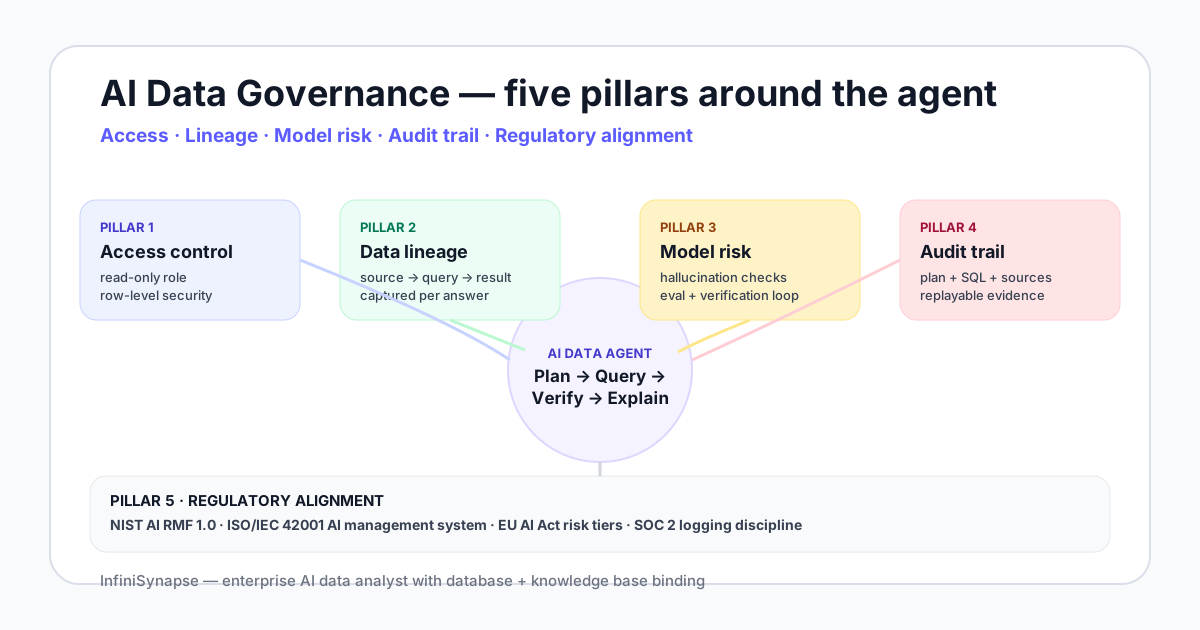
- The working framework has five pillars — access control, data lineage, model risk, audit trail, and regulatory alignment.
- Map each pillar to NIST AI RMF, ISO/IEC 42001, and the EU AI Act so a security or legal reviewer can sign off against a recognized standard, not a marketing page.
- An AI data agent ready for enterprise use exposes its plan, queries, retrieved context, and verification step — not just an answer string.
- Run a 30-day shadow period before stakeholders see results. Promote permissions only when shadow accuracy and zero-exfiltration are confirmed.
Direct answer: what does AI data governance for analytics require?
What AI data governance actually means
Most enterprise data teams already run a governance program: data definitions, owners, quality checks, access policies, retention rules. AI data governance is not a replacement — it is an additional layer that answers a different question. Classical governance asks is this data correct and who can read it? AI governance asks can we trust what the system did with that data, and can we replay the reasoning?
The shift matters because an AI data agent does not behave like a BI dashboard. A dashboard reads pre-modeled metrics that an analyst already validated. An agent picks tables, joins them, writes SQL, and explains the result on the fly — every run can take a different path. Governance has to cover the path, not just the inputs.
The three new layers AI governance adds
- Model risk. The agent can hallucinate, misread a schema, or be steered by prompt injection. You need evaluation sets and verification loops, not just unit tests on data.
- Tool-use logging. Every retrieval, every SQL query, every external API call the agent invokes must be captured with parameters and outputs. Without this you cannot reconstruct what happened.
- Explainability. A reviewer needs to read the plan, the queries, and the sources behind a result and reach the same conclusion. Explainable AI data analysis describes the artifacts the agent must publish.
Why now — the 2026 inflection point
Three forces have pushed AI data governance from a research topic into a board-level requirement. The EU AI Act entered into force in August 2024 and its high-risk obligations kick in across 2026 and 2027. ISO published ISO/IEC 42001 in late 2023, giving organizations the first auditable AI management system standard. And the NIST AI Risk Management Framework has become the de facto reference U.S. enterprises cite in security reviews.
At the same time, agentic analytics has moved from demo to deployment. Anthropic's writeup on building effective agents formalized the pattern of plan, tool use, and verification that most production AI data analysts now follow. Once an agent can write its own SQL against a production warehouse, AI data governance stops being optional.
The five-pillar framework
The framework below is the working AI data governance pattern we apply with security and data architecture teams approving an AI data agent for warehouse access. Each pillar is a control surface, and each control surface maps to one or more clauses in NIST AI RMF and ISO/IEC 42001. Treat it as a starting matrix, not a final answer — your industry will add specifics.
Pillar 1 — Access control
Definition: In AI data governance, access control means the agent receives a scoped read-only role, not a human's credentials. Privileges are granted per schema, never per cluster. Row-level security policies that protect humans must also apply to the agent's role; if a salesperson cannot see the EU customers table, the agent acting on their behalf cannot either. Service accounts rotate keys on a fixed schedule, and the audit log captures every authentication. Cross-platform equivalents: PostgreSQL RLS / GRANT, Snowflake row access policies, BigQuery authorized views, Databricks Unity Catalog grants.
Pillar 2 — Data lineage
Definition: Under AI data governance, every result must carry its lineage: which sources were read, which tables and columns, which transformations were applied, and which rows formed the basis of the answer. Without lineage, a stakeholder cannot tell whether yesterday's revenue number used last week's exchange rate. A good agent captures lineage automatically because it issues the SQL itself. Tooling peers: OpenLineage events, dbt docs/lineage graphs, warehouse INFORMATION_SCHEMA + query history.
Pillar 3 — Model risk management
Definition: Model risk is the AI data governance pillar you measure like credit risk — with a written policy, an evaluation set, and a periodic review. The evaluation set should include known-answer questions, edge cases that exposed problems in prior runs, and prompt-injection probes. Public benchmarks such as BIRD and Spider are useful for calibration but no substitute for your own enterprise eval set.
Pillar 4 — Audit trail
Definition: An AI data governance audit trail must capture the user question, the retrieved business context, the plan the agent proposed, every SQL or tool call executed, the verification step, and the final result with sources. The trail must be immutable and replayable so a reviewer can rerun the analysis and reach the same answer. Cross-platform logging peers: pg_stat_statements, Snowflake QUERY_HISTORY, BigQuery INFORMATION_SCHEMA.JOBS, Databricks query history.
Pillar 5 — Regulatory alignment
Definition: Regulatory alignment is the AI data governance language layer: mapping your controls to NIST AI RMF, ISO/IEC 42001, and the EU AI Act so a security reviewer recognizes them. The mapping is also defensive — if a regulator asks how your AI analytics complies with the EU AI Act's logging requirements, you point to the audit trail pillar with the article citation already attached.
Latest desk benchmark (quarterly refresh)
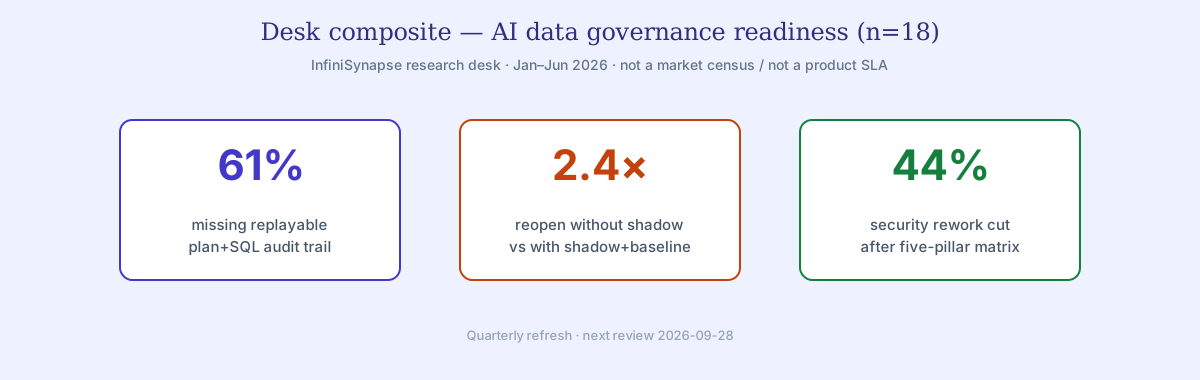
InfiniSynapse research desk — AI data governance readiness (n=18)
Original desk composite (Jan–Jun 2026): we reviewed n=18 regulated mid-market warehouse-agent approvals for AI data governance control completeness. Figures are desk tallies—not a market census and not a product SLA. Independent category reviews: Gartner Peer Insights · G2.
Update cadence: refreshed each quarterly review (next: 2026-09-28). Contradictory tallies: zhuhl@infinisynapse.com.
Anonymized deployment note (desensitized)
In one EU-facing B2B SaaS warehouse review (anonymized), the business unit requested agent access with a shared analyst role. Security blocked the request until AI data governance controls were written down: schema-scoped read-only grants, plan review on PII schemas, and a 30-day shadow log. After the matrix was signed, the first production promotion passed with zero exfiltration flags and shadow accuracy above the agreed threshold. The lesson for AI data governance programs: artifacts beat vendor slides — reviewers signed the control matrix, not a feature list.
Mapping the five pillars to recognized standards
| Pillar | NIST AI RMF function | ISO/IEC 42001 clause area | EU AI Act relevance | Control artifact |
|---|---|---|---|---|
| 1. Access control | Manage | A.7 Resources, A.8 Operation | Article 10 data governance | Read-only role grants, RLS policies |
| 2. Data lineage | Map, Measure | A.6 Planning, A.9 Performance | Article 12 record-keeping | Source-to-result lineage per query |
| 3. Model risk | Measure, Manage | A.9 Performance evaluation | Article 15 accuracy and robustness | Eval set, hallucination report |
| 4. Audit trail | Govern, Manage | A.8 Operation | Articles 12, 13 transparency | Replayable plan + queries + sources |
| 5. Regulatory alignment | Govern | A.4 Leadership, A.5 Policies | All articles | Written control matrix, risk register |
A governance program is not the documents you wrote. It is the controls a reviewer can see running in production on a Tuesday afternoon.
AI data governance tools — categories that matter
The tool landscape is noisy because vendors stretch the term "governance" to cover anything from a data catalog to a model registry to a prompt firewall. Treat the categories below as the buying map; each one covers one or two pillars but no single product covers all five.
The five tool categories
- Identity and access — SSO, service accounts, role-based access control, row-level security. Covers Pillar 1. Equivalents: Okta/Azure AD + warehouse RBAC (Postgres RLS, Snowflake, BigQuery, Databricks UC).
- Data catalog with lineage — column-level lineage, ownership, definitions. Covers Pillars 1 and 2. Equivalents: OpenLineage, DataHub/Amundsen-class catalogs, dbt lineage.
- Model risk and evaluation — eval harnesses, hallucination scoring, red-team probes, drift detection. Covers Pillar 3.
- Immutable audit log — append-only log of plan, queries, retrievals, and outputs, with replay. Covers Pillar 4. Equivalents: pg_stat_statements, Snowflake QUERY_HISTORY, cloud audit logs.
- AI data agent with explainability built in — exposes its plan, runs verification loops, attaches sources to every result. The agent itself is part of the AI data governance surface, not just a consumer of it.
| Pillar | PostgreSQL | Snowflake | BigQuery / Databricks |
|---|---|---|---|
| Access | RLS + GRANT | Row access policies | Authorized views / Unity Catalog |
| Lineage | pg_stat + OpenLineage | Access History | JOBS / UC lineage |
| Audit | pg_stat_statements | QUERY_HISTORY | Job & query history |
This is where AI-native platform design diverges from bolt-on governance for AI data governance programs. A bolt-on approach wraps a black-box LLM with policies after the fact; an AI-native agent emits the artifacts a reviewer needs as a side effect of doing its job — evidence as a primary output, not an afterthought.
Security team approval checklist
Use the checklist below when a business unit asks for production access under an AI data governance program. It is the same checklist we run with customers evaluating AI database query systems against their warehouse.
| Check | What to verify | Pass criterion |
|---|---|---|
| Role scope | Agent has a dedicated read-only role with grants per schema, not cluster-wide privileges | Grant matrix matches business need; no SUPERUSER |
| RLS coverage | Row-level policies that protect humans also protect the agent role | Spot-check on three sensitive tables passes |
| Plan review | Agent surfaces the plan and SQL before execution on sensitive tables | Plan-mode is on by default for the role |
| Audit log | Every query is logged with parameters, output count, and verification result | 30 days of replayable logs available |
| Eval set | 10-30 known-answer questions including edge cases and a prompt-injection probe | Eval accuracy meets agreed threshold |
| Shadow period | Results reviewed for 30 days before stakeholders see them | Zero exfiltration, agreed accuracy |
| Knowledge base binding | Business definitions are bound to the data source and retrieved before SQL | Sampled answers cite the right definitions |
| Standards mapping | Each control mapped to a NIST AI RMF function and ISO/IEC 42001 clause | Control matrix signed by security lead |
Common AI data governance mistakes (and how to avoid them)
- Treating AI governance as a copy of data governance. The two overlap but the model-risk, tool-use, and explainability layers are new. You need both programs running side by side.
- Granting cluster-wide privileges for convenience. A read-only role is not safe if it can read every schema. Scope by schema, then by table where it matters.
- Skipping the shadow period. Letting an agent's first thirty answers reach stakeholders without review is how confident-but-wrong numbers escape into board decks.
- Auditing only the final answer. A number without a plan, a query log, and a verification step is not auditable. The trail must include the path, not just the output.
- Believing a vendor that says "compliant with the EU AI Act". Compliance is a system-level property of how you deploy the tool, not an attribute of the tool itself. Ask for the control matrix.
- Bolting governance on after the fact. If the agent cannot emit a plan and an evidence trail, no amount of wrapping will produce one. Pick an agent that treats evidence as a first-class output.
When this framework applies
- You are approving an AI data agent for warehouse or transactional database access
- You need a control matrix mapped to recognized standards
- Security, legal, or compliance reviewers must sign off before production
- Stakeholders will quote results in board materials or regulatory filings
When it is overkill
- You are exploring an AI tool on a sandbox dataset with no production access
- The agent only runs on synthetic or fully anonymized data
- A single engineer is the only consumer of the output
- No regulated industry obligations apply
FAQ
Expand each question for the short answer. ARIA state stays in sync for assistive tech and AI parsers.
What is AI data governance?
How is AI data governance different from data governance?
What does an AI data governance framework include?
Which AI data governance tools should an enterprise evaluate?
How does NIST AI RMF apply to an AI data agent?
Does the EU AI Act regulate analytics AI agents?
What audit trail must an AI data agent produce?
How do I approve an AI data agent for production access to a warehouse?
Methodology and review notes
Last updated / dateModified: 2026-07-31 · Published: 2026-06-28 · Next scheduled review: 2026-09-28
The five-pillar AI data governance framework is grounded in the NIST AI Risk Management Framework 1.0, ISO/IEC 42001:2023 AI management system standard, the EU AI Act text, and operational experience from InfiniSynapse deployments at customers in regulated sectors. The control matrix mapping was reviewed against the published standard clause numbers and the EU AI Act articles cited in the table. Desk composite n=18 is a convenience sample — validate against your own shadow logs.
Conflict of interest: InfiniSynapse sells an AI data analyst, and the checklist will benefit any vendor whose agent already exposes plan and evidence. To reduce bias, the framework is described in terms of artifacts a reviewer can verify — not vendor features — and every numeric or regulatory claim is cited to its primary source.
Update cadence: Reviewed every 90 days for standards updates, EU AI Act enforcement notes, new evaluation benchmarks, and the Latest desk benchmark module.
Version changelog
2026-07-31 (v1.1): Named author Person signals, About/editorial links, desk benchmark n=18, anonymized deployment note, cross-platform tool peers, FAQ aria-expanded accordion, HowTo/DefinedTerm/speakable structured data, optional commercial note separated from educational sections.
2026-06-28 (v1.0): Initial five-pillar AI data governance framework and standards mapping published.
Sources and references
- [Standard] NIST. AI Risk Management Framework (AI RMF 1.0, 2023). nist.gov/itl/ai-risk-management-framework.
- [Standard] ISO/IEC 42001:2023, Information technology — Artificial intelligence — Management system. iso.org/standard/81230.
- [Regulation] European Parliament and Council. EU Artificial Intelligence Act (Regulation 2024/1689). artificialintelligenceact.eu.
- [Independent] BIRD-SQL: A Big Bench for Large-Scale Database Grounded Text-to-SQL Evaluation. bird-bench.github.io.
- [Independent] Spider text-to-SQL benchmark, Yale LILY group. yale-lily.github.io/spider.
- [Vendor research] Anthropic. Building effective agents. anthropic.com/research/building-effective-agents.
- [Reference] Wikipedia. Retrieval-augmented generation. en.wikipedia.org/wiki/Retrieval-augmented_generation.
- [Peer market] Gartner Peer Insights — Analytics & BI. gartner.com/reviews.
- [Peer market] G2 — Analytics Platforms. g2.com/categories/analytics-platforms.
- [Policy / About] InfiniSynapse — Editorial standards · Vision.