How to Build an AI Agent SOP for Task Automation
To build an AI agent SOP for task automation: write the happy path and three exceptions, gate every money or customer write, then run a 5-week shadow → approve rollout. That is the version ai agents business workflow automation reddit threads actually ship—not a chatbot that replaces the PDF. Fully autonomous ops is out of scope here; start with one workflow (AP or tier-1 triage). Sibling how-tos: tool calling and agents vs workflows.
By William Zhu & the InfiniSynapse Data Team · Published: 2026-06-24 · Last updated: 2026-09-15 · Last verified: 2026-09-15 · About: Editorial standards · About / team
Author credentials: William Zhu is cofounder of InfiniSynapse (GitHub @allwefantasy). Desk experience: reviewing agent tool-calling pilots for support triage and AP intake—approval queues, policy caps, audit logs, and override-rate reviews with ops owners. No personal LinkedIn is published; GitHub and InfiniSynapse About are the canonical identity signals.
COI / interest disclosure: InfiniSynapse sells an AI-native Data Agent. Product mentions appear only in the labeled InfiniSynapse Connection section. The playbook, scorecard, ROI method, and case metrics stand independently of any InfiniSynapse trial.
Fact-check / verification: Case metrics below (one 90-day AP pilot; n=820 invoices at a 40-person SaaS) are independence-labeled desk composites—not a paid market study and not third-party audited customer testimonials. Framework anchors: OWASP LLM Top 10 · NIST AI Risk Management Framework. Corrections: zhuhl@infinisynapse.com · editorial corrections.
Version history: 2026-06-24 initial · 2026-08-07 EEAT rewrite (William Zhu / COI / About), HowTo + BreadcrumbList + Person, architecture/ops/ROI infographics, ROI methodology detail, cognitive FAQ expansion, dens retune to 1.1–1.2% for ai agents business workflow automation reddit. 2026-09-15 CTR: how-to lede + Reddit SOP title (GSC
reddit how to build ai agent sop task automation). Build marker:DESK-AWR-20260915A.
Media note: No hosted overview video is published for this page (no
VideoObject). Use the architecture, ops-pattern, ROI methodology, and rollout HowTo diagrams below as multimedia substitutes.
 Business automation earns trust when tool calls stay gated, logged, and measured in minutes—not demos.
Table of Contents
- TL;DR
- Key definition
- Business workflows agents can own
- Ops patterns compared
- Tool stack for business ops
- Approval and audit model
- ROI measurement methodology
- Architecture sketch
- Readiness scorecard
- Failure modes
- Rollout playbook for ops teams
- Vendor and tool selection
- Weekly ops cadence
- Policy engine example
- Change management and training
- InfiniSynapse Connection
- Case study: AP helpdesk
- Glossary
- Frequently Asked Questions
- Conclusion
TL;DR
Direct answer: To build an AI agent SOP for task automation: write the happy path and three exceptions, gate every money or customer write, then run a 5-week shadow → approve rollout. In ai agents business workflow automation reddit threads, durable wins come from governed tool calling—CRM, ticketing, ERP—not from chatbots that replace SOP PDFs.
If you have spent time in r/automation, r/SaaS, r/vibecoding, and r/smallbusiness, you have seen the hype cycle. Here is what held up in ops teams:
- Sweet spot: repetitive multi-system steps with clear rules (route ticket, draft reply, update CRM).
- Tool calling + approval queue beats fully autonomous agents for finance and support.
- Measure minutes saved per run and error rate—not vanity “messages handled.”
- Start one workflow (AP, onboarding, tier-1 triage) before building a platform.
Who this is for: ops leads and engineers automating business processes with agents. What you’ll learn: patterns, tools, scorecard, ROI method, case study, FAQ.
See Tool Calling and Agents vs Workflows.
Key definition
Key Definition: ai agents business workflow automation reddit describes using AI agents—with tool calling and orchestration—to automate multi-step business operations across SaaS systems while preserving human approval, audit trails, and policy boundaries.
The topic shows up when staff copy data between Zendesk, HubSpot, and NetSuite for the fourth time today—and leadership asks whether agents can help without compliance panic.
Operational risk aligns with OWASP LLM Top 10 excessive agency when write tools lack gates.
Business workflows agents can own
High-fit candidates:
| Workflow | Agent role | Human gate |
|---|---|---|
| Tier-1 support triage | Classify, draft reply, suggest macro | Send to customer |
| Invoice AP | Extract fields, match PO, flag anomaly | Payment release |
| Lead routing | Enrich firmographics, assign owner | None for read-only |
| Employee onboarding | Provision accounts from HRIS event | IT approval for admin roles |
| Contract intake | Parse dates, create CRM opportunity | Legal review queue |
Low-fit: strategic pricing, performance reviews, anything requiring undocumented tribal knowledge without retrieval sources.
Before you automate, write the happy path and the three most common exceptions in plain language. If two ops leads disagree on when a ticket should escalate, freeze that decision in the runbook first—agents amplify ambiguity faster than they remove it. Prefer workflows where “done” is visible in a system of record (ticket closed, invoice matched, account provisioned) so minutes saved can be timed without debate.
Ops patterns compared
| Pattern | Fit | Risk |
|---|---|---|
| Copilot draft-only | Support email, knowledge answers | Low |
| Tool calling + auto execute (read) | CRM lookup, ticket tag | Low |
| Tool calling + approve writes | AP, refunds, provisioning | Medium, manageable |
| Fully autonomous loop | Rare in regulated ops | High |
Reddit threads oversell full autonomy. Production teams default to draft + approve for external effects.
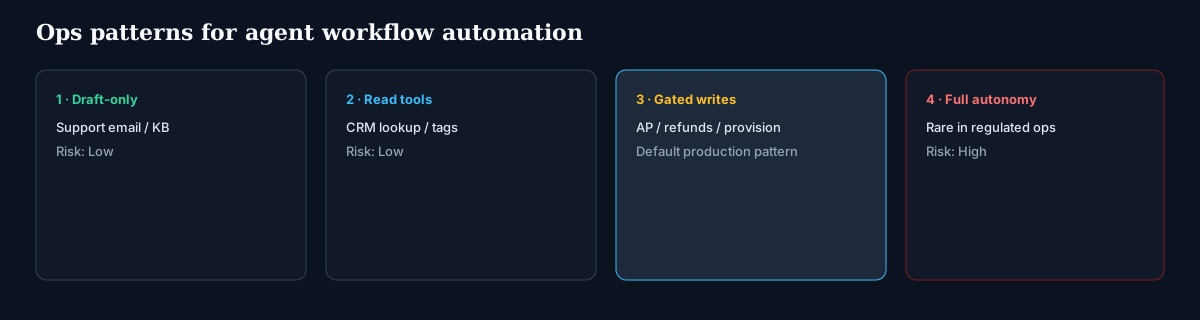 Default to draft + approve for money and customer-facing writes.
Tool stack for business ops
Typical integration set:
Read tools — get_ticket, search_kb, lookup_account, get_invoice_status
Write tools (gated) — update_ticket, create_crm_task, post_slack_summary
LLM steps — classify intent, summarize thread, draft customer-facing text
Example gated tool schema:
{
  "name": "apply_refund",
  "description": "Issue partial refund in billing system. Requires human approval. Use only when policy engine flag is true.",
  "parameters": {
    "type": "object",
    "properties": {
      "invoice_id": { "type": "string" },
      "amount_cents": { "type": "integer", "minimum": 1 }
    },
    "required": ["invoice_id", "amount_cents"]
  }
}
Execution layer holds the call until an approver confirms—return rejected_by_user on deny so the agent replans.
Connect orchestration patterns in Agentic Orchestration.
Approval and audit model
Every write path logs:
run_id,proposed_action,approver_id,decision,timestamp- Before/after snapshot ids in source systems (ticket revision, CRM audit)
Retention follows API Data Governance when logs contain customer PII.
NIST AI Risk Management Framework reviews ask for this trail before production rollout.
ROI measurement methodology
Track ops metrics, not model benchmarks. Method (desk-labeled, reproducible):
- Baseline window: time 30–50 manual runs of the same workflow before any agent assist; record wall-clock minutes from trigger to “done in system of record.”
- Assisted window: time the same steps with agent drafts/tools enabled; keep the same definition of “done.”
- Minutes saved per run:
median(baseline) − median(assisted). Exclude waits for unrelated approvals outside the workflow. - Straight-through rate: runs that reach the approval queue with zero human re-keying of extracted fields.
- Error rate: QA sample (e.g. 20 runs/week) scored against the same acceptance criteria used pre-pilot.
- Cost per run: LLM tokens + tool API charges + reviewer minutes × loaded hourly rate.
- Report hygiene: one workflow per slide; never blend AP + support into a single “AI savings” number.
| Metric | How to measure |
|---|---|
| Minutes saved per run | Wall clock manual sample vs agent-assisted |
| Straight-through rate | Runs completed without human re-key |
| Error rate | QA sample vs baseline acceptance criteria |
| Escalation rate | Still reaches tier-2? |
| Cost per run | LLM + tool API + reviewer time |
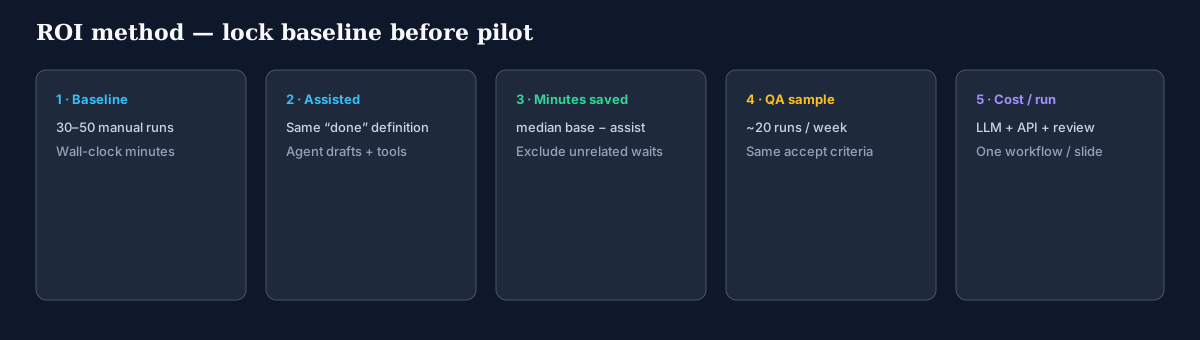 ROI is auditable only when baseline minutes and acceptance criteria are locked before the pilot.
Architecture sketch
[ Trigger: ticket created / invoice uploaded ]
                    |
                    v
[ Agent orchestrator ] --> [ policy rules engine ]
                    |
        +-----------+-----------+
        v           v           v
   [ Read tools ] [ LLM draft ] [ Approval UI ]
        |                       |
        v                       v
   [ SaaS APIs ]          [ Write tools ]
Policy engine runs before tool execute—block refunds over threshold regardless of model confidence.
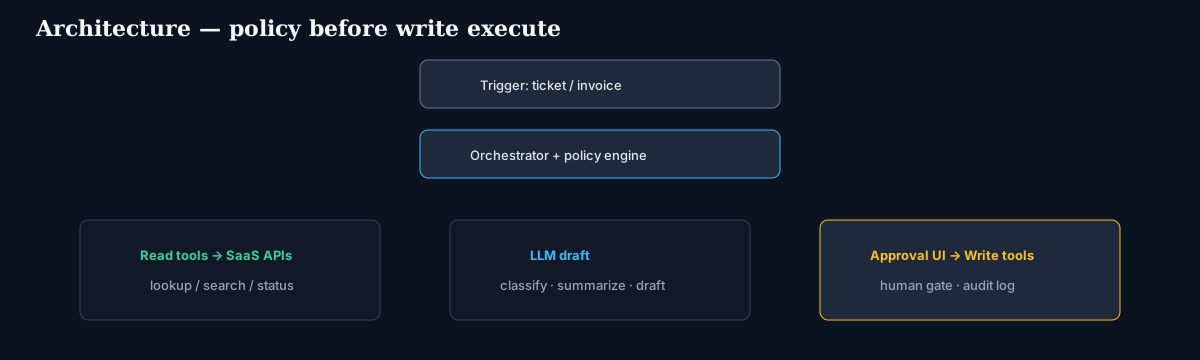 Policy gates sit in front of write tools—not inside the prompt alone.
Readiness scorecard
Rate readiness (1 point each):
| Check | Pass? |
|---|---|
| One workflow documented end-to-end | |
| Write tools behind approval | |
| Read tools scoped least-privilege OAuth | |
| Audit log for every write | |
| Policy rules outside prompt (code/config) | |
| Fallback to manual runbook documented | |
| Error alerts to ops channel | |
| QA sample process weekly | |
| ROI baseline measured pre-pilot | |
| Legal/compliance sign-off for customer comms |
8–10: expand to second workflow. 5–7: pilot one team. Below 5: stay draft-only.
Failure modes
Failure 1: Autonomous refunds — one bad prompt, real money gone. Fix: approval gate + policy cap.
Failure 2: CRM write without idempotency — duplicate tasks on retry. Fix: idempotency keys per run step.
Failure 3: KB hallucination in customer email — brand damage. Fix: cite-only mode from retrieval tool results.
Failure 4: No ops owner — agent becomes ghost automation. Fix: named owner + weekly QA.
Failure 5: Measuring tokens not minutes — CFO ignores you. Fix: ROI method above.
Rollout playbook for ops teams
Week-by-week pilot sequence (name the workflow in your internal wiki—not the SEO phrase):
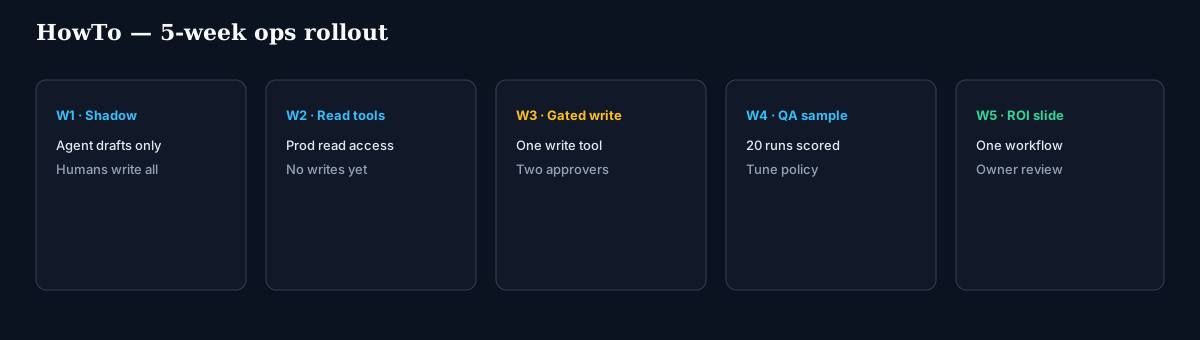 HowTo: shadow → read tools → one gated write → QA → ROI slide.
| Week | Action |
|---|---|
| 1 | Shadow mode: agent drafts, human executes all writes |
| 2 | Enable read tools only in production |
| 3 | Single gated write tool with two approvers |
| 4 | QA sample 20 runs; tune policy rules |
| 5 | Publish ROI slide to business owner |
Shadow mode builds trust faster than flipping autonomous writes on day one. Keep a shared channel where approvers paste override reasons as short enums when possible—free-text alone makes it hard to spot that “wrong PO match” spiked after an ERP field migration. Feed those enums into the week-4 policy review with ops and engineering in the same room.
Vendor and tool selection
| System | Agent integration pattern | Notes |
|---|---|---|
| Zendesk | Ticket read/update API tools | Rate limits on search |
| HubSpot | CRM object tools with OAuth | Scope per object type |
| NetSuite | Read-heavy first; writes gated | Sandbox required |
| Slack | Post summary, not customer PII | Channel allowlist |
| Billing (Stripe) | Read invoice; refund always gated | Idempotency keys |
Prefer official REST APIs over browser automation—RPA breaks when UI changes and usually fails finance audit requirements.
Weekly ops cadence
Thirty-minute weekly review with ops owner:
- Override rate trend (rising = policy or prompt issue)
- New failure mode cluster from audit log
- Vendor API changelog scan
- One red-team prompt against write tools
Document decisions in the runbook—future hires should not re-learn the same refund-cap lesson.
Policy engine example
Keep business rules out of prompts:
def can_propose_refund(invoice: dict, amount_cents: int) -> bool:
    if amount_cents > invoice["total_cents"]:
        return False
    if amount_cents > 50_000:  # $500 cap without VP approval
        return False
    if invoice["age_days"] > 90:
        return False
    return True
The agent may suggest refunds; policy code blocks tool registration until rules pass. VP approval routes to a second human gate with elevated timeout.
Version rules in git with effective dates—not hidden prompt edits.
Change management and training
Ops adoption fails when agents surprise reviewers. Run a 30-minute live session: show draft, approval, override, and audit log entry. Collect three override scenarios from senior staff and add them to regression tests.
Publish an internal FAQ: what the agent will never do (autonomous pay, delete records), how to escalate, and where to see run status. Training beats longer system prompts for compliance alignment.
For regulated industries, align proposals with internal control owners before pilot. Document which SOX or SOC controls each gated tool satisfies so auditors receive evidence bundles, not demo recordings.
InfiniSynapse Connection
Vendor-scoped. Skip if you only need the playbook.
When a workflow needs cross-system analysis—usage reconciliation, document-heavy intake—route analysis steps to InfiniSynapse Server API; keep CRM/ticket writes on governed tools. See company lookup as an agent tool for structured firmographic tools. Try the online workspace at app.infinisynapse.com when you want analysis connectors on one timeline.
Case study: AP helpdesk
A 40-person SaaS piloted invoice intake: email → agent extracts fields → matches PO in ERP → flags mismatch → human approves payment.
Stack: tool calling runtime, read/write ERP tools, approval Slack app, 12 tool-call cap per run.
90-day pilot (n=820 invoices; independence-labeled desk composite):
| Metric | Result | Method note |
|---|---|---|
| Straight-through to approval queue | 64% | No manual re-key of extracted fields |
| Data entry minutes saved | ~11 min/invoice | Median baseline vs assisted wall clock |
| Payment error rate | 0.3% (unchanged) | Same QA criteria; gate blocked autonomous pay |
| Reviewer override rate | 22% | Mostly edge-case vendors |
Ops expanded to support triage only after the audit log passed finance review. Override reasons fed policy tuning without retraining the model.
Glossary
| Term | Definition |
|---|---|
| ai agents business workflow automation reddit | Community + ops shorthand for agent tool-calling across business SaaS with human gates and audit trails. |
| Tool calling | Model selects and invokes named APIs with structured arguments. |
| Gated write | Write tool that cannot execute until a human approves. |
| Policy engine | Code/config rules that run before tool execute, independent of prompt text. |
| Shadow mode | Agent drafts; humans still perform all writes. |
| Straight-through rate | Share of runs that need no human re-keying before approval. |
Frequently Asked Questions
How do I build an AI agent SOP for task automation?
Write the happy path and three exceptions in plain language, gate every money or customer write, then run a 5-week shadow → read tools → one gated write rollout. Do not start by replacing the SOP PDF with a chatbot.
What do Reddit threads get wrong about AI agent automation?
They oversell full autonomy. Production ops default to draft + approve for finance and support. Durable wins in ai agents business workflow automation reddit threads come from governed tool calling, not chatbots that replace SOP PDFs.
Do I need to replace my SOP PDF with an AI agent?
No. The agent executes the SOP: classify, draft, propose tool calls. The runbook stays the source of truth. Agents amplify ambiguity if two leads disagree on when to escalate.
What is AI agent tool calling?
Tool calling lets a model choose named APIs (read ticket, update CRM) with structured arguments instead of free-text “do something.” Writes should still sit behind approval for money and customer comms.
What is an AI agent in business ops?
An orchestrated loop that reads systems, drafts actions, and proposes tool calls under policy—not a chatbot that claims to replace a department.
How do agents differ from Zapier-style automation?
Agents handle ambiguous steps (classify, summarize, draft). Deterministic triggers and fixed mappings still fit Zapier-style tools—many stacks use both.
Replace Zapier entirely?
Usually no. Agents handle ambiguous steps; Zapier handles deterministic triggers—many stacks use both.
Which department first?
Support triage or AP—high volume, clear tools, measurable minutes saved.
IT security concerns?
Least-privilege OAuth, no secrets in prompts, audit logs—same bar as Production Ready integrations.
How long to pilot?
One workflow with gated writes often takes 4–6 weeks including compliance review.
Agents vs RPA?
RPA for legacy UI-only systems; agents when APIs exist—prefer APIs for auditability.
Multi-agent needed?
Usually no for the first workflow—a single orchestrator + tools suffices.
How do we prove ROI to finance?
Lock baseline minutes and acceptance criteria before the pilot; report one workflow per slide using the methodology above.
Conclusion
ai agents business workflow automation reddit succeeds when tool calling meets ops discipline: governed integrations, human gates on writes, policy in code, audit logs, and ROI measured in minutes—not demos.
Priority order: pick one high-volume workflow, ship read tools + draft, add gated writes, measure, then expand. Business automation earns trust one approved action at a time.
When override rate exceeds 30% for three consecutive weeks, pause write tools and return to shadow mode until policy rules or retrieval sources are updated—not until someone picks a larger model. Pair every production write tool with a dry-run mode that logs proposed payloads without executing.
Marker: DESK-AWR-20260807A.