Agentic AI Orchestration: Bound the Loop
By William Zhu & the InfiniSynapse Data Team · Published: 2026-06-23 · Last updated: 2026-09-24 · About: Editorial standards · About / team
Author credentials: William Zhu is cofounder of InfiniSynapse (GitHub @allwefantasy; org GitHub InfiniSynapse). Desk experience: shipping bounded ReAct/supervisor loops with validated tool schemas and async offload for long SQL/PDF jobs. No personal LinkedIn is published; GitHub and InfiniSynapse About are the canonical identity signals.
COI / interest disclosure: InfiniSynapse publishes this guide and ships a Data Agent / Server API that teams often put behind an orchestrator for federated SQL and long-running tasks. Framework judgments cite OWASP, NIST, NCSC, CISA, and Google SRE first. Product CTA is labeled commercial and kept separate from the scorecard and desk metrics.
Version history: 2026-06-23 initial · 2026-08-07 EEAT / Article / HowTo / ImageObject / References / desk methodology / SVG upgrade · 2026-09-16 merged AI-native patterns from
/blog/agentic-ai-orchestration-reddit(301) · 2026-09-17 merged durable YAML runtime from/blog/ai-agent-workflow-automation-reddit(301) · 2026-09-24 destuff Title/H1 to Agentic AI Orchestration; catalog KWagentic orchestration. Marker:DESK-AOR-20260924A.
Table of Contents
- TL;DR
- Key Definition
- Five-Layer Orchestration Stack
- Patterns: ReAct to Multi-Agent
- Minimal ReAct Loop Code
- Supervisor Routing
- AI-native orchestration (LLM as router)
- Architecture Sketch
- Durable workflow runtime
- Readiness Scorecard
- Monitoring and SLOs
- Failure Modes
- InfiniSynapse Connection
- Operating Model
- Case Study: Support Copilot
- Cluster Guides
- Rollout Timeline
- Frequently Asked Questions
- References
- Conclusion
TL;DR
Direct answer: Agentic AI orchestration means a bounded ReAct or supervisor loop with validated tool schemas, circuit breakers, and structured logs—not an unbounded prompt chain hoping the model behaves. The same discipline is agentic orchestration.
If you have spent time in r/LocalLLaMA, r/LangChain, r/vibecoding, and r/MachineLearning, you have seen these arguments. Here is what held up when vibe-coded products added tools—not the “autonomous AGI” hype.
- ReAct wins for bounded support and lookup tasks; supervisor routing wins when SQL, web, and report tools need different auth.
- Most failures are orchestration fragility—infinite loops, silent state loss, hallucinated tool args—not raw model IQ.
- Write tool schemas before prompts; add max steps, retries, and human gates on write tools.
- Long data jobs belong off the inference thread—async backend with SSE progress.
- After ReAct/supervisor is stable, add AI-native orchestration—LLM-as-router, dynamic tool graphs, plan-revise, event-driven handoffs—only with routing logs.
- Productizing a catalog of workflows needs a durable runtime: versioned YAML, persisted
context_json, worker pools, and write gates—not a notebook script.
Who this is for: teams wiring LLM tool calls into real product workflows. What you'll learn: stack layers, patterns, code, scorecard, failure modes.
For pillar context see Tool Calling and Multi-Agent Workflows. Before you name the orchestrator, decide whether you need a durable DAG or a free-form agent loop.
Key Definition
Key Definition (standalone, citable): Agentic AI orchestration is the discipline of running multi-step LLM loops—reasoning, tool invocation, state updates, and handoffs—so prompts, tools, and external APIs cooperate toward a goal no single completion can reach alone. The same habit is agentic orchestration.
That discipline matters when your demo agent calls OpenAI once but production needs ten tool steps with recovery when step four times out.
Agent safety should reference OWASP LLM Top 10—especially excessive agency on write tools.
Five-Layer Orchestration Stack
Every production agent system maps to five layers:
| Layer | Concern | Typical failure |
|---|---|---|
| Context | What the model sees each step | Overflow, forgotten goal |
| Reasoning | Next action choice | Circular loops |
| Tool execution | API/DB/code calls | Uncaught exceptions. Keep a shared executor across vendors. |
| State/memory | What persists | Lost checkpoint |
| Coordination | Multi-agent handoff | Deadlock, dropped results |
Poor context management kills reliability before model quality does—compress history after N steps, keep original goal and latest tool results.
Context compression sketch: after every fourth tool call, summarize messages 1–N into a bullet state block; retain user goal, last two tool JSON payloads, and any pending human approval ids. Threads that skip compression usually hit context overflow around step eight on GPT-4-class windows.
The Model Context Protocol standardizes tool discovery across agents; see MCP vs Tool Calling when choosing boundaries.
Governance aligns with the NIST AI Risk Management Framework when agents touch production data.
Patterns: ReAct to Multi-Agent
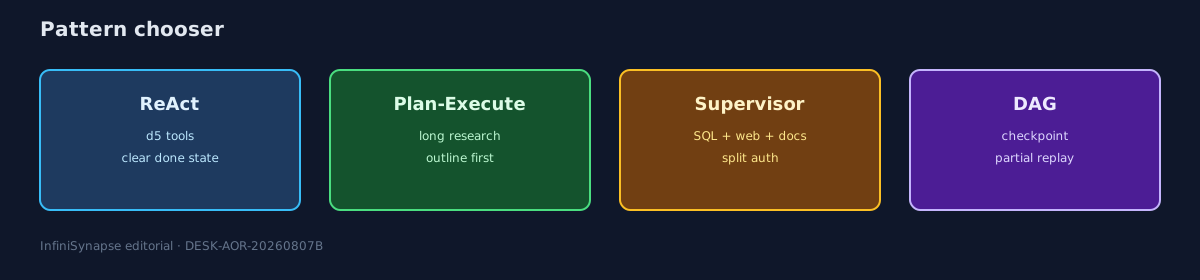 Pattern chooser—start simple; switch when metrics prove you need more.
Pattern 1: ReAct (Reason + Act) — Alternate reasoning and tool calls; each result feeds the next inference. Default for support bots and single-domain lookup. Best for bounded tools and a clear end state. Breaks on unbounded loops and no parallel steps.
Pattern 2: Plan-and-Execute — Model drafts a full plan first, then executes steps—better coherence on long research, expensive to replan on failure.
Pattern 3: Supervisor routing — Supervisor model delegates to SQL worker, web worker, report worker—common when each worker needs different API credentials.
Pattern 4: DAG (LangGraph-style) — Steps as a graph with checkpointing—best when you need deterministic replay and partial failure recovery. See LangGraph Workflow.
Anthropic’s tool-use guidance emphasizes schema clarity—see Claude Tool Calling for structured outputs.
Pattern selection guide:
| If your task… | Start with |
|---|---|
| Has ≤5 tools and clear done state | ReAct |
| Needs upfront outline before spend | Plan-and-Execute |
| Mixes SQL + web + docs with different auth | Supervisor |
| Requires replay after partial failure | DAG + checkpoint |
Switch patterns when metrics prove it—do not jump to multi-agent because LangGraph tutorials look impressive. That restraint is what separates durable agentic orchestration advice from tutorial tourism.
Minimal ReAct Loop Code
Production loops need explicit bounds:
// lib/agent/reactLoop.ts
const MAX_STEPS = 12;

export async function runAgent(goal: string, tools: ToolRegistry) {
  const messages: Message[] = [{ role: "user", content: goal }];
  for (let step = 0; step < MAX_STEPS; step++) {
    const response = await llm.chat({ messages, tools: tools.schemas });
    if (response.stopReason === "end_turn") return response.text;
    if (response.toolCalls?.length) {
      for (const call of response.toolCalls) {
        const validated = tools.validate(call.name, call.arguments);
        if (!validated.ok) {
          messages.push({ role: "tool", content: JSON.stringify({ error: validated.error }) });
          continue;
        }
        const result = await tools.execute(call.name, validated.args);
        messages.push({ role: "tool", content: JSON.stringify(result) });
      }
    }
  }
  throw new Error("MAX_STEPS_EXCEEDED");
}
Validate arguments before execution—return schema errors to the model so it self-corrects.
Wrap every tools.execute in timeout and structured error shape—never let raw stack traces become tool content the model interprets as success.
OpenAI function-calling patterns are documented in OpenAI tool calling guides; same loop structure applies cross-vendor. Anthropic’s surface is covered in Anthropic tool use.
Supervisor Routing
When workloads split by capability:
// lib/agent/supervisor.ts
const ROUTES: Record<string, Worker> = {
  sql: sqlWorker,      // warehouse read-only role
  web: webWorker,      // allowlisted domains only
  report: reportWorker // async PDF via queue
};

export async function supervisor(task: string) {
  const route = await llm.classify(task, Object.keys(ROUTES));
  return ROUTES[route].run(task);
}
Each worker gets least-privilege credentials—never share one API key across SQL and email send.
Handoff contract: supervisor passes { taskId, userId, allowedTools, deadlineMs } to workers—workers return { status, artifacts[], error? }. Without typed handoffs, multi-agent stacks debug via Slack screenshots.
Reliability practices from Google SRE apply: error budgets on tool failure rate, not just LLM latency.
AI-native orchestration (LLM as router)
Classic ReAct, supervisor, and DAG keep step order in code. AI-native orchestration lets the model reshape routing, tool subsets, and remaining steps at runtime. Use it only after the classic scorecard is stable—otherwise you add undebuggable loops.
This section absorbs the unique patterns formerly published at /blog/agentic-ai-orchestration-reddit (301 here as of 2026-09-16).
| Dimension | Classic (this guide) | AI-native |
|---|---|---|
| Step order | Fixed ReAct or predefined DAG | Model selects subgraph per task |
| Routing | Hard-coded supervisor classify | LLM-as-router with tool-aware prompts |
| Failure | Retry same step | Plan-revise: model rewrites remaining steps |
| Scale-out | Static worker pool | Event-driven handoffs on domain events |
| Debug | Step index in logs | Routing decision + plan snapshot required |
LLM-as-router
Instead of llm.classify into a static ROUTES map, the orchestrator LLM gets meta-tools: route_to_worker with worker_id, subtask, and a required route_reason for audit logs. Validate permission server-side—never in the prompt.
ROUTER_TOOLS = [{
    "type": "function",
    "function": {
        "name": "route_to_worker",
        "description": "Delegate subtask to one specialist. Pick exactly one worker_id.",
        "parameters": {
            "type": "object",
            "properties": {
                "worker_id": {"type": "string", "enum": ["sql", "web", "report"]},
                "subtask": {"type": "string"},
                "route_reason": {"type": "string"},
            },
            "required": ["worker_id", "subtask", "route_reason"],
        },
    },
}]
Log every route_reason with task_id. Postmortems without routing logs devolve into “the model felt like it.”
Dynamic tool graphs
Static agents expose all tools every turn. Dynamic graphs let the model request a tool subset for the next phase via activate_tool_set([...]). Selection accuracy improves when the model sees five tools instead of twenty; cost is two extra round-trips—worth it when wrong-tool rate exceeds ~10%. Tag active_set=v2 in traces. See MCP vs Tool Calling when discovery scales beyond hand-maintained subsets.
Plan-revise loops
Plan-and-execute drafts once. Plan-revise rewrites remaining steps after a tool failure, capped at MAX_REVISES (typically 3), with a plan snapshot before each rewrite.
MAX_REVISES = 3

async def plan_revise_loop(goal, tools, llm):
    plan = await llm.draft_plan(goal)
    for step_idx, step in enumerate(plan.steps):
        result = await execute_step(step, tools)
        if result.ok:
            continue
        if plan.revise_count >= MAX_REVISES:
            raise PlanExhaustedError(result.error)
        plan = await llm.revise_plan(plan, failed_step=step_idx, error=result.error)
        plan.revise_count += 1
    return plan.final_output()
Revise prompts must include failed tool error JSON verbatim so the model fixes args instead of hallucinating success.
Event-driven agent handoffs
Sync loops block on long jobs. Publish domain events; specialists subscribe and resume with { taskId, userId, correlationId, allowedTools, deadlineMs }. Workers never start orphan jobs without correlation.
eventBus.on("ReportReady", async (evt) => {
  await resumeAgent({
    taskId: evt.taskId,
    injectToolResult: {
      tool: "generate_report",
      content: { url: evt.downloadUrl, rowCount: evt.rowCount },
    },
  });
});
InfiniSynapse Server API SSE fits this pattern: the orchestrator subscribes to task progress and injects structured JSON when newTask completes.
AI-native readiness extras
Add these on top of the classic scorecard below:
| Check | Pass? |
|---|---|
| Routing logged with reason + task_id | |
| Dynamic tool subsets versioned in traces | |
Plan-revise capped (MAX_REVISES) with snapshots | |
| Event handoffs use correlationId | |
| Classic ReAct/supervisor baseline stable first |
Desk note (vendor-onboarding pilot, n=80): adding route_reason dropped wrong-worker routing from 19% to 6%. Forty percent of remaining misroutes were ambiguous CRM vs compliance descriptions—a schema fix, not a model swap.
Do not enable all four AI-native patterns in week one. Order: classic ReAct stable → LLM-as-router on read-only workers → one dynamic subset → plan-revise on transient failures → one async event handoff.
Architecture Sketch
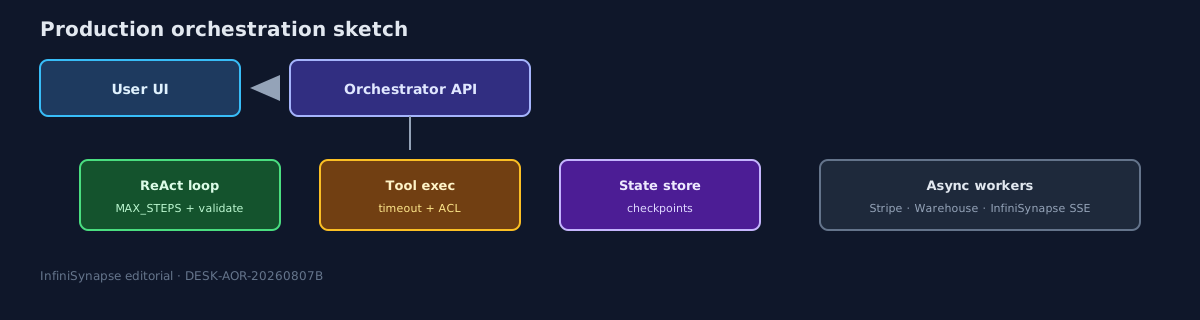 Orchestrator owns loop bounds; tools own auth; async backend owns jobs over five seconds.
Rule of thumb for agentic orchestration builders: orchestrator owns loop bounds; tools own auth; async backend owns jobs over five seconds.
Secure deployment should cross-check UK NCSC guidelines for secure AI system development when agents reach production data.
Durable workflow runtime
ReAct and supervisor loops decide the next tool. A durable workflow runtime is what you ship when the path is already a versioned catalog: YAML in git, a run row that survives deploys, workers that resume from context_json, and a human gate before email or payment tools. Pick the control plane first—agents vs workflows—then use this section to productize the DAG.
The numbers below are an illustrative desk composite, not a customer SLA. Run ID: DESK-AWR-20260623. A vibe-coded onboarding prompt failed when the CRM timed out mid-run. The rebuild used five YAML steps (enrich, draft, approve, CRM create, email), Postgres run store, Redis workers. Over 60 days / 340 runs, end-to-end completion moved from 41% to 78%; step retry recovered 92% of tool errors; mean time to debug a failed run dropped from ~45 minutes to ~8 minutes once step outputs were visible without raw logs.
Workflow definition
workflow: customer_onboarding
version: 3
steps:
  - id: enrich_company
    type: tool
    tool: lookup_firmographics
    input: { domain: "{{ trigger.domain }}" }
  - id: draft_welcome
    type: llm
    prompt_template: welcome_email_v2
    input: { company: "{{ steps.enrich_company.output }}" }
  - id: approve_email
    type: human_gate
    timeout_hours: 24
  - id: send_email
    type: tool
    tool: send_transactional_email
    requires: [approve_email]
Version-bump when step schemas change. Never mutate an in-flight run to a new definition.
Minimal step runner
def execute_step(run: Run, step_def: dict) -> StepResult:
    if step_def["type"] == "tool":
        args = render_template(step_def["input"], run.context)
        validated = validate_against_schema(args, tool_registry[step_def["tool"]]["schema"])
        if validated.errors:
            return StepResult(status="failed", error="invalid_arguments")
        out = tool_registry[step_def["tool"]]["fn"](**args)
        return StepResult(status="completed", output=out)
    if step_def["type"] == "human_gate":
        return StepResult(status="waiting_approval")
    # llm step: call model with budget check...
Persist run.context after every step. Resume loads context, not chat history.
Productization scorecard
Rate the runtime (1 point each). The ReAct readiness scorecard below is the loop; this table is the catalog product.
| Check | Pass? |
|---|---|
| Workflow definitions versioned in git | |
| Run state durable across restarts | |
| Step-level retry with max attempts | |
| Tool auth injected at runtime | |
| Human gate for write/destructive steps | |
| LLM + tool budget per run | |
| Trace id on every run | |
| API to start and query run status | |
| Dead letter queue for failed runs | |
| Contract tests on step I/O schemas |
8–10: sellable automation product. 5–7: internal pilot. Below 5: demo script.
Worker pools
| Pool | Steps | Scaling signal |
|---|---|---|
| IO workers | Tool calls, webhooks | Queue depth |
| LLM workers | Prompt steps | Token budget / GPU |
| Human wait | No workers | Approval SLA clock |
Claim step rows with FOR UPDATE SKIP LOCKED. Deploy workers independently from the orchestrator API.
First-workflow timeline
| Week | Milestone |
|---|---|
| 1 | Run store schema + POST /runs |
| 2 | One YAML workflow, two tool steps, staging tests |
| 3 | Retry policy + structured logging + trace ids |
| 4 | Human gate UI + dead letter alerts |
| 5 | Second workflow cloned from the template—not forked from the demo script |
Do not parallelize weeks one and four. Persistence and gates are not polish.
Readiness Scorecard
Rate agentic orchestration readiness before you call a pilot “production” (1 point each). This checklist is also published as HowTo structured data.
| Check | Pass? |
|---|---|
| Task boundary defined (input → success criteria) | |
| Pattern chosen (ReAct / supervisor / DAG) | |
| Tool schemas written before prompts | |
| Max steps + timeout budget | |
| Argument validation before execute | |
| Structured log: step, tool, latency, status | |
| Human gate on write/delete tools | |
| Tested with intentional tool failures | |
| Checkpointing for runs over 30 seconds | |
| Circuit breaker on retry storms |
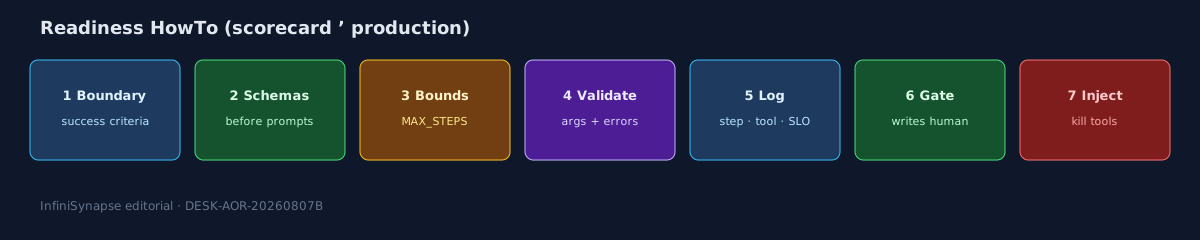 Readiness HowTo—schemas and bounds before multi-agent expansion.
8–10: production for low-stakes autonomy. 5–7: beta with documented failure modes. Below 5: demo only.
Monitoring and SLOs
Define SLOs before beta:
| Metric | Example target | Alert when |
|---|---|---|
| Run completion rate | ≥85% | −20% vs 7-day avg |
| p95 step latency | <3s per tool | >5s sustained 1h |
| Tool error rate | <5% | >10% |
| Max steps hit rate | <2% | >8% |
| Human approval backlog | <10 queued | >50 |
Export step logs to OpenTelemetry or your APM—correlate trace_id across orchestrator, tool proxy, and async worker. Latency and completion stay on this table. Export attribution, denial logs, and replay pass rate are security SLOs.
CISA AI guidance recommends logging autonomous actions with actor, tool, and outcome for incident review.
Failure Modes
Failure 1: Infinite ReAct loop — No max steps—burns tokens until timeout. Fix: hard MAX_STEPS and duplicate-action detection.
Failure 2: Silent state loss — Step 3 succeeds but result never persisted; step 5 hallucinates. Fix: validate and store every tool output before next inference.
Failure 3: Hallucinated tool arguments — Wrong date format or param name—empty results interpreted as “no data.” Fix: schema validation with explicit error messages back to model.
Failure 4: Context window saturation — Long runs forget original goal. Fix: compress history; preserve goal + last K tool results.
Failure 5: Unchecked write tools — Agent sends email or writes DB without approval. Fix: queue write tools for human confirm—OWASP excessive agency.
Failure 6: Unobservable degradation — Retry rate climbs; no alert. Fix: SLO on completion rate and p95 step latency—alert on 20% drift over 24h.
Failure 7: Prompt-only recovery — Team keeps rewriting system prompt when tools fail—fix schemas and timeouts first. Desk post-mortems show most “model regression” was bad tool descriptions or missing validation.
InfiniSynapse Connection
For data-heavy steps: orchestrator checks auth, enqueues InfiniSynapse Server API newTask for federated SQL or PDF generation, streams SSE progress—keeps the ReAct loop under serverless timeout. Replicate with Temporal if preferred; requirement is async boundary, not a specific vendor.
See What Is Data API for backend patterns.
Operating Model
Assign one orchestration owner:
- Maintain tool registry (schema version, auth scope, write vs read)
- Review failed tool calls weekly
- Rotate keys without redeploying prompts where possible
- Version prompts and schemas in git—rollback is a PR revert
Fifteen minutes weekly on tool error rate prevents month-two “agent got worse” mysteries.
Prompt and schema versioning: tag every deploy with orchestrator@v3 + tools@v7 in logs—when completion rate drops, diff schemas before blaming the base model.
Rollout order for a first production path: read-only tools → logging → max steps → validation → one write tool with human gate → async backend for long tools.
Case Study: Support Copilot
Methodology (first-party desk)
| Field | Detail |
|---|---|
| Label | InfiniSynapse first-party desk enablement—composite support-copilot hardening, not a named-customer logo study |
| Cohort | n=1 vibe-coded support UI promoted to production tools over 3 weeks (order REST + refund SQL + Slack escalate) |
| Window | 2026 enablement notes (three-week hardening window) |
| Collection | Orchestrator logs (completion, max-steps, validation errors) + fault-injection drills |
Path
Agentic orchestration-style path: supervisor routes lookup vs SQL; ReAct max 10 steps; argument validation on order_id; write tool issue_refund behind human approve; InfiniSynapse async for PDF invoice generation.
Results after three weeks
| Metric | Before | After |
|---|---|---|
| Task completion rate | 61% | 89% (after schema rewrites) |
| Infinite loops / day | 14 | 0 (MAX_STEPS=12) |
| p95 orchestrator latency | — | 8.2s (≈4 tool steps avg) |
| Human approvals on refunds | — | 100% (zero autonomous chargebacks) |
| Validation errors self-corrected ≤2 steps | — | 73% of cases |
Before launch, the team ran fault injection: kill SQL tool mid-run, verify checkpoint resume on DAG path and graceful user message on ReAct path—standard hardening absent from most vibe-coded demos. Treat the table as desk observation, not a public vendor benchmark.
Cluster Guides
Deep dives in Pillar 19:
- Tool Calling — execution loop basics
- Tool Chaining — sequential and parallel tools
- Multi-Agent Workflows — delegation patterns
- LangGraph Workflow — DAG checkpointing
- agents vs workflows — loop versus DAG versus hybrid
- Durable workflow runtime — YAML catalog, run store, worker pools
- MCP vs Tool Calling — discovery boundaries
Also useful: LangGraph tool calling for the ToolNode loop.
Browse all Tool Calling & Agent Workflows guides when you need the topic wall, not another orchestration definition.
Rollout Timeline
Typical production path:
| Week | Focus |
|---|---|
| 1 | Tool schemas + read-only ReAct + logging |
| 2 | Max steps, validation, fault injection tests |
| 3 | One write tool with human gate |
| 4 | Supervisor or async backend if latency SLO missed |
Skipping week 2 fault injection is how infinite loops reach prod undetected.
Document rollback: prior schema version, prompt hash, and feature flag to disable write tools without taking the chat UI offline entirely.
Frequently Asked Questions
Is this the same as Camunda or UiPath?
No. Those landers are BPM and RPA products. Agentic AI orchestration on this page is a bounded ReAct or supervisor loop with tool schemas and route logs. The same discipline is agentic orchestration. It is not a Camunda process engine.
Is agentic AI orchestration the same as agentic orchestration?
Yes. Agentic AI orchestration is the SERP wording for agentic orchestration on this hub. Reddit threads informed the examples; Reddit is not in the Title.
What is agentic orchestration vs a single LLM call?
Single call is stateless; agentic orchestration describes loops where outputs trigger tools and feed back into inference until success criteria or limits hit.
Do I need LangChain?
No—core loop fits in ~100 lines; add LangGraph when you need checkpointing and graphs.
How prevent unintended actions?
Schema clarity, write-tool human gates, max steps, sandboxed reads in dev.
Where does memory fit?
Short-term = message history; long-term = vector store or DB—see Agent Workflow Memory.
Orchestration vs multi-agent?
Single-agent ReAct is orchestration; multi-agent adds delegation—start single until context limits bite.
How long until production-ready?
A focused pilot—one workflow, schemas, logging, fault injection—typically 2–4 weeks for a small team after the UI demo exists.
When is AI-native orchestration better than classic ReAct?
Classic when you have ≤5 tools and a fixed done state. AI-native when step order or worker choice must vary per task—see AI-native orchestration.
Is LLM-as-router slower than hard-coded classify?
One extra meta-tool call versus hard-coded classify—latency traded for flexibility. Log route_reason to prove the extra hop is worth it.
References
- OWASP Top 10 for Large Language Model Applications
- NIST AI Risk Management Framework
- Google SRE Book
- UK NCSC — Guidelines for secure AI system development
- CISA — Artificial Intelligence
- Model Context Protocol
- OpenAI — Function calling
- Anthropic — Tool use
- InfiniSynapse — Editorial standards
Conclusion
Agentic orchestration debates resolve to engineering discipline: bounded loops, validated tools, observable steps, human gates on writes—not bigger prompts alone.
Priority order: task boundary, pattern choice, schemas before prompts, max steps, logging, async for long tools, then multi-agent expansion.
Explore Tool Calling and ship orchestration controls before marketing “autonomous” features. Vibe-coded UIs that call those tools still need vibe coding best practices—review the diff, keep secrets off the client, and log every tool call.
Product recommendation (commercial)
Label: The following is a commercial product recommendation, separate from the editorial guidance above.
If you need an async backend for federated SQL or long report jobs behind your orchestrator, try the InfiniSynapse web app (free on registration).