Whats a Data Analysis: A Casual Starter Guide
By the InfiniSynapse Data Team · Last updated: 2026-07-08 · We build an AI-native data analysis platform and love explaining this stuff plainly; this is the relaxed, no-jargon starter version.
Table of Contents
- TL;DR
- The Relaxed Answer
- You Already Do This
- The Basic Recipe
- An Easy Example
- What You Do Not Need
- Trying One Yourself
- Growing From Casual to Confident
- Starter Scorecard
- Relaxed Answers to Common Worries
- Frequently Asked Questions
- Conclusion
TL;DR
Direct answer: whats a data analysis? It is just looking at some information carefully to answer a question. You pick a question, gather the relevant stuff, tidy it up, look for patterns, and figure out what it means. No jargon required, and you probably do a casual version already.
Who this is for: anyone casually wondering whats a data analysis, with no background assumed.
What you'll learn: the relaxed answer, why you already do it, the basic recipe, an easy example, and how to try one.
For a slightly more structured take, see what is data analysis; for a worked example, see a data analysis example.
This guide is part of our Data Analysis; for related depth in this pillar, see Data Analysis Meaning, Explained Simply for 2026.
The Relaxed Answer
So, whats a data analysis? In the most relaxed terms, it is looking at information to answer a question you care about. That's really it. If you have ever checked which of your streaming subscriptions you actually use before canceling one, you have done a casual version of whats a data analysis without calling it that.
The reason people overthink the whole thing is the intimidating vocabulary around it, but the idea underneath is friendly and simple. You are curious about something, you have information that might answer it, and you look at that information to find out. That's the whole spirit of whats a data analysis, and while the formal field, outlined in the Wikipedia overview of data analysis, adds structure and tools, the casual heart of it is exactly this approachable.
You Already Do This
Here is a reassuring truth about whats a data analysis: you almost certainly do it already, just informally. When you glance at your step count for the week and notice you move less on rainy days, that's a small analysis. When you compare a few recipes' reviews before cooking, that's another. Everyday life is full of casual versions of whats a data analysis. The Stanford HAI AI Index documents how quickly AI capabilities are reshaping analytical work.
Seeing this makes the whole idea far less scary. You are not learning an alien skill from scratch; you are putting a little more structure on something you do naturally. The formal version of whats a data analysis simply adds clearer questions, tidier data, and better tools to the intuitive sense-making you already practice. So when you wonder whats a data analysis, remember that you have been doing lightweight versions your whole life, and the leap to doing it deliberately is smaller than it looks.
The Basic Recipe
If you want a simple recipe for whats a data analysis, here are the steps in plain language. First, pick a question you actually want answered. Second, gather the information that might answer it. Third, tidy it up, fixing obvious mistakes so you can trust it. Fourth, look for patterns. Fifth, figure out what it means and, if useful, tell someone.
That recipe is all there is to the basic version of whats a data analysis. Notice how ordinary it sounds; there is no step that requires a degree or a fancy tool. Following this recipe on a real question is the fastest way to turn idle wondering into actually doing one. And the beauty is that the same simple recipe scales up: professionals use a more rigorous version of these exact steps, so learning the casual recipe puts you on the same path they follow.
An Easy Example
Let's make whats a data analysis concrete with an easy example. Suppose you want to know whether you sleep better on nights you avoid screens before bed. Your question is clear. You jot down, for two weeks, whether you used screens late and how rested you felt the next morning. That's your data.
Then you tidy it, look at the pattern, and notice you felt rested on four of five screen-free nights but only two of nine screen nights. That casual finding is the whole idea in a nutshell: a question, a bit of tidy data, a pattern, and an answer you can act on by cutting late screens. No spreadsheet wizardry, no statistics degree, just the friendly recipe applied to something you care about. Examples like this show that whats a data analysis is genuinely within anyone's reach. The move toward augmented workflows, outlined in IBM's augmented analytics overview, frames how teams evaluate modern tooling.
What You Do Not Need
Part of answering whats a data analysis is clearing away what you do not need, because the myths scare people off. You do not need advanced math; simple counting and comparing handle most casual analysis. You do not need to code; a notebook, a spreadsheet, or an AI-native tool that answers plain-language questions all work fine.
You also do not need a fancy job title or a data background to grasp whats a data analysis. The activity belongs to anyone curious enough to ask a question and look at some information for the answer. Believing you need special qualifications is the main thing that stops people from trying, so it is worth stating plainly: whats a data analysis is open to everyone, and the barriers are mostly imagined. Start with what you have, and add tools and techniques only as your questions genuinely call for them.
Trying One Yourself
The best way to truly understand whats a data analysis is to try a tiny one today. Pick a small question about your own life, something you are genuinely curious about, like which day you spend the most or how your mood tracks with sleep. Gather a little data over a few days, tidy it, and look for the pattern. Finishing one turns the abstract question of whats a data analysis into a lived experience.
Keep your first attempt at whats a data analysis small and fun rather than ambitious. The goal is to complete the loop once, from question to answer, so the process becomes familiar. In 2026 you can even ask an AI-native tool your question in plain language and watch it do the analysis, which is a gentle way to see whats a data analysis looks like in action. Once you have done one, the mystery evaporates, and bigger questions become approachable because you have felt the process work. Dashboard-centric workflows sit within the broader Wikipedia business intelligence overview.
Growing From Casual to Confident
Once the casual version clicks, you may find yourself curious about bigger questions, and growing from casual to confident is a natural, gentle progression. The move does not require abandoning the friendly approach; it just means applying a bit more care as your questions get more interesting. The same recipe carries you forward, with a little more attention to gathering the right information and tidying it properly as the stakes rise.
A good way to grow is to gradually take on questions where the answer actually matters to a decision you face. Instead of a fun fact about your sleep, you might analyze which of two commuting routes is reliably faster, or whether a side project is actually making money once you count your time. These questions reward a bit more rigor, and rising to meet them naturally builds your confidence and skill. Each slightly harder question you finish expands what feels approachable, and before long the intimidating vocabulary of the formal field starts to feel like a description of things you already do.
As your confidence grows, the tools can grow with you too. A spreadsheet that served your first casual questions can take you surprisingly far, and when you outgrow it, an AI-native tool lets you ask harder questions in plain language while still learning from how it works. There is no sudden leap from casual curiosity to capable practice, only a series of small, satisfying steps, each building on the last. Keeping the process friendly and finishing each question you start is what turns idle wondering into a genuine, confident skill you can rely on whenever a question matters.
Starter Scorecard
Check your casual understanding (1 point each): Enterprise adoption patterns in Google Cloud's AI overview mirror the shift from pilots to governed analytics.
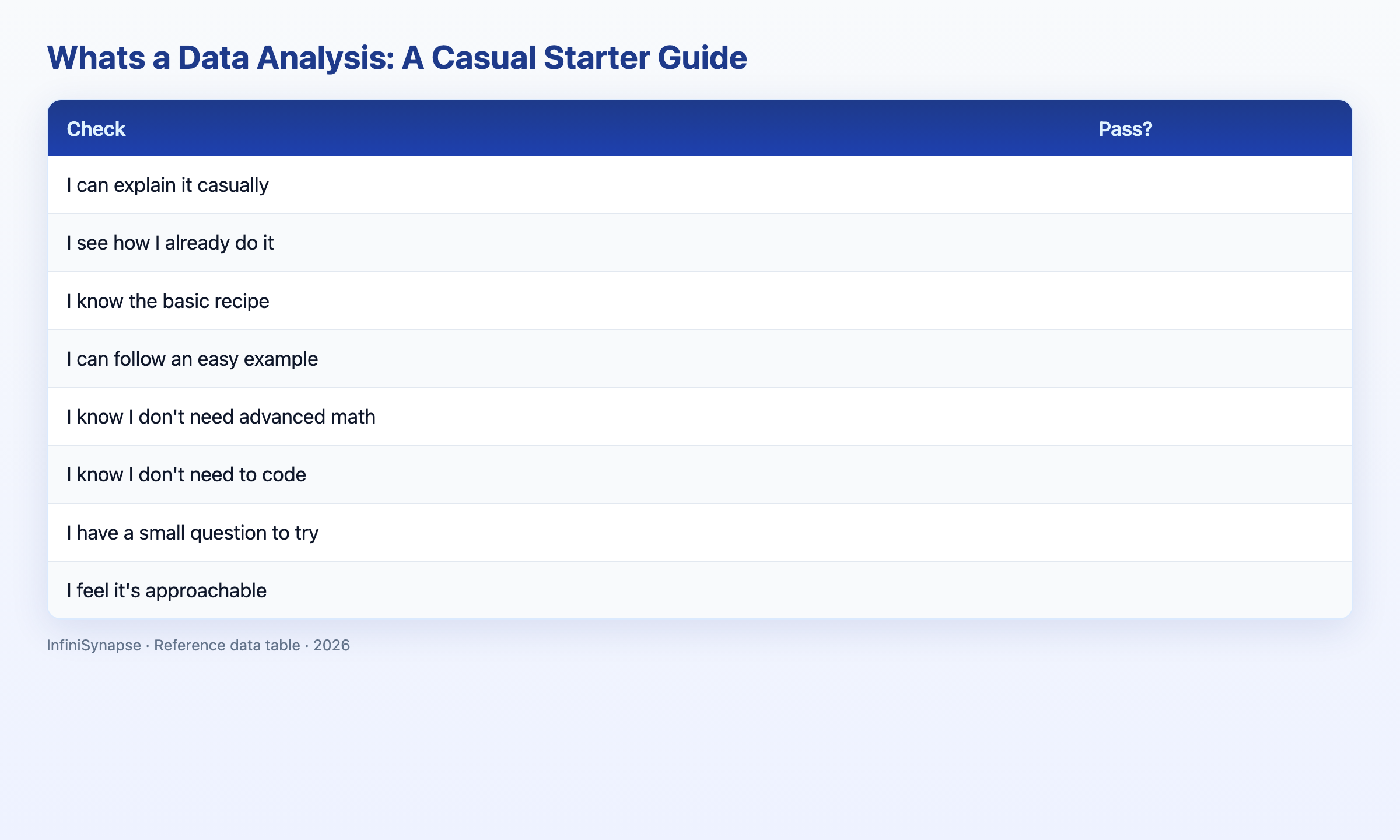
| Check | Pass? |
|---|---|
| I can explain it casually | |
| I see how I already do it | |
| I know the basic recipe | |
| I can follow an easy example | |
| I know I don't need advanced math | |
| I know I don't need to code | |
| I have a small question to try | |
| I feel it's approachable |
6–8: you've got the spirit. 3–5: reread the relaxed answer. Below 3: revisit "you already do this."
Relaxed Answers to Common Worries
Worry 1: I'm bad at math. Whats a data analysis mostly needs curiosity and simple counting, not advanced math.
Worry 2: I can't code. Spreadsheets and AI-native tools let you do it without any code.
Worry 3: It's only for experts. People in all walks of life do casual analysis constantly.
Worry 4: I'll mess it up. Starting small and imperfect is exactly how everyone learns.
Frequently Asked Questions
Whats a data analysis in plain terms?
Whats a data analysis in plain terms is just looking at some information carefully to answer a question you care about. You pick a question, gather the relevant information, tidy it up, look for patterns, and figure out what it means. It needs no jargon, and you likely do casual versions already in daily life.
Do I need to be good at math for a data analysis?
No. Whats a data analysis at the casual level mostly needs curiosity and simple counting or comparing, not advanced math. Everyday analysis relies on clear questions and a careful look at the information. Advanced math exists for harder questions, but you can do plenty of useful analysis without it.
Can I do a data analysis without coding?
Yes, easily. Whats a data analysis can be done in a spreadsheet, in a notebook, or with an AI-native tool that answers plain-language questions, none of which require coding. Coding helps with bigger or more complex tasks, but casual analysis needs no programming at all to get real, useful answers.
What's an easy example of a data analysis?
An easy example: to see if you sleep better without late screens, you note for two weeks whether you used screens late and how rested you felt, then look at the pattern. If screen-free nights left you more rested, that's your answer. That casual question-to-insight is exactly whats a data analysis.
How do I try a data analysis myself?
To try whats a data analysis yourself, pick a small question about your own life, gather a little data over a few days, tidy it, and look for the pattern. Keep it small and fun to complete the loop once. You can also ask an AI-native tool your question in plain language and watch it analyze.
Conclusion
So whats a data analysis? Just looking at information carefully to answer a question, using a friendly recipe of pick, gather, tidy, spot patterns, and interpret. You already do casual versions, you need neither advanced math nor coding to start, and trying one small question today is the best way to make it click.
The friendliest truth here is that curiosity is the only real prerequisite. If you have ever wondered why something happened and looked at the evidence to find out, you already have the instinct that this whole field is built on. Everything else, the tidy data, the clear questions, the helpful tools, simply sharpens an ability you were born with. So start small, stay curious, and enjoy the little jolt of satisfaction when a pile of numbers finally tells you something you did not know before.
When you're ready for a bit more structure and modern tools, read what is data analysis and what AI-native data analysis means, then try the InfiniSynapse web app free on registration.