What Is Enterprise Data Management? A 2026 Guide
By the InfiniSynapse Data Team — a data platform engineer, an analytics engineer, an LLM security reviewer, and an editor. · Published: 2026-06-24 · Last updated: 2026-07-28 · Next review: 2026-10-28 · Editorial standards & review policy
Disclosure: we build InfiniSynapse, an AI-native Data Agent platform, so we compete with several categories described below. This guide is structured to be useful without buying anything: the maturity model, the risk matrix, and the self-assessment are published under CC BY 4.0, the vendor section is fenced off in one clearly-marked place, and every capability claim about another category links to its primary source.
External validation status. Third-party frameworks cited here — not InfiniSynapse product claims: DAMA-DMBOK, EDM Council DCAM, ISO 8000, ISO/IEC 38505, NIST AI RMF, CMMI DMM. Independent buyer signals: Gartner Peer Insights — Analytics & BI, G2 Data Governance, BARC research. Public assets (CC BY 4.0): readiness assessment CSV and diagram set.
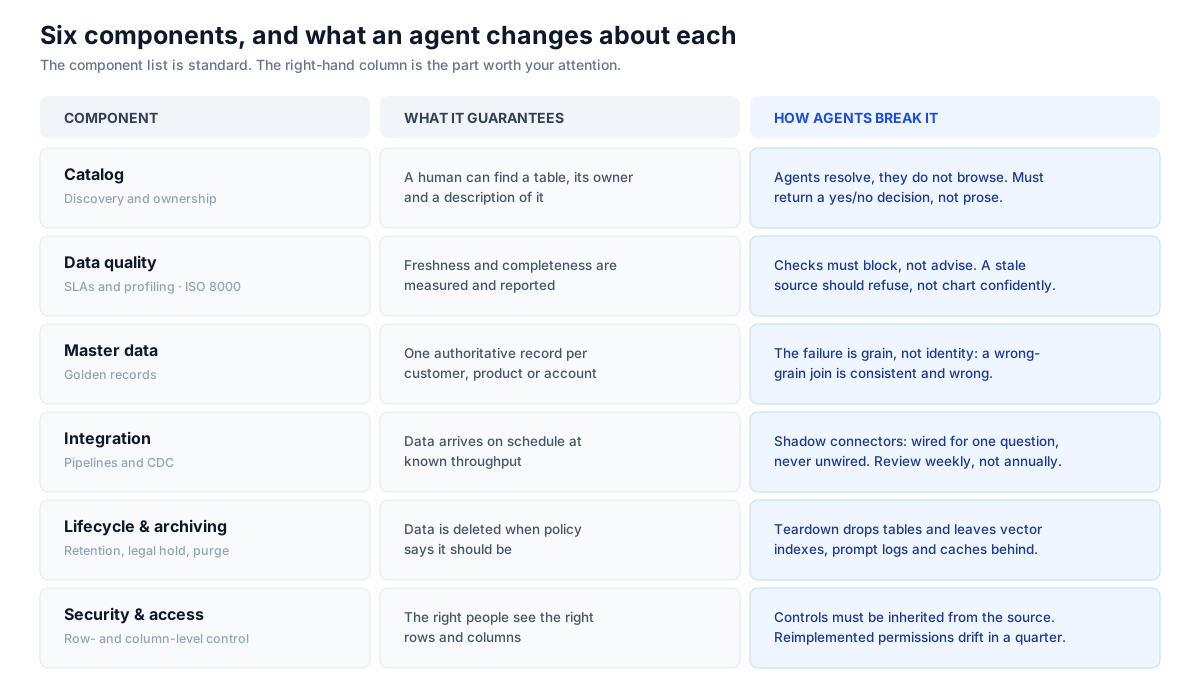
Table of Contents
- TL;DR
- Definition, and how EDM differs from its neighbours
- The six components, and what agents change about each
- Why metadata became a control plane
- Compile-time enforcement
- The four-stage maturity model
- Architecture: the zero-trust analytics path
- Risk, metrics, and the 90-day playbook
- Common failure modes
- Where InfiniSynapse fits (vendor section)
- Glossary
- Frequently asked questions
- References
- How we know this
- Conclusion
TL;DR
Direct answer: Asking what is enterprise data management in 2026 means describing an enforcement layer, not a wiki. Enterprise data management (EDM) is the coordinated discipline — catalog, data quality, master data, integration, and lifecycle — that keeps an organisation's data trustworthy and usable at scale. Metadata now has to block a bad query before it runs, because AI agents add consumers faster than documentation can keep up.
- EDM is not data governance. Governance sets the policy; what is enterprise data management in practice is the machinery that makes the policy true.
- The enforcement point moved left. Unapproved joins should fail at compile time, before the warehouse is touched.
- Stage three is where programmes die. Most teams finish inventory and quality SLAs, then grant natural-language access on raw DDL and skip enforcement.
- Measure reconciliation tickets, not catalog coverage. Whether finance stops re-deriving the number is the outcome metric.
- Score yourself before you shortlist vendors. The readiness assessment is a blank instrument, not a lead-generation quiz.
For platform owners, CISOs, and analytics leaders: if you need a short framing for what is enterprise data management, treat it as policy made enforceable in the query path.
Definition, and how EDM differs from its neighbours
Citable definition: What is enterprise data management? It is the coordinated set of disciplines — governance, cataloging, data quality, master data, integration, and lifecycle — that keeps enterprise data trustworthy and usable at scale. The canonical framing is the DAMA-DMBOK; data-quality expectations map to the ISO 8000 series. Board-level accountability often sits beside ISO/IEC 38505, while regulated estates also borrow scored capability models such as the EDM Council DCAM.
| Discipline | What it decides | Who owns it | Typical failure |
|---|---|---|---|
| Data governance | Policy: who may see what, which definition is authoritative, what retention applies | Governance council or CDO | Policy on a wiki; nothing enforces it |
| Enterprise data management | Machinery that makes policy true across catalog, quality, MDM, integration, lifecycle | Data platform, with stewards | Machinery exists but is optional |
| Master data management | One golden record per business entity | MDM team or platform | Downstream systems join to the wrong grain |
| Data management (generic) | Day-to-day storage, pipelines, and access | Platform engineering | Runs reliably while producing untrusted numbers |
If policy says "revenue is recognised net of refunds" and a query can still compute it gross, you have governance without EDM. When stakeholders ask what is enterprise data management versus governance, the short answer is enforcement capability.
In 2026 what is enterprise data management covers connectors, the semantic layer, result caches, and embedding stores — every surface an agent can touch. Evidence is replay logs stamped with metric and policy versions; ownership is jointly platform, stewards, and security; enforcement is compile-time rejection.
The six components, and what agents change about each
Every framework that answers what is enterprise data management lists roughly the same components. What matters is how an autonomous consumer breaks each one.

Catalog. Agents resolve, they do not browse. In what is enterprise data management for agent estates, the catalog must answer machine questions at compile time with a definitive yes or no. Prose without a decision is not on the control path.
Data quality. Freshness and profiling rules agents inherit. Checks must be blocking: if accounts failed its freshness SLA, refuse or warn — do not return a confident chart. Expectations map to ISO 8000. Quality gates are part of what is enterprise data management, not a side project after the catalog launches.
Master data. Agents introduce grain failures more often than identity failures. Publish golden-record freshness SLAs agents inherit at compile time.
Integration. Judged on freshness guarantees. Shadow connectors wired for one-off questions and left in place are caught by weekly inventory reviews, not annual assessments — a routine check any serious take on what is enterprise data management should schedule.
Lifecycle. Teardown often drops warehouse tables while leaving vector indexes, prompt logs, and caches. Retention policies written before 2024 almost certainly omit embeddings — a gap any honest answer to what is enterprise data management must name.
Security. Row- and column-level controls at the source must be honoured through the agent path. For personal-data risk engineering, overlay the NIST Privacy Framework.
Why metadata became a control plane
Metadata used to be descriptive. Three breaks arrived together: agents multiply query paths faster than documentation can cover; language models write wrong queries in polished form so casual review fails; and a bad definition in reusable agent context spreads to every related question.
The response is rejection-before-execution. That is what "metadata as a control plane" means, and it is central to what is enterprise data management once agents are in scope. Align the gate with the NIST AI Risk Management Framework. Maturity scoring such as CMMI DMM helps programmes report movement year over year rather than asserting it. Teams that still treat catalogs as optional references have not yet operationalised what is enterprise data management for agent workloads.
Compile-time enforcement
This is the core mechanism of an agent-era programme answering what is enterprise data management with more than a catalog screenshot.
- Intent parsing. Resolve to a metric ID and dimensions — no table names, no SQL yet.
- Contract lookup. Bind to a semantic-layer contract: approved sources, join path, grain, filters, policy version.
- Authorization against resolved objects. Check identity against resolved tables and columns, not prompt text.
- Compilation and rejection. Generate SQL only from the contract; unsanctioned joins fail to compile.
- Execution and stamping. Stamp metric version, policy version, and contract hash for replay.
The agent never sees raw DDL. It sees metrics it may ask for — so the unapproved query is unrepresentable. Two limitations: exploratory analysis on raw tables needs a separate, tightly scoped path; and slow metric approval bottlenecks the contract layer, so mean time to approve a new metric belongs on the dashboard. Without this compile stage, slide-deck answers to what is enterprise data management do not survive first contact with an agent.
The four-stage maturity model
Stage three is skipped far more often than it is failed — the pattern that most distorts what is enterprise data management in production.
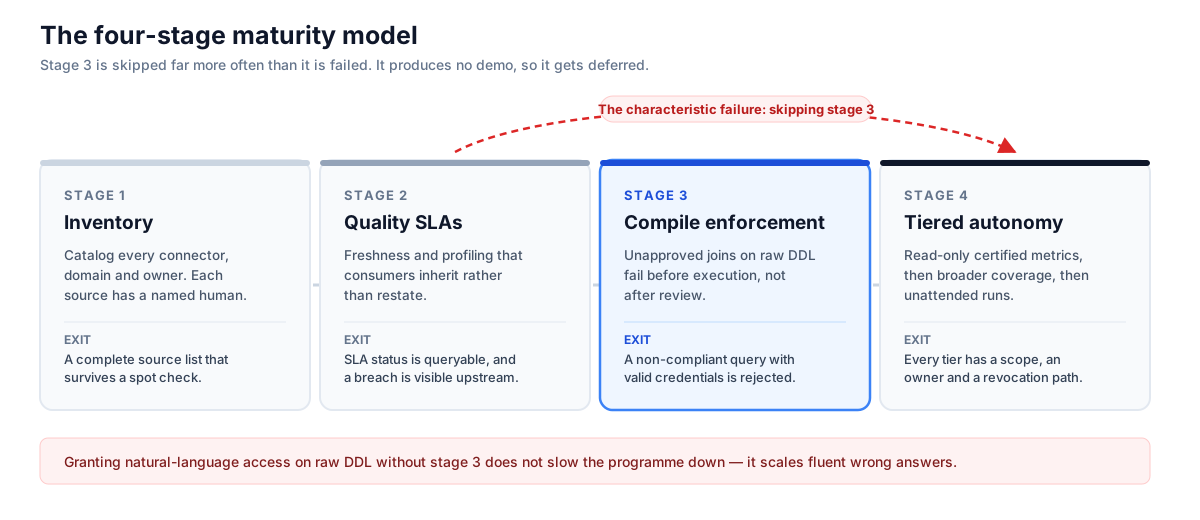
Stage 1 — Inventory. Catalog connectors, domains, and owners. Exit: a source list reachable from any agent credential that survives a spot check. Without inventory, what is enterprise data management remains abstract.
Stage 2 — Quality SLAs. Freshness expectations consumers inherit. Exit: consumers can query SLA status; failing SLAs are visible before read.
Stage 3 — Compile enforcement. Unapproved joins fail before execution. Exit: a non-compliant query with valid credentials is rejected, with a log entry. Test this rather than assume it. Stage three is where what is enterprise data management becomes real for AI access.
Stage 4 — Tiered agent autonomy. Expand autonomy as contracts mature. Exit: each tier has scope, owner, and revocation path.
Jumping from stage two to stage four is the characteristic failure: quality SLAs look like progress, agent access is what the business asked for, and enforcement produces no demo. That sequence is how teams answer what is enterprise data management on slides while operating without it in the query path.
From stage three onward: bind analyst and agent roles at compile time (standing warehouse-admin service accounts are the most common finding in reviews our team has participated in); alert on off-hours bulk queries, new connectors, and NL CSV exports; align prompt, embedding, and log retention with legal hold. Related: What Is Enterprise Data?.
Architecture: the zero-trust analytics path
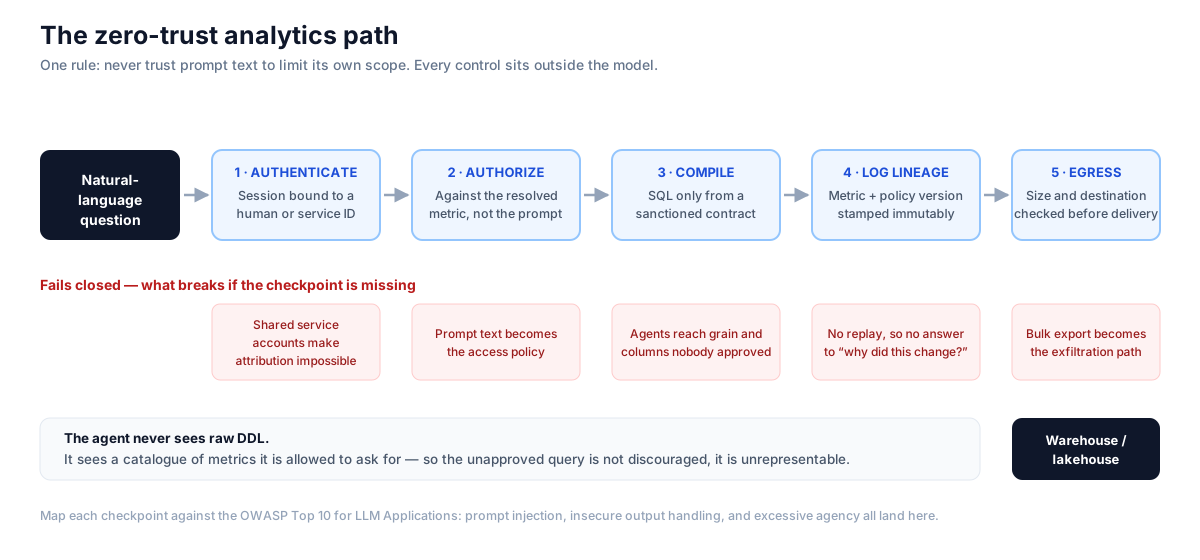
Never trust prompt text to limit its own scope.
| Checkpoint | What it enforces | Failure if skipped |
|---|---|---|
| Authenticate | Identity bound to a human or registered service | Attribution impossible |
| Authorize metrics | Access to resolved metric and objects | Prompt text becomes policy |
| Compile SQL | Only contract-sanctioned joins and filters | Unapproved grain and columns |
| Log lineage | Query, metric version, policy version | No replay |
| Inspect egress | Result size and destination | Bulk export as exfiltration |
LLM risks — prompt injection, insecure output handling, excessive agency — are in the OWASP Top 10 for LLM Applications. For technical control baselines beside EDM, map agent credentials and logging to NIST SP 800-53. Agents and BI should share metric IDs (Agentic Analytics); keep development agents off production credentials (Data Agent Architecture). These choices are how what is enterprise data management shows up in a real path rather than a policy PDF. Zero-trust checkpoints are required once you take what is enterprise data management seriously for chat-driven analytics.
Risk, metrics, and the 90-day playbook
Fund by agent-specific risk. General infrastructure registers often miss these because they assume a human composes every query.
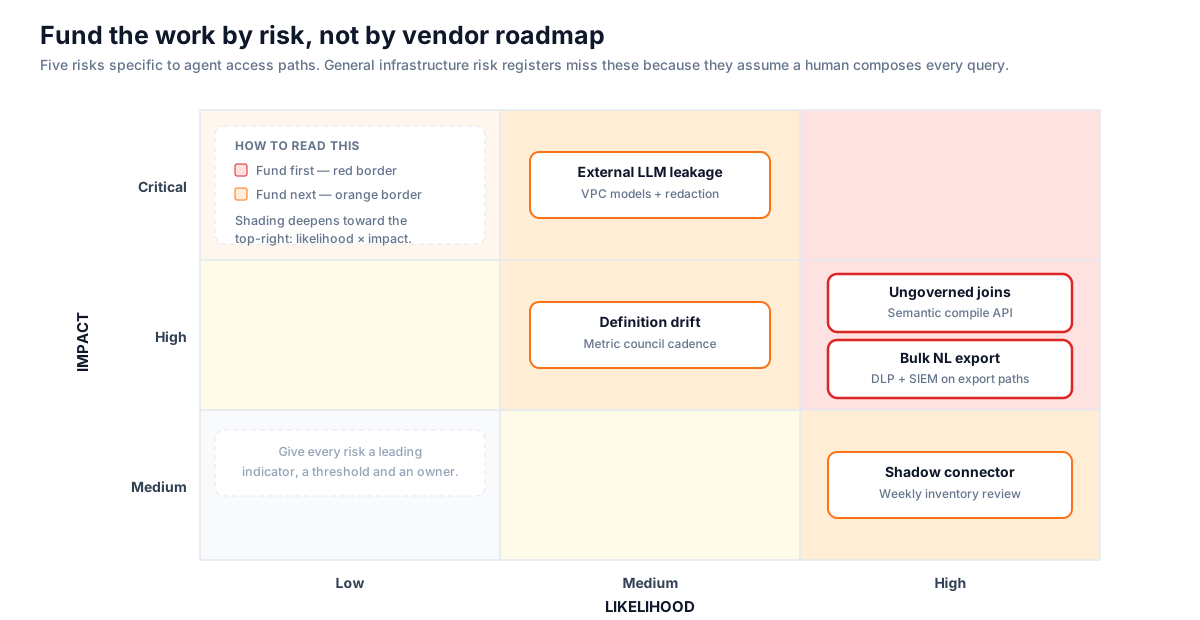
| Risk | L / I | Mitigation | Leading indicator |
|---|---|---|---|
| Ungoverned joins | H / H | Semantic compile API | Queries on unregistered tables |
| Bulk NL export | H / H | DLP + SIEM on export paths | Result sets above row threshold |
| Shadow connector | H / M | Weekly inventory review | Connectors absent from last week |
| Definition drift | M / H | Metric council cadence | Conflicting definitions per KPI |
| External LLM leakage | M / Critical | VPC models + redaction | Egress to unapproved endpoints |
Track outcomes: catalog coverage ↑, agent compile success ↑, conflicting metric definitions ↓, mean time to approve a metric ↓, reconciliation ticket volume ↓. Reconciliation tickets are the renewal metric — the practical test of what is enterprise data management after the pilot.
Readiness self-assessment
Download (CC BY 4.0): edm-readiness-assessment.csv — score semantic fit, operational depth, audit readiness, integration, and cost governance as pass/fail signals before shortlisting platforms. Sibling: Enterprise Data Governance for AI Analytics.
Use this 90-day sequence when translating what is enterprise data management into an auditable pilot:
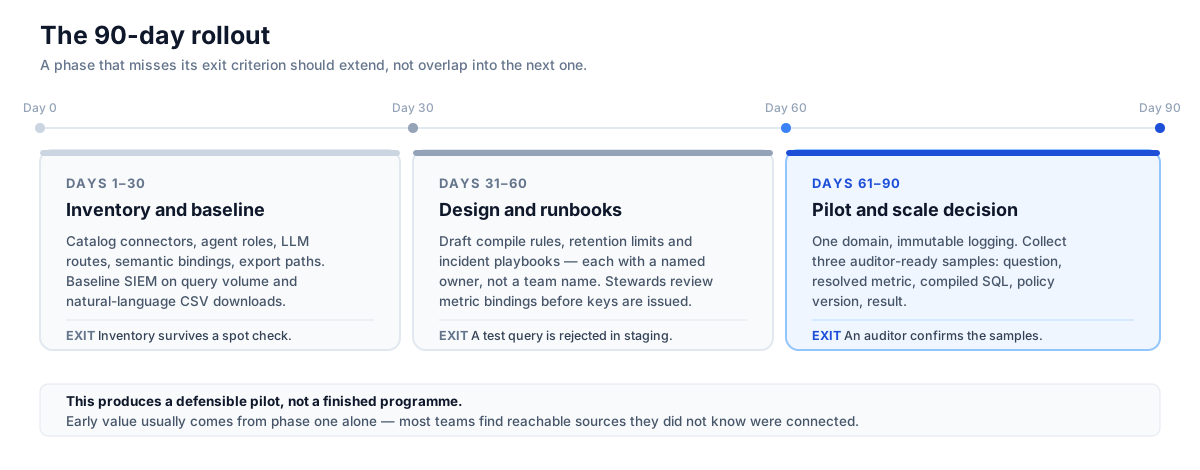
Days 1–30 — Inventory. Catalog connectors, agent roles, LLM routes, semantic bindings, export paths; establish SIEM baselines. Exit: inventory that survives a spot check plus 30 days of telemetry. This phase grounds what is enterprise data management in a list you can audit.
Days 31–60 — Design. Compile rules, retention limits, incident playbooks with named owners; stewards review metric bindings before production keys. Exit: non-compliant test query rejected in staging with a log entry.
Days 61–90 — Bounded pilot. One domain, immutable logging, three auditor-ready session samples (question, metric, SQL, policy version, result). Expand only after export monitors hold. A clean pilot is evidence that what is enterprise data management is working, not merely documented. Then: assess against Enterprise Data Security Solutions, document a RACI, review replay monthly.
Common failure modes
Four patterns account for most stalled programmes in our team's experience — the same places teams misunderstand what is enterprise data management when they equate it with tooling.
Tool-first rollouts. Buy a platform before metric contracts exist. Fix: publish ten executive metrics with version IDs as the evaluation fixture first.
Governance theatre. Catalog, policy, and council exist — nothing in the query path consults them. Fix: submit a non-compliant query with valid credentials and confirm rejection.
Skipping stage three. Natural-language access on raw DDL while the catalog stays passive. Fix: make compile-time rejection a written precondition for agent keys.
Export blind spots. DLP tuned for email while egress is a CSV from chat. Fix: monitor NL exports with agent-session attribution and a row-count threshold.
A programme that still fails these tests has not yet answered what is enterprise data management in operational terms.
Where InfiniSynapse fits (vendor section)
This section is about our own product. Everything above is intended to be useful whether or not you ever talk to us; this part is not neutral, and it is fenced here so you can skip it. A traditional catalog plus an MDM suite is a perfectly good answer for estates without agent access, and several categories referenced above are our direct competitors.
InfiniSynapse implements the compile-time path: InfiniAgent (plans multi-step analysis; emits metric IDs, not SQL), InfiniSQL (dialect-aware compilation with audit stamping), InfiniRAG (scoped retrieval with redaction), metric bindings (the contract layer), and a workflow log for replay. Where it earns a seat: agents spanning several sources with defensible recurring reporting. Where it does not: single-warehouse estates with mature BI and no agent access. We compete on the enforcement layer; we do not redefine what is enterprise data management to equal our product alone.
Glossary
| Term | Meaning in this guide |
|---|---|
| Enterprise data management (EDM) | Operational machinery — catalog, quality, MDM, integration, lifecycle — that makes governance policy enforceable |
| Compile-time enforcement | Rejecting unsanctioned joins and filters before SQL executes |
| Metric contract | Versioned definition of sources, joins, grain, filters, and policy for a named KPI |
| Semantic layer | Shared metric IDs and contracts that BI tools and agents resolve against |
| Replay stamp | Metric version, policy version, and contract hash attached to a result for audit |
If a stakeholder asks only what is enterprise data management, start with the EDM row, then point them at compile-time enforcement as the 2026 differentiator.
Frequently asked questions
What is enterprise data management, in one sentence?
It is the coordinated discipline — governance, catalog, quality, master data, integration, and lifecycle — that keeps enterprise data trustworthy and usable at scale. In practice it is the operational machinery that turns a governance policy into something the query path actually enforces.
How is EDM different from data governance?
Governance decides the policy; EDM makes those decisions true in the systems people query. Funding the first without the second produces documented policies that nothing enforces — the organisational failure that most often prompts the question what is enterprise data management in the first place.
How does EDM change in the AI agent era?
Metadata must enforce policy at compile time rather than merely describe data. Agents add query paths faster than documentation can cover them, and they produce wrong answers in polished form. An unsanctioned join should fail to compile. That shift is the practical update to what is enterprise data management for agent programmes.
What is the highest-leverage first step?
Reach maturity stage three — compile-time enforcement — before granting natural-language access on raw DDL. Protect the enforcement layer in the plan before business pressure arrives. That sequencing is the highest-ROI reading of what is enterprise data management when agent pressure is already high.
Can a small team run an EDM programme?
Yes. One warehouse, ten governed metrics with version IDs, immutable query logs, and quarterly access reviews form a credible start. Small scope does not excuse skipping what is enterprise data management — it makes contracts easier to keep honest.
Do we need a semantic layer before we deploy agents?
For recurring executive metrics, effectively yes. Without governed definitions an agent re-derives the metric each session. One-off exploration on non-sensitive data can stay separate, with its own access limits.
What evidence do auditors typically request?
Replay samples (question, resolved metric, compiled SQL, policy version, result); access attestations for human and service identities; and vendor reports covering LLM sub-processors an agent invokes.
How do we stop AI answers from contradicting certified dashboards?
Route both through the same metric contracts. Where that is not yet possible, require outputs to state denominator, date window, and exclusions. Count distinct SQL implementations per named KPI so disagreement becomes a tracked figure with an owner.
References
- [Reference] DAMA International. Data Management Body of Knowledge (DMBOK). dama.org
- [Reference] EDM Council. Data Management Capability Assessment Model (DCAM). edmcouncil.org
- [Standard] ISO. ISO 8000 — Data quality. iso.org
- [Standard] ISO/IEC. 38505 — Governance of data. iso.org
- [Standard] NIST. AI Risk Management Framework (AI RMF 1.0). nist.gov
- [Standard] NIST. Privacy Framework. nist.gov
- [Standard] NIST. SP 800-53 Rev. 5 — Security and privacy controls. csrc.nist.gov
- [Standard] OWASP. Top 10 for LLM Applications. owasp.org
- [Reference] CMMI Institute. Data Management Maturity (DMM). cmmiinstitute.com
- [Independent] Gartner Peer Insights. Analytics and Business Intelligence Platforms. gartner.com
- [Independent] G2. Data Governance category reviews. g2.com
- [Independent] BARC. Research overview. barc.com
- [Dataset] InfiniSynapse Data Team. EDM readiness assessment (CC BY 4.0). CSV download
How we know this
What this guide is. A synthesis of standards cited inline — DAMA-DMBOK, ISO 8000 / ISO/IEC 38505, NIST AI RMF and Privacy Framework, OWASP LLM Top 10, DCAM, CMMI DMM, and NIST SP 800-53 — plus our team's experience building an agent platform and observations from enterprise reviews we have participated in.
How to read the claims. Standards and independent review platforms link to primary sources. Practice observations are marked as such (for example, standing warehouse-admin accounts as a common finding is not a surveyed statistic). We have not published quantified customer case studies; the readiness assessment is a blank instrument instead — third parties can score their own enterprise data management programme against it and publish contradictory results on editorial corrections.
Review. Written and reviewed by the InfiniSynapse Data Team. Next review: 2026-10-28. Corrections: research desk.
Conflict-of-interest note: InfiniSynapse is our product and competes with several categories referenced here. The maturity model, risk matrix, and readiness assessment are CC BY 4.0.
Conclusion
Answering what is enterprise data management in 2026 means describing an enforcement layer, not a documentation practice. The catalog rejects what the contract does not sanction; the semantic layer is the only route to a governed number; and the audit trail carries enough version information to reconstruct a six-month-old answer.
Sequence inventory → quality SLAs → compile-time enforcement → tiered autonomy, and verify stage three. Measure reconciliation tickets. Start with the readiness assessment, then close gaps via enterprise data governance and enterprise data security solutions. That is the operational answer to what is enterprise data management when agents are already asking questions.